PUBLISHER: Mordor Intelligence | PRODUCT CODE: 2123240

PUBLISHER: Mordor Intelligence | PRODUCT CODE: 2123240
Latin America Jewelry - Market Share Analysis, Industry Trends & Statistics, Growth Forecasts (2026 - 2031)
According to Mordor Intelligence, the Latin America jewelry market size is projected to be USD 33.20 billion in 2025, USD 35.31 billion in 2026, and reach USD 46.10 billion by 2031, growing at a CAGR of 5.48% from 2026 to 2031.
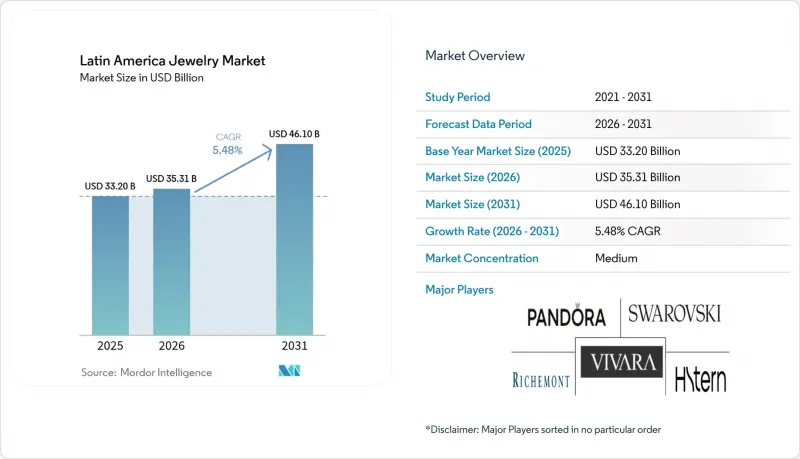
This report is Segmented Into Product Type (Necklaces, Rings, Earrings, and More), Category (Fine Jewelry and Costume Jewelry), Material (Precious Metals, Base Metals, and Mixed Materials), End-User (Women, Men, and Children), Distribution Channel (Offline Retail Stores and Online Retail Stores), and Geography (Brazil, Argentina, and More). The Market Forecasts are Provided in Terms of Value (USD).
Latin America Jewelry Market Trends and Insights
Rising Popularity of Customized and Personalized Jewelry Pieces
Customization has shifted from a niche service to a core revenue stream, particularly in Brazil and Chile, where consumers increasingly demand pieces that reflect personal narratives rather than mass-market designs. Vivara's Life brand, a silver-jewelry line positioned as "democratic luxury", expanded rapidly in 2025, with the company targeting a doubling of Life stores to capture middle-income buyers seeking affordable personalization. Tiffany's limited-edition Lock bracelet, released in Sao Paulo in December 2024 with only 10 pieces featuring Brazilian-flag-inspired sapphires and tsavorite, sold out within days, demonstrating that scarcity and local symbolism drive premiums even in a price-sensitive market. This trend is underpinned by the rise of digital configurators and in-store engraving services, which lower the cost of bespoke production while maintaining the perception of exclusivity. Regional artisans in Chile and Peru are leveraging heritage techniques, such as filigree and pre-Columbian motifs, to differentiate themselves from global brands, creating a bifurcated market where both high-tech personalization platforms and handcrafted customization coexist. The shift toward personalization also reflects a broader generational change; younger buyers view jewelry as an extension of identity rather than a status symbol, a behavioral pivot that favors brands capable of rapid design iteration and direct-to-consumer engagement.
Tourism-Driven Jewelry Purchases
Tourism recovery across Latin America has reignited jewelry sales in gateway cities, with the Americas reaching approximately 97% of 2019 visitor levels by 2024, according to UN Tourism data. Colombia's visitor exports totaled COP 42.1 billion in 2024, a figure that includes significant jewelry purchases by international tourists drawn to Bogota's emerald district and Cartagena's artisan markets, according to the World Travel and Tourism Council. Airport retail has emerged as a strategic channel; Panama's Tocumen International Airport, a regional hub, saw luxury jewelry concessions expand in 2024-2025, capturing transit passengers traveling between North and South America. Tiffany's opening of its first Blue Box Cafe in Latin America, located within the Mexico City flagship in February 2025, signals that experiential retail tied to tourism can drive both immediate sales and long-term brand affinity. Brazil's luxury market benefits from domestic tourism as well; Sao Paulo's Iguatemi mall, which attracts approximately 50,000 visitors daily, hosts flagship stores from Tiffany, Cartier, and Chanel, effectively functioning as a jewelry destination for affluent Brazilians and regional tourists. The tourism-jewelry nexus is further amplified by duty-free shopping incentives in Chile and Argentina, where foreign visitors can reclaim value-added taxes on high-ticket purchases, making fine jewelry comparatively more attractive than in domestic markets with cumulative taxation.
High Risk of Jewelry Counterfeiting and Imitation Products
Counterfeiting erodes brand equity and consumer trust, with Latin America particularly vulnerable due to porous borders, limited enforcement resources, and the proliferation of e-commerce platforms that facilitate cross-border sales of fake goods. INTERPOL's Operation Crete II, conducted in 2024, seized 2,478 counterfeit jewelry items valued at USD 523,000 in Chile alone, underscoring the scale of illicit trade in a relatively small market. The OECD and EUIPO jointly calculated a global jewelry counterfeiting propensity index (GTRIC-p) of 0.8661, indicating that nearly 87% of jewelry trade flows face a high risk of imitation; the European Union scored 0.998, indicating near-universal exposure. In Brazil, the rise of Chinese e-commerce platforms, such as AliExpress, Shein, and Temu, has flooded the market with low-cost jewelry that often mimics branded designs, compressing margins for legitimate players and confusing consumers about authenticity. Mexico's anti-counterfeiting framework includes holographic seals and digital registries, yet enforcement remains inconsistent, particularly in informal markets where counterfeit jewelry circulates alongside genuine pieces. The reputational damage is compounded by social media; a single viral post exposing a fake Pandora charm or Tous bracelet can deter thousands of potential buyers. Blockchain-based authentication systems are emerging as a countermeasure, brands are piloting digital certificates tied to individual pieces, but adoption is slow and costly, limiting deployment to high-value items rather than mass-market jewelry.
Other drivers and restraints analyzed in the detailed report include:
- Strong Cultural Significance of Jewelry in Celebrations
- Rising Demand for Affordable Luxury and Demi-Fine Jewelry
- Fluctuating Prices of Gold, Silver, and Gemstones
For complete list of drivers and restraints, kindly check the Table Of Contents.
Segment Analysis
Rings commanded 35.84% of Latin America's jewelry market in 2025, anchored by bridal demand and cultural traditions that prioritize engagement and wedding bands, yet bracelets will expand at 6.93% annually through 2031, the fastest rate among product types. Tiffany's Lock bracelet, launched in August 2022 and rolled out across Latin America in 2024-2025, exemplifies the shift toward icon-driven, stackable designs that encourage repeat purchases; the limited-edition Brazilian-flag-inspired version sold out in Sao Paulo within days, demonstrating that scarcity and localization drive premiums. Pandora's charm bracelet platform, which allows consumers to add individual charms over time, converts jewelry from a one-time purchase into an ongoing relationship, a model that resonates in Latin America, where gifting culture and milestone celebrations sustain demand. Necklaces and chains with pendants together represent a significant share, driven by religious devotion and the popularity of layered looks among younger consumers; Vivara's Life brand offers silver necklaces with interchangeable pendants, targeting middle-income buyers who seek versatility.
Earrings remain a staple category, particularly in Brazil and Colombia, where piercing is nearly universal among women, but growth is constrained by saturation; most consumers already own multiple pairs, limiting incremental demand to fashion-driven replacements. Chains and pendants benefit from the trend toward personalization, with brands offering engraving services and customizable lengths that appeal to both men and women. Other product types, including brooches, cufflinks, and body jewelry, occupy niche segments but are experiencing renewed interest as fashion cycles revive vintage aesthetics and gender-neutral designs. The product mix is also shifting toward lighter, hollow constructions in response to gold price increases; consumers are prioritizing design and brand over gold weight, a behavioral change that favors skilled designers and penalizes commodity-focused producers. Regulatory frameworks such as Brazil's hallmarking requirements ensure that gold purity claims are verifiable, reducing fraud risk but adding compliance costs for smaller manufacturers.
Precious metals, gold, platinum, and silver, accounted for 63.72% of market value in 2025, but mixed materials will grow at 6.34% through 2031 as consumers seek affordable luxury and brands experiment with innovative alloys and finishes. The 23% surge in gold prices during 2024 accelerated the shift toward mixed-material designs that combine base metals with gold plating, synthetic gemstones, or enamel accents, enabling brands to maintain visual appeal while controlling costs. Vivara's Life brand, which focuses on silver jewelry with gemstone embellishments, posted strong sales growth in 2025, demonstrating that middle-income consumers will trade down in material composition if design and brand remain compelling. Pandora's lab-grown diamond collections, launched in Mexico and Brazil in late 2023, pair lab-created stones with sterling silver or gold-plated settings, offering the look of fine jewelry at a fraction of the price.
Base metals, primarily brass, copper, and stainless steel, are gaining traction in fashion jewelry, particularly among younger consumers who prioritize trend responsiveness over longevity. Brands such as Tous and Swarovski use proprietary alloys and surface treatments to mimic the appearance of precious metals while achieving price points accessible to mass-market buyers. Mixed materials also enable experimentation with color and texture; enamel, resin, and ceramic inserts allow designers to create bold, contemporary pieces that differentiate from traditional gold and diamond jewelry. The regulatory environment is tightening; Brazil's legislation banning the import and production of jewelry containing lead and nickel, enacted in the mid-2010s and enforced more rigorously since 2024, has forced costume jewelry manufacturers to reformulate alloys, increasing production costs but improving consumer safety. Precious metals retain their dominance in bridal and heirloom categories, where consumers view jewelry as an investment and store of value, but the erosion of market share to mixed materials signals a structural shift toward fashion-driven consumption and away from commodity-based valuation.
Complete Report Scope:
- By Product Type
- Necklaces
- Rings
- Earrings
- Bracelets
- Chains and Pendants
- Other Product Types
- By Material
- Precious Metals
- Base Metals
- Mixed Materials
- By Category
- Fine Jewelry
- Costume/Fashion Jewelry
- By End User
- Women
- Men
- Children
- By Distribution Channel
- Offline Retail Stores
- Online Retail Stores
- By Geography
- Brazil
- Argentina
- Colombia
- Chile
- Peru
- Rest of South America
List of Companies Covered in this Report:
- Vivara Participacoes S.A.
- HStern Industria e Comercio SA
- Pandora A/S
- Manoel Bernardes S.A.
- Compagnie Financiere Richemont SA
- LVMH Moet Hennessy Louis Vuitton SE
- Kering
- Swarovski Group
- Morana
- Pepe Dominguez Silver Jewelry
- Tous (Joyeria TOUS, S.A.)
- Zanfeld S.A. de C.V.
- Sabelli S.A. de C.V.
- Fonelli S.A. de C.V.
- Bulgari S.p.A.
- Buccellati Holding Italia S.p.A.
- Tiffany & Co.
- Gallery Gang
- Varon
- Joyeria Bauer
Additional Benefits:
- The market estimate (ME) sheet in Excel format
- 3 months of analyst support
TABLE OF CONTENTS
1 INTRODUCTION
- 1.1 Study Assumptions and Market Definition
- 1.2 Scope of the Study
2 RESEARCH METHODOLOGY
3 EXECUTIVE SUMMARY
4 MARKET LANDSCAPE
- 4.1 Market Overview
- 4.2 Market Drivers
- 4.2.1 Rising popularity of customized and personalized jewelry pieces
- 4.2.2 Tourism-driven jewelry purchases
- 4.2.3 Strong cultural significance of jewelry in celebrations
- 4.2.4 Expansion of branded retail chains and shopping malls
- 4.2.5 Rising demand for affordable luxury and demi-fine jewelry
- 4.2.6 Growth of lab-grown diamonds and synthetic gemstones
- 4.3 Market Restraints
- 4.3.1 High risk of jewelry counterfeiting and imitation products
- 4.3.2 Economic volatility and inflationary pressures
- 4.3.3 Complex import/export duties and taxation
- 4.3.4 Fluctuating prices of gold, silver, and gemstones
- 4.4 Consumer Behaviour Analysis
- 4.5 Regulatory Outlook
- 4.6 Technological Outlook
- 4.7 Porter's Five Forces
- 4.7.1 Threat of New Entrants
- 4.7.2 Bargaining Power of Buyers
- 4.7.3 Bargaining Power of Suppliers
- 4.7.4 Threat of Substitute Products
- 4.7.5 Intensity of Competitive Rivalry
5 MARKET SIZE AND GROWTH FORECASTS (VALUE)
- 5.1 By Product Type
- 5.1.1 Necklaces
- 5.1.2 Rings
- 5.1.3 Earrings
- 5.1.4 Bracelets
- 5.1.5 Chains and Pendants
- 5.1.6 Other Product Types
- 5.2 By Material
- 5.2.1 Precious Metals
- 5.2.2 Base Metals
- 5.2.3 Mixed Materials
- 5.3 By Category
- 5.3.1 Fine Jewelry
- 5.3.2 Costume/Fashion Jewelry
- 5.4 By End User
- 5.4.1 Women
- 5.4.2 Men
- 5.4.3 Children
- 5.5 By Distribution Channel
- 5.5.1 Offline Retail Stores
- 5.5.2 Online Retail Stores
- 5.6 By Geography
- 5.6.1 Brazil
- 5.6.2 Argentina
- 5.6.3 Colombia
- 5.6.4 Chile
- 5.6.5 Peru
- 5.6.6 Rest of South America
6 COMPETITIVE LANDSCAPE
- 6.1 Market Concentration
- 6.2 Strategic Moves
- 6.3 Market Share Analysis
- 6.4 Company Profiles (includes Global level Overview, Market level overview, Core Segments, Financials, Strategic Information, Market Rank/Share, Products and Services, Recent Developments)
- 6.4.1 Vivara Participacoes S.A.
- 6.4.2 HStern Industria e Comercio SA
- 6.4.3 Pandora A/S
- 6.4.4 Manoel Bernardes S.A.
- 6.4.5 Compagnie Financiere Richemont SA
- 6.4.6 LVMH Moet Hennessy Louis Vuitton SE
- 6.4.7 Kering
- 6.4.8 Swarovski Group
- 6.4.9 Morana
- 6.4.10 Pepe Dominguez Silver Jewelry
- 6.4.11 Tous (Joyeria TOUS, S.A.)
- 6.4.12 Zanfeld S.A. de C.V.
- 6.4.13 Sabelli S.A. de C.V.
- 6.4.14 Fonelli S.A. de C.V.
- 6.4.15 Bulgari S.p.A.
- 6.4.16 Buccellati Holding Italia S.p.A.
- 6.4.17 Tiffany & Co.
- 6.4.18 Gallery Gang
- 6.4.19 Varon
- 6.4.20 Joyeria Bauer
7 MARKET OPPORTUNITIES AND FUTURE TRENDS

