PUBLISHER: Mordor Intelligence | PRODUCT CODE: 2123241

PUBLISHER: Mordor Intelligence | PRODUCT CODE: 2123241
Gene Therapy - Market Share Analysis, Industry Trends & Statistics, Growth Forecasts (2026 - 2031)
According to Mordor Intelligence, the gene therapy market size was valued at USD 7.95 billion in 2025 and is estimated to grow from USD 10.04 billion in 2026 to reach USD 25.89 billion by 2031, at a CAGR of 20.86% during the forecast period (2026-2031).
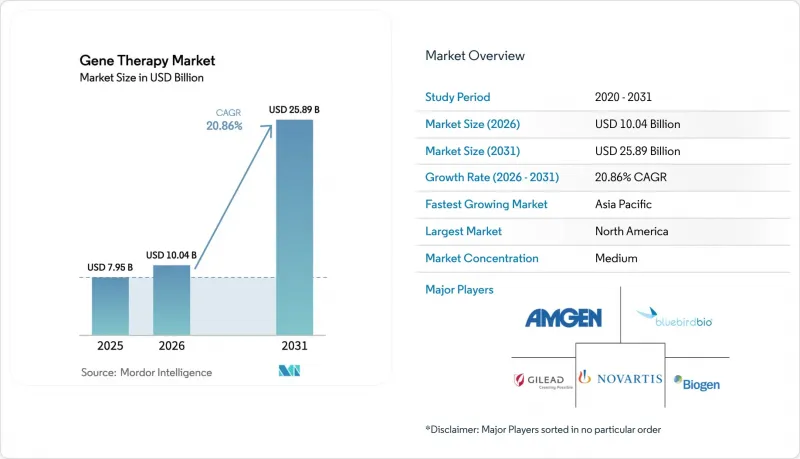
This report is Segmented by Therapy Type (In Vivo, Ex Vivo), Vector Type (Viral Vectors, Non-Viral Vectors), Indication (Oncology, Rare Genetic Disorders, and More), Delivery Method (Systemic, Localised), End User (Hospitals & Specialty Clinics, and More), and Geography (North America, Europe, Asia-Pacific, Middle East & Africa, South America). The Market Forecasts are Provided in Terms of Value (USD).
Global Gene Therapy Market Trends and Insights
Surge in Approvals of One-Shot Curative Therapies
Regulators accelerated timelines in 2024-2025, clearing therapies such as Waskyra for Wiskott-Aldrich syndrome, Itvisma for spinal muscular atrophy, and Casgevy for sickle-cell disease under priority pathways. Clinical datasets underpinning these decisions demonstrate durable efficacy, with Casgevy keeping 93.5% of patients crisis-free over 12 months and Beqvez maintaining greater than 40% factor IX activity, thereby eliminating the need for hemophilia B prophylaxis. Payers acknowledge that one-time interventions can offset decades of chronic-care costs, triggering recalibrated budget models. Japan's Sakigake pathway extension to gene therapy underscores the broader alignment in the Asia-Pacific region, reinforcing the global shift toward curative paradigms.
Expanding Reimbursement for Ultra-Rare Disorders
Outcomes-based models now govern roughly 40% of U.S. commercial contracts, and CMS's Cell and Gene Therapy Access Model covers 35 Medicaid programs, sharing financial risk with manufacturers. Europe remains fragmented but is experimenting with installment payments, as France's HAS spreads Zolgensma's USD 2.1 million cost over five years. U.S. forecasts from the Congressional Budget Office indicate that sickle-cell therapies alone could generate USD 1.8 billion in annual Medicaid expenditures by 2028, prompting legislatures to develop pooled-purchase solutions. Registry data from real-world Zolgensma use indicate that 95% of treated children retain motor milestones at a five-year follow-up, reinforcing the value of pay-for-performance schemes.
High COGS and Six-Figure Price Backlash
Viral-vector batches cost USD 500,000-2 million, driving list prices such as Lenmeldy's USD 4.25 million, provoking U.S. Senate Finance hearings and NICE rejections under GBP 100,000/QALY thresholds. Yield variability ranging from 30% to 70% per campaign forces overproduction and write-offs. Continuous-manufacturing pilots by Resilience and Fujifilm Diosynth promise a 50% cost reduction but will not reach commercial scale meaningfully before 2027. Bluebird's 2024 withdrawal of Zynteglo from the EU, following reimbursement failures, illustrates the existential risk posed by HTA bodies' reluctance to accept prices.
Other drivers and restraints analyzed in the detailed report include:
- Manufacturing Platform Standardization (AAV & LV)
- Growing Venture & SPAC Funding Pipelines
- Complex Long-Term Safety Monitoring Mandates
For complete list of drivers and restraints, kindly check the Table Of Contents.
Segment Analysis
The gene therapy market size for in vivo approaches accounted for 67.31% of the revenue in 2025, reflecting its dominance in liver and systemic applications. Ex vivo therapies accounted for the remainder but are projected to outpace the market at a 21.97% CAGR, fueled by CRISPR-enabled allogeneic CAR-T designs that bypass autologous bottlenecks. Allogene and CRISPR Therapeutics advanced Phase 2 trials in 2024, demonstrating rapid 14-day vein-to-vein workflows. FDA draft CMC guidance clarified batch testing and donor-screening criteria, reducing regulatory ambiguity.
Adoption hinges on cost-effective point-of-care manufacturing. Lonza and Miltenyi Biotec piloted mobile clean rooms in 2024 that slash per-dose costs by 40%, positioning hospital sites as micro-factories. In vivo programs still encounter immunogenicity; up to 50% of candidates possess neutralizing antibodies, prompting the development of engineered capsids. Neurodegenerative disorders, led by uniQure's AMT-130, show promise where ex vivo is impractical, keeping therapeutic diversity high.
Viral platforms generated 74.83% of 2025 revenue, anchored by AAV's hepatocyte tropism and LV's integration for hematologic disorders. Non-viral vectors are expected to expand at a 23.41% CAGR, narrowing the gap through optimized lipid nanoparticles that delivered 40%-60% editing rates in Moderna and BioNTech preclinical models. MaxCyte's electroporation supports 50+ clinical trials, offering transient expression suitable for ex vivo editing.
Within viral categories, engineered AAV-PHP.B capsids entered first-in-human studies for Parkinson's disease, highlighting next-generation tropism for CNS delivery. Touchlight's enzymatic DNA competes as a plasmid alternative that avoids bacterial contaminants, broadening non-viral options. The FDA non-viral guidance standardized quality expectations, aligning oversight with irreversible editing risk rather than vector category.
Complete Report Scope:
- By Therapy Type
- In Vivo
- Ex Vivo
- By Vector Type
- Viral Vectors
- Adeno-Associated Virus
- Lentivirus
- Adenovirus
- Retrovirus & Y-Retrovirus
- Other Viral
- Non-viral Vectors
- Viral Vectors
- By Indication
- Oncology
- Rare Genetic Disorders
- Ophthalmology
- Hematology
- Neurology
- Cardiovascular & Others
- By Delivery Method
- Systemic Administration
- Localised Administration
- By End User
- Hospitals & Specialty Clinics
- Academic & Research Institutes
- Other End Users
- By Geography
- North America
- United States
- Canada
- Mexico
- Europe
- Germany
- United Kingdom
- France
- Italy
- Spain
- Rest of Europe
- Asia-Pacific
- China
- Japan
- India
- Australia
- South Korea
- Rest of Asia-Pacific
- Middle East & Africa
- GCC
- South Africa
- Rest of Middle East & Africa
- South America
- Brazil
- Argentina
- Rest of South America
- North America
Geography Analysis
North America maintained 41.36% of 2025 revenue, supported by 45 new RMAT designations and the CMS Access Model easing Medicaid barriers. Capacity built by Lonza, Catalent, and Resilience totaled 1.2 million liters of bioreactors, cementing the region's supply dominance. Outcomes-based contracts now cover 40% of U.S. therapies, as exemplified by Lyfgenia's coverage for 100 million lives. Canada trails with only two approvals in 2024, due to protracted provincial reimbursement negotiations.
The Asia-Pacific region, projected to grow at a 28.78% CAGR, is driven by China's NMPA approvals of Roctavian and Yescarta, as well as over 200 active clinical trials. WuXi AppTec's plasmid facility and Samsung's AAV plant diversify global manufacturing. Japan's PMDA extended Sakigake's fast-track to gene therapy, and India green-lit its first CAR-T at one-tenth the U.S. price, showcasing cost innovation. Australia approved Casgevy but faces delays in reimbursement.
Europe grapples with fragmented HTA systems. Bluebird's Zynteglo exit following reimbursement failures exemplifies the commercial risk associated with EMA approval. Germany's IQWiG positive Hemgenix assessment and France's installment payments for Zolgensma are isolated wins. EUnetHTA's 2025 joint assessments aim to harmonize evidence, yet national payers still control pricing. The Middle East & Africa, as well as South America, remain nascent but are developing regulatory frameworks, with the UAE and Brazil approving select therapies for compassionate or public hospital use.
- Amgen
- Beam Therapeutics
- bluebird bio Inc.
- Bristol-Myers Squibb
- Biogen
- CRISPR Therapeutic
- Editas Medicine
- Freeline Therapeutics
- Gilead Sciences
- Intellia Therapeutics
- LogicBio Therapeutics
- MeiraGTx
- Mustang Bio
- Novartis
- Orchard Therapeutics
- Passage Bio
- Pfizer
- Regenxbio
- Sangamo Therapeutics
- Sarepta Therapeutics
- Spark Therapeutics
- Takeda Pharmaceuticals
- uniQure N.V.
- ViGeneron
Additional Benefits:
- The market estimate (ME) sheet in Excel format
- 3 months of analyst support
TABLE OF CONTENTS
1 Introduction
- 1.1 Study Assumptions & Market Definition
- 1.2 Scope of the Study
2 Research Methodology
3 Executive Summary
4 Market Landscape
- 4.1 Market Overview
- 4.2 Market Drivers
- 4.2.1 Surge in Approvals of One-Shot Curative Therapies
- 4.2.2 Expanding Reimbursement for Ultra-Rare Disorders
- 4.2.3 Manufacturing Platform Standardisation (AAV & LV)
- 4.2.4 Growing Venture & SPAC Funding Pipelines
- 4.2.5 CRISPR-Based in Vivo Editing Breakthroughs
- 4.2.6 Growing Inclusion of Rare-Disease Gene Therapies
- 4.3 Market Restraints
- 4.3.1 High COGS And Six-Figure Price Backlash
- 4.3.2 Complex Long-Term Safety Monitoring Mandates
- 4.3.3 Global Viral-Vector Capacity Bottlenecks
- 4.3.4 Emerging Patent Thickets on Gene-Editing Payloads
- 4.4 Value / Supply-Chain Analysis
- 4.5 Regulatory Landscape
- 4.6 Technological Outlook
- 4.7 Porter's Five Forces Analysis
- 4.7.1 Threat of New Entrants
- 4.7.2 Bargaining Power of Buyers
- 4.7.3 Bargaining Power of Suppliers
- 4.7.4 Threat of Substitutes
- 4.7.5 Competitive Rivalry
5 Market Size & Growth Forecasts
- 5.1 By Therapy Type
- 5.1.1 In Vivo
- 5.1.2 Ex Vivo
- 5.2 By Vector Type
- 5.2.1 Viral Vectors
- 5.2.1.1 Adeno-Associated Virus
- 5.2.1.2 Lentivirus
- 5.2.1.3 Adenovirus
- 5.2.1.4 Retrovirus & Y-Retrovirus
- 5.2.1.5 Other Viral
- 5.2.2 Non-viral Vectors
- 5.2.1 Viral Vectors
- 5.3 By Indication
- 5.3.1 Oncology
- 5.3.2 Rare Genetic Disorders
- 5.3.3 Ophthalmology
- 5.3.4 Hematology
- 5.3.5 Neurology
- 5.3.6 Cardiovascular & Others
- 5.4 By Delivery Method
- 5.4.1 Systemic Administration
- 5.4.2 Localised Administration
- 5.5 By End User
- 5.5.1 Hospitals & Specialty Clinics
- 5.5.2 Academic & Research Institutes
- 5.5.3 Other End Users
- 5.6 By Geography
- 5.6.1 North America
- 5.6.1.1 United States
- 5.6.1.2 Canada
- 5.6.1.3 Mexico
- 5.6.2 Europe
- 5.6.2.1 Germany
- 5.6.2.2 United Kingdom
- 5.6.2.3 France
- 5.6.2.4 Italy
- 5.6.2.5 Spain
- 5.6.2.6 Rest of Europe
- 5.6.3 Asia-Pacific
- 5.6.3.1 China
- 5.6.3.2 Japan
- 5.6.3.3 India
- 5.6.3.4 Australia
- 5.6.3.5 South Korea
- 5.6.3.6 Rest of Asia-Pacific
- 5.6.4 Middle East & Africa
- 5.6.4.1 GCC
- 5.6.4.2 South Africa
- 5.6.4.3 Rest of Middle East & Africa
- 5.6.5 South America
- 5.6.5.1 Brazil
- 5.6.5.2 Argentina
- 5.6.5.3 Rest of South America
- 5.6.1 North America
6 Competitive Landscape
- 6.1 Market Concentration
- 6.2 Market Share Analysis
- 6.3 Company Profiles (includes Global level Overview, Market-level Overview, Core Segments, Financials, Strategic Information, Market Rank/Share, Products & Services, Recent Developments)
- 6.3.1 Amgen Inc.
- 6.3.2 Beam Therapeutics
- 6.3.3 bluebird bio Inc.
- 6.3.4 Bristol Myers Squibb
- 6.3.5 Biogen Inc.
- 6.3.6 CRISPR Therapeutics
- 6.3.7 Editas Medicine
- 6.3.8 Freeline Therapeutics
- 6.3.9 Gilead Sciences Inc.
- 6.3.10 Intellia Therapeutics
- 6.3.11 LogicBio Therapeutics
- 6.3.12 MeiraGTx
- 6.3.13 Mustang Bio
- 6.3.14 Novartis AG
- 6.3.15 Orchard Therapeutics
- 6.3.16 Passage Bio
- 6.3.17 Pfizer Inc.
- 6.3.18 Regenxbio
- 6.3.19 Sangamo Therapeutics
- 6.3.20 Sarepta Therapeutics
- 6.3.21 Spark Therapeutics
- 6.3.22 Takeda Pharmaceutical
- 6.3.23 uniQure N.V.
- 6.3.24 ViGeneron
7 Market Opportunities & Future Outlook
- 7.1 White-space & Unmet-need Assessment

