PUBLISHER: Mordor Intelligence | PRODUCT CODE: 2123289

PUBLISHER: Mordor Intelligence | PRODUCT CODE: 2123289
Oscilloscope - Market Share Analysis, Industry Trends & Statistics, Growth Forecasts (2026 - 2031)
According to Mordor Intelligence, the oscilloscope market size is expected to grow from USD 3.74 billion in 2025 to USD 4.03 billion in 2026 and is forecast to reach USD 5.87 billion by 2031 at 7.8% CAGR over 2026-2031.
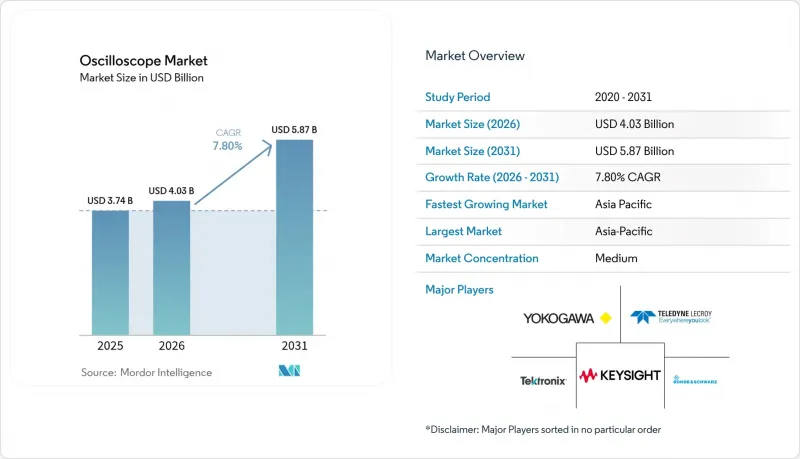
This report is Segmented by Component (Hardware, Software, Services), Type (Analog, Digital/Mixed-Signal, and More), Bandwidth (<=500 MHz, and More), End-User Industry (Automotive and Transportation, IT and Telecommunications, and More), Sales Channel (Direct, Distributors and VARs, and More), and Geography (North America, South America, and More). The Market Forecasts are Provided in Terms of Value (USD).
Global Oscilloscope Market Trends and Insights
Accelerating Adoption of Mixed-Signal Designs in Automotive ECUs
Automakers now integrate power-train electrification, ADAS, and over-the-air update capabilities within unified ECU architectures that blend analog sensor inputs with multi-core digital processors. As these mixed-signal environments proliferate, engineers require oscilloscopes offering synchronized analog-digital acquisition, deep protocol decoding, and domain-correlated analysis. New subsidy programs from the Japanese Ministry of Land, Infrastructure, Transport and Tourism, effective March 2025, reduce test-tool purchase hurdles for service chains, reinforcing demand pull across Asia-Pacific. Vendors that ship automotive-specific triggers for SENT, CAN-FD, and automotive Ethernet stand to benefit the most.
Rising 5G/6G RF Front-End Complexity Necessitating Real-Time Debug Tools
Massive-MIMO arrays, beamforming, and mmWave carrier aggregation raise measurement bandwidth requirements beyond 100 GHz while enforcing phase-coherent multi-channel capture. Keysight's UXR-Series, delivering up to 110 GHz and 256 GSa/s, exemplifies instruments tuned for EVM and spectrum-mask validation under 5G NR FR2 conditions. As early 6G sub-THz prototypes emerge, procurement of ultra-wide-bandwidth scopes accelerates in Korea, Japan, and U.S. research labs.
High Total Cost of Ownership for Greater than 8 GHz Models
Indium-phosphide front ends and precision probes lift ownership cost well above USD 200,000 for flagship scopes, limiting adoption among universities and SMEs. Factory-only calibration contracts, often exceeding USD 30,000 across five years, add further financial strain. Equipment-as-a-service programs from Electro Rent now meet pent-up demand via 12- to 36-month leases that bypass capital-expense hurdles.
Other drivers and restraints analyzed in the detailed report include:
- Surge in High-Speed Serial Bus Standards in Consumer Electronics
- Increased R&D Funding for Quantum Computing Instrumentation
- Acute Shortage of Wide-Bandgap A/D Converters
For complete list of drivers and restraints, kindly check the Table Of Contents.
Segment Analysis
Hardware provided the backbone of measurement budgets, securing 69.52% oscilloscope market share in 2025. However, services already contribute the highest 9.92% CAGR as customers pivot toward subscription access, calibration bundles, and cloud-based analytics. KeysightAccess illustrates how recurring-revenue services lower ownership friction while extending instrumentation uptime.
The oscilloscope market is gradually redefining value from product specifications to outcome assurance. Service-rich packages that combine remote diagnostics, firmware updates, and application consulting show higher renewal rates, signaling a durable shift toward solution selling. Vendors that integrate artificial-intelligence-guided measurement routines within service contracts are well-positioned to deepen wallet share.
Digital/mixed-signal units accounted for 51.74% revenue in 2025, anchoring most R&D benches that juggle analog power stages with digital buses. Yet PC-based instruments, though starting from a smaller baseline, post a category-leading 9.63% CAGR as remote engineers seek compact, Ethernet-enabled devices. BitScope's 100 MHz, USB-powered scopes demonstrate how software updates can unlock new decode options without hardware swaps.
As corporate policies encourage flexible work, engineers adopt laptop-centric test setups that travel between labs and field sites. While these tools lag high-end bandwidth tiers, their sub-USD 1,000 price and multi-instrument functionality resonate with education and maker communities, creating a downstream funnel for future premium-scope buyers.
Complete Report Scope:
- By Component
- Hardware
- Software
- Services
- By Type
- Analog
- Digital/Mixed-Signal
- PC-based/USB
- By Bandwidth
- Less than 500 MHz
- 500 MHz - 1 GHz
- 1 GHz - 4 GHz
- More than 4 GHz
- By End-User Industry
- Automotive and Transportation
- IT and Telecommunications
- Consumer Electronics and Appliances
- Aerospace and Defense
- Medical and Life Sciences
- Education and Research
- By Sales Channel
- Direct
- Distributors and VARs
- E-commerce and Online Platforms
- By Geography
- North America
- United States
- Canada
- Mexico
- South America
- Brazil
- Argentina
- Rest of South America
- Europe
- Germany
- United Kingdom
- France
- Italy
- Rest of Europe
- Asia-Pacific
- China
- Japan
- South Korea
- India
- Rest of Asia-Pacific
- Middle East
- Saudi Arabia
- United Arab Emirates
- Rest of Middle East
- Africa
- South Africa
- Rest of Africa
- North America
Geography Analysis
Asia-Pacific dominated oscilloscope market revenue at 33.05% in 2025 and is heading toward a 8.98% CAGR through 2031. Local OEMs gain cost advantages from regional semiconductor ecosystems, while Chinese challengers such as RIGOL develop proprietary ADC chipsets that elevate domestic value capture. Government subsidies for automotive diagnostic gear in Japan and Korea's aggressive 5G roll-out further underpin regional growth.
North America remains a technology vanguard, funneling large budgets into quantum-computing, aerospace, and defense programs that demand ultra-high-bandwidth oscilloscopes with stringent security certifications. Keysight's partnership with TEVET on spectrum operations exemplifies how national-security projects drive specialized scope requirements beyond commercial norms. Despite slower aggregate growth, the region commands premium average selling prices thanks to advanced feature adoption.
Europe's oscilloscope landscape is anchored by German automotive engineering and pan-regional telecom infrastructure upgrades. Rohde & Schwarz leverages in-house ASIC design to ship compact eight-channel scopes optimized for vehicle Ethernet compliance. Brexit-driven logistics realignments continue to spur distributor network optimization, yet EU-wide regulatory harmonization sustains consistent demand for calibrated, traceable instrumentation.
- Tektronix LLC
- Keysight Technologies Inc.
- Rohde & Schwarz GmbH & Co. KG
- Teledyne LeCroy Inc.
- Yokogawa Test & Measurement Corporation
- National Instruments Corporation
- Rigol Technologies Inc.
- Fluke Corporation
- Siglent Technologies Co., Ltd.
- Pico Technology Ltd.
- B&K Precision Corporation
- Scientech Technologies Pvt. Ltd.
- Good Will Instrument Co., Ltd. (GW Instek)
- Cleverscope Ltd.
- TiePie engineering B.V.
- Advantest Corporation
- Teletek Test Solutions Ltd.
- Danaher Corporation (Tektronix brand holding)
- Anritsu Corporation
- EXFO Inc.
Additional Benefits:
- The market estimate (ME) sheet in Excel format
- 3 months of analyst support
TABLE OF CONTENTS
1 Introduction
- 1.1 Study Assumptions and Market Definition
- 1.2 Scope of the Study
2 Research Methodology
3 Executive Summary
4 Market Landscape
- 4.1 Market Overview
- 4.2 Market Drivers
- 4.2.1 Accelerating adoption of mixed-signal designs in automotive ECUs
- 4.2.2 Rising 5G/6G RF front-end complexity necessitating real-time debug tools
- 4.2.3 Surge in high-speed serial bus standards (PCIe 6.0, USB 4.0) in consumer electronics
- 4.2.4 Increased R&D funding for quantum computing instrumentation
- 4.2.5 Growth of "oscilloscope-as-a-service" subscription pricing
- 4.2.6 Emergence of open-source probe ecosystems lowering TCO
- 4.3 Market Restraints
- 4.3.1 High total cost of ownership for greater than 8 GHz models
- 4.3.2 Short product life-cycles causing inventory risk for distributors
- 4.3.3 Acute shortage of wide-bandgap A/D converters
- 4.3.4 Cyber-security certification backlog delaying deliveries to defense primes
- 4.4 Industry Value Chain Analysis
- 4.5 Regulatory Landscape
- 4.6 Technological Outlook
- 4.7 Porter's Five Forces Analysis
- 4.7.1 Bargaining Power of Suppliers
- 4.7.2 Bargaining Power of Buyers
- 4.7.3 Threat of New Entrants
- 4.7.4 Threat of Substitutes
- 4.7.5 Intensity of Competitive Rivalry
- 4.8 Impact of Macroeconomic Factors on the Market
- 4.9 Investment Analysis
5 Market Size and Growth Forecasts (Value)
- 5.1 By Component
- 5.1.1 Hardware
- 5.1.2 Software
- 5.1.3 Services
- 5.2 By Type
- 5.2.1 Analog
- 5.2.2 Digital/Mixed-Signal
- 5.2.3 PC-based/USB
- 5.3 By Bandwidth
- 5.3.1 Less than 500 MHz
- 5.3.2 500 MHz - 1 GHz
- 5.3.3 1 GHz - 4 GHz
- 5.3.4 More than 4 GHz
- 5.4 By End-User Industry
- 5.4.1 Automotive and Transportation
- 5.4.2 IT and Telecommunications
- 5.4.3 Consumer Electronics and Appliances
- 5.4.4 Aerospace and Defense
- 5.4.5 Medical and Life Sciences
- 5.4.6 Education and Research
- 5.5 By Sales Channel
- 5.5.1 Direct
- 5.5.2 Distributors and VARs
- 5.5.3 E-commerce and Online Platforms
- 5.6 By Geography
- 5.6.1 North America
- 5.6.1.1 United States
- 5.6.1.2 Canada
- 5.6.1.3 Mexico
- 5.6.2 South America
- 5.6.2.1 Brazil
- 5.6.2.2 Argentina
- 5.6.2.3 Rest of South America
- 5.6.3 Europe
- 5.6.3.1 Germany
- 5.6.3.2 United Kingdom
- 5.6.3.3 France
- 5.6.3.4 Italy
- 5.6.3.5 Rest of Europe
- 5.6.4 Asia-Pacific
- 5.6.4.1 China
- 5.6.4.2 Japan
- 5.6.4.3 South Korea
- 5.6.4.4 India
- 5.6.4.5 Rest of Asia-Pacific
- 5.6.5 Middle East
- 5.6.5.1 Saudi Arabia
- 5.6.5.2 United Arab Emirates
- 5.6.5.3 Rest of Middle East
- 5.6.6 Africa
- 5.6.6.1 South Africa
- 5.6.6.2 Rest of Africa
- 5.6.1 North America
6 Competitive Landscape
- 6.1 Market Concentration
- 6.2 Strategic Moves
- 6.3 Market Share Analysis
- 6.4 Company Profiles (includes Global level Overview, Market level overview, Core Segments, Financials as available, Strategic Information, Market Rank/Share for key companies, Products and Services, and Recent Developments)
- 6.4.1 Tektronix LLC
- 6.4.2 Keysight Technologies Inc.
- 6.4.3 Rohde & Schwarz GmbH & Co. KG
- 6.4.4 Teledyne LeCroy Inc.
- 6.4.5 Yokogawa Test & Measurement Corporation
- 6.4.6 National Instruments Corporation
- 6.4.7 Rigol Technologies Inc.
- 6.4.8 Fluke Corporation
- 6.4.9 Siglent Technologies Co., Ltd.
- 6.4.10 Pico Technology Ltd.
- 6.4.11 B&K Precision Corporation
- 6.4.12 Scientech Technologies Pvt. Ltd.
- 6.4.13 Good Will Instrument Co., Ltd. (GW Instek)
- 6.4.14 Cleverscope Ltd.
- 6.4.15 TiePie engineering B.V.
- 6.4.16 Advantest Corporation
- 6.4.17 Teletek Test Solutions Ltd.
- 6.4.18 Danaher Corporation (Tektronix brand holding)
- 6.4.19 Anritsu Corporation
- 6.4.20 EXFO Inc.
7 Market Opportunities and Future Outlook
- 7.1 White-space and Unmet-Need Assessment

