PUBLISHER: Mordor Intelligence | PRODUCT CODE: 2123292

PUBLISHER: Mordor Intelligence | PRODUCT CODE: 2123292
Asia Pacific Apheresis - Market Share Analysis, Industry Trends & Statistics, Growth Forecasts (2026 - 2031)
According to Mordor Intelligence, the Asia Pacific apheresis market size is projected to be USD 0.82 billion in 2025, USD 0.91 billion in 2026, and reach USD 1.48 billion by 2031, growing at a CAGR of 10.46% from 2026 to 2031.
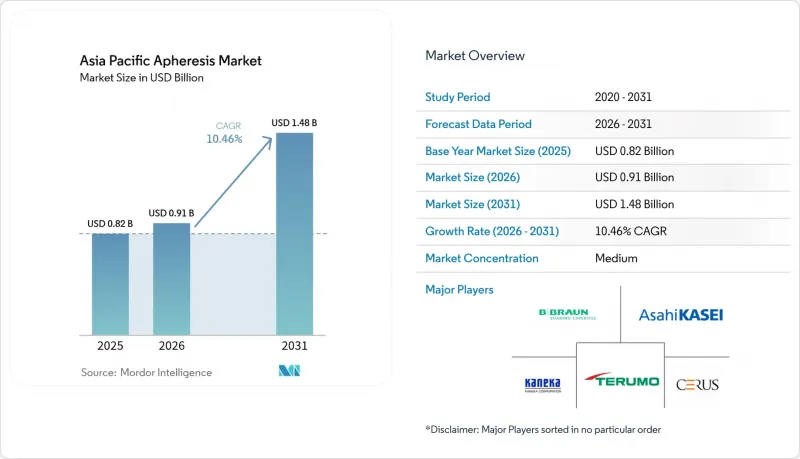
This report is Segmented by Product (Devices, Disposables), Procedure (Plasmapheresis, Plateletpheresis, and More), Technology (Centrifugation, Membrane Filtration, Adsorption), Application (Neurology, Hematology, and More), End-User (Hospitals, Specialty Clinics, and More), and Geography (China, Japan, India, Australia, South Korea, Rest of APAC). Market Forecasts are in Value (USD).
Asia Pacific Apheresis Market Trends and Insights
Growing Prevalence of Hematologic & Autoimmune Disorders
Neurological autoimmune conditions are reshaping procedure volumes in India, where myasthenia gravis, Guillain-Barre syndrome, and chronic inflammatory demyelinating polyneuropathy already account for more than 60% of therapeutic plasma-exchange cases. Initiating treatment within seven days of symptom onset drives functional recovery to 83%, prompting emergency departments to pre-authorize apheresis before electromyography confirmation. China's new reimbursement for hyperviscosity syndrome and Japan's pediatric-optimized kits are widening the addressable base, while the Southeast Asia TPE Consortium harmonizes protocols across 12 tertiary centers, boosting safety and training capacity.
Rising Demand for Convalescent Plasma Programs
The infrastructure created for COVID-19 now supports readiness for emerging infections. Australia maintains a surge capacity of 500 apheresis donations per week, which can be activated within 72 hours of a public health declaration. Japan invested JPY 2.4 billion in automated platforms that fractionate plasma into hyperimmune globulin concentrates, while China's draft ISO 13485 guidance would harmonize quality standards and enable stockpiling agreements with Singapore. Selective collection of high-titer units via apheresis has cut downstream fractionation losses by up to 40%, demonstrating the long-term economic rationale of keeping these programs active.
High Capital Cost of Apheresis Devices
Equipment prices range from USD 80,000 to USD 250,000, placing them out of reach for many district hospitals where annual equipment budgets fall below USD 500,000. Pay-per-procedure models at USD 150-200 cover placement, kits, and maintenance shift costs, aligning with operating budgets and shortening payback periods, but Chinese volume-based procurement slated for 2026 could drop headline prices by 20-30%, favoring local manufacturers with Class III approvals.
Other drivers and restraints analyzed in the detailed report include:
- Expansion of Cell & Gene Therapy Manufacturing Hubs In APAC
- Government-Funded Blood-Safety Modernization Initiatives
- Shortage of Trained Apheresis Nurses & Technologists
For complete list of drivers and restraints, kindly check the Table Of Contents.
Segment Analysis
Disposables accounted for 56.02% of the 2025 revenue in the Asia Pacific apheresis market, as every installed separator consumes 200-400 kits annually. Devices remain the growth engine with an 11.46% CAGR thanks to dual-mode centrifugal-membrane platforms that support photopheresis and future CAR-T workflows. Terumo BCT's integrated leukapheresis-washing system commands 15-20% price premiums yet compresses cell-therapy production timelines by 30%, reinforcing capital-upgrade intent among high-volume centers.
Hospitals in Beijing, Shanghai, and Guangzhou report that single-use kits trimmed labor by 22 minutes per procedure, freeing scarce nurses to manage higher caseloads and directly supporting Asia Pacific apheresis market expansion. Ped-sized 120 mL bowls from Haemonetics now enable safe collection for patients weighing less than 15 kg, carving a niche that strengthens vendor differentiation.
Plasmapheresis retained 41.67% procedure share in 2025, equaling roughly USD 0.34 billion of the Asia Pacific apheresis market size, underpinned by Japan's JPY 90,000-384,000 reimbursement band. Photopheresis, however, is expanding at a 13.62% CAGR due to rising second-line use for graft-versus-host disease and new approvals for Crohn's disease, cutaneous T-cell lymphoma, and solid-organ rejection. Inline photopheresis halves session time, making outpatient models feasible and accelerating adoption across Australia and South Korea.
Leukapheresis volumes grow in tandem with 17 approved Japanese regenerative therapies and 5 new South Korean TIL protocols, each requiring 3-5 sessions per patient. Plateletpheresis growth is capped by donor scarcity, as Japan's eligible donor pool shrank by 8% since 2020. LDL apheresis remains a niche yet stable treatment and is dominated by Kaneka's adsorption columns, which spare HDL and coagulation factors.
Complete Report Scope:
- By Product
- Apheresis Devices
- Apheresis Disposables
- By Procedure Type
- Plasmapheresis
- Plateletpheresis
- Leukapheresis
- LDL Apheresis
- Photopheresis
- Other Procedures
- By Technology
- Centrifugation
- Membrane Filtration
- Adsorption Columns
- By Application
- Neurology
- Hematology
- Renal Disorders
- Autoimmune Diseases
- Oncology & Cell Therapy
- Other Applications
- By End-user
- Hospitals & Transfusion Centers
- Specialty Clinics
- Blood Component Providers
- Research & Academic Institutes
- By Country
- China
- Japan
- India
- Australia
- South Korea
- Rest of Asia-Pacific
List of Companies Covered in this Report:
- Asahi Kasei
- B. Braun
- Baxter
- Cerus
- Cytosorbents Corporation
- Fresenius
- Fresenius
- Haemonetics
- Infomed
- Kaneka
- MacoPharma
- Mallinckrodt (Therakos)
- Medica S.p.A.
- Miltenyi Biotec
- Nikkiso Co., Ltd.
- Terumo
Additional Benefits:
- The market estimate (ME) sheet in Excel format
- 3 months of analyst support
TABLE OF CONTENTS
1 Introduction
- 1.1 Study Assumptions & Market Definition
- 1.2 Scope of the Study
2 Research Methodology
3 Executive Summary
4 Market Landscape
- 4.1 Market Overview
- 4.2 Market Drivers
- 4.2.1 Growing Prevalence of Hematologic & Autoimmune Disorders
- 4.2.2 Rising Demand for Convalescent Plasma Programs
- 4.2.3 Expansion of Cell & Gene Therapy Manufacturing Hubs In APAC
- 4.2.4 Government-Funded Blood Safety Modernization Initiatives
- 4.2.5 Rapid Adoption of Single-Use Apheresis Disposables
- 4.2.6 Accelerated Adoption of Advanced Plasmapheresis Technologies
- 4.3 Market Restraints
- 4.3.1 High Capital Cost of Apheresis Devices
- 4.3.2 Shortage of Trained Apheresis Nurses & Technologists
- 4.3.3 Reimbursement Gaps for Therapeutic Apheresis Procedures
- 4.3.4 Supply-Chain Vulnerability for Critical Filters & Kits
- 4.4 Regulatory Landscape
- 4.5 Technological Outlook
- 4.6 Porter's Five Forces Analysis
- 4.6.1 Threat of New Entrants
- 4.6.2 Bargaining Power of Buyers
- 4.6.3 Bargaining Power of Suppliers
- 4.6.4 Threat of Substitute Products
- 4.6.5 Intensity of Competitive Rivalry
5 Market Size & Growth Forecasts
- 5.1 By Product
- 5.1.1 Apheresis Devices
- 5.1.2 Apheresis Disposables
- 5.2 By Procedure Type
- 5.2.1 Plasmapheresis
- 5.2.2 Plateletpheresis
- 5.2.3 Leukapheresis
- 5.2.4 LDL Apheresis
- 5.2.5 Photopheresis
- 5.2.6 Other Procedures
- 5.3 By Technology
- 5.3.1 Centrifugation
- 5.3.2 Membrane Filtration
- 5.3.3 Adsorption Columns
- 5.4 By Application
- 5.4.1 Neurology
- 5.4.2 Hematology
- 5.4.3 Renal Disorders
- 5.4.4 Autoimmune Diseases
- 5.4.5 Oncology & Cell Therapy
- 5.4.6 Other Applications
- 5.5 By End-user
- 5.5.1 Hospitals & Transfusion Centers
- 5.5.2 Specialty Clinics
- 5.5.3 Blood Component Providers
- 5.5.4 Research & Academic Institutes
- 5.6 By Country
- 5.6.1 China
- 5.6.2 Japan
- 5.6.3 India
- 5.6.4 Australia
- 5.6.5 South Korea
- 5.6.6 Rest of Asia-Pacific
6 Competitive Landscape
- 6.1 Market Concentration
- 6.2 Market Share Analysis
- 6.3 Company Profiles (includes Global Level Overview, Market Level Overview, Core Segments, Financials as Available, Strategic Information, Market Rank/Share for Key Companies, Products & Services, and Recent Developments)
- 6.3.1 Asahi Kasei Medical Co., Ltd.
- 6.3.2 B. Braun Melsungen AG
- 6.3.3 Baxter International Inc.
- 6.3.4 Cerus Corporation
- 6.3.5 Cytosorbents Corporation
- 6.3.6 Fresenius Kabi AG
- 6.3.7 Fresenius Medical Care
- 6.3.8 Haemonetics Corporation
- 6.3.9 Infomed SA
- 6.3.10 Kaneka Corporation
- 6.3.11 Macopharma
- 6.3.12 Mallinckrodt (Therakos)
- 6.3.13 Medica S.p.A.
- 6.3.14 Miltenyi Biotec
- 6.3.15 Nikkiso Co., Ltd.
- 6.3.16 Terumo Corporation
7 Market Opportunities & Future Outlook
- 7.1 White-space & Unmet-Need Assessment

