PUBLISHER: Mordor Intelligence | PRODUCT CODE: 2123308

PUBLISHER: Mordor Intelligence | PRODUCT CODE: 2123308
Fiber Optic Test Equipment (FOTE) - Market Share Analysis, Industry Trends & Statistics, Growth Forecasts (2026 - 2031)
According to Mordor Intelligence, the fiber optic test equipment market size was valued at USD 1.17 billion in 2025 and estimated to grow from USD 1.25 billion in 2026 to reach USD 1.71 billion by 2031, at a CAGR of 6.44% during the forecast period (2026-2031).
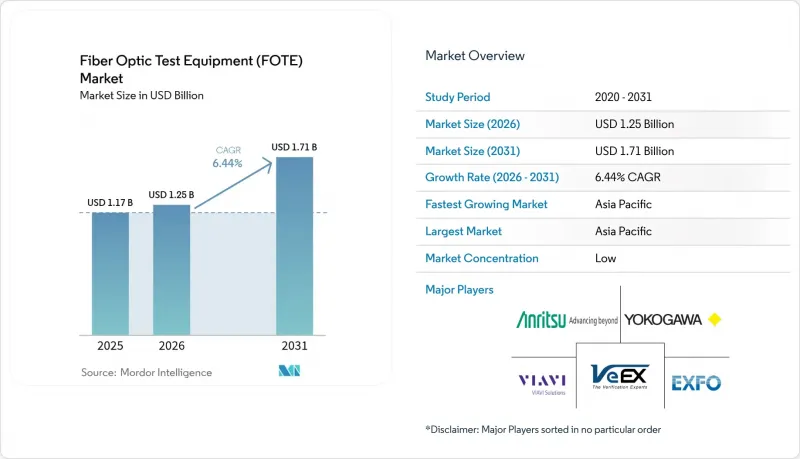
This report is Segmented by Equipment Type (Optical Light Sources, Optical Power & Loss Meters, Optical Time-Domain Reflectometers, and More), Form Factor (Hand-Held, Benchtop, Rack/Module-based), Fiber Mode Tested (Single-Mode, Multi-Mode), End-User Application (Telecommunications Service Providers, and More), and Geography. The Market Forecasts are Provided in Terms of Value (USD).
Global Fiber Optic Test Equipment (FOTE) Market Trends and Insights
Proliferation of 5G Fronthaul and Backhaul Fiber Deployment
Each standalone 5G macro or small cell multiplies fiber strands tenfold compared with 4G, triggering unprecedented demand for coherent OTDR platforms that validate sub-10 ms latency, high-order modulation integrity, and DWDM channel spacing. Saudi Telecom Company added 8,035 dedicated fiber backhaul routes for 5G in 2024, illustrating the infrastructure intensity now routine among Tier-1 operators. Dense urban builds face frequent civil-works disruptions, making automated fault-localization and real-time reflectometry indispensable for service-level compliance. Equipment vendors answer with dual-port designs that support simultaneous upstream and downstream testing, reducing truck rolls and accelerating mean-time-to-repair. The push toward 5.5G and even 6 GHz spectrum refarming sustains the need for higher-bandwidth fiber, thereby underpinning test-instrument replacement cycles across operator footprints.
Explosion of FTTH/B Roll-outs in Emerging Economies
Public-sector digital-inclusion targets are fueling multi-country FTTH extensions well beyond primary metros. Nigeria's roadmap to stretch backbone fiber from 35,000 km to 125,000 km underscores the scale, demanding lightweight, battery-efficient meters technicians can operate after minimal training. Enrollment in BICSI's Installer 2-Optical Fiber curriculum has surged, reflecting how certification uptake directly boosts procurement of compatible test gear. Local-content mandates in Gulf Cooperation Council economies reward regional assembly partnerships that keep device lead times short and service logistics local. As fiber footprints permeate suburban and rural clusters, optical loss and automated end-face inspection become mandatory to meet contractual KPIs tied to government subsidies.
High CAPEX for Coherent-Ready OTDR and OSA Platforms
Transitioning to coherent optical systems obliges operators to invest in analyzers containing costly high-speed DSPs and ultra-narrow-linewidth lasers. Smaller carriers often resort to rental pools or managed-test services, elongating procurement cycles for new hardware. The burden is magnified by mandatory calibration routines and advanced user training that compound total cost of ownership. Vendors experiment with subscription models that bundle firmware updates, automated calibration, and AI fault-analytics to lower entry barriers, but price sensitivity among Tier-2/3 players persists until unit volumes rise.
Other drivers and restraints analyzed in the detailed report include:
- Government Stimulus for Rural Broadband and Power-Grid Digitalization
- Shift to PAM4 and 800 G Optics in Hyperscale Data Centers
- Shortage of Certified Fiber Technicians in Tier-2/3 Cities
For complete list of drivers and restraints, kindly check the Table Of Contents.
Segment Analysis
Remote fiber test systems, though only 16% of shipments, posted an 7.98% CAGR to become the fastest-expanding category. Operators prize their ability to localize faults across thousands of kilometers without dispatching crews, elevating productivity metrics and boosting network availability. Optical power and loss meters nonetheless retained a 28.95% fiber optic test equipment market share in 2025, underscoring their ubiquity during initial installation and periodic certification. EXFO's OTH-7000 introduced cloud APIs that stream measurement packets into operator OSS suites, a capability replicated by rivals aiming to upsell analytics subscriptions.
The pivot toward automation is even clearer in procurement frameworks that now bundle remote monitoring nodes with hand-held kits for corrective work. As SLA penalties tighten, carriers consider real-time OTDR sweeps indispensable for metro rings and long-haul assets alike. Integrated DWDM channel analysis inside spectrum analyzers wins favor in regions where 400 G and 800 G deployments accelerate, while visual fault locators evolve into smartphone-app-controlled devices that auto-attach images to trouble-ticket systems.
Hand-held testers maintained a 51.45% stake in 2025 because field crews still constitute the frontline of fault isolation and acceptance testing. Weight reduction below 1 kg and eight-hour battery lives are now baseline specifications as technicians juggle multiple instruments during multi-site assignments. The rack/module-based class, however, is expanding at a 7.62% CAGR, propelled by hyperscale operators embedding test blades directly into top-of-rack switches to deliver always-on visibility. This practice supports closed-loop automation where orchestration software triggers pre-emptive fiber cleaning or rerouting.
Benchtop systems serve manufacturing and RandD environments where measurement dynamic range and spectral fidelity trump portability. Anritsu's μOTDR module exemplifies miniaturization trends, slotting into PXI chassis to furnish OEMs with in-line production tests. Vendors increasingly adopt common firmware across form factors, allowing enterprises to leverage a single analytics cockpit regardless of device class, thereby reducing operator learning curves and support effort.
Complete Report Scope:
- By Equipment Type
- Optical Light Sources
- LED Sources
- Laser Sources
- Optical Power and Loss Meters
- Optical Time-Domain Reflectometers
- Optical Spectrum Analyzers
- Remote Fiber Test Systems
- Others (Inspection Microscopes, VFL, etc.)
- Optical Light Sources
- By Form Factor
- Hand-held
- Benchtop
- Rack/Module-based
- By Fiber Mode Tested
- Single-mode
- Multi-mode
- By End-user Application
- Telecommunications Service Providers
- Hyperscale and Enterprise Data Centers
- Industrial and Manufacturing
- Energy and Utilities (Smart-grid, Oil and Gas)
- Government and Defense
- Others (Broadcast, Healthcare, RandD)
- By Geography
- North America
- United States
- Canada
- South America
- Brazil
- Argentina
- Mexico
- Europe
- Germany
- United Kingdom
- France
- Russia
- Asia-Pacific
- China
- Japan
- India
- South Korea
- Rest of Asia-Pacific
- Middle East and Africa
- United Arab Emirates
- Saudi Arabia
- South Africa
- North America
Geography Analysis
Asia-Pacific contributed USD 0.45 billion to the fiber optic test equipment market size in 2025, reflecting unrelenting backbone expansion and the migration from GPON to 10G PON in markets such as China, Japan, and South Korea. Regional manufacturing capacity allows quick-turn customization, while national-security directives tilt procurement toward domestically produced optics. ASEAN countries add incremental demand as digital-economy policies broaden FTTH coverage, catalyzing hand-held OTDR sales. Academic collaboration between research labs in Japan and public institutes in South Korea accelerates innovations like coherent pluggables, sustaining local demand for high-precision measurement benches.
Middle East and Africa, though accounting for just USD 0.09 billion in 2025, registers the highest regional growth at 7.88% CAGR on the back of giga-projects requiring secure, high-capacity backbones. Saudi Telecom Company's ORYX terrestrial system alone contributes hundreds of fiber-route-kilometers that mandate continuous monitoring platforms and ruggedized inspection scopes. Gulf operators pair 50G PON pilots with 400 G transport, creating downstream demand for dual-mode analyzers able to handle access and long-haul tests using a unified UI. Emerging African markets take cues from Nigeria's national backbone targets, collaborating with equipment OEMs for tailored training and localization of consumables such as test leads and adaptors.
North America and Europe retain technological leadership in coherent-ready OTDR and optical-spectrum-analysis, collectively spending USD 0.47 billion on test gear in 2025. Federal grants in the United States incentivize purchase of devices that pass Build America, Buy America criteria, favoring vendors with domestic assembly. The European Union's push for energy-efficient data centers triggers fresh demand for in-rack monitoring modules that feed real-time power-consumption data to orchestration stacks. South American carriers, meanwhile, pool procurement to secure volume discounts and shared logistics, a trend benefiting modular, multi-band testers that alleviate import-duty burdens.
- EXFO Inc.
- VIAVI Solutions Inc.
- Anritsu Corporation
- Yokogawa Electric Corporation
- AFL Global (Fujikura)
- Fluke Networks
- Keysight Technologies
- VeEX Inc.
- Kingfisher International
- Tektronix (Fortive)
- Deviser Instruments
- Trend Communications
- Corning Inc.
- Photon Kinetics
- Terahertz Technologies
- GAO Tek
- OptoTest
- Luna Innovations
- Tempo Communications
- VI-Systems GmbH
Additional Benefits:
- The market estimate (ME) sheet in Excel format
- 3 months of analyst support
TABLE OF CONTENTS
1 INTRODUCTION
- 1.1 Study Assumptions and Market Definition
- 1.2 Scope of the Study
2 RESEARCH METHODOLOGY
3 EXECUTIVE SUMMARY
4 MARKET LANDSCAPE
- 4.1 Market Overview
- 4.2 Market Drivers
- 4.2.1 Proliferation of 5G fronthaul and backhaul fiber deployment
- 4.2.2 Explosion of FTTH/B roll-outs in emerging economies
- 4.2.3 Government stimulus for rural broadband and power grid digitalization
- 4.2.4 Shift to PAM4 and 800 G optics in hyperscale data centers
- 4.2.5 Defense adoption of tactical ruggedized fiber links
- 4.2.6 Growing need for automated, AI-driven remote fiber test systems (under-reported)
- 4.3 Market Restraints
- 4.3.1 High CAPEX for coherent-ready OTDR and OSA platforms
- 4.3.2 Shortage of certified fiber technicians in Tier-2/3 cities
- 4.3.3 Displacement by integrated DSP-based self-test in transceiver modules (under-reported)
- 4.3.4 Geo-political export controls on advanced photonic components (under-reported)
- 4.4 Value / Supply-Chain Analysis
- 4.5 Regulatory Landscape
- 4.6 Technological Outlook
- 4.7 Porter's Five Forces
- 4.7.1 Bargaining Power of Suppliers
- 4.7.2 Bargaining Power of Buyers
- 4.7.3 Threat of New Entrants
- 4.7.4 Threat of Substitutes
- 4.7.5 Intensity of Competitive Rivalry
- 4.8 Impact of COVID-19 and Macro-economic Factors
5 MARKET SIZE AND GROWTH FORECASTS (VALUE, USD BN)
- 5.1 By Equipment Type
- 5.1.1 Optical Light Sources
- 5.1.1.1 LED Sources
- 5.1.1.2 Laser Sources
- 5.1.2 Optical Power and Loss Meters
- 5.1.3 Optical Time-Domain Reflectometers
- 5.1.4 Optical Spectrum Analyzers
- 5.1.5 Remote Fiber Test Systems
- 5.1.6 Others (Inspection Microscopes, VFL, etc.)
- 5.1.1 Optical Light Sources
- 5.2 By Form Factor
- 5.2.1 Hand-held
- 5.2.2 Benchtop
- 5.2.3 Rack/Module-based
- 5.3 By Fiber Mode Tested
- 5.3.1 Single-mode
- 5.3.2 Multi-mode
- 5.4 By End-user Application
- 5.4.1 Telecommunications Service Providers
- 5.4.2 Hyperscale and Enterprise Data Centers
- 5.4.3 Industrial and Manufacturing
- 5.4.4 Energy and Utilities (Smart-grid, Oil and Gas)
- 5.4.5 Government and Defense
- 5.4.6 Others (Broadcast, Healthcare, RandD)
- 5.5 By Geography
- 5.5.1 North America
- 5.5.1.1 United States
- 5.5.1.2 Canada
- 5.5.2 South America
- 5.5.2.1 Brazil
- 5.5.2.2 Argentina
- 5.5.2.3 Mexico
- 5.5.3 Europe
- 5.5.3.1 Germany
- 5.5.3.2 United Kingdom
- 5.5.3.3 France
- 5.5.3.4 Russia
- 5.5.4 Asia-Pacific
- 5.5.4.1 China
- 5.5.4.2 Japan
- 5.5.4.3 India
- 5.5.4.4 South Korea
- 5.5.4.5 Rest of Asia-Pacific
- 5.5.5 Middle East and Africa
- 5.5.5.1 United Arab Emirates
- 5.5.5.2 Saudi Arabia
- 5.5.5.3 South Africa
- 5.5.1 North America
6 COMPETITIVE LANDSCAPE
- 6.1 Market Concentration
- 6.2 Strategic Moves
- 6.3 Market Share Analysis
- 6.4 Company Profiles (includes Global level Overview, Market level overview, Core Segments, Financials as available, Strategic Information, Market Rank/Share for key companies, Products and Services, and Recent Developments)
- 6.4.1 EXFO Inc.
- 6.4.2 VIAVI Solutions Inc.
- 6.4.3 Anritsu Corporation
- 6.4.4 Yokogawa Electric Corporation
- 6.4.5 AFL Global (Fujikura)
- 6.4.6 Fluke Networks
- 6.4.7 Keysight Technologies
- 6.4.8 VeEX Inc.
- 6.4.9 Kingfisher International
- 6.4.10 Tektronix (Fortive)
- 6.4.11 Deviser Instruments
- 6.4.12 Trend Communications
- 6.4.13 Corning Inc.
- 6.4.14 Photon Kinetics
- 6.4.15 Terahertz Technologies
- 6.4.16 GAO Tek
- 6.4.17 OptoTest
- 6.4.18 Luna Innovations
- 6.4.19 Tempo Communications
- 6.4.20 VI-Systems GmbH
7 MARKET OPPORTUNITIES AND FUTURE OUTLOOK
- 7.1 White-space and Unmet-need Assessment

