PUBLISHER: Mordor Intelligence | PRODUCT CODE: 2123309

PUBLISHER: Mordor Intelligence | PRODUCT CODE: 2123309
Europe Ski Gear And Equipment - Market Share Analysis, Industry Trends & Statistics, Growth Forecasts (2026 - 2031)
According to Mordor Intelligence, the Europe ski gear and equipment market size reached USD 4.92 billion in 2025, and is projected to reach USD 5.01 billion in 2026, and USD 5.76 billion by 2031, with a CAGR of 2.83% from 2026 to 2031.
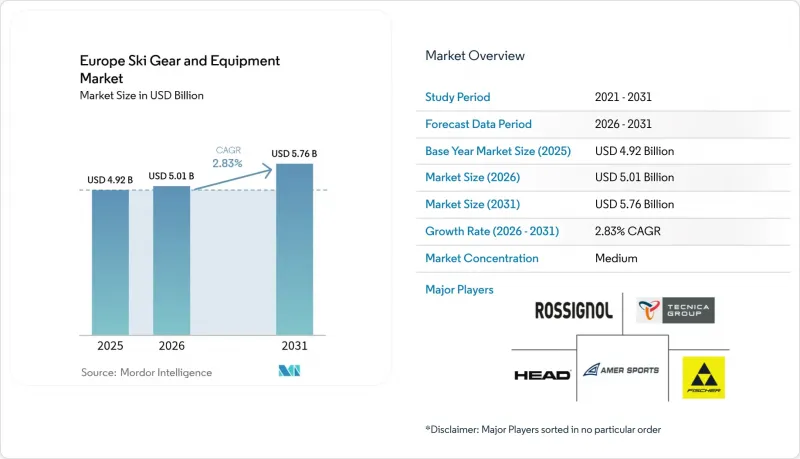
This report is Segmented by Product Type (Skis and Poles, Ski Boots, Ski Helmets, and More), End User (Male, and Female), Age Group (Under 25 Years, 25 To 40 Years, 40 To 55 Years, and Above 55 Years), Distribution Channel (Offline Retail Stores, and Online Retail Stores), and by Geography (United Kingdom, Germany, Italy, and More). The Market Forecasts are Provided in Terms of Value (USD).
Europe Ski Gear And Equipment Market Trends and Insights
Growing popularity of winter sports tourism
The growing popularity of winter sports tourism across Europe is a significant driver for the ski gear and equipment market. Factors such as rising disposable incomes, improved access to ski resorts, and appealing winter travel packages have contributed to increased participation in activities like skiing and snowboarding. According to the Sport England report, approximately 298,500 people in England participated in winter sports between November 2023 and November 2024, up from 290,500 in the previous period, indicating a steady increase in engagement . Similarly, major winter tourism destinations are experiencing robust growth in visitor activity. Statistics Austria reported that overnight stays in Austrian winter tourism accommodations reached 51.35 million from November 2024 to February 2025, a 1.5% rise compared to the previous year, highlighting sustained demand for winter travel experiences. These developments are encouraging consumers to invest in high-quality ski gear, apparel, and accessories, not only for improved performance and safety but also to enhance their overall winter sports experience. As a result, the growth in participation and tourism is driving the continued expansion of the European ski gear and equipment market.
Expansion of ski resorts and facilities
The expansion and modernization of ski resorts across Europe are key factors driving the growth of the ski gear and equipment market. Upgraded resorts and enhanced facilities improve the skiing experience, attracting more domestic and international tourists and encouraging greater participation in winter sports. As resorts invest in advanced infrastructure, visitors are more likely to purchase high-quality ski equipment, apparel, and accessories, thereby increasing market demand. For instance, in December 2025, Spain's Sierra Nevada ski resort allocated approximately EUR 19 million for upgrades during the winter season. These upgrades included new conveyor lifts in the Borreguiles beginner area, improved snowmaking systems, renovated on-mountain facilities, and additional snow groomers to enhance slope conditions. This investment reflects a broader trend among European ski destinations to modernize facilities, expand slope capacity, and improve visitor experiences, directly contributing to the growth of the ski gear and equipment market. Additionally, expanded resort facilities often include ski schools, rental shops, and specialized zones catering to both beginners and advanced skiers, driving demand for both entry-level and premium ski products. As resorts continue to improve accessibility and on-mountain services, the demand for high-performance, safety-oriented, and comfort-focused ski gear is expected to grow steadily across Europe.
Seasonal dependence of skiing activities
The ski gear and equipment market in Europe is significantly impacted by the seasonal nature of skiing activities, which restricts revenue generation primarily to the winter months. This seasonal concentration limits revenue to a 16-20 week period each year, creating inventory and cash-flow challenges, particularly for independent retailers. During the off-season, demand for skis, snowboards, boots, and accessories declines sharply, resulting in underutilized inventory, higher storage costs, and the need for markdowns to clear unsold stock. This seasonality also reduces revenue predictability and complicates cash-flow management, posing difficulties for smaller retailers and new market entrants in sustaining operations throughout the year. Manufacturers and distributors face similar challenges, as production and supply planning must align with short demand periods, often requiring rapid scaling or temporary workforce adjustments. Additionally, the seasonal dependency limits opportunities for continuous customer engagement and brand loyalty, as purchasing decisions are typically confined to a few peak months. While strategies such as off-season promotions, rental models, and diversification into complementary winter sports equipment can help mitigate some of these challenges, the inherent seasonality of skiing remains a structural constraint on consistent market growth in Europe.
Other drivers and restraints analyzed in the detailed report include:
- Rising participation in recreational skiing
- Expansion of ski gear rental models
- Intense competition from alternative winter sports
For complete list of drivers and restraints, kindly check the Table Of Contents.
Segment Analysis
Ski apparel accounted for 37.17% of market revenue in 2025, driven by its high replacement frequency and fashion-driven obsolescence cycles, which encourage repeat purchases every 2-3 seasons. The skis and poles segment, while essential, is facing commoditization pressures due to increasing rental penetration. Growth in this segment is further limited by extended replacement cycles, as recreational skiers now replace skis every 7-8 years compared to 5-6 years a decade ago. This shift is attributed to advancements in materials, such as carbon-reinforced cores and sintered bases, which enhance durability. Ski boots are benefiting from customization trends, with innovations like heat-moldable liners and 3D-printed shells improving fit.
Ski helmets are projected to grow at a CAGR of 3.38% through 2031, supported by mandatory helmet laws in Austria (introduced in 2016 for minors and extended to adults in 2024) and Italy (mandating helmet use for all ages by 2025). These regulations are driving the normalization of helmet use across various demographics. The "Others" category, which includes goggles, gloves, and accessories, is experiencing growth through the integration of smart technologies. For instance, goggles equipped with heads-up displays for speed and navigation sold 85,000 units across Europe in 2024-2025, with price points ranging from EUR 400-600 (USD 432-648).
In 2025, the male segment accounted for a dominant 59.09% share of the European ski gear and equipment market, reflecting historically higher participation rates among men. However, the female segment is projected to grow at a notable CAGR of 4.56% through 2031, driven by targeted product development, gender-specific designs, and focused marketing efforts. Ski brands are increasingly acknowledging the purchasing power and influence of female skiers, leading to innovations such as lightweight skis, ergonomically designed boots, stylish apparel, and performance-oriented accessories tailored specifically for women. Furthermore, social media, influencer campaigns, and women-focused ski events are enhancing engagement and fostering brand loyalty among female consumers.
The maturity of the male segment has prompted brands to focus on expanding wallet share rather than participant growth. Affluent male skiers are increasingly investing in premium touring equipment, including skis with integrated climbing skins and lightweight bindings, for backcountry skiing. In contrast, the female segment presents opportunities for both participant growth and wallet share expansion, as more women are entering skiing and snowboarding through beginner programs, ski schools, and recreational packages.
Complete Report Scope:
- By Product Type
- Skis and Poles
- Ski Boots
- Ski Helmets
- Ski Apparel
- Others
- By End-User
- Male
- Female
- By Age Group
- Under 25 Years
- 25 to 40 Years
- 40 to 55 Years
- Above 55 Years
- By Distribution Channel
- Offline Retail Stores
- Online Retail Stores
- By Geography
- Germany
- United Kingdom
- Italy
- France
- Spain
- Netherlands
- Switzerland
- Austria
- Sweden
- Rest of Europe
List of Companies Covered in this Report:
- Amer Sports, Inc.
- Skis Rossignol S.A.
- Fischer Sports GmbH
- Tecnica Group S.p.A.
- Clarus Corporation
- Marker Dalbello Volkl GmbH
- UVEX Group
- Head Sport GmbH
- Burton Europe
- Scott Sports SA
- K2 Sports
- Faction Skis SA
- Elan d.o.o.
- Stockli Swiss Sports AG
- Decathlon S.A.
- Blizzard Sports GmbH
- Nordica S.p.A.
- Black Crows SAS
- Oberalp Group (Dynafit)
- Salewa Group
Additional Benefits:
- The market estimate (ME) sheet in Excel format
- 3 months of analyst support
TABLE OF CONTENTS
1 INTRODUCTION
- 1.1 Study Assumptions and Market Definition
- 1.2 Scope of the Study
2 RESEARCH METHODOLOGY
3 EXECUTIVE SUMMARY
4 MARKET LANDSCAPE
- 4.1 Market Overview
- 4.2 Market Drivers
- 4.2.1 Growing popularity of winter sports tourism
- 4.2.2 Expansion of ski resorts and facilities
- 4.2.3 Rising participation in recreational skiing
- 4.2.4 Expansion of ski gear rental models
- 4.2.5 Focus on sustainability and eco-friendly products
- 4.2.6 Technological innovations in design and materials
- 4.3 Market Restraints
- 4.3.1 Seasonal dependence of skiing activities
- 4.3.2 Intense competition from alternative winter sports
- 4.3.3 High cost of ski gear and equipment
- 4.3.4 Dependency on tourism trends
- 4.4 Consumer Behaviour Analysis
- 4.5 Technological Outlook
- 4.6 Porter's Five Forces Analysis
- 4.6.1 Threat of New Entrants
- 4.6.2 Bargaining Power of Buyers
- 4.6.3 Bargaining Power of Suppliers
- 4.6.4 Threat of Substitutes
- 4.6.5 Intensity of Competitive Rivalry
5 MARKET SIZE AND GROWTH FORECASTS (VALUE)
- 5.1 By Product Type
- 5.1.1 Skis and Poles
- 5.1.2 Ski Boots
- 5.1.3 Ski Helmets
- 5.1.4 Ski Apparel
- 5.1.5 Others
- 5.2 By End-User
- 5.2.1 Male
- 5.2.2 Female
- 5.3 By Age Group
- 5.3.1 Under 25 Years
- 5.3.2 25 to 40 Years
- 5.3.3 40 to 55 Years
- 5.3.4 Above 55 Years
- 5.4 By Distribution Channel
- 5.4.1 Offline Retail Stores
- 5.4.2 Online Retail Stores
- 5.5 By Geography
- 5.5.1 Germany
- 5.5.2 United Kingdom
- 5.5.3 Italy
- 5.5.4 France
- 5.5.5 Spain
- 5.5.6 Netherlands
- 5.5.7 Switzerland
- 5.5.8 Austria
- 5.5.9 Sweden
- 5.5.10 Rest of Europe
6 COMPETITIVE LANDSCAPE
- 6.1 Market Concentration
- 6.2 Strategic Moves
- 6.3 Market Share Analysis
- 6.4 Company Profiles (includes Global level Overview, Market level overview, Core Segments, Financials as available, Strategic Information, Market Rank/Share for key companies, Products and Services, and Recent Developments)
- 6.4.1 Amer Sports, Inc.
- 6.4.2 Skis Rossignol S.A.
- 6.4.3 Fischer Sports GmbH
- 6.4.4 Tecnica Group S.p.A.
- 6.4.5 Clarus Corporation
- 6.4.6 Marker Dalbello Volkl GmbH
- 6.4.7 UVEX Group
- 6.4.8 Head Sport GmbH
- 6.4.9 Burton Europe
- 6.4.10 Scott Sports SA
- 6.4.11 K2 Sports
- 6.4.12 Faction Skis SA
- 6.4.13 Elan d.o.o.
- 6.4.14 Stockli Swiss Sports AG
- 6.4.15 Decathlon S.A.
- 6.4.16 Blizzard Sports GmbH
- 6.4.17 Nordica S.p.A.
- 6.4.18 Black Crows SAS
- 6.4.19 Oberalp Group (Dynafit)
- 6.4.20 Salewa Group
7 MARKET OPPORTUNITIES AND FUTURE OUTLOOK

