PUBLISHER: Mordor Intelligence | PRODUCT CODE: 2123310

PUBLISHER: Mordor Intelligence | PRODUCT CODE: 2123310
Valves And Actuators - Market Share Analysis, Industry Trends & Statistics, Growth Forecasts (2026 - 2031)
According to Mordor Intelligence, the valves and actuators market size stood at USD 75.9 billion in 2026 and is projected to reach USD 108.15 billion by 2031 at a 7.34% CAGR.
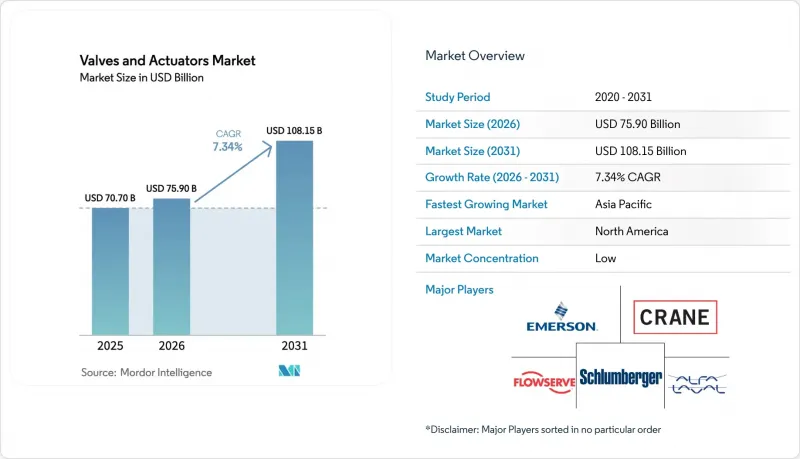
This report is Segmented by Valve Product Type (Ball, Butterfly, Gate/Globe/Check, and More), Actuator Type (Hydraulic, Pneumatic, Electric, and More), End-Use Industry (Oil and Gas, Power Generation, Chemical and Petrochemical, and More), Material (Stainless Steel, Carbon Steel, Alloy-Based, Cast Iron, and More), and Geography. The Market Forecasts are Provided in Terms of Value (USD).
Global Valves And Actuators Market Trends and Insights
Rapid Adoption of Industry 4.0-Enabled Smart Valves and Actuators
Operators are embedding edge processors and wireless sensors in valve assemblies to detect torque deviations and seal wear, converting reactive maintenance into condition-based programs that cut refinery downtime worth USD 500,000 per day. Emerson's Fisher FIELDVUE DVC7K digital controller captures vibration signatures, while similar positioners from Siemens and ABB communicate over HART and PROFIBUS to legacy DCS platforms. Energy-harvesting modules now power diagnostics without the need for batteries, thereby lowering ownership costs in remote pipeline corridors. Compliance with ISO 50001 is accelerating the adoption of smart pneumatics, as they can reduce air consumption by 15%-20%. The resulting productivity gains reinforce the positive 1.4% impact on the Valves and actuators market CAGR.
Expansion of Global Desalination Capacity
Middle Eastern utilities are contracting reverse-osmosis megaprojects to ease water scarcity, adding a combined 12 million m3-per-day capacity by 2028. Dubai's Hassyan plant, for example, specified motorized butterfly valves with IP68 protection against salt-spray corrosion. Similar projects in Egypt and Algeria mirror these specifications, reinforcing a steady pipeline for duplex-steel ball valves and nickel-aluminum-bronze alloys that support the Valves and actuators market.
Prolonged CAPEX Slowdown in Conventional Oil and Gas Refining
Integrated majors are diverting capital toward renewable fuels and carbon capture, reducing refinery projects by 12% year-on-year in 2025. Deferred fluid catalytic cracking upgrades eliminate near-term orders for high-temperature gate and globe valves, squeezing margins for suppliers tied to the hydrocarbon cycle. Vendors are pivoting to aftermarket services and digital retrofits, yet the chill subtracts 0.9% from the Valves and actuators market CAGR.
Other drivers and restraints analyzed in the detailed report include:
- LNG Infrastructure Build-Out
- Retrofit Demand From Fugitive-Emission Rules
- Supply-Chain Bottlenecks for Castings and Forgings
For complete list of drivers and restraints, kindly check the Table Of Contents.
Segment Analysis
Ball valves accounted for 28.73% of the Valves and actuators market in 2025, highlighting their quarter-turn simplicity and bubble-tight shutoff, which is essential for wellhead isolation. Pressure relief and safety valves are forecast to grow at a rate of 8.21% through 2031, as petrochemical complexes upgrade to API 520 designs following high-profile overpressure incidents.
The product spectrum is splintering into niche certifications such as API 607 fire-safe and BS 6364 cryogenic approvals, consolidating supplier bases around firms that can finance multiple test rigs. Control and butterfly valves are gaining ground in desalination and HVAC networks, while plug-valve adoption in slurry services spreads from Chilean tailings dams to Indonesian bauxite mines. These shifts preserve the momentum of the Valves and actuators market.
Pneumatic actuators led with 37.63% revenue share in 2025, favored for intrinsic safety in explosive zones and compatibility with existing air loops. Smart electric models, however, are accelerating at an 8.44% CAGR as asset-performance software tracks stroke counts and torque profiles in real time.
Electric units are displacing pneumatics in water utilities where energy audits spotlight compressed-air costs, while hydraulic designs remain entrenched in subsea trees until all-electric systems scale. ABB's MotorSense actuator, which harvests vibration energy to power onboard sensors, exemplifies cost-saving innovation. This bifurcation sustains healthy competition within the Valves and actuators market.
Complete Report Scope:
- By Valve Product Type
- Ball
- Butterfly
- Gate/Globe/Check
- Plug
- Control
- Pressure Relief / Safety
- Other Valve Product Types
- By Actuator Type
- Hydraulic
- Pneumatic
- Electric
- Electro-hydraulic
- Mechanical
- Smart / Intelligent
- Other Actuator Types
- By End-Use Industry
- Oil and Gas
- Power Generation
- Chemical and Petrochemical
- Water and Wastewater
- Mining and Metals
- Pharmaceuticals
- Food and Beverage
- Pulp and Paper
- HVAC and Building Services
- Marine and Shipbuilding
- Other End-Use Industries
- By Material
- Stainless Steel
- Carbon Steel
- Alloy-based (Duplex, Inconel, etc.)
- Cast Iron
- Plastic and Composite
- Cryogenic-service Materials
- Other Materials
- By Geography
- North America
- United States
- Canada
- Mexico
- South America
- Brazil
- Argentina
- Rest of South America
- Europe
- Germany
- United Kingdom
- France
- Italy
- Spain
- Rest of Europe
- Asia-Pacific
- China
- Japan
- India
- South Korea
- ASEAN
- Rest of Asia-Pacific
- Middle East and Africa
- Middle East
- Saudi Arabia
- United Arab Emirates
- Rest of Middle East
- Africa
- South Africa
- Nigeria
- Rest of Africa
- Middle East
- North America
Geography Analysis
North America retained leadership in 2025 with 38.73% of global revenue as shale play monetization and Gulf Coast LNG projects collectively required up to 500,000 valves. Installed-base services generate nearly half of regional turnover, cushioning suppliers from project lulls. Asia Pacific is forecast to register an 8.55% CAGR through 2031, propelled by China's coal-to-chemicals complexes and India's smart-city water grids, trends that will steadily lift the Valves and actuators market size in the region.
Europe's valve demand is driven more by replacement than expansion as the Industrial Emissions Directive compels chemical plants to retrofit low-emission stems every six months. Refineries, however, are shuttering or converting to biofuels, trimming orders for large-bore isolation valves. South America shows episodic spikes tied to Brazil's pre-salt fields and Argentina's Vaca Muerta pipelines, yet municipal water spending remains constrained by fiscal headwinds.
The Middle East and Africa rely heavily on desalination and petrochemical megaprojects. High-salinity feedwater cuts butterfly-valve life cycles to five-seven years, guaranteeing a steady aftermarket. Nigeria's Dangote refinery and Egypt's Zohr gas field have set precedents for large-scale procurement, though regional distributor networks are still maturing. These geographic dynamics collectively reinforce long-term growth prospects for the Valves and actuators market.
- Emerson Electric Co.
- Schlumberger Limited
- Alfa Laval AB
- Flowserve Corporation
- Crane Company
- Rotork plc
- Metso Corporation
- KITZ Corporation
- IMI plc
- Samson AG
- Honeywell International Inc.
- Danfoss A/S
- Burkert GmbH and Co. KG
- Neway Valve (Suzhou) Co., Ltd.
- CIRCOR International, Inc.
- KSB SE and Co. KGaA
- Velan Inc.
- Spirax-Sarco Engineering plc
- General Electric Company
- ABB Ltd
- Siemens AG
- Curtiss-Wright Corporation
- Pentair plc
- Yokogawa Electric Corporation
- AVK Holding A/S
Additional Benefits:
- The market estimate (ME) sheet in Excel format
- 3 months of analyst support
TABLE OF CONTENTS
1 INTRODUCTION
- 1.1 Study Assumptions and Market Definition
- 1.2 Scope of the Study
2 RESEARCH METHODOLOGY
3 EXECUTIVE SUMMARY
4 MARKET LANDSCAPE
- 4.1 Market Overview
- 4.2 Market Drivers
- 4.2.1 Rapid adoption of Industry 4.0-enabled smart valves and actuators
- 4.2.2 Expansion of global desalination capacity, especially in MENA
- 4.2.3 LNG infrastructure build-out in North America and APAC
- 4.2.4 Retrofit demand driven by fugitive-emission regulations
- 4.2.5 Shift to all-electric subsea production systems
- 4.2.6 Hydrogen-ready valve designs for green-H2 projects
- 4.3 Market Restraints
- 4.3.1 Prolonged CAPEX slowdown in conventional OandG refining
- 4.3.2 Supply-chain bottlenecks for castings and forgings
- 4.3.3 Skills gap in digital valve commissioning and maintenance
- 4.3.4 Cyber-hardening costs for connected flow-control assets
- 4.4 Industry Value Chain Analysis
- 4.5 Regulatory Landscape
- 4.6 Technological Outlook
- 4.7 Porter's Five Forces Analysis
- 4.7.1 Threat of New Entrants
- 4.7.2 Bargaining Power of Buyers
- 4.7.3 Bargaining Power of Suppliers
- 4.7.4 Threat of Substitutes
- 4.7.5 Intensity of Competitive Rivalry
5 MARKET SIZE AND GROWTH FORECASTS (VALUE)
- 5.1 By Valve Product Type
- 5.1.1 Ball
- 5.1.2 Butterfly
- 5.1.3 Gate/Globe/Check
- 5.1.4 Plug
- 5.1.5 Control
- 5.1.6 Pressure Relief / Safety
- 5.1.7 Other Valve Product Types
- 5.2 By Actuator Type
- 5.2.1 Hydraulic
- 5.2.2 Pneumatic
- 5.2.3 Electric
- 5.2.4 Electro-hydraulic
- 5.2.5 Mechanical
- 5.2.6 Smart / Intelligent
- 5.2.7 Other Actuator Types
- 5.3 By End-Use Industry
- 5.3.1 Oil and Gas
- 5.3.2 Power Generation
- 5.3.3 Chemical and Petrochemical
- 5.3.4 Water and Wastewater
- 5.3.5 Mining and Metals
- 5.3.6 Pharmaceuticals
- 5.3.7 Food and Beverage
- 5.3.8 Pulp and Paper
- 5.3.9 HVAC and Building Services
- 5.3.10 Marine and Shipbuilding
- 5.3.11 Other End-Use Industries
- 5.4 By Material
- 5.4.1 Stainless Steel
- 5.4.2 Carbon Steel
- 5.4.3 Alloy-based (Duplex, Inconel, etc.)
- 5.4.4 Cast Iron
- 5.4.5 Plastic and Composite
- 5.4.6 Cryogenic-service Materials
- 5.4.7 Other Materials
- 5.5 By Geography
- 5.5.1 North America
- 5.5.1.1 United States
- 5.5.1.2 Canada
- 5.5.1.3 Mexico
- 5.5.2 South America
- 5.5.2.1 Brazil
- 5.5.2.2 Argentina
- 5.5.2.3 Rest of South America
- 5.5.3 Europe
- 5.5.3.1 Germany
- 5.5.3.2 United Kingdom
- 5.5.3.3 France
- 5.5.3.4 Italy
- 5.5.3.5 Spain
- 5.5.3.6 Rest of Europe
- 5.5.4 Asia-Pacific
- 5.5.4.1 China
- 5.5.4.2 Japan
- 5.5.4.3 India
- 5.5.4.4 South Korea
- 5.5.4.5 ASEAN
- 5.5.4.6 Rest of Asia-Pacific
- 5.5.5 Middle East and Africa
- 5.5.5.1 Middle East
- 5.5.5.1.1 Saudi Arabia
- 5.5.5.1.2 United Arab Emirates
- 5.5.5.1.3 Rest of Middle East
- 5.5.5.2 Africa
- 5.5.5.2.1 South Africa
- 5.5.5.2.2 Nigeria
- 5.5.5.2.3 Rest of Africa
- 5.5.5.1 Middle East
- 5.5.1 North America
6 COMPETITIVE LANDSCAPE
- 6.1 Market Concentration
- 6.2 Strategic Moves
- 6.3 Market Share Analysis
- 6.4 Company Profiles (includes Global-level Overview, Market-level Overview, Core Segments, Financials as available, Strategic Information, Market Rank/Share, Products and Services, Recent Developments)
- 6.4.1 Emerson Electric Co.
- 6.4.2 Schlumberger Limited
- 6.4.3 Alfa Laval AB
- 6.4.4 Flowserve Corporation
- 6.4.5 Crane Company
- 6.4.6 Rotork plc
- 6.4.7 Metso Corporation
- 6.4.8 KITZ Corporation
- 6.4.9 IMI plc
- 6.4.10 Samson AG
- 6.4.11 Honeywell International Inc.
- 6.4.12 Danfoss A/S
- 6.4.13 Burkert GmbH and Co. KG
- 6.4.14 Neway Valve (Suzhou) Co., Ltd.
- 6.4.15 CIRCOR International, Inc.
- 6.4.16 KSB SE and Co. KGaA
- 6.4.17 Velan Inc.
- 6.4.18 Spirax-Sarco Engineering plc
- 6.4.19 General Electric Company
- 6.4.20 ABB Ltd
- 6.4.21 Siemens AG
- 6.4.22 Curtiss-Wright Corporation
- 6.4.23 Pentair plc
- 6.4.24 Yokogawa Electric Corporation
- 6.4.25 AVK Holding A/S
7 MARKET OPPORTUNITIES AND FUTURE OUTLOOK
- 7.1 White-space and Unmet-Need Assessment

