PUBLISHER: Mordor Intelligence | PRODUCT CODE: 2123322

PUBLISHER: Mordor Intelligence | PRODUCT CODE: 2123322
Integrated Marine Automation System - Market Share Analysis, Industry Trends & Statistics, Growth Forecasts (2026 - 2031)
According to Mordor Intelligence, the integrated marine automation system market size stands at USD 8.06 billion in 2026 and is projected to reach USD 11.89 billion by 2031, advancing at an 8.08% CAGR through the period.
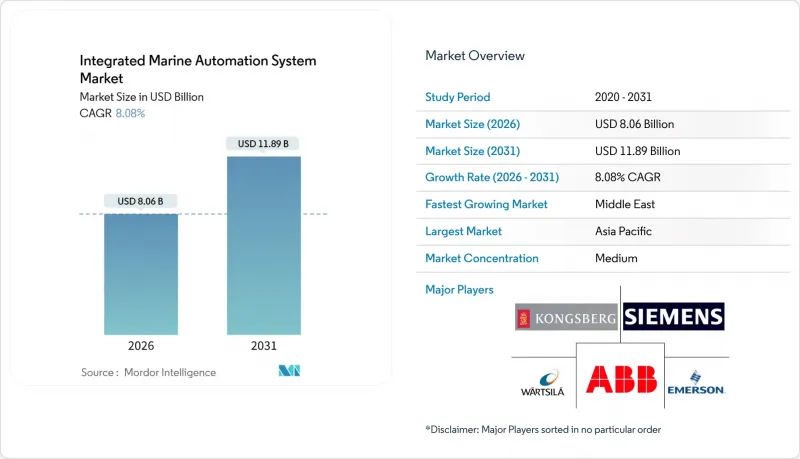
This report is Segmented by Product Type (Hardware, and Software), Solution (Vessel-Management Systems, Power-Management Systems, and More), Installation Type (New-Build, and Retrofit/Upgrade), End User (Commercial, and Defense), and Geography (North America, South America, Europe, Asia Pacific, Middle East, Africa). The Market Forecasts are Provided in Terms of Value (USD).
Global Integrated Marine Automation System Market Trends and Insights
IMO Energy-Efficiency Regulations Driving Digital Automation
Mandatory carbon-intensity targets force owners to install automated emissions monitoring, fuel-flow sensors, and class-approved reporting software, creating an immediate procurement wave for integrated hardware and analytics. Fleet-level pooling under FuelEU Maritime multiplies demand for optimization tools that calculate voyage-by-voyage balances and distribute credits across owners. Early adopters in Europe connect shore-power interfaces to ship-to-shore power-management software, lifting auxiliary-engine savings and reducing port emissions.
Crew Cost Optimization Amid Seafarer Shortage
A widening officer shortfall drives automation that cuts routine watchkeeping and diagnostic tasks. Platforms such as Kongsberg Vessel Insight stream standardised data to shore, letting technical managers monitor fleets remotely and redeploy specialists only when sensors flag anomalies. Predictive algorithms prevent unplanned downtime, enabling leaner manning scales without sacrificing reliability.
Vulnerability to Cyber-Attacks Through Digitalisation
Maritime operational-technology networks combine legacy control systems with new IP-based devices, creating attack vectors that can disable propulsion and navigation. The IMO now mandates cyber-risk management in safety systems, yet smaller operators lag on patching and incident response. Type-approved security retrofits often exceed USD 500,000 per vessel, deterring budget-constrained owners.
Other drivers and restraints analyzed in the detailed report include:
- Remote-Operated and Autonomous Vessels for Offshore-Wind Maintenance
- Growing Demand for Edge-Based Cyber-Resilient Automation Modules
- High Upfront Cost and Integration Complexity
For complete list of drivers and restraints, kindly check the Table Of Contents.
Segment Analysis
Hardware retained 65.36% of 2025 revenue thanks to the installed base of sensors, control modules, and bridge electronics. The integrated marine automation system market size for hardware benefits from mandated emissions and fuel-flow monitoring but posts modest growth as many newbuilds arrive sensor-ready. Conversely, software revenue is projected to climb at 9.87% CAGR, driven by analytics, digital twins, and predictive-maintenance apps that monetize the expanding data stream. The hardware-to-software transition lets vendors capture recurring fees, locking in clients for lifecycle support.
Software's rapid rise hinges on physics-informed AI that predicts component wear. For example, Synthetica's platform flagged abnormal lubricator behavior on four bulkers in 2025, averting USD 80,000 repairs per hull. As owners pivot to condition-based maintenance, the integrated marine automation system market capitalizes on cloud infrastructures that scale analytics across fleets.
Integrated bridge and engine-room platforms captured 45.12% 2025 share, underscoring demand for single-pane-of-glass control. These systems embed navigation, propulsion, cargo handling, and auxiliary functions, reducing crew workload and enabling remote operations. Power-management modules balance generators, batteries, and shore-power interfaces, essential for hybrid vessels and port-side zero-emission mandates.
Analytics and predictive-maintenance software is the fastest-growing solution, forecast at an 11.27% CAGR. Danelec Performance, installed on 14,000 vessels, streams voyage-data-recorder feeds to cloud AI that pinpoints hull fouling, engine inefficiencies, and propeller wear, unlocking 3-8% fuel savings. The integrated marine automation system market share for analytics increases as class societies endorse data-driven maintenance contracts.
Complete Report Scope:
- By Product Type
- Hardware
- Sensors and Field Devices
- Control Modules
- Navigation and Communication Systems
- Other Hardware
- Software
- Integrated Platform-Management Software
- Safety and Security Software
- Analytics and Predictive-Maintenance Software
- Other Software
- Hardware
- By Solution
- Vessel-Management Systems
- Power-Management Systems
- Safety and Security Systems
- Other Solutions
- By Installation Type
- New-Build
- Retrofit / Upgrade
- By End User
- Commercial
- Defense
- By Geography
- North America
- United States
- Canada
- Mexico
- South America
- Brazil
- Argentina
- Rest of South America
- Europe
- United Kingdom
- Germany
- France
- Italy
- Spain
- Russia
- Rest of Europe
- Asia Pacific
- China
- India
- Japan
- South Korea
- Australia
- Southeast Asia
- Rest of Asia Pacific
- Middle East
- United Arab Emirates
- Saudi Arabia
- Turkey
- Rest of Middle East
- Africa
- South Africa
- Nigeria
- Egypt
- Rest of Africa
- North America
Geography Analysis
Asia Pacific captured 35.13% revenue in 2025 on the back of South Korean and Japanese shipyard strength and government-led autonomy roadmaps. Seoul waived a feasibility study in 2025 to accelerate Level 4 autonomous-ship R&D, while Tokyo funds AI robotics in shipbuilding to counter skilled-labor gaps. Chinese yards scale low-carbon vessel production, embedding integrated automation as standard. Regional policies target manufacturing productivity gains above 40% by 2030, further anchoring the integrated marine automation system market.
The Middle East is projected to record the fastest 12.89% CAGR through 2031, fueled by naval modernization and offshore-energy activity. A 2025 United Arab Emirates contract worth AED 1.3 billion (USD 350 million) covering new patrol vessels includes predictive-maintenance and inventory-management packages, demonstrating preference for turnkey automation. Saudi Arabia's King Salman complex accelerates regional shipbuilding, while SAMI Sea pursues unmanned platforms requiring cyber-resilient control systems.
North America and Europe prioritize retrofits to meet emissions policy milestones. Cross-border partnerships, such as HD Hyundai's 2025 deal with Siemens to apply digital twins in United States yards, address domestic capacity gaps and spread advanced automation know-how. EU ports enforce shore-power mandates, boosting ship-to-shore automation, and ETS compliance software gains traction across Atlantic trader fleets.
- Kongsberg Gruppen
- ABB Group
- Wartsila
- Siemens AG
- Emerson Electric Co.
- Rolls-Royce Power Systems (MTU)
- Rockwell Automation Inc.
- Honeywell Marine
- Danelec Marine
- Schneider Electric
- Navis (Cargotec)
- Praxis Automation Technology
- Marine Technologies LLC
- Ulstein Group
- Avikus
- SMEC Automation
- Logimatic
- Sedni Marine Systems
- Hyundai Heavy Industries (Avikus)
- Damen Shipyards Group
Additional Benefits:
- The market estimate (ME) sheet in Excel format
- 3 months of analyst support
TABLE OF CONTENTS
1 INTRODUCTION
- 1.1 Study Assumptions and Market Definition
- 1.2 Scope of the Study
2 RESEARCH METHODOLOGY
3 EXECUTIVE SUMMARY
4 MARKET LANDSCAPE
- 4.1 Market Overview
- 4.2 Market Drivers
- 4.2.1 High Growth in Maritime Tourism Industry
- 4.2.2 Volumetric Growth in Seaborne Trade
- 4.2.3 IMO Energy-Efficiency Regulations Driving Digital Automation
- 4.2.4 Crew Cost Optimisation Amid Seafarer Shortage
- 4.2.5 Remote-Operated and Autonomous Vessels for Offshore-Wind Maintenance
- 4.2.6 Growing Demand for Edge-Based Cyber-Resilient Automation Modules
- 4.3 Market Restraints
- 4.3.1 Vulnerability to Cyber-Attacks Through Digitalisation
- 4.3.2 High Upfront Cost and Integration Complexity
- 4.3.3 Interoperability Gaps Among Proprietary Systems
- 4.3.4 Limited Satellite Bandwidth on Remote Routes
- 4.4 Industry Value Chain Analysis
- 4.5 Regulatory Landscape
- 4.6 Technological Outlook
- 4.7 Porter's Five Forces Analysis
- 4.7.1 Threat of New Entrants
- 4.7.2 Bargaining Power of Buyers
- 4.7.3 Bargaining Power of Suppliers
- 4.7.4 Threat of Substitutes
- 4.7.5 Intensity of Competitive Rivalry
- 4.8 Impact of Macroeconomic Factors on the Market
5 MARKET SIZE AND GROWTH FORECASTS (VALUE)
- 5.1 By Product Type
- 5.1.1 Hardware
- 5.1.1.1 Sensors and Field Devices
- 5.1.1.2 Control Modules
- 5.1.1.3 Navigation and Communication Systems
- 5.1.1.4 Other Hardware
- 5.1.2 Software
- 5.1.2.1 Integrated Platform-Management Software
- 5.1.2.2 Safety and Security Software
- 5.1.2.3 Analytics and Predictive-Maintenance Software
- 5.1.2.4 Other Software
- 5.1.1 Hardware
- 5.2 By Solution
- 5.2.1 Vessel-Management Systems
- 5.2.2 Power-Management Systems
- 5.2.3 Safety and Security Systems
- 5.2.4 Other Solutions
- 5.3 By Installation Type
- 5.3.1 New-Build
- 5.3.2 Retrofit / Upgrade
- 5.4 By End User
- 5.4.1 Commercial
- 5.4.2 Defense
- 5.5 By Geography
- 5.5.1 North America
- 5.5.1.1 United States
- 5.5.1.2 Canada
- 5.5.1.3 Mexico
- 5.5.2 South America
- 5.5.2.1 Brazil
- 5.5.2.2 Argentina
- 5.5.2.3 Rest of South America
- 5.5.3 Europe
- 5.5.3.1 United Kingdom
- 5.5.3.2 Germany
- 5.5.3.3 France
- 5.5.3.4 Italy
- 5.5.3.5 Spain
- 5.5.3.6 Russia
- 5.5.3.7 Rest of Europe
- 5.5.4 Asia Pacific
- 5.5.4.1 China
- 5.5.4.2 India
- 5.5.4.3 Japan
- 5.5.4.4 South Korea
- 5.5.4.5 Australia
- 5.5.4.6 Southeast Asia
- 5.5.4.7 Rest of Asia Pacific
- 5.5.5 Middle East
- 5.5.5.1 United Arab Emirates
- 5.5.5.2 Saudi Arabia
- 5.5.5.3 Turkey
- 5.5.5.4 Rest of Middle East
- 5.5.6 Africa
- 5.5.6.1 South Africa
- 5.5.6.2 Nigeria
- 5.5.6.3 Egypt
- 5.5.6.4 Rest of Africa
- 5.5.1 North America
6 COMPETITIVE LANDSCAPE
- 6.1 Market Concentration
- 6.2 Strategic Moves
- 6.3 Market Share Analysis
- 6.4 Company Profiles (includes Global Level Overview, Market Level Overview, Core Segments, Financials as Available, Strategic Information, Market Rank/Share for Key Companies, Products and Services, and Recent Developments)
- 6.4.1 Kongsberg Gruppen
- 6.4.2 ABB Group
- 6.4.3 Wartsila
- 6.4.4 Siemens AG
- 6.4.5 Emerson Electric Co.
- 6.4.6 Rolls-Royce Power Systems (MTU)
- 6.4.7 Rockwell Automation Inc.
- 6.4.8 Honeywell Marine
- 6.4.9 Danelec Marine
- 6.4.10 Schneider Electric
- 6.4.11 Navis (Cargotec)
- 6.4.12 Praxis Automation Technology
- 6.4.13 Marine Technologies LLC
- 6.4.14 Ulstein Group
- 6.4.15 Avikus
- 6.4.16 SMEC Automation
- 6.4.17 Logimatic
- 6.4.18 Sedni Marine Systems
- 6.4.19 Hyundai Heavy Industries (Avikus)
- 6.4.20 Damen Shipyards Group
7 MARKET OPPORTUNITIES AND FUTURE OUTLOOK
- 7.1 White-Space and Unmet-Need Assessment

