PUBLISHER: Mordor Intelligence | PRODUCT CODE: 2123351

PUBLISHER: Mordor Intelligence | PRODUCT CODE: 2123351
Non-Invasive Prenatal Testing - Market Share Analysis, Industry Trends & Statistics, Growth Forecasts (2026 - 2031)
According to Mordor Intelligence, the non-invasive prenatal testing market size is projected to expand from USD 3.9 billion in 2025 and USD 4.43 billion in 2026 to USD 8.36 billion by 2031, registering a 13.53% CAGR over 2026-2031.
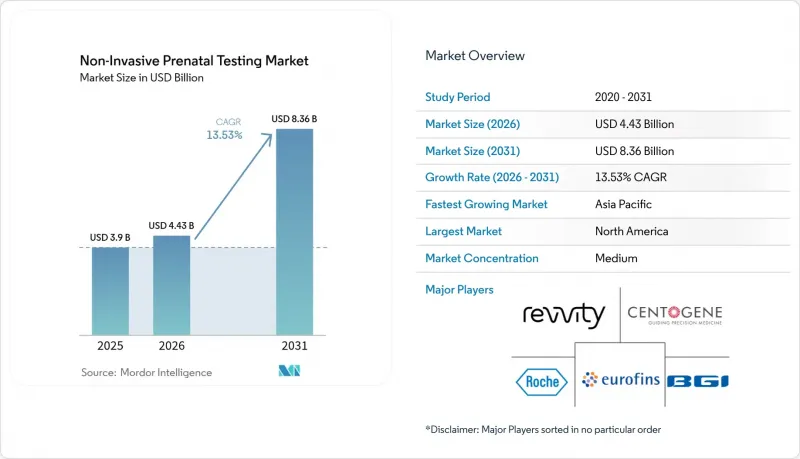
This report is Segmented by Technology (Next-Generation Sequencing, and More), Test Type (Aneuploidy Screening, and More), Gestation Window (10-12 Weeks, and More), Sample Type (Maternal Plasma CfDNA, and More), Component (Instruments, and More), End User (Hospitals, and More), Distribution Channel, Application, and Geography. The Market Forecasts are Provided in Terms of Value (USD).
Global Non-Invasive Prenatal Testing Market Trends and Insights
Rising Global Maternal Age Elevating Aneuploidy Risk
Women are delaying childbirth for economic and career reasons, pushing the median maternal age higher in every OECD country. In the United States, the mean age at first birth reached 27.8 years in 2024. Age-linked trisomy incidence drives obstetricians to recommend cfDNA screening universally, especially where public programs subsidize testing for women >= 35 years. National registries in Denmark, Japan, and South Korea record parallel shifts, converting high-risk screening into population-level demand. As older mothers often pursue prenatal care earlier and more frequently, laboratories can capture samples sooner, lifting overall test volumes. This demographic trend feeds long-term growth for the non-invasive prenatal testing market by expanding both the eligible base and the clinical urgency for accurate, low-risk diagnostics.
Shift from Invasive Karyotyping to cfDNA Screening
Professional societies now endorse cfDNA as first-line screening, eliminating legacy risk-stratification hurdles. ACOG's 2024 bulletin recommends cfDNA for all pregnancies, while ACMG's 2025 statement highlights > 99% detection for trisomy 21 versus 85% for biochemical methods. Payers have followed suit; UnitedHealthcare, Centene, and Medica stopped requiring high-risk justification in 2024-2025, transforming care pathways. Amniocentesis, though still definitive, carries a 0.1-0.3% loss risk that many patients now avoid, further propelling cfDNA volumes. As laboratories retire serum screening platforms, sequencing capacity is redeployed to support expanded panels, reinforcing the migration away from invasive diagnostics and boosting the non-invasive prenatal testing market.
Persisting Ethical Debate on Secondary Findings & Sex Selection
Incidental maternal findings-such as malignancy signals in cfDNA-raise disclosure dilemmas that require extra counseling time and consent forms. In India, audits uncovered clinics reporting fetal sex in violation of the PCPNDT Act, prompting license suspensions. China similarly bans non-medical sex reporting. The European Society of Human Genetics now urges explicit pre-test consent for secondary findings. Added administrative overhead can deter providers and delay testing, moderating growth in the non-invasive prenatal testing market.
Other drivers and restraints analyzed in the detailed report include:
- Sequencing Cost Curve Less Than USD 200/Sample Enabling Mass Adoption
- Payer Coverage Expansion to Average-Risk Pregnancies
- Bioinformatics Talent Shortage in Emerging Markets
For complete list of drivers and restraints, kindly check the Table Of Contents.
Segment Analysis
The non-invasive prenatal testing market size for technology reached USD 3.9 billion in 2025, with next-generation sequencing accounting for 70.55%. RCA platforms, however, are accelerating at an 18.25% CAGR on simpler, benchtop hardware that slashes capital costs. Clinical Chemistry reported 98.7% concordance between RCA and NGS for trisomy 21 detection, cutting library prep time to 90 minutes. NGS remains entrenched thanks to FDA grandfathering and CE-IVD validation pathways, but small hospitals favor RCA kits that match daily throughput needs.
NGS players continue to enhance throughput; Illumina's NextSeq 2000 multiple-flow-cell architecture allows labs to batch low-volume runs flexibly, while Thermo Fisher's Genexus integrates sample-to-report automation. Even so, isothermal vendors appeal to decentralized networks in Latin America and Southeast Asia where power stability and HVAC constraints limit traditional sequencers. Patent disputes between Illumina and Natera over SNP methodologies inject uncertainty, prompting some providers to trial open-filed RCA alternatives. Overall, technology diversification broadens supplier competition and underpins sustained growth for the non-invasive prenatal testing market.
In 2025, aneuploidy panels held 85.53% of the non-invasive prenatal testing market share. Whole-genome cfDNA screening, meanwhile, is growing at 19.75% CAGR as clinicians seek copy-number variant (CNV) insights beyond common trisomies. The Lancet study of 90,000 pregnancies identified clinically significant CNVs in 1.7% of cases missed by standard panels. Despite payer hesitancy, private patients opt for broader coverage, especially in China where domestic kits bundle genome-wide analysis at sub-USD 450 price points.
Microdeletion screening faces reimbursement roadblocks in the United States but gains traction in Germany and Israel for high-risk cohorts. Rh-D genotyping remains a niche, stabilizing revenues in Rhesus-negative populations. Monogenic disorder cfDNA panels are emerging; Natera's 21-gene Fetal Focus launch in 2026 illustrates a pivot toward single-gene detection without extra blood draws. As validation datasets expand, broader panels could shift payer perspectives, accelerating revenue diversification inside the non-invasive prenatal testing market.
The non-invasive prenatal testing market size tied to the 13-24-week capturing 50.15%. Algorithms that refine fetal-fraction estimates now support reliable calls as early as 10 weeks, propelling the 10-12-week cohort at a 14.82% CAGR. Obstetrics & Gynecology data show patients tested before 13 weeks are 40% likelier to act on abnormal results within legal termination timelines.
Earlier draws appeal to telehealth prenatal programs, permitting same-day phlebotomy at primary-care clinics. However, strict ultrasound dating requirements in Japan and parts of Europe slow first-trimester uptake. Laboratories mitigate redraw risk through predictive models that flag low expected fetal fraction, scheduling later collections when necessary. Wider first-trimester adoption accelerates turnover and elevates total addressable volume across the non-invasive prenatal testing market.
Complete Report Scope:
- By Technology
- Next-Generation Sequencing (NGS)
- Rolling-Circle Amplification
- Microarray
- Real-Time PCR
- Other Technologies
- By Test Type
- Aneuploidy Screening
- Microdeletion / Microduplication Screening
- Whole-Genome cfDNA Screening
- Rh-D Genotyping
- Monogenic Disease Testing
- By Gestation Window
- 10 - 12 Weeks
- 13 - 24 Weeks
- > 24 Weeks
- By Sample Type
- Maternal Plasma cfDNA
- Circulating Trophoblastic Cells
- By Component
- Instruments
- Kits & Reagents
- Services
- By End User
- Hospitals & Birthing Centers
- Diagnostic Laboratories
- IVF & Fertility Clinics
- Research Institutes
- By Distribution Channel
- Physician-Referral
- Direct-to-Consumer (DTC)
- By Application
- Down Syndrome (Trisomy 21)
- Edwards Syndrome (Trisomy 18)
- Patau Syndrome (Trisomy 13)
- Turner Syndrome
- Other Chromosomal Abnormalities
- By Geography
- North America
- United States
- Canada
- Mexico
- Europe
- Germany
- United Kingdom
- France
- Italy
- Spain
- Rest of Europe
- Asia-Pacific
- China
- India
- Japan
- Australia
- South Korea
- Rest of Asia-Pacific
- Middle East and Africa
- GCC
- South Africa
- Rest of Middle East and Africa
- South America
- Brazil
- Argentina
- Rest of South America
- North America
Geography Analysis
North America led the non-invasive prenatal testing market in 2025 with a 45.23% share, supported by guideline-driven universal screening and payers that removed risk prerequisites. Average negotiated test prices remain high at USD 800-1,200, sustaining healthy margins for U.S. labs. Canada's funding varies provincially; Ontario covers women >= 40 years, while British Columbia relies on private pay, capping national penetration at 35%. Mexico's private hospitals offer USD 600-800 tests, but public institutions still default to biochemical screening.
Asia-Pacific is the fastest-growing region at 16.42% CAGR. China's NMPA approvals for BGI and Berry Genomics platforms lifted national test volumes 40% year-over-year. Domestic sequencing economics enable USD 150-300 pricing, expanding access beyond top-tier cities. Japan's certified facility network increased to 142 in 2025, though cautious counseling slows mass adoption. India's urban middle class drives volumes at INR 18,000 (USD 215) per test, yet rural cold-chain gaps limit nationwide reach.
Europe shows mid-single-digit growth influenced by IVDR compliance costs. Germany funds only high-risk cases but covers microdeletions for select patients. The U.K.'s NHS restricts NIPT to women flagged high-risk by first-trimester screens, a targeted policy that still cut amniocentesis 60%. Middle East adoption is led by the UAE, where expatriate populations demand premium prenatal care; Dubai labs report 25% annual growth. Latin America is nascent beyond Brazil, where Dasa launched USD 500 NIPT in 2024.
- Agilent Technologies
- Berry Genomics
- BGI Genomics Co. Ltd
- Centogene
- Eurofins
- F. Hoffmann-La Roche Ltd (Ariosa)
- Fulgent Genetics Inc.
- Genetron Health
- Illumina
- Invitae
- Laboratory Corp of America Holdings (Labcorp)
- MedGenome Labs
- Myriad Women's Health Inc.
- Natera
- QIAGEN
- Ravgen Inc.
- Revvity, Inc.
- Thermo Fisher Scientific
Additional Benefits:
- The market estimate (ME) sheet in Excel format
- 3 months of analyst support
TABLE OF CONTENTS
1 Introduction
- 1.1 Study Assumptions & Market Definition
- 1.2 Scope of the Study
2 Research Methodology
3 Executive Summary
4 Market Landscape
- 4.1 Market Overview
- 4.2 Market Drivers
- 4.2.1 Rising global maternal age elevating aneuploidy risk
- 4.2.2 Shift from invasive karyotyping to cfDNA screening
- 4.2.3 Sequencing cost curve Less Than USD 200/sample enabling mass adoption
- 4.2.4 Payer coverage expansion to average-risk pregnancies
- 4.2.5 AI-assisted fetal fraction calling improving first-trimester accuracy
- 4.2.6 Bundled reproductive-genetic panels (carrier + NIPT) gaining traction
- 4.3 Market Restraints
- 4.3.1 Persisting ethical debate on secondary findings & sex selection
- 4.3.2 Bioinformatics talent shortage in emerging markets
- 4.3.3 Discordant results in multifetal / IVF pregnancies dampen clinician confidence
- 4.3.4 Reimbursement push-back on microdeletion add-ons
- 4.4 Supply-Chain Analysis
- 4.5 Regulatory Landscape
- 4.6 Technological Outlook
- 4.7 Porter's Five Forces
- 4.7.1 Threat of New Entrants
- 4.7.2 Bargaining Power of Buyers
- 4.7.3 Bargaining Power of Suppliers
- 4.7.4 Threat of Substitutes
- 4.7.5 Competitive Rivalry
5 Market Size & Growth Forecasts (Value, USD)
- 5.1 By Technology
- 5.1.1 Next-Generation Sequencing (NGS)
- 5.1.2 Rolling-Circle Amplification
- 5.1.3 Microarray
- 5.1.4 Real-Time PCR
- 5.1.5 Other Technologies
- 5.2 By Test Type
- 5.2.1 Aneuploidy Screening
- 5.2.2 Microdeletion / Microduplication Screening
- 5.2.3 Whole-Genome cfDNA Screening
- 5.2.4 Rh-D Genotyping
- 5.2.5 Monogenic Disease Testing
- 5.3 By Gestation Window
- 5.3.1 10 - 12 Weeks
- 5.3.2 13 - 24 Weeks
- 5.3.3 > 24 Weeks
- 5.4 By Sample Type
- 5.4.1 Maternal Plasma cfDNA
- 5.4.2 Circulating Trophoblastic Cells
- 5.5 By Component
- 5.5.1 Instruments
- 5.5.2 Kits & Reagents
- 5.5.3 Services
- 5.6 By End User
- 5.6.1 Hospitals & Birthing Centers
- 5.6.2 Diagnostic Laboratories
- 5.6.3 IVF & Fertility Clinics
- 5.6.4 Research Institutes
- 5.7 By Distribution Channel
- 5.7.1 Physician-Referral
- 5.7.2 Direct-to-Consumer (DTC)
- 5.8 By Application
- 5.8.1 Down Syndrome (Trisomy 21)
- 5.8.2 Edwards Syndrome (Trisomy 18)
- 5.8.3 Patau Syndrome (Trisomy 13)
- 5.8.4 Turner Syndrome
- 5.8.5 Other Chromosomal Abnormalities
- 5.9 By Geography
- 5.9.1 North America
- 5.9.1.1 United States
- 5.9.1.2 Canada
- 5.9.1.3 Mexico
- 5.9.2 Europe
- 5.9.2.1 Germany
- 5.9.2.2 United Kingdom
- 5.9.2.3 France
- 5.9.2.4 Italy
- 5.9.2.5 Spain
- 5.9.2.6 Rest of Europe
- 5.9.3 Asia-Pacific
- 5.9.3.1 China
- 5.9.3.2 India
- 5.9.3.3 Japan
- 5.9.3.4 Australia
- 5.9.3.5 South Korea
- 5.9.3.6 Rest of Asia-Pacific
- 5.9.4 Middle East and Africa
- 5.9.4.1 GCC
- 5.9.4.2 South Africa
- 5.9.4.3 Rest of Middle East and Africa
- 5.9.5 South America
- 5.9.5.1 Brazil
- 5.9.5.2 Argentina
- 5.9.5.3 Rest of South America
- 5.9.1 North America
6 Competitive Landscape
- 6.1 Market Concentration
- 6.2 Market Share Analysis
- 6.3 Company Profiles (includes Global-level Overview, Market-level Overview, Core Segments, Financials as available, Strategic Information, Market Rank/Share for key companies, Products & Services, and Recent Developments)
- 6.3.1 Agilent Technologies Inc.
- 6.3.2 Berry Genomics
- 6.3.3 BGI Genomics Co. Ltd
- 6.3.4 Centogene N.V.
- 6.3.5 Eurofins Scientific SE
- 6.3.6 F. Hoffmann-La Roche Ltd (Ariosa)
- 6.3.7 Fulgent Genetics Inc.
- 6.3.8 Genetron Health
- 6.3.9 Illumina Inc.
- 6.3.10 Invitae Corporation
- 6.3.11 Laboratory Corp of America Holdings (Labcorp)
- 6.3.12 MedGenome Labs Ltd
- 6.3.13 Myriad Women's Health Inc.
- 6.3.14 Natera Inc.
- 6.3.15 Qiagen N.V.
- 6.3.16 Ravgen Inc.
- 6.3.17 Revvity, Inc.
- 6.3.18 Thermo Fisher Scientific Inc.
7 Market Opportunities & Future Outlook
- 7.1 White-Space & Unmet-Need Assessment

