PUBLISHER: Mordor Intelligence | PRODUCT CODE: 2123353

PUBLISHER: Mordor Intelligence | PRODUCT CODE: 2123353
Von Willebrand Disease Treatment - Market Share Analysis, Industry Trends & Statistics, Growth Forecasts (2026 - 2031)
According to Mordor Intelligence, the von willebrand disease treatment market size was valued at USD 2.40 billion in 2025 and estimated to grow from USD 2.55 billion in 2026 to reach USD 3.44 billion by 2031, at a CAGR of 6.15% during the forecast period (2026-2031).
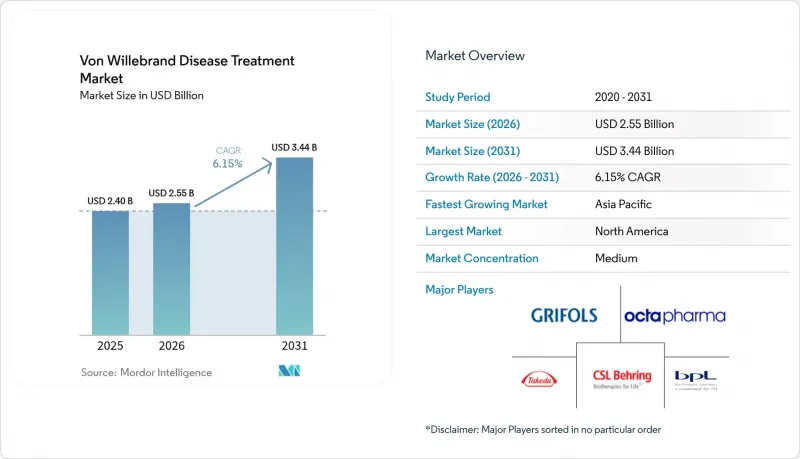
This report is Segmented by Disease Type (Type 1, Type 2, Type 3, and Acquired VWD), Treatment Type (Desmopressin, VWF/FVIII Combination Concentrates, Recombinant VWF-Only Concentrates, and More), Route of Administration (Oral, Intravenous, and More), and Geography (North America, Europe, Asia-Pacific, and More). The Market Forecasts are Provided in Terms of Value (USD).
Global Von Willebrand Disease Treatment Market Trends and Insights
Growing Patient-Assistance & Charitable-Access Schemes
Federal funding for 141 Hemophilia Treatment Centers lets providers dispense discounted factor products under the 340B program, reducing out-of-pocket costs and improving adherence. State action, such as California's All Copays Count law, further lowers financial hurdles, while CMS has steadily raised the clotting-factor furnishing fee, ensuring predictable reimbursement. These measures make therapies accessible to underserved patients, sustaining demand across the Von Willebrand disease treatment market. Replication of this multi-stakeholder model in Europe and emerging economies is expected to widen global reach. Charitable foundations also finance prophylaxis for uninsured adults, boosting treatment volume.
Rising Diagnosis From Wider Prophylactic Genetic Screening
Countries adding dried-blood-spot biomarker panels to newborn screening achieve 95% detection accuracy for bleeding disorders that routine tests miss. Asia-Pacific health ministries are scaling similar programs, doubling the recognized VWD population in pilot provinces. Sweden's inclusion of NT-proBNP and IL-1 RL1 biomarkers illustrates how early detection shifts identification to infancy, prompting timely intervention and enlarging the Von Willebrand disease treatment market. Together with ATHN's natural-history registry, real-world outcome data now drives payer coverage for proactive treatments. The diagnostic surge builds a stable pipeline of patients requiring lifelong or curative therapies.
Persistent Under-Diagnosis In Low-Income Geographies
Many developing countries identify fewer than 10% of expected cases, curbing demand growth for therapies. Limited laboratory capacity, scarce coagulation reagents, and low clinician awareness mean VWD symptoms are often misattributed to gynecological or infectious conditions. Investment priorities favor communicable diseases, delaying introduction of specialist diagnostics. International donor partnerships remain small-scale, so coverage gaps are unlikely to close quickly, weighing on the global Von Willebrand disease treatment market.
Other drivers and restraints analyzed in the detailed report include:
- Increasing Hospital Adoption Of Recombinant VWF-Only Concentrates
- FDA Fast-Track For Sub-Cutaneous DDAVP Nano-Formulations
- High Lifetime Therapy Cost Despite Biosimilar Entries
For complete list of drivers and restraints, kindly check the Table Of Contents.
Segment Analysis
Type 1 VWD generated 71.78% of global revenue in 2025, anchoring the Von Willebrand disease treatment market size for that year. Prevalent mild phenotypes rely on affordable desmopressin, sustaining predictable volumes. Acquired VWD, while smaller today, delivers the fastest expansion at 10.78% CAGR through 2031 as oncologists and cardiologists test patients pre-procedure. Type 2 sub-variants together add clinical complexity because they require concentrate prophylaxis; Type 2A cases especially benefit from recombinant VWF-only products that restore high-molecular-weight multimers, reducing annual bleed rate.
The severe but rare Type 3 cohort incurs disproportionate costs due to intensive factor infusions and orthopedic surgeries, highlighting reimbursement challenges in emerging economies. Long-term center experience shows persistent under-diagnosis across all types, prompting calls for registry expansion and payer support for genetic testing. Growing awareness of drug-induced VWD in aging populations further enlarges the Von Willebrand disease treatment market.
Complete Report Scope:
- By Disease Type
- Type 1
- Type 2 (2A, 2B, 2M, 2N)
- Type 3
- Acquired VWD
- By Treatment Type
- Desmopressin (DDAVP)
- VWF/FVIII Combination Concentrates
- Recombinant VWF-only Concentrates
- Antifibrinolytics (e.g., Tranexamic Acid)
- Topical & Adjunctive Agents
- By Route of Administration
- Intravenous
- Intranasal
- Oral
- Sub-cutaneous
- Geography
- North America
- United States
- Canada
- Mexico
- Europe
- Germany
- United Kingdom
- France
- Italy
- Spain
- Rest of Europe
- Asia-Pacific
- China
- Japan
- India
- South Korea
- Australia
- Rest of Asia-Pacific
- Middle East and Africa
- GCC
- South Africa
- Rest of Middle East and Africa
- South America
- Brazil
- Argentina
- Rest of South America
- North America
Geography Analysis
North America contributed 38.36% of 2025 revenue, underpinned by 340B discounts and comprehensive treatment-center networks that guarantee product access. Gene therapy reimbursement frameworks emerge first in the United States, enabling earlier adoption and supporting premium pricing. Canada trails slightly due to provincial formulary reviews but benefits from centralized plasma procurement.
Europe exhibits high recombinant uptake as national payers demand virus-safe concentrates, yet stringent health-technology assessments delay some novel therapies. Western European markets negotiate risk-sharing deals for gene therapy, tying payment to sustained factor independence, which shapes purchasing dynamics in the Von Willebrand disease treatment market. Eastern Europe faces tighter budgets and slower diagnostic rollout, creating a two-tier landscape within the region.
Asia-Pacific leads growth with a 10.12% CAGR through 2031 because regulators are streamlining review pathways and governments are investing in local manufacturing. China, India, and South-Korea expand newborn-screening panels and subsidize concentrate imports, driving double-digit volume gains. South America, notably Brazil, leverages centralized purchasing and clinical-protocol standardization to broaden access despite economic constraints. In contrast, Middle East and Africa progress is hampered by diagnostic and cold-chain deficits, although recombinant price declines could unlock latent demand later in the forecast.
- CSL Behring
- Takeda (Shire)
- Octapharma
- Grifols
- Sanofi
- Pfizer
- Ferring Pharmaceuticals
- Bio Products Laboratory
- Bayer
- Novo Nordisk
- Kedrion Biopharma
- LFB Group
- ADMA Biologics
- CSL Vifor
- Aptevo Therapeutics
- Kamada Ltd
- Biotest
Additional Benefits:
- The market estimate (ME) sheet in Excel format
- 3 months of analyst support
TABLE OF CONTENTS
1 Introduction
- 1.1 Study Assumptions & Market Definition
- 1.2 Scope of the Study
2 Research Methodology
3 Executive Summary
4 Market Landscape
- 4.1 Market Overview
- 4.2 Market Drivers
- 4.2.1 Growing Patient Assistance & Charitable?Access Schemes
- 4.2.2 Rising Diagnosis From Wider Prophylactic Genetic Screening
- 4.2.3 Increasing Hospital Adoption Of Recombinant VWF-Only Concentrates
- 4.2.4 FDA Fast-Track For Sub-Cutaneous DDAVP Nano-Formulations
- 4.2.5 Surge In Pay-For-Performance Hemophilia Centers Bundling VWD Care
- 4.2.6 AI-Enabled Bleeding-Risk Decision Engines Integrated In EHRs
- 4.3 Market Restraints
- 4.3.1 Persistent Under-Diagnosis In Low-Income Geographies
- 4.3.2 High Lifetime Therapy Cost Despite Biosimilar Entries
- 4.3.3 Limited Cold-Chain Capacity For Plasma-Derived Products In Africa
- 4.3.4 Regulatory Uncertainty Around Gene-Editing Trials For VWD
- 4.4 Porter's Five Forces
- 4.4.1 Bargaining Power of Suppliers
- 4.4.2 Bargaining Power of Buyers
- 4.4.3 Threat of New Entrants
- 4.4.4 Threat of Substitutes
- 4.4.5 Intensity of Competitive Rivalry
5 Market Size & Growth Forecasts (Value, USD)
- 5.1 By Disease Type
- 5.1.1 Type 1
- 5.1.2 Type 2 (2A, 2B, 2M, 2N)
- 5.1.3 Type 3
- 5.1.4 Acquired VWD
- 5.2 By Treatment Type
- 5.2.1 Desmopressin (DDAVP)
- 5.2.2 VWF/FVIII Combination Concentrates
- 5.2.3 Recombinant VWF-only Concentrates
- 5.2.4 Antifibrinolytics (e.g., Tranexamic Acid)
- 5.2.5 Topical & Adjunctive Agents
- 5.3 By Route of Administration
- 5.3.1 Intravenous
- 5.3.2 Intranasal
- 5.3.3 Oral
- 5.3.4 Sub-cutaneous
- 5.4 Geography
- 5.4.1 North America
- 5.4.1.1 United States
- 5.4.1.2 Canada
- 5.4.1.3 Mexico
- 5.4.2 Europe
- 5.4.2.1 Germany
- 5.4.2.2 United Kingdom
- 5.4.2.3 France
- 5.4.2.4 Italy
- 5.4.2.5 Spain
- 5.4.2.6 Rest of Europe
- 5.4.3 Asia-Pacific
- 5.4.3.1 China
- 5.4.3.2 Japan
- 5.4.3.3 India
- 5.4.3.4 South Korea
- 5.4.3.5 Australia
- 5.4.3.6 Rest of Asia-Pacific
- 5.4.4 Middle East and Africa
- 5.4.4.1 GCC
- 5.4.4.2 South Africa
- 5.4.4.3 Rest of Middle East and Africa
- 5.4.5 South America
- 5.4.5.1 Brazil
- 5.4.5.2 Argentina
- 5.4.5.3 Rest of South America
- 5.4.1 North America
6 Competitive Landscape
- 6.1 Market Concentration
- 6.2 Market Share Analysis
- 6.3 Company Profiles (includes Global level Overview, Market level overview, Core Segments, Financials as available, Strategic Information, Market Rank/Share for key companies, Products & Services, and Recent Developments)
- 6.3.1 CSL Behring
- 6.3.2 Takeda (Shire)
- 6.3.3 Octapharma AG
- 6.3.4 Grifols SA
- 6.3.5 Sanofi SA
- 6.3.6 Pfizer Inc.
- 6.3.7 Ferring Pharmaceuticals
- 6.3.8 Bio Products Laboratory
- 6.3.9 Bayer AG
- 6.3.10 Novo Nordisk A/S
- 6.3.11 Kedrion Biopharma
- 6.3.12 LFB Group
- 6.3.13 ADMA Biologics
- 6.3.14 CSL Vifor
- 6.3.15 Aptevo Therapeutics
- 6.3.16 Kamada Ltd
- 6.3.17 Biotest AG
7 Market Opportunities & Future Outlook
- 7.1 White-space & Unmet-need Assessment

