PUBLISHER: Mordor Intelligence | PRODUCT CODE: 2123368

PUBLISHER: Mordor Intelligence | PRODUCT CODE: 2123368
United States Freestanding Emergency Department - Market Share Analysis, Industry Trends & Statistics, Growth Forecasts (2026 - 2031)
According to Mordor Intelligence, the United States freestanding emergency department market size was valued at USD 15.08 billion in 2025 and is estimated to grow from USD 15.87 billion in 2026 to reach USD 20.47 billion by 2031, at a CAGR of 5.23% during the forecast period (2026-2031).
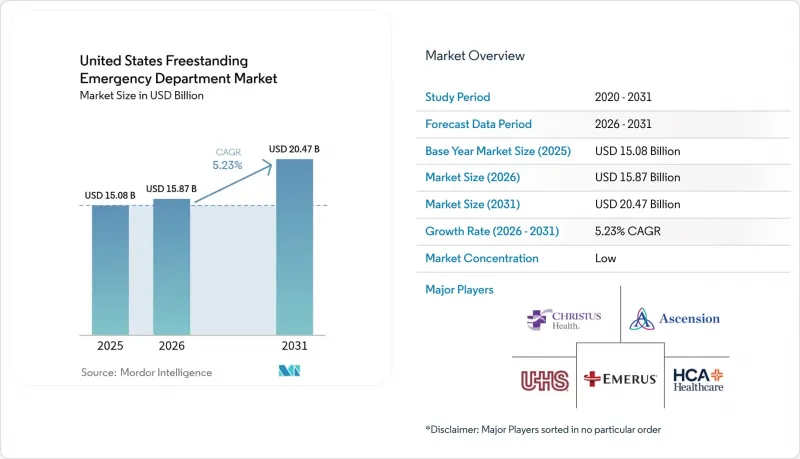
This report is Segmented by Ownership Type (Off-Campus Emergency Departments, Independent Freestanding Emergency Departments), Service (Emergency Care & Other Services, Imaging Services, Laboratory Services), Facility Size (Micro, Small, Medium, Large), and Geography (Northeast, Midwest, South, West). Market Forecasts are Provided in Terms of Value (USD).
United States Freestanding Emergency Department Market Trends and Insights
Consumer-Driven Health Plans and Federal Grant Programmes
Federal grant programs lower capital barriers and address workforce shortages by tying loan repayments to medically underserved areas. The FY 2025 budget doubles community health center financing, positioning freestanding emergency departments as referral anchors that can absorb emergency demand for 37 million Americans. In 2026, federal support plays a pivotal role, highlighted by a USD 204 million grant allocated to New Hampshire under the Rural Health Transformation Program. This funding is part of a broader USD 50 billion national initiative spanning 2026 to 2030 aimed at enhancing access to emergency and urgent care in underserved counties. Additional funding is directed toward telehealth infrastructure and advanced practice provider training, ensuring 24/7 coverage in areas with limited on-site emergency physicians. Utilization trends indicate a divide by income: higher earners prioritize time savings despite higher facility fees, while lower-income individuals often delay visits until conditions worsen. Independent operators are strategically expanding into suburban areas, offering services that align with these utilization patterns.
Rising Demand for Convenience-Care Access
Patient surveys show that door-to-provider times under 15 minutes strongly influence facility choice; freestanding emergency departments routinely meet this threshold, whereas hospital EDs average 45 minutes or more. Health-system acquisitions of urgent-care chains illustrate strategic alignment around convenience: HCA Healthcare acquired 41 Texas centers in 2025 to create feeder networks for nearby freestanding EDs. Facilities situated along commuter routes capture after-work traffic and divert non-life-threatening cases from congested hospital campuses. Hybrid facilities that combine urgent-care and emergency licensure allow on-site physicians to direct nearly 70% of visits to lower-acuity billing, improving patient affordability while preserving emergency capabilities.
High Total Cost Per Visit Vs Urgent-Care Alternatives
Freestanding emergency departments typically charge facility fees of USD 1,500 to USD 3,000 per visit across acuity levels, compared to USD 100 to USD 200 in urgent care for many low-complexity conditions, raising consumer cost concerns and reputational risk. Commercial payers are responding with prior authorization, network design, and differential cost-sharing to steer avoidable visits to lower-cost sites, thereby narrowing the pool of commercially insured patients willing to absorb higher out-of-pocket costs. High-deductible plan designs amplify this friction because members pay the full facility fee until they reach deductibles, which drives negative reviews when patients later learn their visit was processed as out-of-network. Urgent care chains are countering convenience by expanding late hours, adding on-site diagnostics, and publishing clear prices to compete head-to-head for minor illnesses and injuries.
Other drivers and restraints analyzed in the detailed report include:
- Expansion of Hospital Outpatient Strategies
- Rapid Uptake of AI-Enabled Triage and Ambient Documentation
- CMS Reimbursement and Billing-Policy Volatility
For complete list of drivers and restraints, kindly check the Table Of Contents.
Segment Analysis
Off-campus emergency departments held a 58.02% share of the United States freestanding emergency department market in 2025, leveraging integrated electronic health records, favorable Medicare Part B billing, and hospital referral streams. Independent centers, though smaller in aggregate footprint, are projected to outpace at a 5.87% CAGR through 2031 as entrepreneurial groups exploit regulatory gaps in counties underserved by hospitals.
Hospital systems continue to treat off-campus units as strategic beachheads that deter competitors. HCA Florida's USD 70 million plan to open three new sites across Pasco, Hernando, and Citrus Counties exemplifies an asset-light expansion play that places branded emergency access within 10 miles of growing subdivisions. Independent operators counter by specializing in pediatric trauma or geriatric-friendly environments, differentiating on shorter triage queues and concierge-style amenities.
Complete Report Scope:
- By Ownership Type
- Off-Campus Emergency Departments (Hospital-affiliated)
- Independent Freestanding Emergency Departments
- By Service
- Emergency Care & Other Services
- Imaging Services
- Laboratory Services
- By Facility Size (Bed Count)
- Micro (<10 beds)
- Small (10-19 beds)
- Medium (20-29 beds)
- Large (>30 beds)
- By U.S. Census Region
- Northeast
- Midwest
- South
- West
List of Companies Covered in this Report:
- Adeptus Health LLC
- AdventHealth
- Ardent Health Services
- Ascension Health
- Baylor Scott & White Health
- CHRISTUS Health
- CommonSpirit Health
- Community Health Systems, Inc. (CHS)
- Emerus Hospital Partners, LLC
- Envision Healthcare
- HCA Healthcare, Inc.
- Intuitive Health
- LifePoint Health, Inc.
- Northwell Health Inc.
- SignatureCare Emergency Center
- Sutter Health
- Team Health Holdings, Inc.
- Tenet Healthcare
- Universal Health Services
- US Acute Care Solutions
Additional Benefits:
- The market estimate (ME) sheet in Excel format
- 3 months of analyst support
TABLE OF CONTENTS
1 Introduction
- 1.1 Study Assumptions & Market Definition
- 1.2 Scope of the Study
2 Research Methodology
3 Executive Summary
4 Market Landscape
- 4.1 Market Overview
- 4.2 Market Drivers
- 4.2.1 Consumer-Driven Health Plans & Federal Grant Programmes
- 4.2.2 Rising Demand for Convenience-Care Access
- 4.2.3 Expansion of Hospital Outpatient Strategies
- 4.2.4 Rapid Uptake of AI-Enabled Triage and Ambient Documentation
- 4.2.5 Hybrid ED/Urgent-Care Co-Licensing Models
- 4.2.6 State-Level Regulatory Easing (CON Exemptions)
- 4.3 Market Restraints
- 4.3.1 High Total Cost Per Visit Vs Urgent-Care Alternatives
- 4.3.2 CMS Reimbursement & Billing-Policy Volatility
- 4.3.3 Price-Transparency Pressure on Facility Fees
- 4.3.4 Staffing Shortages & Wage Inflation
- 4.4 Value Chain Analysis
- 4.5 Regulatory Landscape
- 4.6 Technological Outlook
- 4.7 Porter's Five Forces Analysis
- 4.7.1 Threat of New Entrants
- 4.7.2 Bargaining Power of Buyers
- 4.7.3 Bargaining Power of Suppliers
- 4.7.4 Threat of Substitutes
- 4.7.5 Intensity of Competitive Rivalry
5 Market Size & Growth Forecasts (Value, USD)
- 5.1 By Ownership Type
- 5.1.1 Off-Campus Emergency Departments (Hospital-affiliated)
- 5.1.2 Independent Freestanding Emergency Departments
- 5.2 By Service
- 5.2.1 Emergency Care & Other Services
- 5.2.2 Imaging Services
- 5.2.3 Laboratory Services
- 5.3 By Facility Size (Bed Count)
- 5.3.1 Micro (<10 beds)
- 5.3.2 Small (10-19 beds)
- 5.3.3 Medium (20-29 beds)
- 5.3.4 Large (>30 beds)
- 5.4 By U.S. Census Region
- 5.4.1 Northeast
- 5.4.2 Midwest
- 5.4.3 South
- 5.4.4 West
6 Competitive Landscape
- 6.1 Market Concentration
- 6.2 Market Share Analysis
- 6.3 Company Profiles (includes Global level Overview, Market-level Overview, Core Segments, Financials, Strategic Information, Market Rank/Share, Products & Services, Recent Developments)
- 6.3.1 Adeptus Health LLC
- 6.3.2 AdventHealth
- 6.3.3 Ardent Health Services
- 6.3.4 Ascension Health
- 6.3.5 Baylor Scott & White Health
- 6.3.6 CHRISTUS Health
- 6.3.7 CommonSpirit Health
- 6.3.8 Community Health Systems, Inc. (CHS)
- 6.3.9 Emerus Hospital Partners, LLC
- 6.3.10 Envision Healthcare Corporation
- 6.3.11 HCA Healthcare, Inc.
- 6.3.12 Intuitive Health
- 6.3.13 LifePoint Health, Inc.
- 6.3.14 Northwell Health Inc.
- 6.3.15 SignatureCare Emergency Center
- 6.3.16 Sutter Health
- 6.3.17 Team Health Holdings, Inc.
- 6.3.18 Tenet Healthcare Corporation
- 6.3.19 Universal Health Services, Inc.
- 6.3.20 US Acute Care Solutions
7 Market Opportunities & Future Outlook
- 7.1 White-space & Unmet-Need Assessment

