PUBLISHER: Mordor Intelligence | PRODUCT CODE: 2123399

PUBLISHER: Mordor Intelligence | PRODUCT CODE: 2123399
Digital Printing - Market Share Analysis, Industry Trends & Statistics, Growth Forecasts (2026 - 2031)
According to Mordor Intelligence, the digital printing market size is expected to increase from USD 34.33 billion in 2025 to USD 36.95 billion in 2026 and reach USD 53.32 billion by 2031, growing at a CAGR of 7.61% over 2026-2031.
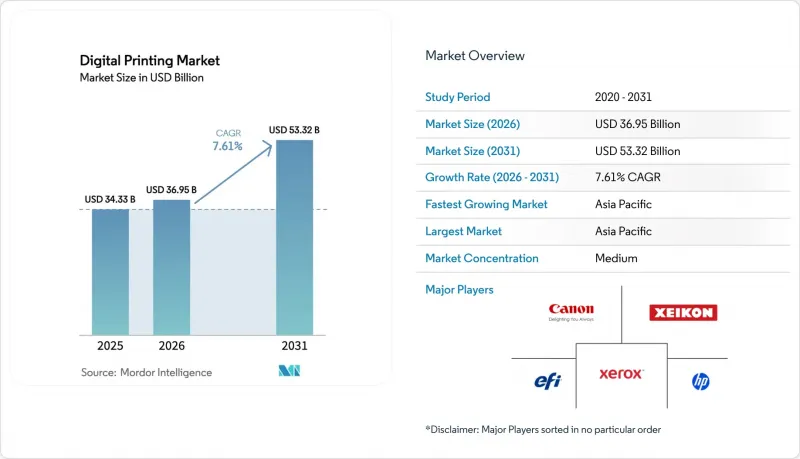
This report is Segmented by Printing Process (Electrophotography Toner, and Inkjet), Ink Type (Water-Based Pigment, Solvent, and More), Substrate (Paper and Paperboard, Plastics and Films, Textiles/Fabrics, and More), Application (Books and Publishing, Commercial Printing, Packaging, Textile Printing, and More), and Geography. The Market Forecasts are Provided in Terms of Value (USD).
Global Digital Printing Market Trends and Insights
Booming Short-Run Customized Packaging Demand
Global parcel volumes keep rising as direct-to-consumer retail embeds itself in everyday shopping, driving converters toward press setups that economically handle sub-1,000-unit packaging jobs. Canon's varioPrint iX-series reduces changeover time to three minutes, allowing mid-size folding-carton plants to run up to 20 artwork versions during a single shift. High-mix production helps beauty and nutraceutical brands test seasonal SKUs without carrying dead inventory. The United States Postal Service logged a 23% spike in parcel volume during the 2025 holiday peak, reinforcing that quick-turn packaging is no passing trend. As SKU rotations accelerate, converters that marry fast makeready with variable-data workflows are seeing double-digit share gains among e-commerce-first brands. Analog offset, with its plate costs and 90-minute washups, cannot compete below 5,000 units, opening lasting headroom for the digital printing market.
Declining Per-Unit Print Cost and Faster Turnaround
Press vendors have trimmed click charges and raised productivity enough to match offset economics for 2,000-10,000-sheet orders. HP's Indigo 200K outputs 4,600 B2 sheets per hour at under USD 0.02 per A4 page, thanks to longer-life Samba printheads that exceed two billion drops before replacement. Label converters in India cut order-to-ship cycles to 36 hours after installing EFI Jetrion UV units, enabling real-time artwork changes required by pharmaceutical serialization. These performance jumps allow regional printers to win work once monopolized by multinational plants, boosting competition yet widening the overall digital printing market.
High Capex and R&D Outlays for High-End Presses
Single-pass inkjet systems for corrugated lines range from USD 2.5 million to USD 4 million, a capital wall that regional plants cannot scale without private-equity backing. EFI's Nozomi C18000 demands another USD 500,000 of site upgrades, from reinforced floors to humidity controls, before the first print fires. Lease deals soften the blow, yet USD 35,000-50,000 monthly notes remain untenable for plants with revenue under USD 20 million. The financing gap is pushing Tier-1 converters further ahead, consolidating high-margin brand contracts and restraining smaller shops from entering the digital printing market.
Other drivers and restraints analyzed in the detailed report include:
- Rapid AI-Enabled Workflow Automation for Micro-Batch Orders
- Expansion of Digital-Textile Micro-Factories in European Union and United States
- Stricter PFAS/Solvent-Ink Regulations Causing Re-Qualification Delays
For complete list of drivers and restraints, kindly check the Table Of Contents.
Segment Analysis
Inkjet secured 58.83% revenue in 2025 and is forecast at an 8.44% CAGR through 2031 as single-pass architectures deliver 150 meters-per-minute speeds on 40-GSM tissue and 600-micron board alike. The digital printing market size attributed to inkjet installations topped USD 21 billion in 2026. HP Indigo 200K and Canon ProStream placements in China and the United States prove that aqueous pigment lines now equal offset gloss on coated stock while switching jobs in minutes. Electrophotography still shines in monochrome transactional print; Xerox Iridesse adds metallic toner for premium invitations, sustaining its niche. Yet toner platforms rely on heated fusers that burn 40% more power than LED-UV curing, a cost penalty in Europe where energy prices remain volatile. ISO is updating standard 12647-2 to formalize single-pass tolerances, easing brand audits and accelerating inkjet adoption.
Electrophotography's growth will trail at roughly 6.2% as sustainability standards disfavor silicone-oil contamination in recycled fiber streams. Ricoh's oil-free C9500 doubles maintenance intervals to 1 million impressions, but substrate limits persist. Konica Minolta's AccurioPress C14000 competes on click rate, yet brand owners increasingly pick presses that carry Forest Stewardship Council and Cradle to Cradle seals, awards more easily earned by water-based systems. Therefore, inkjet's versatility and regulatory alignment continue to expand its share inside the digital printing market.
UV-curable formulations accounted for 31.74% of 2025 revenue and will grow at an 8.14% pace, boosted by LED arrays that fire at 385-395 nanometers and start instantly. Fujifilm Jet Press 750S High Speed demonstrated 60% lower electricity draw than mercury predecessors during 2025 tests, giving European printers a direct route to carbon-reduction targets. Water-based pigments dominate corrugated and textile applications, offering zero volatile organic compounds and straightforward wastewater treatment. Latex inks straddle indoor-air compliance and outdoor durability; HP Latex 2700 extends applied-graphics durability to a five-year outdoor life without lamination. Dye-sublimation lines such as Mimaki Tiger-1800B MkII reached 180 square meters per hour, allowing sportswear factories to compete with rotary screen at runs above 500 units.
Solvent inks now cluster in vehicle wraps and outdoor banners where adhesion to vinyl overrides environmental rules. The European Union Ecodesign for Sustainable Products Regulation, effective 2027, will obligate recyclability labeling on textiles, nudging buyers toward water-based pigments. Collectively, these shifts expand the ink type diversity in the digital printing market, but LED-UV remains the star for its energy and compliance profile.
Complete Report Scope:
- By Printing Process
- Electrophotography (Toner)
- Inkjet
- By Ink Type
- Water-based Pigment
- Solvent
- UV-Curable
- Latex
- Dye-Sublimation
- By Substrate
- Paper and Paperboard
- Plastics and Films
- Textiles / Fabrics
- Glass and Ceramics
- Metals
- By Application
- Books and Publishing
- Commercial Printing
- Packaging
- Labels
- Corrugated Packaging
- Cartons
- Flexible Packaging
- Rigid Plastic Packaging
- Metal Packaging
- Textile Printing
- Photographic and Merchandise
- Signage and Large-Format Graphics
- By Geography
- North America
- United States
- Canada
- Mexico
- South America
- Brazil
- Argentina
- Rest of South America
- Europe
- Germany
- United Kingdom
- France
- Italy
- Spain
- Rest of Europe
- Asia-Pacific
- China
- Japan
- India
- South Korea
- ASEAN
- Rest of Asia-Pacific
- Middle East and Africa
- Middle East
- Saudi Arabia
- United Arab Emirates
- Rest of Middle East
- Africa
- South Africa
- Nigeria
- Rest of Africa
- Middle East
- North America
Geography Analysis
Asia Pacific generated 38.73% of 2025 revenue and is on track for an 8.32% CAGR, anchored by more than 200 single-pass corrugated lines installed in China during 2024-2025 to serve cross-border shipments. The China National Packaging Corporation pegged digital penetration in corrugated at 12% in 2025, double 2023 levels. India's label sector is digitizing quickly to satisfy Food Safety and Standards Authority QR-code rules. Vietnam and Bangladesh attract garment micro-factories as brands diversify away from China, such as Kornit opened a Ho Chi Minh training hub in early 2025. North America captured roughly 28% of revenue, propelled by flexible packaging that serves nutraceutical and cannabis products requiring ever-changing compliance copy. Canada leverages digital for province-specific cannabis warnings, while Mexico's nearshoring boom demands just-in-time cartons for electronics assembly.
Europe emphasizes sustainability and circular-economy compliance under the EU Green Deal. The Digital Product Passport for textiles and packaging necessitates item-level encoding, a function naturally embedded within high-resolution inkjet lines. Germany's mechanical engineering base integrates print modules into robotized finishing cells, while France's luxury sector insists on exacting spot-color reproduction and tactile varnish effects. The United Kingdom exploits creative industries' demand for bespoke limited-run prints, encouraging SMEs to buy compact B2 inkjet units. Collectively, these regional dynamics reinforce the digital printing market as a cornerstone of next-generation manufacturing worldwide.
Europe held about a notable share of sales, with Germany and the United Kingdom leading installations of high-end inkjet presses. Single-Use Plastics restrictions channel investments into printed paper trays and molded fiber, favoring water-based inks. Luxury labels in France and Italy prize digital textile and label lines for limited runs. Spain and Portugal have become hubs for on-demand garment printing that meet next-day shipping into Western Europe. South America, Middle East, and Africa together form a sub-10% revenue block, yet Brazil shows double-digit label growth, and the United Arab Emirates equips exhibition printers with wide-format LED-UV units. South Africa tests direct-to-garment units under its retail master plan, indicating that the digital printing market's reach is progressively global.
- HP Inc.
- Canon Inc.
- Xerox Holdings Corporation
- Ricoh Company, Ltd.
- Electronics For Imaging, Inc.
- Konica Minolta, Inc.
- Xeikon NV
- WestRock Company
- Mondi plc
- DS Smith plc
- Amcor plc
- Multi-Color Corporation
- Avery Dennison Corporation
- Quad/Graphics, Inc.
- Durst Phototechnik AG
- Landa Digital Printing
- Domino Printing Sciences plc
- Screen Holdings Co., Ltd.
- Fujifilm Holdings Corporation
- Heidelberger Druckmaschinen AG
- Agfa-Gevaert NV
- Mimaki Engineering Co., Ltd.
- Seiko Epson Corporation
- Kornit Digital Ltd.
- OKI Data Corporation
- R.R. Donnelley and Sons Company
Additional Benefits:
- The market estimate (ME) sheet in Excel format
- 3 months of analyst support
TABLE OF CONTENTS
1 INTRODUCTION
- 1.1 Study Assumptions and Market Definition
- 1.2 Scope of the Study
2 RESEARCH METHODOLOGY
3 EXECUTIVE SUMMARY
4 MARKET LANDSCAPE
- 4.1 Market Overview
- 4.2 Market Drivers
- 4.2.1 Booming short-run customised packaging demand
- 4.2.2 Declining per-unit print cost and faster turnaround
- 4.2.3 Rapid AI-enabled workflow automation for micro-batch orders
- 4.2.4 Expansion of digital-textile micro-factories in EU and US
- 4.2.5 Rising demand for sustainable inks and recyclable substrates
- 4.2.6 E-commerce-led surge in on-demand packaging and label printing
- 4.3 Market Restraints
- 4.3.1 High CAPEX and RandD outlays for high-end presses
- 4.3.2 Stricter PFAS/solvent-ink regulations causing re-qualification delays
- 4.3.3 Persistent colour-management complexity across substrates
- 4.3.4 Semiconductor supply bottlenecks for industrial inkjet heads
- 4.4 Industry Value Chain Analysis
- 4.5 Regulatory Landscape
- 4.6 Technological Outlook
- 4.7 Porter's Five Forces Analysis
- 4.7.1 Bargaining Power of Suppliers
- 4.7.2 Bargaining Power of Buyers
- 4.7.3 Threat of New Entrants
- 4.7.4 Threat of Substitutes
- 4.7.5 Intensity of Competitive Rivalry
5 MARKET SIZE AND GROWTH FORECASTS (VALUE)
- 5.1 By Printing Process
- 5.1.1 Electrophotography (Toner)
- 5.1.2 Inkjet
- 5.2 By Ink Type
- 5.2.1 Water-based Pigment
- 5.2.2 Solvent
- 5.2.3 UV-Curable
- 5.2.4 Latex
- 5.2.5 Dye-Sublimation
- 5.3 By Substrate
- 5.3.1 Paper and Paperboard
- 5.3.2 Plastics and Films
- 5.3.3 Textiles / Fabrics
- 5.3.4 Glass and Ceramics
- 5.3.5 Metals
- 5.4 By Application
- 5.4.1 Books and Publishing
- 5.4.2 Commercial Printing
- 5.4.3 Packaging
- 5.4.3.1 Labels
- 5.4.3.2 Corrugated Packaging
- 5.4.3.3 Cartons
- 5.4.3.4 Flexible Packaging
- 5.4.3.5 Rigid Plastic Packaging
- 5.4.3.6 Metal Packaging
- 5.4.4 Textile Printing
- 5.4.5 Photographic and Merchandise
- 5.4.6 Signage and Large-Format Graphics
- 5.5 By Geography
- 5.5.1 North America
- 5.5.1.1 United States
- 5.5.1.2 Canada
- 5.5.1.3 Mexico
- 5.5.2 South America
- 5.5.2.1 Brazil
- 5.5.2.2 Argentina
- 5.5.2.3 Rest of South America
- 5.5.3 Europe
- 5.5.3.1 Germany
- 5.5.3.2 United Kingdom
- 5.5.3.3 France
- 5.5.3.4 Italy
- 5.5.3.5 Spain
- 5.5.3.6 Rest of Europe
- 5.5.4 Asia-Pacific
- 5.5.4.1 China
- 5.5.4.2 Japan
- 5.5.4.3 India
- 5.5.4.4 South Korea
- 5.5.4.5 ASEAN
- 5.5.4.6 Rest of Asia-Pacific
- 5.5.5 Middle East and Africa
- 5.5.5.1 Middle East
- 5.5.5.1.1 Saudi Arabia
- 5.5.5.1.2 United Arab Emirates
- 5.5.5.1.3 Rest of Middle East
- 5.5.5.2 Africa
- 5.5.5.2.1 South Africa
- 5.5.5.2.2 Nigeria
- 5.5.5.2.3 Rest of Africa
- 5.5.5.1 Middle East
- 5.5.1 North America
6 COMPETITIVE LANDSCAPE
- 6.1 Market Concentration
- 6.2 Strategic Moves
- 6.3 Market Share Analysis
- 6.4 Company Profiles (includes Global level Overview, Market level overview, Core Segments, Financials as available, Strategic Information, Market Rank/Share for key companies, Products and Services, and Recent Developments)
- 6.4.1 HP Inc.
- 6.4.2 Canon Inc.
- 6.4.3 Xerox Holdings Corporation
- 6.4.4 Ricoh Company, Ltd.
- 6.4.5 Electronics For Imaging, Inc.
- 6.4.6 Konica Minolta, Inc.
- 6.4.7 Xeikon NV
- 6.4.8 WestRock Company
- 6.4.9 Mondi plc
- 6.4.10 DS Smith plc
- 6.4.11 Amcor plc
- 6.4.12 Multi-Color Corporation
- 6.4.13 Avery Dennison Corporation
- 6.4.14 Quad/Graphics, Inc.
- 6.4.15 Durst Phototechnik AG
- 6.4.16 Landa Digital Printing
- 6.4.17 Domino Printing Sciences plc
- 6.4.18 Screen Holdings Co., Ltd.
- 6.4.19 Fujifilm Holdings Corporation
- 6.4.20 Heidelberger Druckmaschinen AG
- 6.4.21 Agfa-Gevaert NV
- 6.4.22 Mimaki Engineering Co., Ltd.
- 6.4.23 Seiko Epson Corporation
- 6.4.24 Kornit Digital Ltd.
- 6.4.25 OKI Data Corporation
- 6.4.26 R.R. Donnelley and Sons Company
7 MARKET OPPORTUNITIES AND FUTURE OUTLOOK
- 7.1 White-space and Unmet-Need Assessment

