PUBLISHER: Mordor Intelligence | PRODUCT CODE: 2123401

PUBLISHER: Mordor Intelligence | PRODUCT CODE: 2123401
Vacuum Packaging - Market Share Analysis, Industry Trends & Statistics, Growth Forecasts (2026 - 2031)
According to Mordor Intelligence, the vacuum packaging market size is projected to expand from USD 30.38 billion in 2025 and USD 31.14 billion in 2026 to USD 37.38 billion by 2031, registering a CAGR of 3.72% between 2026 to 2031.
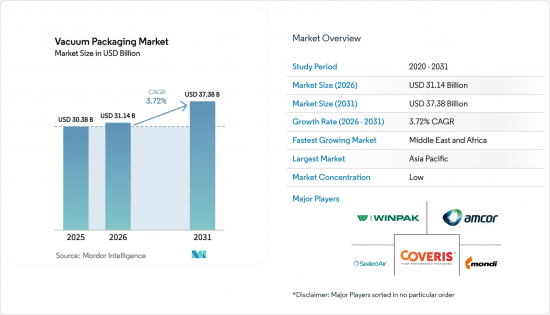
This report is Segmented by Packaging Type (Flexible Packaging, and Rigid Packaging), Material (Polyethylene, Polyamide, Polypropylene, and More), End-User Industry (Food, Healthcare and Pharmaceutical, Industrial Goods, and More), Machinery Type (Thermoformers, Chamber Vacuum Sealers, External/ Edge Vacuum Sealers, and More), and Geography. The Market Forecasts are Provided in Terms of Value (USD).
Global Vacuum Packaging Market Trends and Insights
Growing Demand for Packaged and Convenience Foods
Ready-to-eat meal volumes increased 18% year-over-year in 2025, as vacuum-sealed protein bowls and sous-vide entrees secured a broader presence on grocery shelves. Meal-kit firms doubled the order frequency over the same period, relying on portion-controlled pouches that maintain sensory quality for up to 10 days without freezing. Fulfillment centers now favor larger, consolidated shipments, trimming logistics cost per unit by roughly 13% yet exposing packs to more handling cycles that vacuum formats withstand. Nestle has earmarked BRL 500 million (USD 95 million) to expand chilled-meal capacity in Brazil, targeting dual-income households, which were expected to surpass 60% penetration by 2025. Consumers are willing to accept a 20-25% price premium for grab-and-go convenience, supporting double-digit expansion in vacuum-packed offerings, even as food inflation moderated last year.
Increasing Focus on Food-Safety Compliance by Retailers
Regulators have zeroed in on Clostridium botulinum risk in low-acid, reduced-oxygen items. The UK Food Standards Agency now requires chilled vacuum packs marketed beyond 10 days to show a 6-log spore reduction or add hurdles such as pH below 5.0. In the United States, USDA FSIS enforces hermetic standards under 9 CFR 318.300, while 21 CFR 113 covers thermal validation. Retailers audit suppliers quarterly and delist non-conformers within 30 days, a move that favors converters owning microbiology labs and shelf-life chambers. As a result, tier-1 suppliers lengthen their lead over small regionals that lack capital for validation infrastructure.
High Capital Cost of Industrial Vacuum Machinery
Entry-level chamber sealers start at around USD 15,000, while full thermoform-fill-seal lines exceed USD 3.5 million, a gap that small co-packers in South America and South Asia struggle to bridge. Financing in those regions carries premiums of 300-500 bps above developed-market rates, pushing payback beyond seven years. Development lenders, such as the IFC, injected EUR 65 million (USD 73 million) into a Brazilian converter in 2025; however, such programs reach less than 5% of eligible firms. Vendors are piloting pay-per-pack fees in India and Indonesia, yet uptake stays below 2% because processors fear long-term cost uncertainty.
Other drivers and restraints analyzed in the detailed report include:
- Rapid Expansion of E-Commerce Grocery Channels
- Automation of High-Speed Thermoform Lines
- Environmental Concerns over Multi-Layer Plastic Films
For complete list of drivers and restraints, kindly check the Table Of Contents.
Segment Analysis
Flexible variants accounted for 78.43% of the vacuum packaging market share in 2025 and are projected to grow at a 4.23% CAGR through 2031. They use up to 50% less resin than trays, resulting in freight savings of nearly USD 0.10 per kilogram on export routes and enabling better cube utilization in e-commerce totes. Schur Flexibles launched a recyclable polyethylene mono-material pouch in 2025 that preserves sliced deli meats for 21 days while complying with Extended Producer Responsibility rules. Rigid trays kept a 21.57% share but grew only 2.8% as higher tooling costs hindered SKU proliferation. Klockner Pentaplast's PET tray with built-in scavengers now extends the color life of red meat to 18 days; however, adoption is concentrated in premium private labels willing to pass a 15% price increase to shoppers.
E-commerce accentuates the benefits of flexible packs, which stack 30% more units per refrigerated tote than trays, resulting in lower last-mile costs and fewer breakages. Coveris reported 22% growth in flexible solutions for meal kits in 2025, whereas rigid equivalents slipped 3%, underscoring channel preference. ISO 18601 assigns higher recyclability scores to mono-material flexible films than to multi-substrate trays, encouraging brand owners to opt for pouches. Foodservice remains the last stronghold for rigid trays because they endure high-heat reheating, a niche representing under 10% of vacuum packaging market size.
Polyethylene represented 38.53% of the market share in 2025, driven by its low cost, broad sealing window, and installed extrusion base. Polypropylene is suitable for hot-fill and retort duty, while niche oxygen-barrier jobs rely on EVOH and polyamide. Polyamide logs the quickest 4.54% CAGR through 2031, as its oxygen barrier is up to seven times tighter than polyethylene, making it essential for cured meats and lyophilized drugs.
Dow's 2025 INNATE TF resin family aims to dethrone polyamide by achieving 15 cc/m2/day oxygen rates without lamination; however, uptake currently sits at around 5% due to 12-15% price premiums. Borealis' Borstar line enhances puncture resistance, enabling converters to reduce film gauge by approximately 12%, resulting in a savings of USD 0.02 per pack. Healthcare customers underpin polyamide's rise because ISO 11607 validation counts on its toughness during 134 °C sterilization.
Complete Report Scope:
- By Packaging Type
- Flexible Packaging
- Rigid Packaging
- By Material
- Polyethylene (PE)
- Polyamide (PA)
- Polypropylene (PP)
- Other Materials
- By End-User Industry
- Food
- Healthcare and Pharmaceutical
- Industrial Goods
- Other End -user Industries
- By Machinery Type
- Thermoformers
- Chamber Vacuum Sealers
- External / Edge Vacuum Sealers
- Other Machinery Types
- By Geography
- North America
- United States
- Canada
- Mexico
- South America
- Brazil
- Argentina
- Rest of South America
- Europe
- Germany
- United Kingdom
- France
- Italy
- Spain
- Rest of Europe
- Asia-Pacific
- China
- Japan
- India
- South Korea
- Australia
- Rest of Asia-Pacific
- Middle East and Africa
- Middle East
- Saudi Arabia
- United Arab Emirates
- Turkey
- Rest of Middle East
- Africa
- South Africa
- Egypt
- Nigeria
- Rest of Africa
- Middle East
- North America
Geography Analysis
Asia-Pacific generated 40.77% of global revenue in 2025, fueled by China's 4.8 million-ton vacuum-packed meat exports and India's cold-chain build-out. Japan mandates real-time GMP monitoring in pharma packs, driving adoption of data-logging thermoformers. South Korea's convenience stores enlarged vacuum-meal offerings by 18% as single-person households topped 30% of dwellings. Australia's processors invested AUD 120 million (USD 78 million) in barrier lines to serve premium exports to the Middle East and North America.
The Middle East and Africa are the fastest risers, with a 5.22% CAGR through 2031. The UAE's Food Security Strategy 2050 requires a ten-day protein reserve, prompting supermarkets to vacuum-pack chilled produce, which now occupies 22% of their fridge space. Saudi Arabia allocated SAR 8 billion (USD 2.1 billion) to food-processing infrastructure between 2024 and 2026. South Africa's top three grocers, which control 68% of the trade, have mandated vacuum packs for private-label meats to reduce shrinkage.
North America and Europe together accounted for 45% of 2025 sales, but grew modestly at 3.2% and 2.9%, respectively. FDA 21 CFR 113 compliance adds up to USD 80,000 per SKU, while Germany's 2024 packaging law imposes EUR 0.52 per kilogram EPR fees on non-recyclable laminates. Canada's pending single-use plastics rules cloud investment timing. South America advances at 4.1% as nearshoring and IFC-backed capital inject capacity. Tetra Pak's Mexicali upgrade expands thermoform output 60% for North American nearshoring programs.
- Amcor plc
- Sealed Air Corporation
- Mondi Group
- Winpak Ltd.
- Coveris Holdings SA
- Schur Flexibles Group
- Klockner Pentaplast Group
- Plastopil Ltd.
- Swiss Pac Pvt Ltd.
- Multivac Sepp Haggenmuller SE
- Ulma Packaging
- Wipak Oy
- Dow Inc.
- Bemis (An Amcor Brand)
- Constantia Flexibles
- ProAmpac LLC
- CVP Systems Inc.
- LINPAC Packaging
- Allfo Vakuumverpackungen
Additional Benefits:
- The market estimate (ME) sheet in Excel format
- 3 months of analyst support
TABLE OF CONTENTS
1 INTRODUCTION
- 1.1 Study Assumptions and Market Definition
- 1.2 Scope of the Study
2 RESEARCH METHODOLOGY
3 EXECUTIVE SUMMARY
4 MARKET LANDSCAPE
- 4.1 Market Overview
- 4.2 Market Drivers
- 4.2.1 Growing Demand for Packaged and Convenience Foods
- 4.2.2 Increasing Focus on Food-Safety Compliance by Retailers
- 4.2.3 Rapid Expansion of E-Commerce Grocery Channels
- 4.2.4 Automation of High-Speed Thermoform Lines
- 4.2.5 Integration of Smart Sensors for Real-Time Quality Checks
- 4.3 Market Restraints
- 4.3.1 High Capital Cost of Industrial Vacuum Machinery
- 4.3.2 Environmental Concerns Over Multi-Layer Plastic Films
- 4.3.3 Regulatory Pressure on PVDC and Other Halogenated Barriers
- 4.3.4 Limited Recycling Streams for Contaminated Flexible Films
- 4.4 Industry Value Chain Analysis
- 4.5 Regulatory Landscape
- 4.6 Technological Outlook
- 4.7 Porter's Five Forces Analysis
- 4.7.1 Threat of New Entrants
- 4.7.2 Bargaining Power of Buyers
- 4.7.3 Bargaining Power of Suppliers
- 4.7.4 Threat of Substitutes
- 4.7.5 Intensity of Competitive Rivalry
- 4.8 Impact of Macroeconomic Factors on the Market
- 4.9 Investment Analysis
5 MARKET SIZE AND GROWTH FORECASTS (VALUE)
- 5.1 By Packaging Type
- 5.1.1 Flexible Packaging
- 5.1.2 Rigid Packaging
- 5.2 By Material
- 5.2.1 Polyethylene (PE)
- 5.2.2 Polyamide (PA)
- 5.2.3 Polypropylene (PP)
- 5.2.4 Other Materials
- 5.3 By End-User Industry
- 5.3.1 Food
- 5.3.2 Healthcare and Pharmaceutical
- 5.3.3 Industrial Goods
- 5.3.4 Other End -user Industries
- 5.4 By Machinery Type
- 5.4.1 Thermoformers
- 5.4.2 Chamber Vacuum Sealers
- 5.4.3 External / Edge Vacuum Sealers
- 5.4.4 Other Machinery Types
- 5.5 By Geography
- 5.5.1 North America
- 5.5.1.1 United States
- 5.5.1.2 Canada
- 5.5.1.3 Mexico
- 5.5.2 South America
- 5.5.2.1 Brazil
- 5.5.2.2 Argentina
- 5.5.2.3 Rest of South America
- 5.5.3 Europe
- 5.5.3.1 Germany
- 5.5.3.2 United Kingdom
- 5.5.3.3 France
- 5.5.3.4 Italy
- 5.5.3.5 Spain
- 5.5.3.6 Rest of Europe
- 5.5.4 Asia-Pacific
- 5.5.4.1 China
- 5.5.4.2 Japan
- 5.5.4.3 India
- 5.5.4.4 South Korea
- 5.5.4.5 Australia
- 5.5.4.6 Rest of Asia-Pacific
- 5.5.5 Middle East and Africa
- 5.5.5.1 Middle East
- 5.5.5.1.1 Saudi Arabia
- 5.5.5.1.2 United Arab Emirates
- 5.5.5.1.3 Turkey
- 5.5.5.1.4 Rest of Middle East
- 5.5.5.2 Africa
- 5.5.5.2.1 South Africa
- 5.5.5.2.2 Egypt
- 5.5.5.2.3 Nigeria
- 5.5.5.2.4 Rest of Africa
- 5.5.5.1 Middle East
- 5.5.1 North America
6 COMPETITIVE LANDSCAPE
- 6.1 Market Concentration
- 6.2 Strategic Moves
- 6.3 Market Share Analysis
- 6.4 Company Profiles (Includes Global Level Overview, Market Level Overview, Core Segments, Financials as Available, Strategic Information, Market Rank/Share, Products and Services, and Recent Developments)
- 6.4.1 Amcor plc
- 6.4.2 Sealed Air Corporation
- 6.4.3 Mondi Group
- 6.4.4 Winpak Ltd.
- 6.4.5 Coveris Holdings SA
- 6.4.6 Schur Flexibles Group
- 6.4.7 Klockner Pentaplast Group
- 6.4.8 Plastopil Ltd.
- 6.4.9 Swiss Pac Pvt Ltd.
- 6.4.10 Multivac Sepp Haggenmuller SE
- 6.4.11 Ulma Packaging
- 6.4.12 Wipak Oy
- 6.4.13 Dow Inc.
- 6.4.14 Bemis (An Amcor Brand)
- 6.4.15 Constantia Flexibles
- 6.4.16 ProAmpac LLC
- 6.4.17 CVP Systems Inc.
- 6.4.18 LINPAC Packaging
- 6.4.19 Allfo Vakuumverpackungen
7 MARKET OPPORTUNITIES AND FUTURE OUTLOOK
- 7.1 White-Space and Unmet-Need Assessment

