PUBLISHER: Mordor Intelligence | PRODUCT CODE: 2123404

PUBLISHER: Mordor Intelligence | PRODUCT CODE: 2123404
Laminated Labels - Market Share Analysis, Industry Trends & Statistics, Growth Forecasts (2026 - 2031)
According to Mordor Intelligence, laminated label market size in 2026 is estimated at USD 38.44 billion, growing from 2025 value of USD 36.5 billion with 2031 projections showing USD 49.82 billion, growing at 5.32% CAGR over 2026-2031.
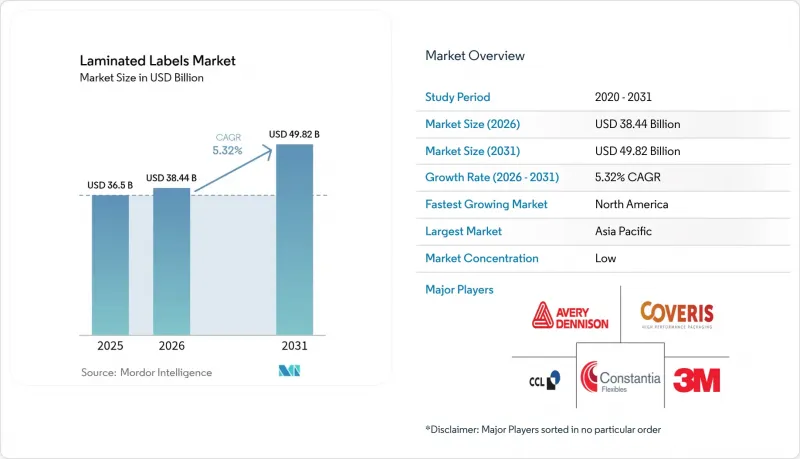
This report is Segmented by Material Type (Polyester, Polypropylene (BOPP, CPP), Vinyl, and More), Form (Rolls, Sheets), Composition (Facestock, Adhesive), Printing Technology (Flexographic, Digital - Ink-Jet, and More), End-User Industry (Food and Beverage, Manufacturing and Industrial, Electronics and Appliances, and More), and by Geography. The Market Forecasts are Provided in Terms of Value (USD).
Global Laminated Labels Market Trends and Insights
E-commerce boom driving durable shipping labels
Surging online retail volumes have pushed parcel handling intensity up by more than 60%, exposing ordinary labels to temperature swings and mechanical shocks that cause delamination. ASTM D4169-22 now requires sequential hazard testing, prompting converters to engineer substrates that stay bonded to corrugate throughout distribution cycles. Sustainability goals add a removal-cleanly prerequisite so that labels do not disrupt fiber recycling streams. Linerless rolls such as OptiCut WashOff increase label yield by 50% and slash transport emissions, attracting logistics operators that track Scope 3 footprints. Converters report 15-20% higher margins on e-commerce-specific constructions, while digital print lets shippers embed real-time codes for tracking and returns management.
Packaged food and beverage demand surge
Urban lifestyles and single-serve preferences are lifting packaged food volumes, with India's packaging spend growing at 26.7% CAGR as brands court rising middle-class consumers. India's FSSAI now bans toluene in food-contact inks, pushing label makers toward low-migration chemistries and rigorous migration testing. Premium snack and beverage lines want metalized pressure-sensitive films that give brighter shelf appeal and barrier protection. Paper-based laminates from partnerships such as Saica-Mondelez target a 25% virgin-plastic cutback without losing heat-sealability. Regional supply diversification, especially within Asia-Pacific, is mitigating disruption risks and stimulating new local capacity additions.
Raw-material price volatility
Propylene feedstock is forecast to top 40 cents/lb by mid-2025 following refinery rationalizations, raising polyester and polypropylene film costs. December 2024 contracts already traded at 35.75 cents, telegraphing lasting inflation into 2026. Brady Corporation disclosed raw-material spikes as a chief drag on FY 2024 margins. Converters are exploring recycled or bio-based resins, yet volumes remain low and premiums high. Multi-supplier strategies and regional inventory buffers are becoming standard risk-management playbooks.
Other drivers and restraints analyzed in the detailed report include:
- Pharmaceutical serialization mandates
- Linerless laminated labels adoption
- Shift to metallized foils and shrink sleeves
For complete list of drivers and restraints, kindly check the Table Of Contents.
Segment Analysis
Polyester delivered the largest slice of the laminated label market at 34.92% in 2025 thanks to chemical resistance vital for pharma, chemical drum, and outdoor-exposure uses. Polypropylene's 7.12% CAGR through 2031 reflects food and beverage converters embracing its lower density, higher yield, and smoother print surface. EU rules dictating 30% recycled PET in packaging by 2030 are pushing buyers to recycled PET facestocks, though supply lags demand and prices remain elevated. Vinyl continues to decline amid REACH microplastics curbs. Bio-films are a niche today but attract brands pursuing compostable or bio-sourced messaging.
Looking ahead, recycled content mandates should tighten polyester's availability and buoy prices, possibly accelerating polypropylene's replacement rate in cost-sensitive SKUs. Simultaneously, R&D around bio-based PET and chemically recycled resins promises future volumes once scale materializes. Suppliers that can qualify recycled inputs without sacrificing clarity or stiffness will seize share as the laminated label market rewards low-carbon footprints.
Roll configurations dominated 57.88% of laminated label market share in 2025 because automated applicators in beverages, pharmaceuticals, and logistics depend on continuous web feeds. Sheet labels, though only 42.12%, clock a 6.28% CAGR on the back of digital presses that handle short runs for craft food, cosmetics, and seasonal campaigns. Automatic splicing systems like Unisplice 413 raised line uptime by 10%, reinforcing rolls' productivity advantage.
Sheets, however, let brand owners vary artwork across multiple SKUs without tooling, cutting inventory waste. As e-commerce microbrands proliferate, sheet demand will intensify for orders under 1,000 units where flexo setup costs are untenable. Linerless technology reinforces rolls' appeal, yet printer retrofits required for butt-cut webs may limit adoption to large fleet owners initially.
Complete Report Scope:
- By Material Type
- Polyester
- Polypropylene (BOPP, CPP)
- Vinyl
- Biodegradable Films
- Other Material Type
- By Form
- Rolls
- Sheets
- By Composition
- Facestock
- Adhesive
- Release Liner
- By Printing Technology
- Flexographic
- Digital - Ink-jet
- Digital - Electrophotography
- Gravure
- Offset
- Screen / Letterpress
- By End-user Industry
- Food and Beverage
- Manufacturing and Industrial
- Electronics and Appliances
- Pharmaceuticals and Healthcare
- Personal Care and Cosmetics
- Retail and Logistics
- Other End-user Industry
- By Geography
- North America
- United States
- Canada
- Mexico
- Europe
- Germany
- France
- Italy
- Spain
- United Kingdom
- Russia
- Rest of Europe
- Asia-Pacific
- China
- India
- Japan
- South Korea
- Australia
- Rest of Asia-Pacific
- Middle East and Africa
- Middle East
- Saudi Arabia
- United Arab Emirates
- Turkey
- Rest of Middle East
- Africa
- South Africa
- Nigeria
- Rest of Africa
- Middle East
- South America
- Brazil
- Argentina
- Rest of South America
- North America
Geography Analysis
Asia-Pacific held 40.98% of the laminated label market in 2025, buoyed by China's 6% industrial output rise and 12.7% jump in chemical manufacturing that secures film feedstocks. India's production-linked incentives aim for 25% GDP contribution from advanced manufacturing by 2025, enlarging domestic demand and export capacity. Multinationals such as Amcor added Gujarat capacity to serve regional snack and personal-care brands, confirming the region's scale and cost edge. Japan and South Korea contribute high-precision coating know-how, whereas Southeast Asia gains from supply-chain diversification.
North America, projected at an 7.95% CAGR, is propelled by DSCSA serialization, EPA solvent regulations, and rapid parcel-shipping growth. ASTM shipping standards and consumer preference for premium graphics position the region for value-added volumes. Mexico's role in near-shoring strengthens, illustrated by ProMach's Etiflex acquisition that expands RFID and variable-data offerings.
Europe maintains regulatory leadership through the Packaging and Packaging Waste Regulation, obliging full recyclability by 2028 and recycled-content thresholds that reshape material menus. FINAT's liner recycling drive and Germany's plant-based-ink transition underscore sustainability as the prime competitive lever. Eastern Europe may attract new coating lines as Western converters seek low-cost yet EU-compliant production bases.
Middle East & Africa and South America together form a smaller slice of the laminated label market but register brisk uptake as food-processing and agro-exporters adopt traceability stickers. Infrastructure gaps and currency swings restrain scale for now, though localized manufacturing might rise as governments court investment to cut import dependence.
- Avery Dennison Corporation
- CCL Industries Inc.
- 3M Company
- Coveris Holdings S.A.
- Torraspapel Adestor
- Constantia Flexibles Group GmbH
- R.R. Donnelley & Sons Company
- Flexcon Company Inc.
- Stickythings Ltd.
- Gipako Ltd.
- Hub Labels Inc.
- Cenveo Corporation
- Ravenwood Packaging Ltd.
- Reflex Labels Ltd.
- UPM Raflatac Oy
- Amcor plc
- Multi-Color Corporation
- Fuji Seal International Inc.
- SATO Holdings Corp.
- Lintec Corporation
- Zebra Technologies Corp.
- Brady Corporation
Additional Benefits:
- The market estimate (ME) sheet in Excel format
- 3 months of analyst support
TABLE OF CONTENTS
1 INTRODUCTION
- 1.1 Study Assumptions and Market Definition
- 1.2 Scope of the Study
2 RESEARCH METHODOLOGY
3 EXECUTIVE SUMMARY
4 MARKET LANDSCAPE
- 4.1 Market Overview
- 4.2 Market Drivers
- 4.2.1 E-commerce boom driving durable shipping labels
- 4.2.2 Packaged food and beverage demand surge
- 4.2.3 Pharmaceutical serialization mandates
- 4.2.4 Linerless laminated labels adoption
- 4.2.5 "Carbon-footprint" disclosure labels
- 4.3 Market Restraints
- 4.3.1 Raw-material price volatility
- 4.3.2 Shift to metallized foils and shrink sleeves
- 4.3.3 Solvent-borne ink and adhesive regulation
- 4.3.4 Closed-loop paper packs eliminating plastic labels
- 4.4 Supply-Chain Analysis
- 4.5 Regulatory Landscape
- 4.6 Technological Outlook
- 4.7 Porter's Five Forces Analysis
- 4.7.1 Threat of New Entrants
- 4.7.2 Bargaining Power of Buyers
- 4.7.3 Bargaining Power of Suppliers
- 4.7.4 Threat of Substitutes
- 4.7.5 Competitive Rivalry
- 4.8 Environmental Footprint Analysis
5 MARKET SIZE AND GROWTH FORECASTS (VALUE)
- 5.1 By Material Type
- 5.1.1 Polyester
- 5.1.2 Polypropylene (BOPP, CPP)
- 5.1.3 Vinyl
- 5.1.4 Biodegradable Films
- 5.1.5 Other Material Type
- 5.2 By Form
- 5.2.1 Rolls
- 5.2.2 Sheets
- 5.3 By Composition
- 5.3.1 Facestock
- 5.3.2 Adhesive
- 5.3.3 Release Liner
- 5.4 By Printing Technology
- 5.4.1 Flexographic
- 5.4.2 Digital - Ink-jet
- 5.4.3 Digital - Electrophotography
- 5.4.4 Gravure
- 5.4.5 Offset
- 5.4.6 Screen / Letterpress
- 5.5 By End-user Industry
- 5.5.1 Food and Beverage
- 5.5.2 Manufacturing and Industrial
- 5.5.3 Electronics and Appliances
- 5.5.4 Pharmaceuticals and Healthcare
- 5.5.5 Personal Care and Cosmetics
- 5.5.6 Retail and Logistics
- 5.5.7 Other End-user Industry
- 5.6 By Geography
- 5.6.1 North America
- 5.6.1.1 United States
- 5.6.1.2 Canada
- 5.6.1.3 Mexico
- 5.6.2 Europe
- 5.6.2.1 Germany
- 5.6.2.2 France
- 5.6.2.3 Italy
- 5.6.2.4 Spain
- 5.6.2.5 United Kingdom
- 5.6.2.6 Russia
- 5.6.2.7 Rest of Europe
- 5.6.3 Asia-Pacific
- 5.6.3.1 China
- 5.6.3.2 India
- 5.6.3.3 Japan
- 5.6.3.4 South Korea
- 5.6.3.5 Australia
- 5.6.3.6 Rest of Asia-Pacific
- 5.6.4 Middle East and Africa
- 5.6.4.1 Middle East
- 5.6.4.1.1 Saudi Arabia
- 5.6.4.1.2 United Arab Emirates
- 5.6.4.1.3 Turkey
- 5.6.4.1.4 Rest of Middle East
- 5.6.4.2 Africa
- 5.6.4.2.1 South Africa
- 5.6.4.2.2 Nigeria
- 5.6.4.2.3 Rest of Africa
- 5.6.4.1 Middle East
- 5.6.5 South America
- 5.6.5.1 Brazil
- 5.6.5.2 Argentina
- 5.6.5.3 Rest of South America
- 5.6.1 North America
6 COMPETITIVE LANDSCAPE
- 6.1 Market Concentration
- 6.2 Strategic Moves
- 6.3 Market Share Analysis
- 6.4 Company Profiles (includes Global level Overview, Market level overview, Core Segments, Financials as available, Strategic Information, Market Rank/Share, Products and Services, Recent Developments)
- 6.4.1 Avery Dennison Corporation
- 6.4.2 CCL Industries Inc.
- 6.4.3 3M Company
- 6.4.4 Coveris Holdings S.A.
- 6.4.5 Torraspapel Adestor
- 6.4.6 Constantia Flexibles Group GmbH
- 6.4.7 R.R. Donnelley & Sons Company
- 6.4.8 Flexcon Company Inc.
- 6.4.9 Stickythings Ltd.
- 6.4.10 Gipako Ltd.
- 6.4.11 Hub Labels Inc.
- 6.4.12 Cenveo Corporation
- 6.4.13 Ravenwood Packaging Ltd.
- 6.4.14 Reflex Labels Ltd.
- 6.4.15 UPM Raflatac Oy
- 6.4.16 Amcor plc
- 6.4.17 Multi-Color Corporation
- 6.4.18 Fuji Seal International Inc.
- 6.4.19 SATO Holdings Corp.
- 6.4.20 Lintec Corporation
- 6.4.21 Zebra Technologies Corp.
- 6.4.22 Brady Corporation
7 MARKET OPPORTUNITIES AND FUTURE OUTLOOK
- 7.1 White-space and Unmet-need Assessment

