PUBLISHER: Mordor Intelligence | PRODUCT CODE: 2123412

PUBLISHER: Mordor Intelligence | PRODUCT CODE: 2123412
Cleaning Robot - Market Share Analysis, Industry Trends & Statistics, Growth Forecasts (2026 - 2031)
According to Mordor Intelligence, the cleaning robot market size is projected to be USD 16.89 billion in 2025, USD 19.68 billion in 2026, and reach USD 38.52 billion by 2031, growing at a CAGR of 14.38% from 2026 to 2031.
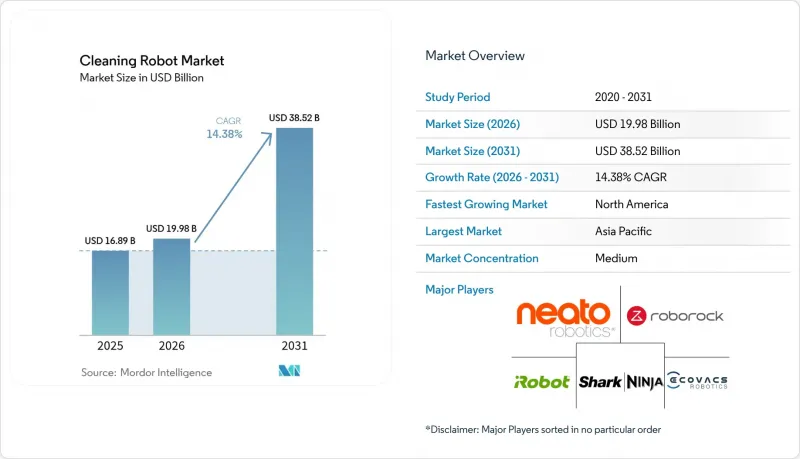
This report is Segmented by Robot Type (Domestic and Household Robots [Lawn Cleaning, Pool Cleaning, and More], and Professional Robots [Tank, Tube and Pipe Cleaning, and More]), End-User (Residential, Commercial [Hospitality, Healthcare Facilities, and More], and Industrial), Sales Channel (Online, Offline, and Robots-As-A-Service), and Geography. The Market Forecasts are Provided in Terms of Value (USD).
Global Cleaning Robot Market Trends and Insights
Rising Post-Pandemic Hygiene Standards in Commercial Spaces
Airports, hotels, and hospitals now treat continuous, highly visible cleaning as a non-negotiable amenity. At London Heathrow Airport, 50 autonomous scrubbers deployed in 2025 delivered a 40% reduction in labor hours while enabling 24/7 floor sanitization. Facility managers view audit-ready disinfection logs and pathogen-removal metrics as differentiators when bidding for corporate tenants. The premium commanded by professional cleaning robots, typically priced between USD 30,000 and USD 120,000, is increasingly justified by payback periods of under 18 months in high-traffic venues. Heightened infection-control standards lock in recurring demand for UV-C and electrostatic-spray variants, ensuring sustained growth in the cleaning robot market. Vendors that integrate compliance reporting directly into the fleet-management dashboard strengthen their value proposition to risk-averse operators.
Rapid Smart-Home Penetration and Disposable-Income Growth
Robot vacuums have graduated from novelty to necessity in North American and Western European households, a shift mirrored by rising ownership in Chinese and Southeast Asian urban centers. At IFA 2025, 94% of new smart-home cleaning launches were robotic vacuums. Parks Associates reported that 42% of U.S. homes owned at least one smart-home device in 2024, with robot vacuums ranking third in adoption. Feature innovation, AI obstacle avoidance, self-emptying docks, and combined vacuum-mop capability, encourages replacement purchases every three to four years. Disposable-income gains in Asia-Pacific expand the buyer pool, with units priced between USD 300 and USD 800 now within reach of the growing middle class. This demographic tailwind sustains double-digit unit growth for the cleaning robot market even as mature regions plateau.
High Upfront Cost Versus Conventional Equipment
Professional robots often carry price tags ten to forty times higher than manual scrubbers, creating sticker shock for budget-constrained operators. While robots-as-a-service spreads payments over time, hidden expenses, consumables, software subscriptions, and periodic recalibration, add up to 25% per year to total cost of ownership. The hurdle is most acute in South America and Africa, where household and enterprise purchasing power lags developed regions. Vendors bundle financing and predictive-maintenance guarantees to soften the blow, yet many facilities delay adoption until component costs fall further, tempering near-term growth in the cleaning robot market.
Other drivers and restraints analyzed in the detailed report include:
- Falling LiDAR and Sensor ASPs Reduce Bill of Materials Cost
- Facility-Management Contracts Shifting to Robots-As-A-Service
- Data-Privacy Concerns Over Camera/VSLAM Mapping
For complete list of drivers and restraints, kindly check the Table Of Contents.
Segment Analysis
Domestic robots accounted for 71.32% of revenue in 2025, reflecting their entrenched status as smart-home staples, but professional units are forecast to outpace them at a 15.23% CAGR to 2031. The vacuum sub-segment remains the cornerstone, benefiting from self-emptying docks and AI obstacle avoidance that spur upgrade cycles. Pool cleaners form a high-margin niche as solar-powered designs slash electricity use by up to 80%. ECOVACS has sold 1.5 million window-cleaning units cumulatively and holds 278 patents in suction and edge detection. Lawn-mowing robots equipped with RTK-GPS are scaling in suburban markets, with commercial models such as Husqvarna CEORA priced at EUR 15,000-20,000 (USD 16,950-22,600).
Professional robots, though smaller in unit volume, deliver higher revenue per device and deeper workflow integration. Floor-scrubber fleets connect to facility dashboards, covering 20,000 square feet per charge and sending real-time utilization metrics. UV-C disinfection units, now routine in Japanese and South Korean hospitals, achieve 99.9% pathogen reduction in 15-minute cycles. Tank-cleaning robots priced between USD 50,000 and USD 200,000 minimize confined-space entry risks in oil, chemical, and water utilities. Subscription models are accelerating adoption: the International Federation of Robotics recorded a 31% jump in robots-as-a-service fleets in 2024, underscoring the structural shift toward pay-per-use economics.
Complete Report Scope:
- By Robot Type
- Domestic and Household Robots
- Vacuum Floor Cleaner
- Pool Cleaning
- Window Cleaning
- Lawn Cleaning
- Other Domestic and Household Cleaning
- Professional Robots
- Floor Cleaning
- Tank, Tube and Pipe Cleaning
- Disinfection Robots
- Other Professional Cleaning
- Domestic and Household Robots
- By End-User
- Residential
- Commercial
- Hospitality
- Retail and Shopping Centres
- Healthcare Facilities
- Airports and Transportation Hubs
- Office and Corporate Facilities
- Other Commercial Facilities
- Industrial (Manufacturing and Warehousing)
- By Sales Channel
- Online
- Offline
- Robots-as-a-Service
- By Geography
- North America
- United States
- Canada
- Mexico
- South America
- Brazil
- Argentina
- Rest of South America
- Europe
- Germany
- United Kingdom
- France
- Italy
- Spain
- Rest of Europe
- Asia-Pacific
- China
- Japan
- India
- Singapore
- South Korea
- Australia
- Rest of Asia-Pacific
- Middle East
- Saudi Arabia
- United Arab Emirates
- Turkey
- Rest of Middle East
- Africa
- South Africa
- Nigeria
- Rest of Africa
- North America
Geography Analysis
North America generated 39.41% of 2025 revenue, underpinned by early smart-home adoption and stringent workplace-safety codes. The United States leads, with 42% household smart-home penetration in 2024 and robot vacuums ranking third in ownership, while Canada's infection-control building codes spur UV-robot uptake. Mexico's export-oriented manufacturing sector installs autonomous scrubbers to meet ISO 14001 compliance. Yet escalating tariffs on Chinese robots inflate retail prices, pressuring elasticity and nudging some buyers toward refurbished units or subscription models.
Asia-Pacific is expected to record the fastest 15.07% CAGR, fueled by urbanization and rising disposable incomes. Chinese giants Ecovacs and Roborock posted combined 2024 revenue exceeding USD 1.09 billion at prevailing exchange rates, underscoring domestic scale. Japan earmarked JPY 5 billion (USD 45.5 million) in subsidies for hospital UV-robot purchases in 2025. India's e-commerce growth opens tier-2 cities, while Singapore's ROBIN program showed a 60% pathogen-count reduction in public transport hubs. South Korea and Australia boast high per-capita ownership, aided by compact living spaces and tech-savvy consumers.
Europe, South America, Middle East, and Africa round out the cleaning robot market. Europe's GDPR drives demand for on-device mapping, a boon for hybrid LiDAR-plus-vision systems from regional leaders. The United Kingdom's window-robot segment reached GBP 64.21 million (USD 73.2 million) in 2025. German and French automakers deploy shop-floor robots for occupational safety compliance. South America remains highly price-sensitive, leading distributors to import mid-tier Chinese models with installment financing. Middle Eastern sovereign funds finance public-space fleets, while Africa's nascent adoption is visible in South African malls and Nigerian airports despite infrastructural challenges.
- iRobot Corporation
- Ecovacs Robotics Co., Ltd.
- Roborock Technology Co., Ltd.
- Neato Robotics Inc.
- Dreame Technology (Suzhou) Co., Ltd.
- Narwal Robotics Inc.
- SharkNinja Operating LLC
- ILIFE Innovation Ltd.
- Cecotec Innovaciones S.L.
- bObsweep Inc.
- Proscenic Technology Co., Ltd.
- Anker Innovations Ltd. (Eufy)
- SoftBank Robotics Corp.
- Tennant Company
- Alfred Karcher SE and Co. KG
- Nilfisk A/S
- Avidbots Corp.
- Gaussian Robotics Co., Ltd. (Gausium)
- Midea Group Co., Ltd. (Eureka)
- Tineco Intelligent Technology Co., Ltd.
Additional Benefits:
- The market estimate (ME) sheet in Excel format
- 3 months of analyst support
TABLE OF CONTENTS
1 INTRODUCTION
- 1.1 Study Assumptions and Market Definition
- 1.2 Scope of the Study
2 RESEARCH METHODOLOGY
3 EXECUTIVE SUMMARY
4 MARKET LANDSCAPE
- 4.1 Market Overview
- 4.2 Market Drivers
- 4.2.1 Rising Post-Pandemic Hygiene Standards in Commercial Spaces
- 4.2.2 Rapid Smart-Home Penetration and Disposable-Income Growth
- 4.2.3 Falling LiDAR and Sensor-Suite ASPs Reduce BOM Cost
- 4.2.4 E-Commerce Channel Scaling Accelerates Global Reach
- 4.2.5 Facility-Management Contracts Shifting to Robots-as-a-Service
- 4.2.6 Government Procurement of UV-Disinfection Bots for Public Infrastructure
- 4.3 Market Restraints
- 4.3.1 High Upfront Cost Versus Conventional Equipment
- 4.3.2 Data-Privacy Concerns over Camera / vSLAM Mapping
- 4.3.3 Supply-Chain Fragility for Solid-State LiDAR Components
- 4.3.4 Emerging Trade Tariffs on Chinese Robot Exports
- 4.4 Industry Value Chain Analysis
- 4.5 Regulatory Landscape
- 4.6 Technological Outlook
- 4.6.1 Navigation Technology
- 4.6.1.1 LiDAR SLAM
- 4.6.1.2 Visual SLAM (vSLAM)
- 4.6.1.3 Hybrid (LiDAR + Vision)
- 4.6.1.4 Random / Infra-Red Based
- 4.6.1.5 AI Sensor-Fusion Suites
- 4.6.1.6 Other Navigation Technologies
- 4.6.1 Navigation Technology
- 4.7 Porter's Five Forces Analysis
- 4.7.1 Bargaining Power of Suppliers
- 4.7.2 Bargaining Power of Buyers
- 4.7.3 Threat of New Entrants
- 4.7.4 Threat of Substitutes
- 4.7.5 Intensity of Competitive Rivalry
- 4.8 Impact of Macroeconomic Factors on the Market
5 MARKET SIZE AND GROWTH FORECASTS (VALUE)
- 5.1 By Robot Type
- 5.1.1 Domestic and Household Robots
- 5.1.1.1 Vacuum Floor Cleaner
- 5.1.1.2 Pool Cleaning
- 5.1.1.3 Window Cleaning
- 5.1.1.4 Lawn Cleaning
- 5.1.1.5 Other Domestic and Household Cleaning
- 5.1.2 Professional Robots
- 5.1.2.1 Floor Cleaning
- 5.1.2.2 Tank, Tube and Pipe Cleaning
- 5.1.2.3 Disinfection Robots
- 5.1.2.4 Other Professional Cleaning
- 5.1.1 Domestic and Household Robots
- 5.2 By End-User
- 5.2.1 Residential
- 5.2.2 Commercial
- 5.2.2.1 Hospitality
- 5.2.2.2 Retail and Shopping Centres
- 5.2.2.3 Healthcare Facilities
- 5.2.2.4 Airports and Transportation Hubs
- 5.2.2.5 Office and Corporate Facilities
- 5.2.2.6 Other Commercial Facilities
- 5.2.3 Industrial (Manufacturing and Warehousing)
- 5.3 By Sales Channel
- 5.3.1 Online
- 5.3.2 Offline
- 5.3.3 Robots-as-a-Service
- 5.4 By Geography
- 5.4.1 North America
- 5.4.1.1 United States
- 5.4.1.2 Canada
- 5.4.1.3 Mexico
- 5.4.2 South America
- 5.4.2.1 Brazil
- 5.4.2.2 Argentina
- 5.4.2.3 Rest of South America
- 5.4.3 Europe
- 5.4.3.1 Germany
- 5.4.3.2 United Kingdom
- 5.4.3.3 France
- 5.4.3.4 Italy
- 5.4.3.5 Spain
- 5.4.3.6 Rest of Europe
- 5.4.4 Asia-Pacific
- 5.4.4.1 China
- 5.4.4.2 Japan
- 5.4.4.3 India
- 5.4.4.4 Singapore
- 5.4.4.5 South Korea
- 5.4.4.6 Australia
- 5.4.4.7 Rest of Asia-Pacific
- 5.4.5 Middle East
- 5.4.5.1 Saudi Arabia
- 5.4.5.2 United Arab Emirates
- 5.4.5.3 Turkey
- 5.4.5.4 Rest of Middle East
- 5.4.6 Africa
- 5.4.6.1 South Africa
- 5.4.6.2 Nigeria
- 5.4.6.3 Rest of Africa
- 5.4.1 North America
6 COMPETITIVE LANDSCAPE
- 6.1 Market Concentration
- 6.2 Strategic Moves
- 6.3 Market Share Analysis
- 6.4 Company Profiles (includes Global Level Overview, Market Level Overview, Core Segments, Financials as available, Strategic Information, Market Rank / Share, Products and Services, Recent Developments)
- 6.4.1 iRobot Corporation
- 6.4.2 Ecovacs Robotics Co., Ltd.
- 6.4.3 Roborock Technology Co., Ltd.
- 6.4.4 Neato Robotics Inc.
- 6.4.5 Dreame Technology (Suzhou) Co., Ltd.
- 6.4.6 Narwal Robotics Inc.
- 6.4.7 SharkNinja Operating LLC
- 6.4.8 ILIFE Innovation Ltd.
- 6.4.9 Cecotec Innovaciones S.L.
- 6.4.10 bObsweep Inc.
- 6.4.11 Proscenic Technology Co., Ltd.
- 6.4.12 Anker Innovations Ltd. (Eufy)
- 6.4.13 SoftBank Robotics Corp.
- 6.4.14 Tennant Company
- 6.4.15 Alfred Karcher SE and Co. KG
- 6.4.16 Nilfisk A/S
- 6.4.17 Avidbots Corp.
- 6.4.18 Gaussian Robotics Co., Ltd. (Gausium)
- 6.4.19 Midea Group Co., Ltd. (Eureka)
- 6.4.20 Tineco Intelligent Technology Co., Ltd.
7 MARKET OPPORTUNITIES AND FUTURE OUTLOOK
- 7.1 White-Space and Unmet-Need Assessment

