PUBLISHER: Mordor Intelligence | PRODUCT CODE: 2123417

PUBLISHER: Mordor Intelligence | PRODUCT CODE: 2123417
Aircraft Electrical Systems - Market Share Analysis, Industry Trends & Statistics, Growth Forecasts (2026 - 2031)
According to Mordor Intelligence, the aircraft electrical systems market size is expected to grow from USD 23.13 billion in 2025 to USD 26.09 billion in 2026 and is forecasted to reach USD 37.07 billion by 2031 at a 7.28% CAGR over 2026-2031.
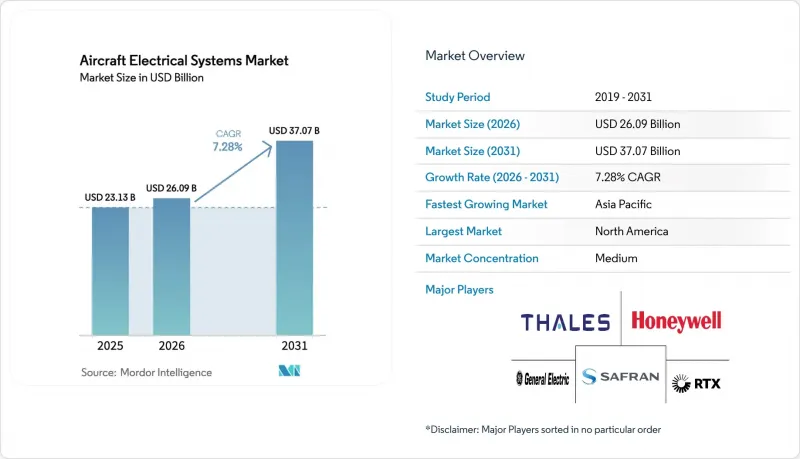
This report is Segmented by System (Power Generation, Power Distribution, and More), Component (Generators and Starter-Generators, Converters, and More), Platform (Commercial Aviation, Military Aviation, and More), Application (Power Generation Management, Cabin Systems, and More), and Geography (North America, Europe, and More). The Market Forecasts are Provided in Terms of Value (USD).
Global Aircraft Electrical Systems Market Trends and Insights
Increasing Adoption of MEA Architecture
Airlines favor MEA layouts because eliminating engine-bleed air for pressurization and ice protection trims fuel burn by 3-5% on twin-aisle routes across each twenty-year airframe lifecycle. The B787 and A350 paved the way, and the next step targets electromechanical primary flight-control actuators that remove centralized hydraulics altogether. Collins Aerospace's HECATE program validated a 500-kilowatt hybrid-electric system in 2024, proving that distributed electric motors can assist turbofans during climb and regenerate power during descent. Such architectures require starter-generators exceeding 250 kVA and solid-state power controllers utilizing SiC MOSFETs that can operate at temperatures exceeding 200 °C. Although MEA retrofits increase capital costs by 15-20% over conventional upgrades, they deliver net lifecycle savings by mitigating hydraulic-fluid contamination risk. Compliance with SAE AS50881 on insulation and bend radii ensures that high-voltage harnesses remain compatible with legacy structures.
Rising Aircraft Production Volume and Existing Aircraft Production Backlog
Airbus closed 2024 with 8,658 aircraft on order, equivalent to approximately eleven years of production, guaranteeing recurring demand for generators, power-distribution units, and 180 kilometers of wiring per narrowbody airframe. Boeing plans to increase B737 MAX production to 38 jets per month in 2024 and aims to reach 42 by mid-2026, with each aircraft requiring 15-20 power-distribution modules. COMAC aims to deliver 150 C919s per year by 2028, adding to Asia-Pacific electrical-system demand on an already tight global supply base. India's Tata-Airbus C295 line in Vadodara features military-grade power-generation capabilities that meet MIL-STD-704F specifications. Although semiconductor packaging bottlenecks lengthen lead times, OEMs now dual-source generator housings and SiC devices to prevent delays in final assembly.
Challenges in managing heat and wiring complexity as system voltage levels increase
HVDC buses above 270 volts create localized hotspots where SiC devices dissipate 2-3 W per ampere, requiring robust heat sinks that add up to 12 kg per kilowatt of managed power. Liquid-cooling loops enhance thermal performance but introduce leak risks and duplicate pumps to maintain single-failure tolerance in accordance with FAA Part 25 rules. Thicker cross-linked polyethylene insulation for HVDC wiring increases the bundle diameter by 20-25%, complicating routing through spars that were initially sized for 115-volt cabling. High-frequency switching noise necessitates the use of shielded twisted pairs and ferrite filters, resulting in an additional 3-5 kg per electrical bay. Graphene-enhanced interface pads improve heat transfer but degrade under vibration and must be replaced every 5,000 flight hours, thereby increasing the life-cycle cost. Arc-fault interrupters, as specified in SAE AS5692, prevent wiring fires; however, false trips still disrupt dispatch reliability at rates unacceptable to high-utilization carriers.
Other drivers and restraints analyzed in the detailed report include:
- Implementation of HVDC Distribution Systems
- Growing Need for Lightweight and Compact Electrical Systems for Unmanned Aerial Platforms
- High certification costs associated with advanced aerospace battery technologies
For complete list of drivers and restraints, kindly check the Table Of Contents.
Segment Analysis
Energy storage systems are expected to grow at a 9.44% CAGR through 2031, the fastest rate among system categories in the aircraft electrical systems market. The acceleration comes from eVTOL entrants such as Joby's air taxi and Lilium's electric jet, both of which are transitioning from prototype to production with large Li-ion packs that comply with AC 20-184 containment rules. Power distribution retained a 34.41% share in 2025, reflecting an installed base of fault-tolerant buses on narrowbody and widebody fleets. Growth moderates as retrofit opportunities on legacy aircraft taper, yet the aircraft electrical systems market size attached to power distribution remains significant for spares and upgrades.
Power generation modules, including constant-frequency and variable-frequency generators, continue to serve baseline loads but are being displaced by hybrid architectures that leverage battery packs during taxi. Power conversion units enable voltage translation between HVDC primary buses and 28-volt secondary avionics rails, with aerospace-qualified converters now achieving 95% efficiency at a power density of 1 kW/in3. Bidirectional converters that recuperate energy during descent support distributed-propulsion concepts being tested on NASA's X-57 and Airbus's E-Fan X. As certification frameworks under SAE ARP4754B mature, energy storage and power conversion segments look set for sustained share gains within the aircraft electrical systems market.
Battery packs and BMS are forecast to expand at an 8.24% CAGR, driven by eVTOL certification milestones and hybrid-electric demonstrators that demand high-reliability energy storage. Generators and starter-generators maintained a 23.22% share in 2025, underpinned by replacement demand in aging turbofan fleets. Yet growth plateaus as airlines favor auxiliary battery units that power ground operations and reduce fuel burn.
Power distribution units, including SiC solid-state contactors, integrate prognostic health monitoring that predicts wear 500 hours ahead of failure. Converters provide bidirectional power flow for regenerative modes, and aluminum wiring reduces harness mass by 30% while maintaining conductivity via copper-clad terminations. Connectors rated for 50,000 mating cycles ensure reliability on high-frequency test vehicles, and DO-326A cyber-secure firmware is standard in power-distribution software. Together, these trends reinforce component diversification inside the aircraft electrical systems market.
Complete Report Scope:
- By System
- Power Generation
- Power Distribution
- Power Conversion
- Energy Storage
- By Component
- Generators and Starter-Generators
- Power Distribution Units
- Converters
- Battery Packs and Battery Management System (BMS)
- Wiring and Cables
- Connectors and Contactors
- Power-distribution Software
- By Platform
- Commercial Aviation
- Narrowbody
- Widebody
- Regional Jets
- Freighters
- Military Aviation
- Combat Aircraft
- Transport Aircraft
- Unmanned Aerial Vehicles (UAVs)
- Trainer Aircraft
- General Aviation
- Business Jets
- Helicopters
- Electric Vertical Take-Off and Landing (eVTOL)/Advanced Air Mobility (AAM)
- Commercial Aviation
- By Application
- Power Generation Management
- Flight Control and Operation
- Cabin System
- Configuration Management
- Air Pressurization and Conditioning
- By Geography
- North America
- United States
- Canada
- Mexico
- Europe
- United Kingdom
- France
- Germany
- Italy
- Rest of Europe
- Asia-Pacific
- China
- India
- Japan
- South Korea
- Australia
- Rest of Asia-Pacific
- South America
- Brazil
- Rest of South America
- Middle East and Africa
- Middle East
- Saudi Arabia
- United Arab Emirates
- Rest of Middle East
- Africa
- South Africa
- Rest of Africa
- Middle East
- North America
Geography Analysis
Asia-Pacific is poised to post an 8.01% CAGR through 2031, the highest regional rate in the aircraft electrical systems market, supported by COMAC's C919 ramp, Airbus's Tianjin A320 line, and India's Tata-Airbus C295 program. North America retained a 42.22% share in 2025, leveraging Boeing's Everett and Renton centers, Lockheed Martin's F-35 facility, and a dense Tier-1 ecosystem across Seattle, Wichita, and Phoenix. Europe benefits from Airbus hubs in Hamburg and Toulouse, and sees consistent demand for retrofits of its widebody fleets.
Middle East carriers operate young, widebody heavy fleets, purchasing high-power cabin connectivity upgrades that boost regional electrical system revenues. South America remains modest, anchored by Embraer's E2 line, but aftermarket retrofits on older ERJ-145 fleets add steady pull. Africa's market is small yet growing, as Ethiopian Airlines modernizes its mixed fleets to comply with ICAO Annex 6 electrical safety mandates. As OEM offsets and localized manufacturing spread across Asia and the Middle East, geographic diversification strengthens global supply chain resilience within the aircraft electrical systems market.
- RTX Corporation
- Honeywell International Inc.
- General Electric Company
- Safran S.A.
- Thales Group
- Amphenol Aerospace
- Astronics
- Crane Aerospace and Electronics
- AMETEK Inc.
- Nabtesco Corporation
- Hartzell Engine Tech LLC
- PBS AEROSPACE Inc.
- Acme Aerospace Inc. & Avionic Instruments, LLC
- BAE Systems plc
- Moog Inc.
- Parker-Hannifin Corporation
- Rolls-Royce plc
- Vicor Corporation
Additional Benefits:
- The market estimate (ME) sheet in Excel format
- 3 months of analyst support
TABLE OF CONTENTS
1 INTRODUCTION
- 1.1 Study Assumptions and Market Definition
- 1.2 Scope of the Study
2 RESEARCH METHODOLOGY
3 EXECUTIVE SUMMARY
4 MARKET LANDSCAPE
- 4.1 Market Overview
- 4.2 Market Drivers
- 4.2.1 Increasing adoption of More-Electric Aircraft (MEA) architectures to reduce mechanical complexity and improve efficiency
- 4.2.2 Rising aircraft production volumes and sustained order backlogs driving demand for advanced electrical systems
- 4.2.3 Implementation of high-voltage direct current (HVDC) distribution systems to support next-generation power architectures
- 4.2.4 Growing need for lightweight and compact electrical systems tailored to unmanned aerial platforms
- 4.2.5 Silicon-carbide (SiC) power electronics enable higher temperature limits
- 4.2.6 Retrofit-driven upgrades focused on cabin electrification, including in-seat power and galley modernization
- 4.3 Market Restraints
- 4.3.1 Challenges in managing heat and wiring complexity as system voltage levels increase
- 4.3.2 High certification costs associated with advanced aerospace battery technologies
- 4.3.3 Limited availability of qualified semiconductors meeting aerospace-grade performance and reliability standards
- 4.3.4 Delays in regulatory approvals for software-driven power distribution units due to cybersecurity concerns
- 4.4 Value Chain Analysis
- 4.5 Regulatory Landscape and Technological Outlook
- 4.6 Porter's Five Forces Analysis
- 4.6.1 Bargaining Power of Suppliers
- 4.6.2 Bargaining Power of Buyers
- 4.6.3 Threat of New Entrants
- 4.6.4 Threat of Substitutes
- 4.6.5 Intensity of Competitive Rivalry
5 MARKET SIZE AND GROWTH FORECASTS (VALUE)
- 5.1 By System
- 5.1.1 Power Generation
- 5.1.2 Power Distribution
- 5.1.3 Power Conversion
- 5.1.4 Energy Storage
- 5.2 By Component
- 5.2.1 Generators and Starter-Generators
- 5.2.2 Power Distribution Units
- 5.2.3 Converters
- 5.2.4 Battery Packs and Battery Management System (BMS)
- 5.2.5 Wiring and Cables
- 5.2.6 Connectors and Contactors
- 5.2.7 Power-distribution Software
- 5.3 By Platform
- 5.3.1 Commercial Aviation
- 5.3.1.1 Narrowbody
- 5.3.1.2 Widebody
- 5.3.1.3 Regional Jets
- 5.3.1.4 Freighters
- 5.3.2 Military Aviation
- 5.3.2.1 Combat Aircraft
- 5.3.2.2 Transport Aircraft
- 5.3.2.3 Unmanned Aerial Vehicles (UAVs)
- 5.3.2.4 Trainer Aircraft
- 5.3.3 General Aviation
- 5.3.3.1 Business Jets
- 5.3.3.2 Helicopters
- 5.3.3.3 Electric Vertical Take-Off and Landing (eVTOL)/Advanced Air Mobility (AAM)
- 5.3.1 Commercial Aviation
- 5.4 By Application
- 5.4.1 Power Generation Management
- 5.4.2 Flight Control and Operation
- 5.4.3 Cabin System
- 5.4.4 Configuration Management
- 5.4.5 Air Pressurization and Conditioning
- 5.5 By Geography
- 5.5.1 North America
- 5.5.1.1 United States
- 5.5.1.2 Canada
- 5.5.1.3 Mexico
- 5.5.2 Europe
- 5.5.2.1 United Kingdom
- 5.5.2.2 France
- 5.5.2.3 Germany
- 5.5.2.4 Italy
- 5.5.2.5 Rest of Europe
- 5.5.3 Asia-Pacific
- 5.5.3.1 China
- 5.5.3.2 India
- 5.5.3.3 Japan
- 5.5.3.4 South Korea
- 5.5.3.5 Australia
- 5.5.3.6 Rest of Asia-Pacific
- 5.5.4 South America
- 5.5.4.1 Brazil
- 5.5.4.2 Rest of South America
- 5.5.5 Middle East and Africa
- 5.5.5.1 Middle East
- 5.5.5.1.1 Saudi Arabia
- 5.5.5.1.2 United Arab Emirates
- 5.5.5.1.3 Rest of Middle East
- 5.5.5.2 Africa
- 5.5.5.2.1 South Africa
- 5.5.5.2.2 Rest of Africa
- 5.5.5.1 Middle East
- 5.5.1 North America
6 COMPETITIVE LANDSCAPE
- 6.1 Market Concentration
- 6.2 Strategic Moves
- 6.3 Market Share Analysis
- 6.4 Company Profiles (includes Global level Overview, Market level overview, Core Segments, Financials as available, Strategic Information, Market Rank/Share, Products and Services, and Recent Developments)
- 6.4.1 RTX Corporation
- 6.4.2 Honeywell International Inc.
- 6.4.3 General Electric Company
- 6.4.4 Safran S.A.
- 6.4.5 Thales Group
- 6.4.6 Amphenol Aerospace
- 6.4.7 Astronics
- 6.4.8 Crane Aerospace and Electronics
- 6.4.9 AMETEK Inc.
- 6.4.10 Nabtesco Corporation
- 6.4.11 Hartzell Engine Tech LLC
- 6.4.12 PBS AEROSPACE Inc.
- 6.4.13 Acme Aerospace Inc. & Avionic Instruments, LLC
- 6.4.14 BAE Systems plc
- 6.4.15 Moog Inc.
- 6.4.16 Parker-Hannifin Corporation
- 6.4.17 Rolls-Royce plc
- 6.4.18 Vicor Corporation
7 MARKET OPPORTUNITIES AND FUTURE OUTLOOK
- 7.1 White-space and Unmet-Need Assessment

