PUBLISHER: Mordor Intelligence | PRODUCT CODE: 2123430

PUBLISHER: Mordor Intelligence | PRODUCT CODE: 2123430
Warehousing And Storage Services - Market Share Analysis, Industry Trends & Statistics, Growth Forecasts (2026 - 2031)
According to Mordor Intelligence, the warehousing and storage services market size was valued at USD 521.53 billion in 2025 and estimated to grow from USD 544.11 billion in 2026 to reach USD 672.36 billion by 2031, at a CAGR of 4.33% during the forecast period (2026-2031).
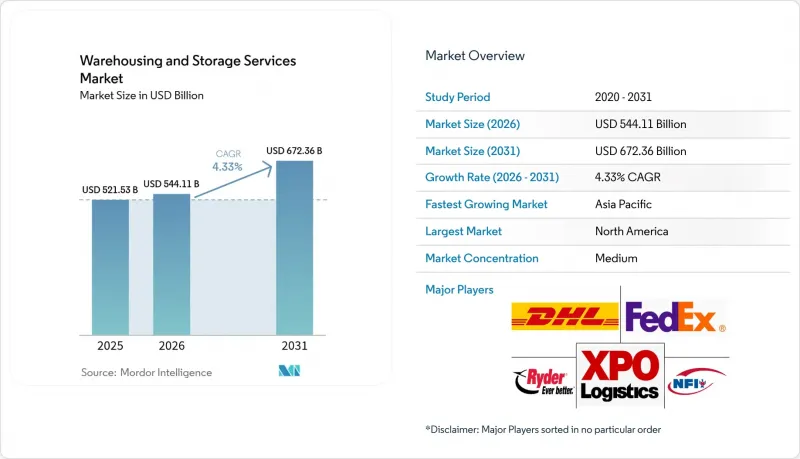
This report is Segmented by Type (General Warehousing and Storage, Refrigerated Warehousing and Storage, and More), Ownership (Private Warehouses, and More), Duration of Storage (Short-Term Storage and Long-Term Storage), End-User Industry (Manufacturing, Consumer Goods, and More), and Geography. The Market Forecasts are Provided in Terms of Value (USD).
Global Warehousing And Storage Services Market Trends and Insights
Rising Omnichannel Fulfillment Requirements
Retailers blend online and in-store inventory pools to give customers flexible pick-up and delivery options, elevating demand for real-time inventory visibility and multi-channel order processing. Operators position facilities closer to dense consumer zones, shrinking delivery windows, and boosting last-mile efficiency. Public warehouses benefit because shared nodes support multiple retailers that lack sufficient volume for a dedicated site. Early adopters integrate predictive analytics that reposition stock automatically, cutting stockouts and markdowns. Technology-enabled hubs quickly reconfigure pick zones to align with shifting demand patterns, solidifying competitiveness.
E-commerce-led Warehouse Demand Boom
Online retail continues to push unprecedented throughput into fulfillment centers, and parcel profiles skew toward smaller, higher-velocity orders requiring automated sorters and goods-to-person robotics. Cold-chain nodes grow because digital grocery and pharmaceutical sales rise, prompting sizable investments in refrigeration controls and condition monitoring. Micro-fulfillment sites below 10,000 square feet proliferate in dense metros, enhancing same-day delivery capabilities while trimming transport miles. Flexible contracts become attractive as brands confront seasonality and promotional spikes. Cross-docking areas expand because businesses favor inventory-light models that move inbound cases directly to outbound docks.
High Capital and Maintenance Outlay
Fully automated warehouses can exceed USD 50 million in initial spend, and annual maintenance often consumes 15-20% of operating budgets because of complex mechatronics and software support. Refrigerated sites require insulated panels, ammonia or CO2 systems, and backup generators, inflating cost profiles relative to dry storage. Rising interest rates elevate hurdle rates for new builds, causing some operators to delay projects or lease instead of own. Robotics-as-a-service contracts ease cash flow but raise long-term expense commitments. Smaller firms lacking collateral struggle to secure financing, thereby slowing technology diffusion across the broader warehousing and storage services market.
Other drivers and restraints analyzed in the detailed report include:
- Expansion of 3PL Outsourcing
- Growth of On-Demand Micro-warehousing Networks
- Shortage of Skilled Warehouse Labor
For complete list of drivers and restraints, kindly check the Table Of Contents.
Segment Analysis
The warehousing and storage services market size attributed to general warehousing stood at USD 271.98 billion in 2025, reflecting a 52.15% share of overall revenues. Refrigerated facilities, while smaller in absolute value, posted the strongest 5.36% CAGR outlook, signaling durable demand from biopharma, frozen foods, and meal-kit services. The warehousing and storage services market share commanded by farm-product warehouses remains stable as export-oriented agriculture requires controlled atmospheres that reduce spoilage. Cold-chain players invest in low-charge ammonia systems that limit refrigerant risk, and automated pallet shuttle racking widens aisle-free storage density, trimming per-case energy usage.
Aging North American cold stores average 37 years and often lack high-bay clearances, prompting modern rebuilds that integrate oxygen-reduction fire systems and digital temperature mapping. Lineage Logistics and Americold funnel capital into multi-tenant facilities linked to rail spurs and port terminals, highlighting intermodal connections as a differentiator. Pharma-grade warehouses secure Good Distribution Practice certification, unlocking premium rate structures that can exceed dry storage tariffs by 2X. Altogether, specialized temperature control underpins value-accretive growth while general warehousing sustains the volume foundation of the warehousing and storage services market.
Public warehouses represented 46.88% of 2025 revenues, anchored by shared-infrastructure economics that appeal to companies with variable demand. Yet the private automated subset expects the fastest 4.83% CAGR as manufacturers and retailers internalize inventory control and extract productivity from robotics at scale. The warehousing and storage services market size for public sites remains significant and provides flexible overflow capacity during demand spikes. Bonded warehouses target importers seeking duty deferral; their occupancy stays resilient near border crossings and free-trade zones.
Sustainability commitments spur private investors to pursue LEED-certified builds that align with corporate climate targets, often adding rooftop solar that offsets autonomous vehicle charging loads. Public operators respond by layering value-added services, such as kitting and reverse logistics, to maintain relevance. Hybrid models emerge where core SKUs sit in automated private hubs while slower movers reside in public space, illustrating nuanced portfolio strategies within the warehousing and storage services market.
Complete Report Scope:
- By Service Type
- General Warehousing and Storage
- Refrigerated Warehousing and Storage
- Farm-Product Warehousing and Storage
- By Ownership
- Private Warehouses
- Public Warehouses
- Bonded Warehouses
- By Duration of Storage
- Short-Term Storage
- Long-Term Storage
- By End-user Industry
- Manufacturing
- Consumer Goods
- Food and Beverage
- Retail and E-commerce
- Healthcare and Pharma
- Other End-user Industries
- By Geography
- North America
- United States
- Canada
- Mexico
- South America
- Brazil
- Argentina
- Rest of South America
- Europe
- Germany
- United Kingdom
- France
- Italy
- Spain
- Rest of Europe
- Asia-Pacific
- China
- Japan
- India
- South Korea
- ASEAN
- Rest of Asia-Pacific
- Middle East and Africa
- Middle East
- Saudi Arabia
- United Arab Emirates
- Rest of Middle East
- Africa
- South Africa
- Egypt
- Rest of Africa
- Middle East
- North America
Geography Analysis
North America retained 31.45% warehousing and storage services market share in 2025, sustained by mature e-commerce networks and dense 3PL ecosystems that assure same-day delivery in most metropolitan areas. Manufacturers' re-shoring to the United States and near-shoring into Mexico intensify demand along the southern border, where cross-border flows make Laredo and El Paso prime warehouse construction zones. Grid connections lag behind automation uptake in legacy buildings, motivating on-site solar installations and micro-grids.
Asia Pacific delivers the fastest 7.21% CAGR through 2031, propelled by India's forecast of more than 300 million square feet of Grade A stock by 2025 and policy incentives that promote logistics parks. Chinese developers follow consumer demand inland, while Belt and Road rail corridors extend regional connectivity. Southeast Asian nations such as Vietnam and Malaysia attract multinational distribution centers that diversify away from single-country dependence. Automated mega-warehouses like the 1.8 million-square-foot Omega 1 Bukit Raja in Malaysia showcase cutting-edge designs hardwired for e-commerce growth.
European operators navigate land scarcity and strict zoning, which lengthen entitlement timelines but also keep vacancy below global averages. Sustainability mandates spur retrofits featuring heat pumps and rooftop photovoltaics as corporate tenants seek carbon-neutral contracts. Eastern European hubs gain traction because of proximity to Western consumers and lower wage bases, complementing resilient port-centric clusters in the Netherlands and Belgium. South America and the Middle East & Africa remain nascent but rising investment in bonded-free zones and food security facilities widens their role in the worldwide warehousing and storage services market.
- DHL International GmbH
- XPO Logistics Inc.
- Ryder System Inc.
- NFI Industries Inc.
- FedEx Corp
- Americold Logistics LLC
- Lineage Logistics Holding LLC
- NF Global Logistics Ltd
- APM Terminals BV
- DSV A/S
- Kane Is Able Inc.
- Mediterranean Shipping Co. (MSC)
- Amazon.com Inc.
- C.H. Robinson Worldwide Inc.
- CEVA Logistics
- GEODIS SA
- GXO Logistics Inc.
- DB Schenker
- CJ Logistics Corp.
- Kerry Logistics Network Ltd.
Additional Benefits:
- The market estimate (ME) sheet in Excel format
- 3 months of analyst support
TABLE OF CONTENTS
1 INTRODUCTION
- 1.1 Study Assumptions and Market Definition
- 1.2 Scope of the Study
2 RESEARCH METHODOLOGY
3 EXECUTIVE SUMMARY
4 MARKET LANDSCAPE
- 4.1 Market Overview
- 4.2 Market Drivers
- 4.2.1 Rising omnichannel fulfilment requirements
- 4.2.2 E-commerce-led warehouse demand boom
- 4.2.3 Expansion of 3PL outsourcing
- 4.2.4 Growth of on-demand micro-warehousing networks
- 4.2.5 ESG-driven retrofitting for energy-efficient warehouses
- 4.2.6 AI-powered dynamic slotting to raise storage densities
- 4.3 Market Restraints
- 4.3.1 High capital and maintenance outlay
- 4.3.2 Shortage of skilled warehouse labour
- 4.3.3 Grid-congestion limiting power availability for automation
- 4.3.4 Cyber-security risks from cloud WMS convergence
- 4.4 Industry Supply-Chain Analysis
- 4.5 Regulatory Landscape
- 4.6 Technological Outlook
- 4.7 Porter's Five Forces Analysis
- 4.7.1 Bargaining Power of Suppliers
- 4.7.2 Bargaining Power of Buyers
- 4.7.3 Threat of New Entrants
- 4.7.4 Threat of Substitutes
- 4.7.5 Intensity of Competitive Rivalry
- 4.8 Assessment of Macro-economic Trends on the Market
5 MARKET SIZE AND GROWTH FORECASTS (VALUE)
- 5.1 By Service Type
- 5.1.1 General Warehousing and Storage
- 5.1.2 Refrigerated Warehousing and Storage
- 5.1.3 Farm-Product Warehousing and Storage
- 5.2 By Ownership
- 5.2.1 Private Warehouses
- 5.2.2 Public Warehouses
- 5.2.3 Bonded Warehouses
- 5.3 By Duration of Storage
- 5.3.1 Short-Term Storage
- 5.3.2 Long-Term Storage
- 5.4 By End-user Industry
- 5.4.1 Manufacturing
- 5.4.2 Consumer Goods
- 5.4.3 Food and Beverage
- 5.4.4 Retail and E-commerce
- 5.4.5 Healthcare and Pharma
- 5.4.6 Other End-user Industries
- 5.5 By Geography
- 5.5.1 North America
- 5.5.1.1 United States
- 5.5.1.2 Canada
- 5.5.1.3 Mexico
- 5.5.2 South America
- 5.5.2.1 Brazil
- 5.5.2.2 Argentina
- 5.5.2.3 Rest of South America
- 5.5.3 Europe
- 5.5.3.1 Germany
- 5.5.3.2 United Kingdom
- 5.5.3.3 France
- 5.5.3.4 Italy
- 5.5.3.5 Spain
- 5.5.3.6 Rest of Europe
- 5.5.4 Asia-Pacific
- 5.5.4.1 China
- 5.5.4.2 Japan
- 5.5.4.3 India
- 5.5.4.4 South Korea
- 5.5.4.5 ASEAN
- 5.5.4.6 Rest of Asia-Pacific
- 5.5.5 Middle East and Africa
- 5.5.5.1 Middle East
- 5.5.5.1.1 Saudi Arabia
- 5.5.5.1.2 United Arab Emirates
- 5.5.5.1.3 Rest of Middle East
- 5.5.5.2 Africa
- 5.5.5.2.1 South Africa
- 5.5.5.2.2 Egypt
- 5.5.5.2.3 Rest of Africa
- 5.5.5.1 Middle East
- 5.5.1 North America
6 COMPETITIVE LANDSCAPE
- 6.1 Market Concentration
- 6.2 Strategic Moves
- 6.3 Market Share Analysis
- 6.4 Company Profiles (includes Global level Overview, Market level overview, Core Segments, Financials as available, Strategic Information, Market Rank/Share for key companies, Products and Services, and Recent Developments)
- 6.4.1 DHL International GmbH
- 6.4.2 XPO Logistics Inc.
- 6.4.3 Ryder System Inc.
- 6.4.4 NFI Industries Inc.
- 6.4.5 FedEx Corp
- 6.4.6 Americold Logistics LLC
- 6.4.7 Lineage Logistics Holding LLC
- 6.4.8 NF Global Logistics Ltd
- 6.4.9 APM Terminals BV
- 6.4.10 DSV A/S
- 6.4.11 Kane Is Able Inc.
- 6.4.12 Mediterranean Shipping Co. (MSC)
- 6.4.13 Amazon.com Inc.
- 6.4.14 C.H. Robinson Worldwide Inc.
- 6.4.15 CEVA Logistics
- 6.4.16 GEODIS SA
- 6.4.17 GXO Logistics Inc.
- 6.4.18 DB Schenker
- 6.4.19 CJ Logistics Corp.
- 6.4.20 Kerry Logistics Network Ltd.
7 MARKET OPPORTUNITIES AND FUTURE OUTLOOK
- 7.1 White-space and Unmet-Need Assessment

