PUBLISHER: Mordor Intelligence | PRODUCT CODE: 2123434

PUBLISHER: Mordor Intelligence | PRODUCT CODE: 2123434
Data Processing And Hosting Services - Market Share Analysis, Industry Trends & Statistics, Growth Forecasts (2026 - 2031)
According to Mordor Intelligence, the data processing and hosting services market size is expected to grow from USD 118.83 billion in 2025 to USD 131.06 billion in 2026 and is forecast to reach USD 213.74 billion by 2031 at 10.29% CAGR over 2026-2031.
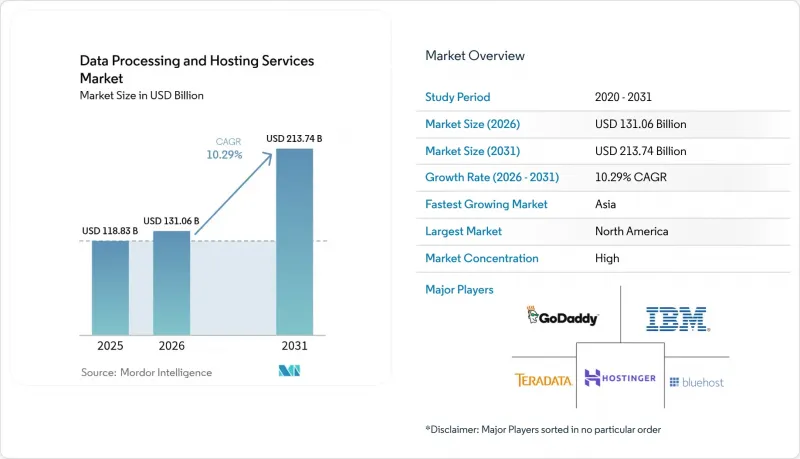
This report is Segmented by Organisation (Large Enterprise and Small and Medium Enterprises [SME]), Offering (Data Processing Services and Hosting Services), Deployment Model (Public Cloud, Private Cloud, and Hybrid and Multi-Cloud), End-User Industry (IT and Telecommunication, BFSI, Retail and E-Commerce, Manufacturing, Healthcare and Life Sciences, and More), and Geography
Global Data Processing And Hosting Services Market Trends and Insights
Growing Migration of Enterprise Workloads to Hyperscale Cloud Data-Centers
Enterprises continue to de-risk capital budgets by shifting mission-critical systems to hyperscale regions, with U.S. datacenter power demand expected to double to 35 GW by 2030. The move is increasingly capability-driven, anchored in access to AI accelerators and managed security services that remain prohibitively expensive on-prem. Pre-lease agreements now secure capacity years ahead of physical handover, particularly in Ashburn, Phoenix, Dublin, and Frankfurt, where power allotments are constrained.
AI/ML Workload Explosion Elevating Demand for High-Density GPU Hosting
By 2025, over 40,000 companies will run production AI on discrete GPUs, raising computational density and cooling requirements. Dedicated GPU clouds such as Lambda and CoreWeave post triple-digit growth as they guarantee H100 and MI300 inventory for training, fine-tuning, and inference workloads.
Power-Grid Instability and Rising Energy Tariffs Limiting Data-Center Expansion
Electricity supply shortfalls and surcharges in South Asia and Africa throttle new builds. Data centers consumed 176 TWh of U.S. power in 2023, or 4.4% of national demand, underscoring the tension between compute growth and grid capacity. Operators pivot to onsite solar-plus-battery and micro-grid solutions, inflating capital requirements and elongating deployment schedules.
Other drivers and restraints analyzed in the detailed report include:
- Proliferation of Edge-Native Applications Requiring Distributed Micro-Hosting
- Emergence of Sovereign-Cloud Mandates Boosting In-Country Hosting
- Data-Sovereignty Conflicts Hindering Cross-Border Hosting
For complete list of drivers and restraints, kindly check the Table Of Contents.
Segment Analysis
Large enterprises controlled 70.35% of 2025 revenue, leveraging deep coffers to modernize mainframes, adopt container orchestration, and spin up global DR replicas. In contrast, SMEs are the fastest movers, accelerating at 11.55% CAGR as simplified migration tooling, marketplace credits, and managed DevOps services flatten technical barriers. In African and Latin American markets, more than 90% of SMEs have adopted digital payments, underscoring widespread digital adoption. Governments subsidize training and cloud vouchers, further broadening reach. The absolute data processing and hosting services market size for SMEs is projected to double by 2030, while their slice of overall spending remains under 30% because large-enterprise estates also keep expanding.
SME cloud maturation creates new partner ecosystems. Resellers bundle point-of-sale, analytics, and local-language support, embedding compute costs into service fees. Advanced observability stacks surface anomalies and auto-apply remediation scripts, mitigating the skill gap that once stymied smaller firms. Those efficiencies, in turn, reinforce subscription renewals and incremental upsell, positioning the SME segment as a durable growth flywheel within the broader data processing and hosting services market.
Hosting services delivered 63.40% of sector revenue in 2025, anchored by reliable compute, storage, and network primitives. The sub-segment of cloud hosting (IaaS, PaaS, SaaS) commands a 13.85% CAGR to 2031, fueled by elastic scaling, bundled APIs, and declining unit pricing as hyperscalers aggregate demand. Customers increasingly favor workload-optimized tiers, GPU clusters for AI, ARM cores for web tier, and z-parity CICS as a service for financial ledgers. Concurrently, professional services revenue grows as firms seek cloud-native redesign, data pipeline refactor, and FinOps governance. Edge and colocation providers embed cloud-like provisioning into portals, blurring the lines between core and distributed hosting. Over time, integrated pipelines that marry data preparation with compute will erode standalone ETL vendors, folding their economics into the data processing and hosting services market gatekeepers.
Financial flexibility remains a draw. Pay-by-the-second billing and sustained-usage credits lower the total cost of ownership. As energy costs fluctuate, workloads re-balance across regions based on real-time power spot prices, a capability accessible only through cloud automation. The result is a structurally higher utilization rate, translating to margin expansion for providers and cost predictability for tenants.
Complete Report Scope:
- By Organisation Size
- Large Enterprises
- Small and Medium Enterprises (SME)
- By Offering
- Data Processing Services
- Data Entry Services
- Data Mining Services
- Data Cleansing and Formatting
- Data Scanning and Indexing
- Managed ETL and Analytics
- Hosting Services
- Shared (Reseller) Hosting
- Virtual Private Server (VPS) Hosting
- Dedicated Server Hosting
- Cloud Hosting
- IaaS
- PaaS
- SaaS
- Managed WordPress Hosting
- Application Hosting
- Colocation and Bare-Metal
- Data Processing Services
- By Deployment Model
- Public Cloud
- Private Cloud
- Hybrid and Multi-Cloud
- By End-user Industry
- IT and Telecommunication
- BFSI
- Retail and E-commerce
- Manufacturing
- Healthcare and Life Sciences
- Media and Entertainment
- Government and Public Sector
- Others (Education, Hospitality, etc.)
- By Geography
- North America
- United States
- Canada
- Mexico
- South America
- Brazil
- Argentina
- Rest of South America
- Europe
- Germany
- United Kingdom
- France
- Rest of Europe
- Middle East
- Saudi Arabia
- UAE
- Turkey
- Rest of Middle East
- Africa
- South Africa
- Nigeria
- Rest of Africa
- Asia Pacific
- China
- India
- Japan
- South Korea
- Rest of Asia Pacific
- North America
Geography Analysis
North America claimed 38.62% of 2025 revenue on the back of vast fiber backbones, generous tax incentives, and dense hyperscale clusters. Loudoun County, Virginia, alone hosts over 30 million square feet of raised floor and is now facing grid-interconnection pauses due to transformer constraints. Providers respond with campus-scale micro-grids, 24X7 renewable PPAs, and reclaimed-heat reuse programs to counter sustainability scrutiny. AWS, Microsoft, and Google collectively earmarked more than USD 255 billion for new U.S. halls in 2025, ensuring the region's capacity lead. Privacy legislation at the state level, such as California CCPA and Texas privacy bills, could demand that data copies remain in-state, subtly reshaping deployment footprints inside the data processing and hosting services market.
Asia records the fastest 13.18% CAGR as 5G proliferation, digital banking, and AI start-up ecosystems converge. Singapore's moratorium on new datacenter permits diverts cap-ex toward Johor, Batam, Bangkok, and Hyderabad, all vying to become the region's latency hubs. Japanese operators exploit underused geothermal in Hokkaido while Chinese hyperscalers replicate domestic super-app stacks to Southeast Asia, blending compute with payments and logistics. Smartphone saturation and real-time translation services multiply data flows, anchoring durable demand.
Europe's sovereignty agenda steers procurement trends. The EU's Digital Europe Programme has allocated EUR 900 million to cloud marketplaces and security centers, catalysing domestic capacity. Germany and France vie for AI training clusters by touting nuclear and hydro power mixes. Gaia-X lays interoperability standards, albeit slower than first envisioned. Nordic states leverage cheap hydroelectricity yet grapple with limited fiber routes; Eastern European states woo investors through special economic zones, though geopolitical risk remains a hurdle. Notably, post-Brexit UK relaxes VAT on datacenter gear, attracting trans-Atlantic investment and reinforcing London's pole position.
- Amazon Web Services Inc.
- Microsoft Corporation (Azure)
- Alphabet Inc. (Google Cloud Platform)
- International Business Machines Corporation
- Alibaba Cloud
- Oracle Corporation
- SAP SE
- Teradata Corporation
- Hewlett Packard Enterprise Development LP
- GoDaddy Operating Company LLC
- Bluehost (Newfold Digital Inc.)
- HostGator.com LLC
- Hostinger International Ltd.
- SiteGround Hosting Ltd.
- A2 Hosting Inc.
- DreamHost LLC
- GreenGeeks LLC
- DigitalOcean Holdings Inc.
- OVHcloud
- Equinix Inc.
- Hetzner Online GmbH
- Cloudflare Inc.
- Salesforce.com Inc.
- Alteryx Inc.
- Cloudera Inc.
Additional Benefits:
- The market estimate (ME) sheet in Excel format
- 3 months of analyst support
TABLE OF CONTENTS
1 INTRODUCTION
- 1.1 Study Assumptions and Market Definition
- 1.2 Scope of the Study
2 RESEARCH METHODOLOGY
3 EXECUTIVE SUMMARY
4 MARKET LANDSCAPE
- 4.1 Market Overview
- 4.2 Market Drivers
- 4.2.1 Growing Migration of Enterprise Workloads to Hyperscale Cloud Data-Centers (North America and Europe)
- 4.2.2 Proliferation of Edge-Native Applications Requiring Distributed Micro-Hosting (Asia and Oceania)
- 4.2.3 Emergence of Sovereign Cloud Mandates Boosting In-Country Hosting (EU and Middle-East)
- 4.2.4 Zero-Trust and Data-Residency Compliance Driving Managed Processing Contracts (BFSI and Healthcare)
- 4.2.5 AI/ML Workload Explosion Elevating Demand for High-Density GPU Hosting (Global)
- 4.2.6 SME Digital-First Strategies Fueling Bundled Processing?Hosting Packages (South America and Africa)
- 4.3 Market Restraints
- 4.3.1 Power-Grid Instability and Rising Energy Tariffs Limiting Data-Center Expansion (Africa and South Asia)
- 4.3.2 Escalating Cloud Egress Fees Creating Vendor-Lock Concerns (Global)
- 4.3.3 Data-Sovereignty Conflicts Hindering Cross-Border Hosting (Europe vs US)
- 4.3.4 Shortage of Certified Cloud Talent Delaying Migration Projects (Nordics and GCC)
- 4.4 Value/Supply-Chain Analysis
- 4.5 Porter's Five Forces Analysis
- 4.5.1 Bargaining Power of Suppliers
- 4.5.2 Bargaining Power of Buyers
- 4.5.3 Threat of New Entrants
- 4.5.4 Threat of Substitutes
- 4.5.5 Competitive Rivalry
- 4.6 Technological Outlook
- 4.6.1 Container-Native Hosting and Kubernetes Automation
- 4.6.2 Serverless Data-Processing Platforms
- 4.6.3 Silicon Specialisation (DPUs/G-chips)
- 4.7 Investment Analysis
- 4.8 Regulatory Outlook
5 MARKET SIZE AND GROWTH FORECASTS (VALUE)
- 5.1 By Organisation Size
- 5.1.1 Large Enterprises
- 5.1.2 Small and Medium Enterprises (SME)
- 5.2 By Offering
- 5.2.1 Data Processing Services
- 5.2.1.1 Data Entry Services
- 5.2.1.2 Data Mining Services
- 5.2.1.3 Data Cleansing and Formatting
- 5.2.1.4 Data Scanning and Indexing
- 5.2.1.5 Managed ETL and Analytics
- 5.2.2 Hosting Services
- 5.2.2.1 Shared (Reseller) Hosting
- 5.2.2.2 Virtual Private Server (VPS) Hosting
- 5.2.2.3 Dedicated Server Hosting
- 5.2.2.4 Cloud Hosting
- 5.2.2.4.1 IaaS
- 5.2.2.4.2 PaaS
- 5.2.2.4.3 SaaS
- 5.2.2.5 Managed WordPress Hosting
- 5.2.2.6 Application Hosting
- 5.2.2.7 Colocation and Bare-Metal
- 5.2.1 Data Processing Services
- 5.3 By Deployment Model
- 5.3.1 Public Cloud
- 5.3.2 Private Cloud
- 5.3.3 Hybrid and Multi-Cloud
- 5.4 By End-user Industry
- 5.4.1 IT and Telecommunication
- 5.4.2 BFSI
- 5.4.3 Retail and E-commerce
- 5.4.4 Manufacturing
- 5.4.5 Healthcare and Life Sciences
- 5.4.6 Media and Entertainment
- 5.4.7 Government and Public Sector
- 5.4.8 Others (Education, Hospitality, etc.)
- 5.5 By Geography
- 5.5.1 North America
- 5.5.1.1 United States
- 5.5.1.2 Canada
- 5.5.1.3 Mexico
- 5.5.2 South America
- 5.5.2.1 Brazil
- 5.5.2.2 Argentina
- 5.5.2.3 Rest of South America
- 5.5.3 Europe
- 5.5.3.1 Germany
- 5.5.3.2 United Kingdom
- 5.5.3.3 France
- 5.5.3.4 Rest of Europe
- 5.5.4 Middle East
- 5.5.4.1 Saudi Arabia
- 5.5.4.2 UAE
- 5.5.4.3 Turkey
- 5.5.4.4 Rest of Middle East
- 5.5.5 Africa
- 5.5.5.1 South Africa
- 5.5.5.2 Nigeria
- 5.5.5.3 Rest of Africa
- 5.5.6 Asia Pacific
- 5.5.6.1 China
- 5.5.6.2 India
- 5.5.6.3 Japan
- 5.5.6.4 South Korea
- 5.5.6.5 Rest of Asia Pacific
- 5.5.1 North America
6 COMPETITIVE LANDSCAPE
- 6.1 Market Concentration
- 6.2 Strategic Moves (MandA, Partnerships, Funding)
- 6.3 Market Share Analysis
- 6.4 Company Profiles {(includes Global level Overview, Market level overview, Core Segments, Financials as available, Strategic Information, Market Rank/Share for key companies, Products and Services, and Recent Developments)}
- 6.4.1 Amazon Web Services Inc.
- 6.4.2 Microsoft Corporation (Azure)
- 6.4.3 Alphabet Inc. (Google Cloud Platform)
- 6.4.4 International Business Machines Corporation
- 6.4.5 Alibaba Cloud
- 6.4.6 Oracle Corporation
- 6.4.7 SAP SE
- 6.4.8 Teradata Corporation
- 6.4.9 Hewlett Packard Enterprise Development LP
- 6.4.10 GoDaddy Operating Company LLC
- 6.4.11 Bluehost (Newfold Digital Inc.)
- 6.4.12 HostGator.com LLC
- 6.4.13 Hostinger International Ltd.
- 6.4.14 SiteGround Hosting Ltd.
- 6.4.15 A2 Hosting Inc.
- 6.4.16 DreamHost LLC
- 6.4.17 GreenGeeks LLC
- 6.4.18 DigitalOcean Holdings Inc.
- 6.4.19 OVHcloud
- 6.4.20 Equinix Inc.
- 6.4.21 Hetzner Online GmbH
- 6.4.22 Cloudflare Inc.
- 6.4.23 Salesforce.com Inc.
- 6.4.24 Alteryx Inc.
- 6.4.25 Cloudera Inc.
7 MARKET OPPORTUNITIES AND FUTURE OUTLOOK
- 7.1 White-space and Unmet-Need Assessment

