PUBLISHER: Mordor Intelligence | PRODUCT CODE: 2123471

PUBLISHER: Mordor Intelligence | PRODUCT CODE: 2123471
Lecture Capture Systems - Market Share Analysis, Industry Trends & Statistics, Growth Forecasts (2026 - 2031)
According to Mordor Intelligence, the lecture capture systems market size was valued at USD 13.65 billion in 2025 and estimated to grow from USD 17.44 billion in 2026 to reach USD 59.39 billion by 2031, at a CAGR of 27.77% during the forecast period (2026-2031).
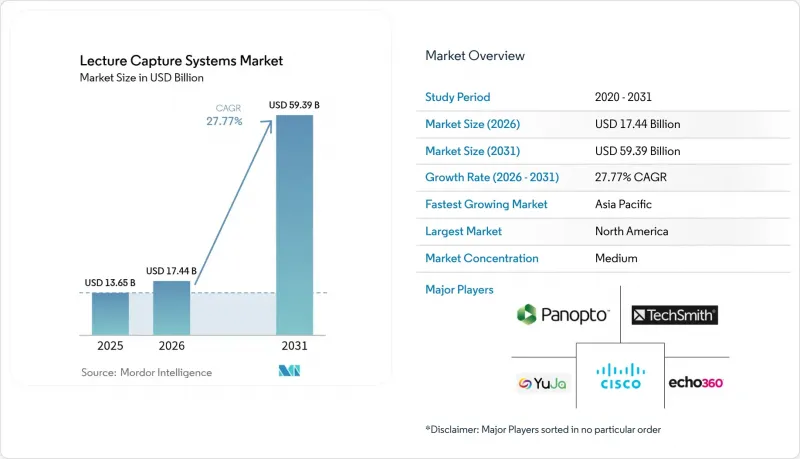
This report is Segmented by Component (Hardware, and Software), Deployment Model (On-Premise, and Cloud), End-User (Higher-Education Institutions, K-12 Schools, Corporates and Enterprises, Government and Public Agencies), Service Type (Professional Services, Integration and Maintenance, Training Services), and Geography. The Market Forecasts are Provided in Terms of Value (USD).
Global Lecture Capture Systems Market Trends and Insights
Rising Demand for Distance and Hybrid Education
Most of chief online-learning officers report continued student preference for flexible learning pathways, and 52% of online programs generate net revenue, up from 47% in 2020. Learners now expect studio-quality video, interactive transcripts, and mobile-optimized playback as table stakes. Vendors respond by integrating multilingual auto-captioning based on OpenAI Whisper and sentiment-analysis APIs that flag disengagement. Hybrid models therefore drive a distinct revenue stream that demands specialized content-production workflows. Institutions that ignore quality thresholds risk erosion of enrollment to competitors that package instruction asynchronously.
Government-Led Digital-Learning Initiatives
The U.S. Digital Equity Act directs USD 811 million toward connectivity, Germany's Digital Pact 2.0 allocates EUR 2.5 billion, and South Korea designates USD 276 million for classroom digitization. Japan pilots generative-AI content across 52 schools, indicating a shift from device provisioning to algorithm-based instruction. Subsidies lower adoption risk but introduce region-specific compliance mandates such as FERPA or GDPR, forcing vendors to maintain localized SKUs. Such fragmentation increases development costs but expands the addressable demand.
Data-Privacy and Compliance Hurdles
The FTC levied USD 91.5 million against University of Phoenix in 2024 and USD 5.8 million against Chegg in 2022, demonstrating an appetite for strict enforcement. Most of higher-education institutions suffered breaches in 2024, incurring average costs of USD 3.86 million. The EU AI Act restricts biometric surveillance, compelling vendors to disable facial recognition. These pressures prolong procurement cycles and tilt preference toward suppliers offering indemnification clauses.
Other drivers and restraints analyzed in the detailed report include:
- Corporate Upskilling and Compliance Training Spend
- AI-Driven Micro-Credential Analytics Adoption
- High Up-Front Hardware and Integration Costs
For complete list of drivers and restraints, kindly check the Table Of Contents.
Segment Analysis
In 2025, software dominated the lecture capture systems market, holding a 65.12% share. Meanwhile, cloud delivery is projected to grow at a robust 28.67% CAGR, continuing through 2031. This trajectory reflects institutions prioritizing cloud-native video management suites that include AI captioning and engagement analytics. Hardware contributed the remaining USD 4.76 billion and faces pressure from commoditization as inexpensive webcams and mobile devices satisfy entry-level capture needs. Software-driven offerings deliver gross margins of 70% to 80%, supporting aggressive reinvestment in R&D, whereas hardware carries thinner margins, constrained by supply-chain volatility. Vendors therefore champion "software-first" roadmaps that offload encoding and storage to the cloud, anchoring recurring revenue streams that underpin higher valuations.
Moderate hardware demand endures in flagship lecture theaters where multi-camera switching, balanced audio, and redundant recording remain essential. Epiphan's Pearl Nexus rack-mount encoder, certified with Panopto in January 2024, illustrates hardware's pivot toward high-density enterprise installations. Yet software's rapid gains confirm that institutions value agility over appliance ownership, reinforcing the software premium within the lecture capture systems market.
On-premise deployments represented 53.85% of 2025 revenue but now grow in single digits. Cloud-hosted platforms are projected to grow at a 28.95% CAGR to 2031, driven by elastic scaling, lower maintenance costs, and tight LMS integrations that reduce IT workload. Institutions with unpredictable enrollment, especially during periods of MOOC or executive education peaks, leverage usage-based pricing to avoid capital overspending. However, the GDPR and China's Personal Information Protection Law necessitate localized data centers, which delays wholesale migration. Hybrid models that combine on-premise capture with cloud archiving have therefore gained favor, helping campuses comply with residency mandates while leveraging cloud-based AI services for transcription and analytics.
As vendors bolster zero-trust architectures and secure SOC 2 Type II certifications, cloud apprehension gradually eases. Still, latency-sensitive engagements such as live polling preserve an on-premise niche. The balance of cost, compliance, and user experience will dictate deployment choices as the lecture capture systems market matures.
Complete Report Scope:
- By Component
- Hardware
- Software
- By Deployment Model
- On-premise
- Cloud
- By End-User
- Higher-education Institutions
- K-12 Schools
- Corporates and Enterprises
- Government and Public Agencies
- By Service Type
- Professional Services
- Integration and Maintenance
- Training Services
- By Geography
- North America
- United States
- Canada
- South America
- Brazil
- Mexico
- Argentina
- Rest of South America
- Europe
- Germany
- United Kingdom
- France
- Italy
- Rest of Europe
- Asia-Pacific
- China
- Japan
- India
- South Korea
- Rest of Asia-Pacific
- Middle East and Africa
- Middle East
- United Arab Emirates
- Saudi Arabia
- Rest of Middle East
- Africa
- South Africa
- Nigeria
- Rest of Africa
- Middle East
- North America
Geography Analysis
North America accounted for 38.10% revenue in 2025, supported by USD 811 million from the U.S. Digital Equity Act and Canada's CAD 39.2 million CanCode investment. Continued hybrid learning demand underpins license renewals; however, many institutions now enter refresh rather than expansion cycles. Budget restrictions, 61% of organizations reported flat or declining L&D allocations, curb upsell opportunities. Meanwhile, heightened data-privacy enforcement following the University of Phoenix settlement compels vendors to embed FERPA-aligned controls at the core of product architectures.
The Asia-Pacific region is projected to grow at a 28.60% CAGR, the fastest worldwide. South Korea's USD 276 million classroom initiative, Japan's generative-AI pilots, and India's National Education Policy 2020 collectively drive volume. Localization challenges abound: China demands onshore data hosting under its personal-information statute, while Japan favors licensed domestic cloud zones. Vendors must therefore field region-specific instances and language packs to capture share, increasing operational complexity across the lecture capture systems market.
Europe shows steady momentum on the back of Germany's EUR 2.5 billion Digital Pact 2.0 and EU Digital Europe funding. Yet stringent GDPR requirements suppress rapid cloud migration. The EU AI Act bans certain biometric functions in classrooms, forcing feature roll-backs that slow deployment. Emerging regions, including South America and the Middle East, gain traction through World Bank-backed digital-education grants, though inconsistent broadband and power reliability sustain preference for download-first workflow.
- Panopto Inc.
- YuJa Corporation
- TechSmith Corporation
- Echo360 Inc.
- Cisco Systems, Inc.
- Kaltura Inc.
- Haivision Systems Inc.
- Sonic Foundry, Inc.
- VBrick Systems, Inc.
- Streamitup Ltd.
- Crestron Electronics, Inc.
- Cattura Video Inc.
- Epiphan Systems Inc.
- Telestream LLC
- Qumu Corporation
- UbiCast SAS
- Matrox Electronic Systems Ltd.
- Lumens Digital Optics Inc.
- ShareStream Educational Resources LLC
- Poly Communications LLC
- NewTek Inc.
- Teltek Video Research SL
- VIDIZMO LLC
- Winnov Inc.
Additional Benefits:
- The market estimate (ME) sheet in Excel format
- 3 months of analyst support
TABLE OF CONTENTS
1 INTRODUCTION
- 1.1 Study Assumptions and Market Definition
- 1.2 Scope of the Study
2 RESEARCH METHODOLOGY
3 EXECUTIVE SUMMARY
4 MARKET LANDSCAPE
- 4.1 Market Overview
- 4.2 Market Drivers
- 4.2.1 Rising Demand For Distance And Hybrid Education
- 4.2.2 Government-Led Digital-Learning Initiatives
- 4.2.3 Corporate Upskilling And Compliance Training Spend
- 4.2.4 AI-Driven Micro-Credential Analytics Adoption
- 4.2.5 Growth Of Micro-Learning And Short-Form Video
- 4.2.6 LMS-Talent-Platform Integration Unlocking ROI
- 4.3 Market Restraints
- 4.3.1 Data-Privacy And Compliance Hurdles
- 4.3.2 High Up-Front Hardware And Integration Costs
- 4.3.3 Faculty Push-Back Over Performance Scrutiny
- 4.3.4 Fragmented AV Standards And Interoperability Gaps
- 4.4 Industry Value Chain Analysis
- 4.5 Regulatory Landscape
- 4.6 Technological Outlook
- 4.7 Porter's Five Forces Analysis
- 4.7.1 Threat of New Entrants
- 4.7.2 Threat of Substitutes
- 4.7.3 Bargaining Power of Buyers
- 4.7.4 Bargaining Power of Suppliers
- 4.7.5 Competitive Rivalry
5 MARKET SIZE AND GROWTH FORECASTS (VALUE)
- 5.1 By Component
- 5.1.1 Hardware
- 5.1.2 Software
- 5.2 By Deployment Model
- 5.2.1 On-premise
- 5.2.2 Cloud
- 5.3 By End-User
- 5.3.1 Higher-education Institutions
- 5.3.2 K-12 Schools
- 5.3.3 Corporates and Enterprises
- 5.3.4 Government and Public Agencies
- 5.4 By Service Type
- 5.4.1 Professional Services
- 5.4.2 Integration and Maintenance
- 5.4.3 Training Services
- 5.5 By Geography
- 5.5.1 North America
- 5.5.1.1 United States
- 5.5.1.2 Canada
- 5.5.2 South America
- 5.5.2.1 Brazil
- 5.5.2.2 Mexico
- 5.5.2.3 Argentina
- 5.5.2.4 Rest of South America
- 5.5.3 Europe
- 5.5.3.1 Germany
- 5.5.3.2 United Kingdom
- 5.5.3.3 France
- 5.5.3.4 Italy
- 5.5.3.5 Rest of Europe
- 5.5.4 Asia-Pacific
- 5.5.4.1 China
- 5.5.4.2 Japan
- 5.5.4.3 India
- 5.5.4.4 South Korea
- 5.5.4.5 Rest of Asia-Pacific
- 5.5.5 Middle East and Africa
- 5.5.5.1 Middle East
- 5.5.5.1.1 United Arab Emirates
- 5.5.5.1.2 Saudi Arabia
- 5.5.5.1.3 Rest of Middle East
- 5.5.5.2 Africa
- 5.5.5.2.1 South Africa
- 5.5.5.2.2 Nigeria
- 5.5.5.2.3 Rest of Africa
- 5.5.5.1 Middle East
- 5.5.1 North America
6 COMPETITIVE LANDSCAPE
- 6.1 Market Concentration
- 6.2 Strategic Moves
- 6.3 Market Share Analysis
- 6.4 Company Profiles (includes Global level Overview, Market level overview, Core Segments, Financials as available, Strategic Information, Market Rank/Share for key companies, Products and Services, and Recent Developments)
- 6.4.1 Panopto Inc.
- 6.4.2 YuJa Corporation
- 6.4.3 TechSmith Corporation
- 6.4.4 Echo360 Inc.
- 6.4.5 Cisco Systems, Inc.
- 6.4.6 Kaltura Inc.
- 6.4.7 Haivision Systems Inc.
- 6.4.8 Sonic Foundry, Inc.
- 6.4.9 VBrick Systems, Inc.
- 6.4.10 Streamitup Ltd.
- 6.4.11 Crestron Electronics, Inc.
- 6.4.12 Cattura Video Inc.
- 6.4.13 Epiphan Systems Inc.
- 6.4.14 Telestream LLC
- 6.4.15 Qumu Corporation
- 6.4.16 UbiCast SAS
- 6.4.17 Matrox Electronic Systems Ltd.
- 6.4.18 Lumens Digital Optics Inc.
- 6.4.19 ShareStream Educational Resources LLC
- 6.4.20 Poly Communications LLC
- 6.4.21 NewTek Inc.
- 6.4.22 Teltek Video Research SL
- 6.4.23 VIDIZMO LLC
- 6.4.24 Winnov Inc.
7 MARKET OPPORTUNITIES AND FUTURE OUTLOOK
- 7.1 White-space and Unmet-Need Assessment

