PUBLISHER: Mordor Intelligence | PRODUCT CODE: 2123486

PUBLISHER: Mordor Intelligence | PRODUCT CODE: 2123486
Foldable Smartphone - Market Share Analysis, Industry Trends & Statistics, Growth Forecasts (2026 - 2031)
According to Mordor Intelligence, the foldable smartphone market size is expected to increase from USD 31.37 billion in 2025 to USD 38.68 billion in 2026 and reach USD 110.19 billion by 2031, growing at a CAGR of 23.29% over 2026-2031.
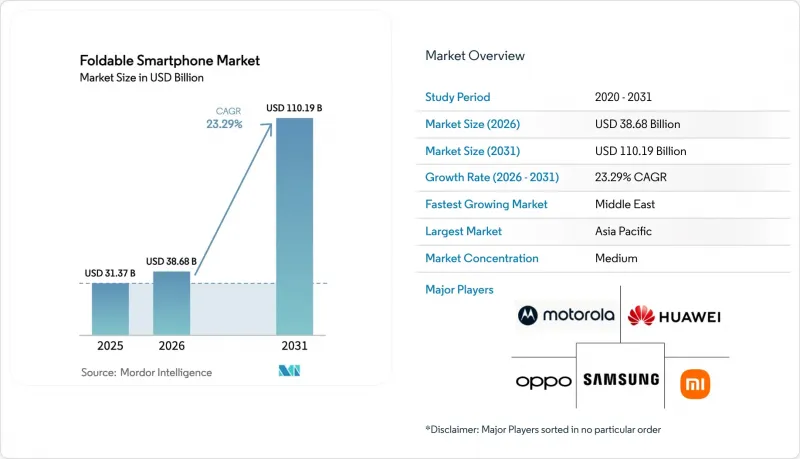
This report is Segmented by Form Factor (Clamshell, Book-Style, and More), Screen Size (<=6. 9 Inch, 7-8 Inch, and More Than 8 Inch), Price Range (Less Than USD 1, 000, USD 1, 000-1, 499, and More), Sales Channel (Carrier/Operator, Consumer Electronics Retail, and E-commerce/DTC), End User (Consumer, and Government/Defense), and Geography. The Market Forecasts are Provided in Terms of Value (USD).
Global Foldable Smartphone Market Trends and Insights
Rapid Advancements in Ultra-Thin Glass Yield Rates
Ultra-thin-glass yield improvements from 60% in 2023 to 85% in 2025 cut scrap costs and enabled sub-USD 1,000 models for emerging markets without eroding gross margins. Samsung Display and Corning achieved 30 micrometer substrates via precision chemical etching, reducing dependence on polyimide films that scratch easily. As yields approach 90% by 2027, the cost gap between foldable and conventional flagship displays is projected to shrink below 15%, paving the path for broader adoption.
Declining Per-Unit Cost of Flexible AMOLED Panels
A 30% price drop between 2024 and 2025 followed BOE and Visionox capacity expansions that added 50,000 m2 of Gen-6 OLED lines and Samsung Display's low-temperature polycrystalline oxide licensing program. Cheaper panels now support 120 Hz and HDR10+ on mid-tier devices, absorb tariff volatility, and align with EU energy directives, as OLED manufacturing consumes 40% less energy than LCD.
Sub-200k Cycle Hinge Durability Concerns in Humid Tropics
Field reports from Indonesia and coastal India show hinges failing within 18 months, three times the claim-rate of temperate markets, due to corrosion from sustained 80% humidity. OEMs face elevated warranty costs and explore sealed or coated mechanisms that increase weight and bill-of-materials.
Other drivers and restraints analyzed in the detailed report include:
- Carrier Subsidization Strategies for Premium 5G Plans
- Enterprise Demand for Foldables to Support Field-Productivity Apps in Logistics Sector
- Volatile Import Tariffs on Flexible OLED Components in Key Emerging Markets
For complete list of drivers and restraints, kindly check the Table Of Contents.
Segment Analysis
Book-style units held 62.31% of 2025 foldable smartphone market share, anchored by Samsung's Galaxy Z Fold line and Huawei's Mate X series. Rollable displays from OPPO and Motorola, growing at 24.21% CAGR, promise crease-free expansion from 6.7 inches to 7.4 inches without added thickness, positioning the foldable smartphone market for another wave of form-factor disruption.
Folding clamshells, prized for pocketability, sustain demand among fashion-forward buyers, while outward-fold designs remain niche due to screen-protection challenges. Tri-fold prototypes hint at future 10-inch displays that could further enlarge the foldable smartphone market size for productivity-oriented professionals.
The 7-8 inch bracket generated 44.34% of 2025 revenue as customers used single devices to replace tablets, and models exceeding 8 inches are slated for a 25.76% CAGR to 2031. These gains underline a strategic pivot within the foldable smartphone market toward bigger canvases that accommodate side-by-side applications.
Clamshells below 6.9 inches endure for portability, but enterprise buyers gravitate to 7-8 inch devices where foldable smartphone market size expansion aligns with ERP and video-conferencing use cases. Screen-ratio experimentation, such as 21:9 unfolded versus 25:9 folded, aims to balance usability and thickness.
Complete Report Scope:
- By Form Factor
- Clamshell (Vertical Fold)
- Book-Style (Horizontal Fold)
- Outward Fold
- Rollable/Slide-out
- By Screen Size
- Less than Equal 6.9 inch
- 7 - 8 inch
- Greater than to 8 inch
- By Price Range
- Less than USD 1,000
- USD 1,000 - 1,499
- USD 1,500 - 1,999
- Greater than equal USD 2,000
- By Sales Channel
- Carrier/Operator Stores
- Consumer Electronics and Specialty Retail
- E-commerce/Direct-to-Consumer
- By End User
- Consumer
- Enterprise/Corporate
- Government and Defense
- By Geography
- North America
- United States
- Canada
- Mexico
- Europe
- Germany
- United Kingdom
- France
- Italy
- Spain
- Russia
- Rest of Europe
- Asia Pacific
- China
- Japan
- India
- South Korea
- ASEAN
- Australia and New Zealand
- Rest of Asia Pacific
- South America
- Brazil
- Argentina
- Rest of South America
- Middle East
- Saudi Arabia
- UAE
- Turkey
- Rest of Middle East
- Africa
- South Africa
- Nigeria
- Rest of Africa
- North America
Geography Analysis
Asia-Pacific captured 54.84% of 2025 revenue, as Huawei, Honor, Xiaomi, and Oppo shipped over 8 million units in three quarters despite chipset supply constraints, underscoring how local ecosystems power foldable smartphone market leadership. China's Mate XT tri-fold sold out at CNY 19,999 (USD 2870.78), South Korea enjoys high per-capita uptake, and India's tariff relief in March 2025 trimmed costs, though price remains a hurdle for mass buyers. Southeast Asia's rising incomes and carrier subsidies are widening the foldable smartphone market, yet hinge failures in humid climates are tempering momentum.
The Middle East exhibits the highest CAGR of 23.43%, propelled by Vision 2030 digitization targets and zero-down carrier bundles that place USD 1,800 devices within the reach of affluent consumers. Saudi Arabia's Public Investment Fund earmarked USD 500 million for digital government services, creating procurement opportunities that will expand the foldable smartphone market across the enterprise and public sectors.
North America accounts for roughly 22% of 2025 revenue; Samsung's 64% share is maintained through partnerships with Verizon, AT&T, and T-Mobile, though Google's Pixel 9 Pro Fold launches at USD 1,799 with limited channel reach. Europe mirrors this premium profile, while Latin America and Africa collectively stay below 5% share because of tariffs and currency risk, suggesting future growth will depend on local assembly and enterprise seeding.
- Samsung Electronics Co. Ltd.
- Huawei Technologies Co. Ltd.
- Motorola Mobility LLC (Lenovo)
- Xiaomi Corp.
- Oppo Co. Ltd.
- vivo Communication Technology Co. Ltd.
- Royole Corp.
- Honor Device Co. Ltd.
- TCL Technology Group Corp.
- ZTE Corporation
- Google LLC
- Microsoft Corp.
- Sony Corp.
- LG Electronics Inc.
- Apple Inc.
- TECNO Mobile Ltd.
- OnePlus Technology (Shenzhen) Co. Ltd.
- Energizer Holdings Inc.
- Sharp Corp.
- BOE Technology Group Co. Ltd.
- Visionox Technology Inc.
- Kyocera Corp.
Additional Benefits:
- The market estimate (ME) sheet in Excel format
- 3 months of analyst support
TABLE OF CONTENTS
1 INTRODUCTION
- 1.1 Study Assumptions
- 1.2 Scope of the Study
2 RESEARCH METHODOLOGY
3 EXECUTIVE SUMMARY
4 MARKET LANDSCAPE
- 4.1 Market Overview
- 4.2 Market Drivers
- 4.2.1 Rapid Advancements in Ultra-Thin Glass Yield Rates
- 4.2.2 Carrier Subsidization Strategies for Premium 5G Plans
- 4.2.3 Enterprise Demand for Foldables to Support Field-Productivity Apps in Logistics Sector
- 4.2.4 Content-Streaming Partnerships Requiring Wider Aspect Ratios
- 4.2.5 Declining Per-Unit Cost of Flexible AMOLED Panels
- 4.2.6 Emergence of Foldable-Specific Mobile Gaming Titles Monetized via In-App Purchases
- 4.3 Market Restraints
- 4.3.1 Sub-200 k Cycle Hinge Durability Concerns in Humid Tropics
- 4.3.2 Limited App Optimization for Multi-Window Foldable UI
- 4.3.3 Supply-Chain Bottlenecks for UTG and Hinge Components (Post-2023 Taiwan Quake)
- 4.3.4 Volatile Import Tariffs on Flexible OLED Components in Key Emerging Markets
- 4.4 Industry Value Chain Analysis
- 4.5 Regulatory Outlook
- 4.6 Technological Outlook
- 4.7 Folding Smartphone Technology Scenario
- 4.7.1 Folding Display Panel Overview
- 4.7.2 Foldable Smartphone Convertibility
- 4.7.3 RandD Investment and Industry Policies
- 4.7.4 Foldable Smartphone Compatibility
- 4.7.4.1 Software Compatibility
- 4.7.4.2 Hardware Compatibility
- 4.8 Porter's Five Forces Analysis
- 4.8.1 Threat of New Entrants
- 4.8.2 Bargaining Power of Buyers
- 4.8.3 Bargaining Power of Suppliers
- 4.8.4 Threat of Substitute Products
- 4.8.5 Intensity of Competitive Rivalry
5 MARKET SIZE AND GROWTH FORECASTS (VALUE)
- 5.1 By Form Factor
- 5.1.1 Clamshell (Vertical Fold)
- 5.1.2 Book-Style (Horizontal Fold)
- 5.1.3 Outward Fold
- 5.1.4 Rollable/Slide-out
- 5.2 By Screen Size
- 5.2.1 Less than Equal 6.9 inch
- 5.2.2 7 - 8 inch
- 5.2.3 Greater than to 8 inch
- 5.3 By Price Range
- 5.3.1 Less than USD 1,000
- 5.3.2 USD 1,000 - 1,499
- 5.3.3 USD 1,500 - 1,999
- 5.3.4 Greater than equal USD 2,000
- 5.4 By Sales Channel
- 5.4.1 Carrier/Operator Stores
- 5.4.2 Consumer Electronics and Specialty Retail
- 5.4.3 E-commerce/Direct-to-Consumer
- 5.5 By End User
- 5.5.1 Consumer
- 5.5.2 Enterprise/Corporate
- 5.5.3 Government and Defense
- 5.6 By Geography
- 5.6.1 North America
- 5.6.1.1 United States
- 5.6.1.2 Canada
- 5.6.1.3 Mexico
- 5.6.2 Europe
- 5.6.2.1 Germany
- 5.6.2.2 United Kingdom
- 5.6.2.3 France
- 5.6.2.4 Italy
- 5.6.2.5 Spain
- 5.6.2.6 Russia
- 5.6.2.7 Rest of Europe
- 5.6.3 Asia Pacific
- 5.6.3.1 China
- 5.6.3.2 Japan
- 5.6.3.3 India
- 5.6.3.4 South Korea
- 5.6.3.5 ASEAN
- 5.6.3.6 Australia and New Zealand
- 5.6.3.7 Rest of Asia Pacific
- 5.6.4 South America
- 5.6.4.1 Brazil
- 5.6.4.2 Argentina
- 5.6.4.3 Rest of South America
- 5.6.5 Middle East
- 5.6.5.1 Saudi Arabia
- 5.6.5.2 UAE
- 5.6.5.3 Turkey
- 5.6.5.4 Rest of Middle East
- 5.6.6 Africa
- 5.6.6.1 South Africa
- 5.6.6.2 Nigeria
- 5.6.6.3 Rest of Africa
- 5.6.1 North America
6 COMPETITIVE LANDSCAPE
- 6.1 Market Concentration
- 6.2 Strategic Moves
- 6.3 Market Share Analysis
- 6.4 Company Profiles (includes Global Level Overview, Market Level Overview, Core Segments, Financials as Available, Strategic Information, Market Rank/Share for Key Companies, Products and Services, and Recent Developments)
- 6.4.1 Samsung Electronics Co. Ltd.
- 6.4.2 Huawei Technologies Co. Ltd.
- 6.4.3 Motorola Mobility LLC (Lenovo)
- 6.4.4 Xiaomi Corp.
- 6.4.5 Oppo Co. Ltd.
- 6.4.6 vivo Communication Technology Co. Ltd.
- 6.4.7 Royole Corp.
- 6.4.8 Honor Device Co. Ltd.
- 6.4.9 TCL Technology Group Corp.
- 6.4.10 ZTE Corporation
- 6.4.11 Google LLC
- 6.4.12 Microsoft Corp.
- 6.4.13 Sony Corp.
- 6.4.14 LG Electronics Inc.
- 6.4.15 Apple Inc.
- 6.4.16 TECNO Mobile Ltd.
- 6.4.17 OnePlus Technology (Shenzhen) Co. Ltd.
- 6.4.18 Energizer Holdings Inc.
- 6.4.19 Sharp Corp.
- 6.4.20 BOE Technology Group Co. Ltd.
- 6.4.21 Visionox Technology Inc.
- 6.4.22 Kyocera Corp.
7 MARKET OPPORTUNITIES AND FUTURE OUTLOOK
- 7.1 White-space and Unmet-Need Assessment

