PUBLISHER: Mordor Intelligence | PRODUCT CODE: 2123552

PUBLISHER: Mordor Intelligence | PRODUCT CODE: 2123552
Laboratory Gas Generators - Market Share Analysis, Industry Trends & Statistics, Growth Forecasts (2026 - 2031)
According to Mordor Intelligence, the laboratory gas generators market size is estimated at USD 567.34 million in 2026, and is expected to reach USD 781.73 million by 2031, at a CAGR of 6.62% during the forecast period (2026-2031).
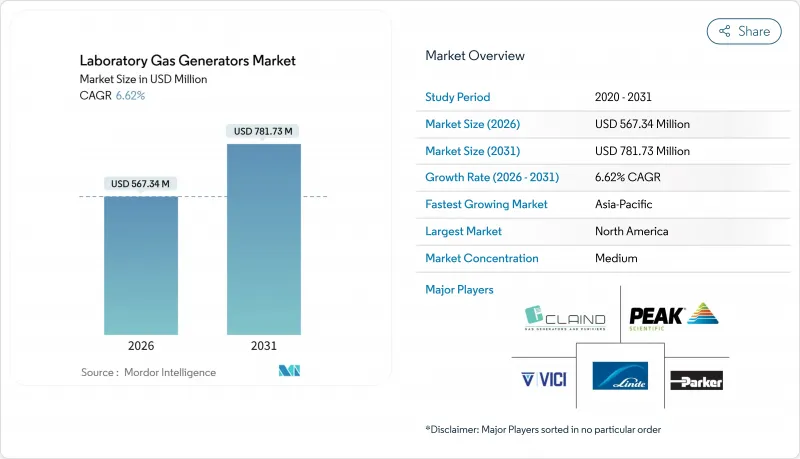
This report is Segmented by Gas Type (Nitrogen Gas Generators, Hydrogen Gas Generators, and More), Application (Gas Chromatography, and More), Technology (Pressure-Swing Adsorption (PSA), and More), End User (Pharmaceutical & Biotechnology, and More), and Geography (North America, Europe, Asia-Pacific, Middle East & Africa, South America). The Market Forecasts are Provided in Terms of Value (USD).
Global Laboratory Gas Generators Market Trends and Insights
Rising Safety Concerns Over Conventional Gas Cylinders
Laboratory incidents involving high-pressure cylinders have intensified regulatory attention, and OSHA 1910.101 compliance adds USD 2,000-USD 5,000 per cylinder each year. Frequent inspections mandated by NIST and NIH inflate operating budgets by 22% relative to on-site units that avoid handling risk. Insurance premiums rise 15-30% for facilities storing more than 50 cylinders. Nitrogen and hydrogen generators operate below 10 bar, reducing the probability of catastrophic failure by an order of magnitude. Because generators are considered fixed assets, they are exempt from Department of Transportation placarding, which simplifies logistics and accelerates the acceptance process.
Growing Adoption of Analytical Techniques in Drug & Food Approvals
FDA's Laboratory Flexible Funding Model makes chromatography and mass spectrometry mandatory in pharmaceutical quality control, pushing demand for continuous nitrogen streams. Agilent booked USD 513 million in LC/MS revenue in Q4 2024, while Waters logged USD 265 million in LC system sales in Q3 2024, indicating sustained growth in instrumentation. EFSA's updated validation guide similarly compels European food labs to deploy chromatography. Each LC-MS platform consumes up to 25 L min-1 of nitrogen, resulting in annual cylinder costs exceeding USD 12,000, which on-site systems recoup within 18 months. The result is a pronounced shift toward the adoption of generators across regulated environments.
Reluctance To Replace Established Gas-Cylinder Infrastructure
Capital outlays of USD 25,000-80,000 per generator deter switchovers when existing cylinder contracts include multiyear price locks. Volume rebates and deferred billing from cylinder suppliers conceal lifecycle economics, while generator vendors often demand upfront commitments. Legacy laboratories usually lack sufficient electrical capacity or floor space for PSA or PEM units, making upgrades costly and complex. Analytical method revalidation, as required by FDA 21 CFR Part 11 and ISO 17025, can consume 400 labor hours, further delaying payback. Risk-averse quality teams frequently postpone adoption, sustaining cylinder demand despite higher per-liter costs.
Other drivers and restraints analyzed in the detailed report include:
- Escalating R&D Spending Among Life-Science & Semiconductor Fabs
- Surging Demand for On-Site Hydrogen as Helium Substitute
- Raw-Material Supply Risk for PEM Catalyst Metals
For complete list of drivers and restraints, kindly check the Table Of Contents.
Segment Analysis
Nitrogen systems generated 42.81% of 2025 revenue, reflecting their ubiquity in LC-MS workflows across pharmaceutical quality control and food safety. Hydrogen units are expected to be the fastest risers, with a 7.86% CAGR through 2031, as chromatographers switch to carrier gas in response to helium scarcity. Zero-air generators serve flame-ionization detectors that require hydrocarbon levels below 0.1 ppm, ensuring compliance with EPA Method 8015. TOC and oxygen generators address water system validation and cell culture demands in biologics production. Each technology presents a distinct purity-versus-cost profile that laboratories align with instrument specifications.
Helium market volatility continues to elevate total operating costs, strengthening the case for hydrogen. Palladium-membrane designs such as Parker Hannifin ChromGas H2F achieve 99.9995% purity, satisfying trace detection limits in pesticide or pharmaceutical impurity assays. Nitrogen remains dominant in regulated LC-MS environments that prioritize reliability, while hydrogen gains a share in academic and environmental labs seeking lower operating expenses. Zero-air and TOC oxygen systems remain smaller niches but are growing as food-safety frameworks expand.
Gas chromatography accounted for 33.73% of 2025 revenue due to its entrenched usage in petrochemical, environmental, and food laboratories. GC-MS is forecasted to advance at an annual rate of 8.38% through 2031, driven by ICH Q3D, which promotes pharmaceutical impurity profiling. LC-MS setups, which each consume up to 25 L min-1 of nitrogen, double gas demand compared with stand-alone LC instruments. Gas analyzers and spectroscopy systems extend the use of generators into process analytical technology arenas.
Waters Corporation's USD 265 million in LC sales in Q3 2024 underscores the momentum behind ultra-high-performance platforms. Food-safety laboratories are accelerating the adoption of GC-MS because EFSA now mandates chromatography for pesticide and mycotoxin screening. Each GC-MS requires a sustained hydrogen carrier gas and zero air for FID detection, making on-site generation an attractive option. Process analyzers in bioprocessing rely on nitrogen purges to prevent oxidation artifacts, creating additional pull for high-flow PSA units.
Complete Report Scope:
- By Gas Type
- Nitrogen Gas Generators
- Hydrogen Gas Generators
- Zero-Air Generators
- TOC/Oxygen & Other Gas Generators
- By Application
- Gas Chromatography
- LC-MS
- GC-MS
- Gas Analyzers & Spectroscopy
- By Technology
- Pressure-Swing Adsorption (PSA)
- Membrane Separation
- Electrolytic (PEM / Alkaline)
- Catalytic Reforming & Others
- By End User
- Pharmaceutical & Biotechnology Companies
- Food & Beverage Companies
- Academic & Research Institutes
- Other End Users
- By Geography
- North America
- United States
- Canada
- Mexico
- Europe
- Germany
- United Kingdom
- France
- Italy
- Spain
- Rest of Europe
- Asia-Pacific
- China
- Japan
- India
- Australia
- South Korea
- Rest of Asia-Pacific
- Middle East & Africa
- GCC
- South Africa
- Rest of Middle East & Africa
- South America
- Brazil
- Argentina
- Rest of South America
- North America
Geography Analysis
North America accounted for 36.26% of 2025 revenue, primarily driven by CHIPS incentives that fund nitrogen infrastructure for new semiconductor fabs requiring flows exceeding 50,000 m3 h-1. TSMC's USD 65 billion Arizona complex features multiple PSA trains that replace cylinder logistics, resulting in a 40% reduction in Scope 1 carbon emissions. Pharmaceutical hubs in Massachusetts and California installed more than 200 LC-MS units in 2025, each drawing up to 25 L min-1 of nitrogen, further bolstering generator uptake. Canada leverages National Research Council grants, while Mexico's near-shoring boom raises food-safety testing needs that require zero-air and hydrogen units.
Asia-Pacific will post a 9.01% CAGR through 2031, led by Shimadzu's Suzhou expansion for biopharma instruments and Thermo Fisher's new analytical factories in India. China's USD 40 billion in pharmaceutical R&D in 2024 drove double-digit LC-MS installations, while domestic PSA vendors undercut imports by 30% on price. South Korea's fabs operated by Samsung adopt redundant PSA systems to guarantee five-nines uptime. India's tier-2 cities install generators to meet the Food Safety and Standards Authority's requirements, thereby bypassing fragile cylinder supply chains.
Europe's share slips as ISO 8573 compliance elevates cylinder costs, nudging labs toward on-site generation. The Middle East experiences grid instability, which led to a 220 million-person blackout in Pakistan in 2023; therefore, laboratories pair generators with UPS systems. South American food exporters add hydrogen and zero-air units to comply with pesticide limits in destination markets. African adoption remains nascent; however, South African pharmaceutical producers are beginning to specify PSA nitrogen systems for biosimilar quality control.
- Air Products & Chemicals Inc.
- Angstrom Advanced
- Atlas Copco
- Claind
- ErreDue
- F-DGSi
- Generon LLC
- Isolcell
- LabTech S.R.L.
- Linde plc (Praxair Technology Inc.)
- LNI Swissgas
- MVS Engineering
- Nel
- On Site Gas Systems Inc.
- Oxymat
- Parker Hannifin
- PCI Gases
- Peak Scientific Instruments
- South-Tek Systems
- Valco Instruments Company
Additional Benefits:
- The market estimate (ME) sheet in Excel format
- 3 months of analyst support
TABLE OF CONTENTS
1 Introduction
- 1.1 Study Assumptions & Market Definition
- 1.2 Scope of the Study
2 Research Methodology
3 Executive Summary
4 Market Landscape
- 4.1 Market Overview
- 4.2 Market Drivers
- 4.2.1 Rising Safety Concerns Over Conventional Gas Cylinders
- 4.2.2 Growing Adoption of Analytical Techniques in Drug & Food Approvals
- 4.2.3 Escalating R&D Spending Among Life-Science & Semiconductor Fabs
- 4.2.4 Surging Demand for On-Site Hydrogen as Helium Substitute
- 4.2.5 AI-Enabled Predictive Maintenance Lowering TCO Of Generators
- 4.2.6 Growing Technological Advancement Boosting the Demand
- 4.3 Market Restraints
- 4.3.1 Reluctance To Replace Established Gas-Cylinder Infrastructure
- 4.3.2 Shortage Of Skilled Service Engineers for High-Purity Systems
- 4.3.3 Raw-Material Supply Risk for PEM Catalyst Metals
- 4.3.4 Grid-Power Instability in Emerging Markets Affecting Uptime
- 4.4 Regulatory Landscape
- 4.5 Technological Outlook
- 4.6 Porter's Five Forces Analysis
- 4.6.1 Threat of New Entrants
- 4.6.2 Bargaining Power of Buyers
- 4.6.3 Bargaining Power of Suppliers
- 4.6.4 Threat of Substitutes
- 4.6.5 Competitive Rivalry
5 Market Size & Growth Forecasts
- 5.1 By Gas Type
- 5.1.1 Nitrogen Gas Generators
- 5.1.2 Hydrogen Gas Generators
- 5.1.3 Zero-Air Generators
- 5.1.4 TOC/Oxygen & Other Gas Generators
- 5.2 By Application
- 5.2.1 Gas Chromatography
- 5.2.2 LC-MS
- 5.2.3 GC-MS
- 5.2.4 Gas Analyzers & Spectroscopy
- 5.3 By Technology
- 5.3.1 Pressure-Swing Adsorption (PSA)
- 5.3.2 Membrane Separation
- 5.3.3 Electrolytic (PEM / Alkaline)
- 5.3.4 Catalytic Reforming & Others
- 5.4 By End User
- 5.4.1 Pharmaceutical & Biotechnology Companies
- 5.4.2 Food & Beverage Companies
- 5.4.3 Academic & Research Institutes
- 5.4.4 Other End Users
- 5.5 By Geography
- 5.5.1 North America
- 5.5.1.1 United States
- 5.5.1.2 Canada
- 5.5.1.3 Mexico
- 5.5.2 Europe
- 5.5.2.1 Germany
- 5.5.2.2 United Kingdom
- 5.5.2.3 France
- 5.5.2.4 Italy
- 5.5.2.5 Spain
- 5.5.2.6 Rest of Europe
- 5.5.3 Asia-Pacific
- 5.5.3.1 China
- 5.5.3.2 Japan
- 5.5.3.3 India
- 5.5.3.4 Australia
- 5.5.3.5 South Korea
- 5.5.3.6 Rest of Asia-Pacific
- 5.5.4 Middle East & Africa
- 5.5.4.1 GCC
- 5.5.4.2 South Africa
- 5.5.4.3 Rest of Middle East & Africa
- 5.5.5 South America
- 5.5.5.1 Brazil
- 5.5.5.2 Argentina
- 5.5.5.3 Rest of South America
- 5.5.1 North America
6 Competitive Landscape
- 6.1 Market Concentration
- 6.2 Market Share Analysis
- 6.3 Company Profiles (includes Global level Overview, Market-level Overview, Core Segments, Financials, Strategic Information, Market Rank/Share, Products & Services, Recent Developments)
- 6.3.1 Air Products & Chemicals Inc.
- 6.3.2 Angstrom Advanced Inc.
- 6.3.3 Atlas Copco AB
- 6.3.4 Claind S.r.l.
- 6.3.5 ErreDue spa
- 6.3.6 F-DGSi
- 6.3.7 Generon LLC
- 6.3.8 Isolcell S.p.A
- 6.3.9 LabTech S.R.L.
- 6.3.10 Linde plc (Praxair Technology Inc.)
- 6.3.11 LNI Swissgas
- 6.3.12 MVS Engineering
- 6.3.13 Nel ASA
- 6.3.14 On Site Gas Systems Inc.
- 6.3.15 Oxymat A/S
- 6.3.16 Parker-Hannifin Corporation
- 6.3.17 PCI Gases
- 6.3.18 Peak Scientific Instruments, Ltd.
- 6.3.19 South-Tek Systems
- 6.3.20 Valco Instruments Company, Inc (VICI DBS SRL)
7 Market Opportunities & Future Outlook
- 7.1 White-space & Unmet-need Assessment

