PUBLISHER: Mordor Intelligence | PRODUCT CODE: 2123565

PUBLISHER: Mordor Intelligence | PRODUCT CODE: 2123565
Adherence Packaging - Market Share Analysis, Industry Trends & Statistics, Growth Forecasts (2026 - 2031)
According to Mordor Intelligence, the adherence packaging market size is expected to grow from USD 1.11 billion in 2025 to USD 1.18 billion in 2026 and is forecast to reach USD 1.63 billion by 2031 at 6.64% CAGR over 2026-2031.
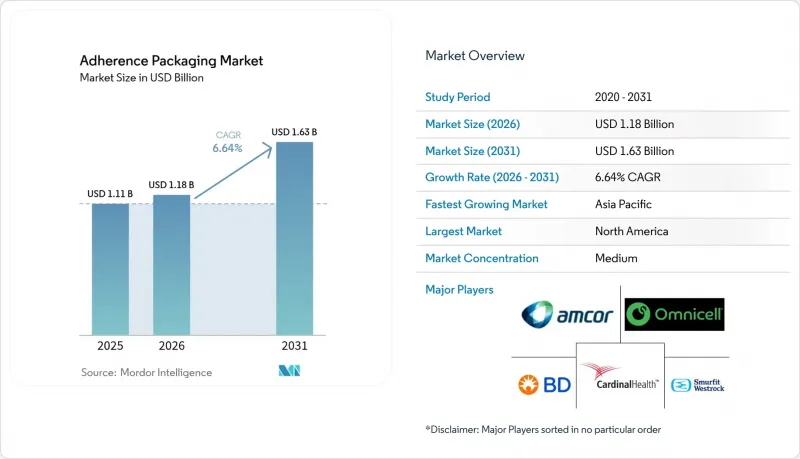
This report is Segmented by Material (Plastics, Paper and Paperboard, and More), System (Unit-Dose Packaging, Multi-Dose Packaging), Packaging Format (Blisters, Pouches/Strips, and More), Technology (Conventional, Smart/Connected, and More), End User (Retail Pharmacies, Hospitals, and More), and Geography (North America, South America, and More). The Market Forecasts are Provided in Terms of Value (USD).
Global Adherence Packaging Market Trends and Insights
Rise in Need to Minimize Medication Wastage
Serialization requirements under the U.S. Drug Supply Chain Security Act highlight dose-level traceability, making adherence packaging instrumental in cutting redundant stock and expired returns. Dose-specific dispensing curtails over-prescription while improving compliance, lowering pharmaceutical waste across retail, mail-order, and institutional channels. Health agencies estimate that better adherence could prevent 125,000 U.S. deaths annually and save USD 100-289 billion in direct costs. Parallel cost pressure from an 18% polyethylene price jump during 2024 encourages sustainable formats that reduce virgin resin dependency while matching pharmaceutical barrier needs.
High Prevalence of Medication Non-adherence and Cost Burden
Roughly one in two chronic-condition patients worldwide fails to take therapy as prescribed, prompting urgent demand for packaging that makes regimens simpler to follow. Poor compliance contributes to 125,000 U.S. deaths and more than USD 100 billion in avoidable spending each year. Programs such as Kaiser Permanente's diabetes blister initiative raised adherence 23% and cut emergency visits 15%, showing tangible clinical and economic upside. Connected packs layer sensors and mobile alerts onto traditional formats, giving providers real-time visibility and enabling early outreach before complications escalate.
High Installation and Maintenance Costs of Automated Systems
Independent pharmacies face average robotics outlays of USD 500,000-750,000, or roughly one-fifth of annual revenue. Additional building upgrades inflate capital demands, while consumables add a recurring 12-18% to operating expenses. Emerging-market providers grapple with currency swings and lower prescription volumes that lengthen payback periods beyond five years, slowing widespread automation uptake.
Other drivers and restraints analyzed in the detailed report include:
- Geriatric-Driven Polypharmacy Surge
- Centralized Pharmacy Automation Scaling Adherence Formats
- Limited Awareness Among Physicians and Caregivers in Emerging Markets
For complete list of drivers and restraints, kindly check the Table Of Contents.
Segment Analysis
Plastic substrates kept 48.86% of adherence packaging market share in 2025 due to established converting lines, robust moisture barriers, and competitive economics. Yet composites post the swiftest 7.90% CAGR as regulators valorize recyclability and brand owners chase ESG commitments. The adherence packaging industry now sees bio-polymer-paper hybrids advancing from pilot to scale, supported by IPEC guidelines that codify sustainable excipient compatibility. Paper-based formats gain in low-humidity therapies, while aluminum maintains niche leadership in ultra-barrier indications. Pfizer's 2024 transition of eight products to composite films trimmed packaging carbon 25% without jeopardizing drug stability. Although bio-based resins carry 20-30% premiums, Medicare bonus payments and EU EPR avoidance often offset incremental spend, encouraging broader adoption. Ongoing resin price volatility further underlines the appeal of diversified, less petroleum-dependent material portfolios.
Composites also prove compatible with digital features, embedding near-field communication tags between paper and polymer layers without compromising barrier strength. That integration supports future smart-pack roll-outs in sustainability-sensitive geographies. Suppliers continue optimizing heat-seal windows, printable surfaces, and high-clarity windows to match patient information needs, positioning composites for outsized share capture over the forecast horizon.
Multi-dose cards dominate retail workflows and therefore retain 61.74% of adherence packaging market size in 2025. Pharmacies favor the format for its week-at-a-glance simplicity across chronic regimens. Even so, unit-dose blister expansion at 7.05% CAGR signals a shift toward hospital and mail-order models that prioritize individual pill tracking. Hospitals deploying unit-dose saw medication errors fall 45% and nursing workflows improve by nearly one-third. Though unit dosing consumes 15-20% more wrap per pill, reduced waste and error mitigation justify the material uptick, especially where payer penalties for adverse events loom large.
Automation spurs further momentum. Robotic loaders accurately place single tablets into color-coded cavities, seal with serialized lidding, and feed data to electronic health records. Closed-loop integration appeals to institutional buyers tasked with audit readiness and controlled substance stewardship. As centralized fill centers scale, economies spread, narrowing the cost delta with multi-dose approaches and helping unit-dose offerings cross into retail and home delivery segments.
Complete Report Scope:
- By Material
- Plastics
- Polyethylene
- Polyethylene Terephthalate
- Polyvinyl Chloride
- Other Plastics
- Paper and Paperboard
- Aluminum
- Composite Materials
- Plastics
- By System
- Unit-dose Packaging
- Multi-dose Packaging
- By Packaging Format
- Blisters
- Pouches / Strips
- Bottles
- Other Packging Formats
- By Technology
- Conventional Packaging
- Smart / Connected Packaging
- Sustainable / Eco-friendly Packaging
- By End User
- Retail Pharmacies
- Hospitals
- Long-term Care Facilities
- Mail-order Pharmacies
- Others End User
- By Geography
- North America
- United States
- Canada
- Mexico
- South America
- Brazil
- Argentina
- Chile
- Rest of South America
- Europe
- Germany
- United Kingdom
- France
- Italy
- Spain
- Rest of Europe
- Asia-Pacific
- China
- Japan
- India
- South Korea
- Australia
- Rest of Asia-Pacific
- Middle East and Africa
- Middle East
- Saudi Arabia
- United Arab Emirates
- Turkey
- Rest of Middle East
- Africa
- South Africa
- Nigeria
- Kenya
- Rest of Africa
- Middle East
- North America
Geography Analysis
North America captured 38.92% of adherence packaging market share in 2025 thanks to advanced automation ecosystems and payer programs that reward documented compliance. U.S. adoption is anchored by Medicare Advantage bonus structures, the Drug Supply Chain Security Act's serialization rules, and widespread mail-order penetration. Canada's single-payer approach emphasizes cost-effective formats and steady composite uptake, while Mexico's budding private insurance sector introduces new growth pockets as regulations converge with international standards.
Asia-Pacific posts the most robust 8.31% CAGR, driven by expanding access, aging demographics, and chronic disease escalation. China upgrades hospital pharmacies and local packaging capacity under NMPA rules aligned with global norms, unlocking substantial volume for both conventional and smart packs. Japan, South Korea, and Australia, with mature infrastructure, deploy automation and sensor-enabled solutions to address elderly care challenges, yielding measurable reductions in medication-related hospitalizations. India's trajectory hinges on regulatory harmonization and investment in cold-chain and e-pharmacy logistics, which are progressing alongside digital-health initiatives.
Europe balances sustainability leadership with privacy protection. The PPWR mandates full recyclability by 2030, fast-tracking composite and paper-based innovation. Germany anchors regional volume through reimbursement policies that privilege adherence-enhancing interventions, while France, Italy, Spain, and the United Kingdom advance pilot programs marrying recyclable substrates with data-light smart features compatible with GDPR. Cross-border regulatory divergence following Brexit adds complexity but also fosters solution specialization tailored to national compliance nuances.
- Amcor plc
- Smurfit WestRock
- Omnicell Inc.
- Becton, Dickinson and Company
- Cardinal Health Inc.
- McKesson Corporation
- Parata Systems LLC (BD)
- TCGRx LLC
- Jones Healthcare Group Inc.
- Keystone Folding Box Co.
- Medicine-On-Time LLC
- Manrex Limited
- Drug Package LLC
- Rx Systems Inc.
- RxSafe LLC
- ARxIUM Inc.
- AARDEX Group SA
- Pearson Medical Technologies LLC
- Synergy Medical Inc.
- Gerresheimer AG
- West Pharmaceutical Services Inc.
Additional Benefits:
- The market estimate (ME) sheet in Excel format
- 3 months of analyst support
TABLE OF CONTENTS
1 INTRODUCTION
- 1.1 Study Assumptions and Market Definition
- 1.2 Scope of the Study
2 RESEARCH METHODOLOGY
3 EXECUTIVE SUMMARY
4 MARKET LANDSCAPE
- 4.1 Market Overview
- 4.2 Market Drivers
- 4.2.1 Rise in Need to Minimize Medication Wastage
- 4.2.2 High Prevalence of Medication Non-adherence and Cost Burden
- 4.2.3 Geriatric-Driven Polypharmacy Surge
- 4.2.4 Centralized Pharmacy Automation Scaling Adherence Formats
- 4.2.5 Payer Incentives Linked to Adherence Metrics
- 4.2.6 ESG Push for Recyclable Paper-based Blister Innovations
- 4.3 Market Restraints
- 4.3.1 High Installation and Maintenance Costs of Automated Systems
- 4.3.2 Limited Awareness Among Physicians and Caregivers in Emerging Markets
- 4.3.3 Data-Privacy Regulations Hindering Smart-Pack Roll-outs
- 4.3.4 Recycling Mandates Raising Costs for Multi-material Blisters
- 4.4 Industry Value Chain Analysis
- 4.5 Porter's Five Forces Analysis
- 4.5.1 Bargaining Power of Suppliers
- 4.5.2 Bargaining Power of Buyers
- 4.5.3 Threat of New Entrants
- 4.5.4 Threat of Substitutes
- 4.5.5 Intensity of Competitive Rivalry
- 4.6 Impact of Macroeconomic Factors on the Market
- 4.7 Regulatory Landscape
- 4.8 Technological Outlook
5 MARKET SIZE AND GROWTH FORECASTS (VALUE)
- 5.1 By Material
- 5.1.1 Plastics
- 5.1.1.1 Polyethylene
- 5.1.1.2 Polyethylene Terephthalate
- 5.1.1.3 Polyvinyl Chloride
- 5.1.1.4 Other Plastics
- 5.1.2 Paper and Paperboard
- 5.1.3 Aluminum
- 5.1.4 Composite Materials
- 5.1.1 Plastics
- 5.2 By System
- 5.2.1 Unit-dose Packaging
- 5.2.2 Multi-dose Packaging
- 5.3 By Packaging Format
- 5.3.1 Blisters
- 5.3.2 Pouches / Strips
- 5.3.3 Bottles
- 5.3.4 Other Packging Formats
- 5.4 By Technology
- 5.4.1 Conventional Packaging
- 5.4.2 Smart / Connected Packaging
- 5.4.3 Sustainable / Eco-friendly Packaging
- 5.5 By End User
- 5.5.1 Retail Pharmacies
- 5.5.2 Hospitals
- 5.5.3 Long-term Care Facilities
- 5.5.4 Mail-order Pharmacies
- 5.5.5 Others End User
- 5.6 By Geography
- 5.6.1 North America
- 5.6.1.1 United States
- 5.6.1.2 Canada
- 5.6.1.3 Mexico
- 5.6.2 South America
- 5.6.2.1 Brazil
- 5.6.2.2 Argentina
- 5.6.2.3 Chile
- 5.6.2.4 Rest of South America
- 5.6.3 Europe
- 5.6.3.1 Germany
- 5.6.3.2 United Kingdom
- 5.6.3.3 France
- 5.6.3.4 Italy
- 5.6.3.5 Spain
- 5.6.3.6 Rest of Europe
- 5.6.4 Asia-Pacific
- 5.6.4.1 China
- 5.6.4.2 Japan
- 5.6.4.3 India
- 5.6.4.4 South Korea
- 5.6.4.5 Australia
- 5.6.4.6 Rest of Asia-Pacific
- 5.6.5 Middle East and Africa
- 5.6.5.1 Middle East
- 5.6.5.1.1 Saudi Arabia
- 5.6.5.1.2 United Arab Emirates
- 5.6.5.1.3 Turkey
- 5.6.5.1.4 Rest of Middle East
- 5.6.5.2 Africa
- 5.6.5.2.1 South Africa
- 5.6.5.2.2 Nigeria
- 5.6.5.2.3 Kenya
- 5.6.5.2.4 Rest of Africa
- 5.6.5.1 Middle East
- 5.6.1 North America
6 COMPETITIVE LANDSCAPE
- 6.1 Market Concentration
- 6.2 Strategic Moves
- 6.3 Market Share Analysis
- 6.4 Company Profiles (includes Global Level Overview, Market Level Overview, Core Segments, Financials as available, Strategic Information, Market Rank/Share, Products and Services, Recent Developments)
- 6.4.1 Amcor plc
- 6.4.2 Smurfit WestRock
- 6.4.3 Omnicell Inc.
- 6.4.4 Becton, Dickinson and Company
- 6.4.5 Cardinal Health Inc.
- 6.4.6 McKesson Corporation
- 6.4.7 Parata Systems LLC (BD)
- 6.4.8 TCGRx LLC
- 6.4.9 Jones Healthcare Group Inc.
- 6.4.10 Keystone Folding Box Co.
- 6.4.11 Medicine-On-Time LLC
- 6.4.12 Manrex Limited
- 6.4.13 Drug Package LLC
- 6.4.14 Rx Systems Inc.
- 6.4.15 RxSafe LLC
- 6.4.16 ARxIUM Inc.
- 6.4.17 AARDEX Group SA
- 6.4.18 Pearson Medical Technologies LLC
- 6.4.19 Synergy Medical Inc.
- 6.4.20 Gerresheimer AG
- 6.4.21 West Pharmaceutical Services Inc.
7 MARKET OPPORTUNITIES AND FUTURE OUTLOOK
- 7.1 White-space and Unmet-need Assessment

