PUBLISHER: Mordor Intelligence | PRODUCT CODE: 2123574

PUBLISHER: Mordor Intelligence | PRODUCT CODE: 2123574
Photochromic Lenses - Market Share Analysis, Industry Trends & Statistics, Growth Forecasts (2026 - 2031)
According to Mordor Intelligence, the photochromic lenses market size was valued at USD 7.28 billion in 2025 and is estimated to grow from USD 7.92 billion in 2026 to reach USD 11.23 billion by 2031, at a CAGR of 7.23% during the forecast period (2026-2031).
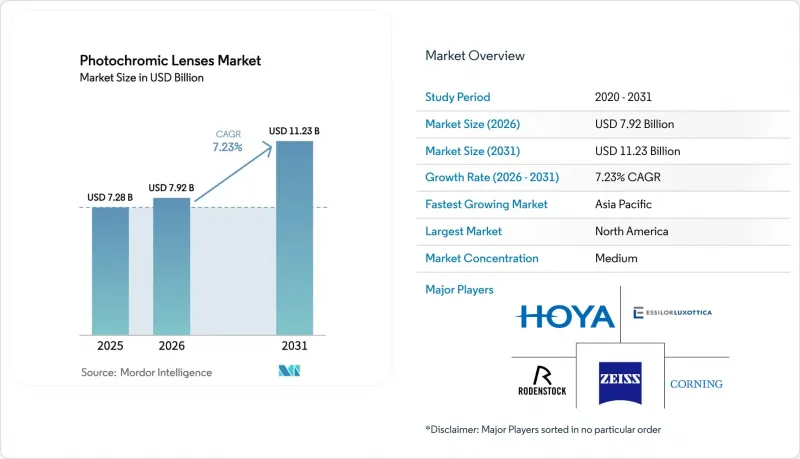
This report is Segmented by Material (Glass, Polycarbonate, Plastic Including CR-39, Trivex, High-Index Plastics), Technology (UV & Visible-Light Activated, and More), Application (Corrective, Preventive/Protective, Smart Wearables), End User (Adults, and More), Sales Channel (Specialty Clinics, and More), and Geography (North America, and More). Market Forecasts are Provided in Terms of Value (USD).
Global Photochromic Lenses Market Trends and Insights
Prevalence of Vision Disorders and an Aging Population
More than 2.2 billion people live with visual impairment, and presbyopia affects 1.8 billion individuals worldwide. Photochromic lenses let older and presbyopic consumers combine vision correction and UV protection in one pair of glasses, which streamlines daily use. Rising myopia in children adds urgency, with prevalence already at 35% in 2023 and forecast to hit 40% by 2050. Aging markets in Japan and Italy, as well as rapidly urbanizing regions in China and India, therefore constitute strong demand pools. Manufacturers that align product lines with these demographic realities secure a durable growth runway.
Multipurpose Eyewear Demand (Prescription + Sun)
Consumers dislike switching between clear lenses and sunglasses during indoor-outdoor transitions. Modern photochromic products darken in under 30 seconds and clear within 2 minutes, delivering a seamless experience. Transitions Optical's GEN S and ZEISS PhotoFusion X set the performance benchmark with 25-second activation and 80% faster fade-back compared with prior models. High convenience resonates in North America and Europe, where per-capita eyewear spend tops USD 150, yet demand is spreading into urban Asia-Pacific populations as disposable income climbs. Retailers are bundling adaptive-tint coatings into mid-tier packages, which accelerates uptake by positioning photochromic functionality as standard rather than luxury.
Premium Pricing Over Conventional Lenses
Photochromic products still cost 40-60% more than clear lenses in many emerging markets. Despite aggressive bundling, India's penetration remains below 15% of lens sales. Retailers employ financing plans and tiered offerings to lessen sticker shock, yet the luxury perception persists and slows adoption in middle-income economies.
Other drivers and restraints analyzed in the detailed report include:
- Retail and E-Commerce Penetration of Premium Coatings
- Faster Activation and Color-Clarity Innovations
- Counterfeit and Low-Quality Product Circulation
For complete list of drivers and restraints, kindly check the Table Of Contents.
Segment Analysis
Plastic lenses captured 46.62% of 2025 value, yet the segment is gradually tilting toward polycarbonate because families and athletes value durability. Polycarbonate is forecast to post a 10.63% CAGR, the highest within the materials hierarchy, while retaining optical quality that meets ISO 8980-3 baselines. Mitsubishi Gas Chemical's IURESIN plant scheduled for 2026 will introduce an ultra-high-index polycarbonate (n = 1.74), enabling thinner, lighter forms that appeal to rimless-frame enthusiasts. Trivex and other mid-index plastics are also gaining ground for ballistic and pediatric use. Meanwhile, glass lenses have fallen to single-digit share due to weight and breakage concerns, remaining mainly in luxury niches.
Mitsui Chemicals' planned MR monomer facility for 2028 underscores the importance of continued material innovation and signals the next leap in premium-tier differentiation. CR-39 will stay relevant at the budget end, but migration toward impact-resistant and high-index options will gradually trim its share. Regulatory standards guarantee base-line transmittance performance regardless of substrate, but buyers increasingly favor the lighter weight and resilience of polycarbonate.
UV- and visible-light-activated coatings held 61.57% of 2025 revenue, thanks to compatibility with existing production lines and broad substrate applicability. Trans-bonding remains common, yet in-mass embedding-where dyes are mixed directly into monomers-grows rapidly for premium lines because of superior scratch resistance and color stability. Luxexcel's additive manufacturing uses in-mass dyes to produce complex prescription lenses for AR waveguides, sidestepping traditional coating steps.
Electronic systems such as Chamelo's liquid-crystal lenses record 0.1-second transitions but remain pricey and require power sources. Over the forecast horizon, UV-activated technology will keep the lion's share due to cost efficiency, though in-mass and electronic variations will capture incremental high-margin demand.
Complete Report Scope:
- By Material
- Glass
- Polycarbonate
- Plastic
- CR-39 (Standard Resin)
- Trivex
- High-Index Plastics
- By Technology
- UV & Visible-Light Activated
- Imbibing & Trans-bonding
- In-Mass (Bulk)
- Other Emerging Technologies
- By Application
- Corrective (Prescription)
- Preventive / Protective (Non-Rx, Sunglass Replacement)
- Smart Wearables & Connected Eyewear
- By End User
- Adults
- Children & Teens
- Elderly (65+)
- By Sales Channel
- Specialty Clinics & Optometrists
- Optical Retail Chains
- Online Direct-to-Consumer
- OEM Partnerships (Smart-glasses Makers)
- By Geography
- North America
- United States
- Canada
- Mexico
- Europe
- Germany
- France
- United Kingdom
- Italy
- Spain
- Rest of Europe
- Asia-Pacific
- China
- Japan
- India
- South Korea
- Australia
- Rest of Asia-Pacific
- Middle East & Africa
- GCC
- South Africa
- Rest of Middle East & Africa
- South America
- Brazil
- Argentina
- Rest of South America
- North America
Geography Analysis
North America accounted for 33.24% of 2025 revenue, backed by USD 150-plus annual per-capita eyewear spending and strong optometrist networks. The FDA's device labeling standards reinforce consumer confidence, and direct-to-consumer leaders such as Warby Parker add momentum.Although growth moderates because penetration is high, ongoing smart-wearable launches sustain a healthy pipeline.
Asia-Pacific will log the fastest 10.29% CAGR. India's eyewear market is on track to expand from USD 9.2 billion in fiscal 2025 to USD 17.2 billion by fiscal 2030, while China's expanding middle class buys photochromic lenses for smog and UV protection. Japan and South Korea, already premium markets, lead adoption of advanced dye blends, and Southeast Asia is catching up as e-commerce solves distribution gaps.
Europe remains a hub for high-end developments. Germany, France, and the United Kingdom maintain stringent REACH and ISO compliance, which raise entry barriers but guarantee quality. ZEISS and Rodenstock dominate innovation pipelines with fast-acting, temperature-stable products. Middle East & Africa and South America lag in penetration due to pricing sensitivities, yet rising disposable incomes and extreme UV exposure in regions such as the GCC open white-space opportunities.
- BNL Eurolens
- Carl Zeiss
- Chemiglas Corp.
- ClearVision Optical
- Corning
- EssilorLuxottica
- GKB Ophthalmics
- HOYA
- Indo Optical
- Jiangsu Aogang Optical Glasses
- Luxexcel Group BV (3D-printed Lenses)
- Mitsui Chemicals Inc.
- Nikon-Essilor Co. Ltd
- Rodenstock
- Seiko Optical Products Co. Ltd
- Shamir Optical Industry Ltd
- Sundex Optical
- Tokai Optical
- Transitions Optical (PPG-Essilor JV)
- Vision Dynamics
- Younger Optics
Additional Benefits:
- The market estimate (ME) sheet in Excel format
- 3 months of analyst support
TABLE OF CONTENTS
1 Introduction
- 1.1 Study Assumptions & Market Definition
- 1.2 Scope of the Study
2 Research Methodology
3 Executive Summary
4 Market Landscape
- 4.1 Market Overview
- 4.2 Market Drivers
- 4.2.1 Prevalence Of Vision Disorders & Ageing Population
- 4.2.2 Multipurpose Eyewear Demand (Prescription + Sun)
- 4.2.3 Retail & E-Commerce Penetration of Premium Coatings
- 4.2.4 Fast Activation & Colour-Clarity Innovations
- 4.2.5 AR Smart-Glasses Integration of Photochromics
- 4.2.6 Bio-Based, Eco-Friendly Dye Development
- 4.3 Market Restraints
- 4.3.1 Premium Pricing Over Conventional Lenses
- 4.3.2 Counterfeit & Low-Quality Product Circulation
- 4.3.3 Temperature-Dependent Performance Limitations
- 4.3.4 Regulatory Scrutiny on Specific Dye Chemicals
- 4.4 Value / Supply-Chain Analysis
- 4.5 Regulatory Landscape
- 4.6 Technological Outlook
- 4.7 Porter's Five Forces Analysis
- 4.7.1 Threat of New Entrants
- 4.7.2 Bargaining Power of Buyers/Consumers
- 4.7.3 Bargaining Power of Suppliers
- 4.7.4 Threat of Substitute Products
- 4.7.5 Intensity of Competitive Rivalry
5 Market Size & Growth Forecasts (Value - USD)
- 5.1 By Material
- 5.1.1 Glass
- 5.1.2 Polycarbonate
- 5.1.3 Plastic
- 5.1.3.1 CR-39 (Standard Resin)
- 5.1.3.2 Trivex
- 5.1.3.3 High-Index Plastics
- 5.2 By Technology
- 5.2.1 UV & Visible-Light Activated
- 5.2.2 Imbibing & Trans-bonding
- 5.2.3 In-Mass (Bulk)
- 5.2.4 Other Emerging Technologies
- 5.3 By Application
- 5.3.1 Corrective (Prescription)
- 5.3.2 Preventive / Protective (Non-Rx, Sunglass Replacement)
- 5.3.3 Smart Wearables & Connected Eyewear
- 5.4 By End User
- 5.4.1 Adults
- 5.4.2 Children & Teens
- 5.4.3 Elderly (65+)
- 5.5 By Sales Channel
- 5.5.1 Specialty Clinics & Optometrists
- 5.5.2 Optical Retail Chains
- 5.5.3 Online Direct-to-Consumer
- 5.5.4 OEM Partnerships (Smart-glasses Makers)
- 5.6 By Geography
- 5.6.1 North America
- 5.6.1.1 United States
- 5.6.1.2 Canada
- 5.6.1.3 Mexico
- 5.6.2 Europe
- 5.6.2.1 Germany
- 5.6.2.2 France
- 5.6.2.3 United Kingdom
- 5.6.2.4 Italy
- 5.6.2.5 Spain
- 5.6.2.6 Rest of Europe
- 5.6.3 Asia-Pacific
- 5.6.3.1 China
- 5.6.3.2 Japan
- 5.6.3.3 India
- 5.6.3.4 South Korea
- 5.6.3.5 Australia
- 5.6.3.6 Rest of Asia-Pacific
- 5.6.4 Middle East & Africa
- 5.6.4.1 GCC
- 5.6.4.2 South Africa
- 5.6.4.3 Rest of Middle East & Africa
- 5.6.5 South America
- 5.6.5.1 Brazil
- 5.6.5.2 Argentina
- 5.6.5.3 Rest of South America
- 5.6.1 North America
6 Competitive Landscape
- 6.1 Market Concentration
- 6.2 Market Share Analysis
- 6.3 Company Profiles (includes Global level Overview, Market level overview, Core Segments, Financials as available, Strategic Information, Market Rank/Share, Products & Services, Recent Developments)
- 6.3.1 BNL Eurolens
- 6.3.2 Carl Zeiss AG
- 6.3.3 Chemiglas Corp.
- 6.3.4 ClearVision Optical
- 6.3.5 Corning Incorporated
- 6.3.6 EssilorLuxottica SA
- 6.3.7 GKB Ophthalmics Ltd
- 6.3.8 Hoya Corporation
- 6.3.9 Indo Optical
- 6.3.10 Jiangsu Aogang Optical Glasses Co. Ltd
- 6.3.11 Luxexcel Group BV (3D-printed Lenses)
- 6.3.12 Mitsui Chemicals Inc.
- 6.3.13 Nikon-Essilor Co. Ltd
- 6.3.14 Rodenstock GmbH
- 6.3.15 Seiko Optical Products Co. Ltd
- 6.3.16 Shamir Optical Industry Ltd
- 6.3.17 Sundex Optical Co. Ltd
- 6.3.18 Tokai Optical Co. Ltd
- 6.3.19 Transitions Optical (PPG-Essilor JV)
- 6.3.20 Vision Dynamics LLC
- 6.3.21 Younger Optics
7 Market Opportunities & Future Outlook
- 7.1 White-space & Unmet-Need Assessment

