PUBLISHER: Mordor Intelligence | PRODUCT CODE: 2123587

PUBLISHER: Mordor Intelligence | PRODUCT CODE: 2123587
Urgent Care Center - Market Share Analysis, Industry Trends & Statistics, Growth Forecasts (2026 - 2031)
According to Mordor Intelligence, the urgent care center market size was valued at USD 28.81 billion in 2025 and estimated to grow from USD 30.34 billion in 2026 to reach USD 39.32 billion by 2031, at a CAGR of 5.32% during the forecast period (2026-2031).
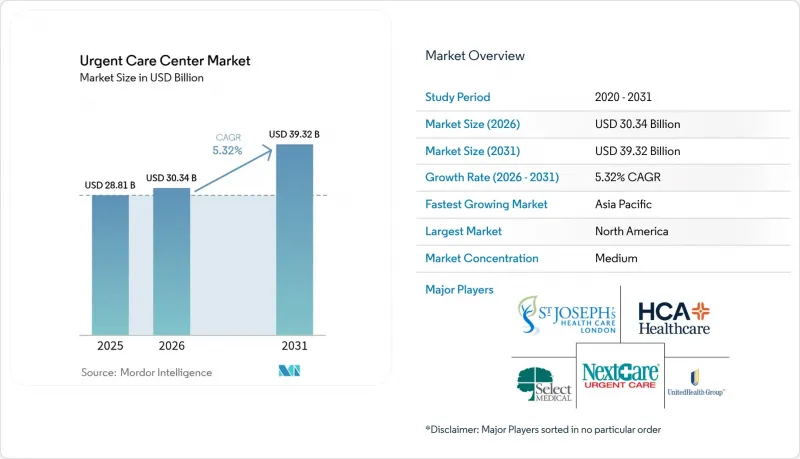
This report is Segmented by Service (Trauma/Injury Care, and More), Ownership (Corporate Chains, Hospital/Health-System Owned, Physician Group Owned, Other Ownerships), Age Group (Pediatrics 0-17 Yrs, Adults 18-64 Yrs, Geriatrics 65+ Yrs), and Geography (North America, Europe, Asia-Pacific, Middle East & Africa, South America). The Market Forecasts are Provided in Terms of Value (USD).
Global Urgent Care Center Market Trends and Insights
Emergency-Department Overcrowding Shifting Non-Critical Cases to Urgent Care
Median emergency-department wait times have risen 16% since 2014, funneling lower-acuity patients toward urgent care centers that can deliver equivalent treatment at lower cost. RAND research estimates that one-third of non-urgent ED encounters could be redirected, saving up to USD 4.4 billion annually. Hospitals consequently embed urgent care sites inside integrated delivery networks, transforming former competitors into throughput partners for ED de-congestion. Payer push toward site-of-care optimization reinforces the shift, as value-based contracts penalize unnecessary ED utilization. Collectively these demand-side and payer-side forces lock in steady volume growth for the urgent care center market.
Digital Scheduling & Tele-Urgent Add-Ons Enhancing Patient Capture Rates
Artificial-intelligence engines orchestrate patient intake, slot utilization, and documentation. CityMD's multi-year pact with Notable automates front-end tasks for nearly 200 clinics handling 4 million visits each year, coinciding with a 60% visit surge since 2019. Surveys show 55% of consumers now prefer digital channels and 74% rate appointment speed as decisive. Telehealth reached 39.3% adult utilization in 2022; 80.5% experienced no technical glitches and three-quarters deemed visit quality equal to in-person care. "Tele-untethered" models remove virtual waiting rooms, with 76% of users favoring freedom to multitask and saving 55 minutes per session. Digital capacity therefore heightens patient throughput, lifts net promoter scores, and entrenches competitive differentiation inside the urgent care center market.
Physician & Advanced-Practitioner Shortages in Rural and Suburban Catchments
Thirteen percent of Americans live in primary-care shortage areas, and the shortfall may swell to 49,000 physicians by 2030. Employing APPs mitigates gaps-63% of medical groups intend to add new APP roles in 2025-yet formal onboarding exists in only 70% of ambulatory sites. Rural EDs lack emergency physicians in 27% of counties, pushing urgent care centers to stretch clinician coverage with leaner staffing ratios. Productivity rises when APP penetration deepens, but competition for talent inflates labor costs and may slow clinic roll-outs, tempering the urgent care center market CAGR.
Other drivers and restraints analyzed in the detailed report include:
- Active-Lifestyle Injuries Among Millennials & Gen Z Populations
- Expansion Of Value-Based & High-Deductible Insurance Plans Favoring Low-Cost Settings
- State-Level Certificate-Of-Need / Licensing Hurdles (US, EU Select Markets)
For complete list of drivers and restraints, kindly check the Table Of Contents.
Segment Analysis
Trauma and injury care accounted for 31.85% of 2025 revenue, underscoring an enduring core at the urgent care center market's clinical mix. On-site X-ray, fracture stabilization, and laceration repair divert patients from EDs and offer favorable payer economics. Acute illness management ranks second, handling respiratory and gastrointestinal conditions with rapid throughput. Diagnostic advances now include ultrasound and advanced imaging, raising average ticket size.
Vaccination and preventive offerings expand fastest at a 6.86% CAGR, reshaping centers from episodic venues to comprehensive health destinations. Mass immunization campaigns and travel medicine bundles fill scheduling valleys, while AI-driven triage engines support standardized care. A Cedars-Sinai study found virtual urgent care algorithms outscored physicians for treatment appropriateness on common complaints, validating decision-support adoption. Preventive momentum creates spillover demand for chronic-condition screening and lifestyle coaching, elevating cross-sell potential within the urgent care center market size at both national and local levels.
Complete Report Scope:
- By Service
- Trauma / Injury Care
- Acute Illness Management
- Vaccination & Preventive Services
- Diagnostic & Screening Services
- Other Services
- By Ownership
- Corporate Chains (PE / Retail / Franchise)
- Hospital / Health-System Owned
- Physician Group Owned
- Other Ownerships
- By Age Group
- Pediatrics (0-17 yrs)
- Adults (18-64 yrs)
- Geriatrics (65+ yrs)
- Geography
- North America
- United States
- Canada
- Mexico
- Europe
- Germany
- United Kingdom
- France
- Italy
- Spain
- Rest of Europe
- Asia-Pacific
- China
- Japan
- India
- Australia
- South Korea
- Rest of Asia-Pacific
- Middle East & Africa
- GCC
- South Africa
- Rest of Middle East & Africa
- South America
- Brazil
- Argentina
- Rest of South America
- North America
Geography Analysis
North America captured 47.90% of 2025 revenue, underpinned by insurance mechanisms that reimburse out-of-hospital encounters and by well-established clinic chains. Consolidators continue to target suburban infill opportunities while pivoting toward rural counties where 57 million residents remain underserved. CON reform across the Carolinas, plus Tennessee's phased deregulation, eases expansion and invites cross-state operator entries, fortifying the urgent care center market size within the region.
Asia-Pacific provides the sharpest 6.29% CAGR outlook. China's aging demographic, India's 275-million-plus eSanjeevani consultations, and Japan's robust telemedicine adoption validate urgent care viability. Public-private partnerships blend physical clinics with digital triage kiosks located in transit hubs, yielding high-volume low-acuity throughput models that mirror U.S. suburban prototypes.
Europe, Middle East & Africa, and South America log moderate growth. European universal-care systems restrict private pay volumes, yet cross-border telehealth and expatriate communities sustain niche demand. Gulf nations deploy urgent care inside medical-tourism corridors, while Brazil and Colombia flirt with hybrid ED-urgent models inside private hospitals. Currency volatility and regulatory opacity temper speed of scale-out but open localized franchise pathways for risk-tolerant investors.
- CVS Health
- Select Medical
- UnitedHealth Group (MedExpress)
- HCA Healthcare (CareNow / CareSpot)
- NextCare Holdings
- GoHealth Urgent Care
- CityMD / Summit Health
- American Family Care
- Carbon Health
- Patient First
- FastMed Urgent Care
- Dignity Health (US HealthWorks)
- Tenet Healthcare (United Surgical Partners)
- Adeptus Health
- Indigo Health (MultiCare)
- Urgent Care Group
- HealthBay (UAE)
- Virgin Care (UK)
Additional Benefits:
- The market estimate (ME) sheet in Excel format
- 3 months of analyst support
TABLE OF CONTENTS
1 Introduction
- 1.1 Study Assumptions & Market Definition
- 1.2 Scope of the Study
2 Research Methodology
3 Executive Summary
4 Market Landscape
- 4.1 Market Overview
- 4.2 Market Drivers
- 4.2.1 Emergency-Department Overcrowding Shifting Non-critical Cases to Urgent Care
- 4.2.2 Partnerships Between Retail Chains & Health Systems Accelerating Site Roll-outs
- 4.2.3 Digital Scheduling & Tele-Urgent Add-ons Enhancing Patient Capture Rates
- 4.2.4 Active Lifestyle-Related Injuries Among Millennials & Gen-Z Populations
- 4.2.5 Expansion of Value-Based & High-Deductible Insurance Plans Favoring Low-Cost Settings
- 4.2.6 Aging Populations Seeking Same-Day Care for Chronic Exacerbations
- 4.3 Market Restraints
- 4.3.1 Physician & Advanced-Practitioner Shortages in Rural and Suburban Catchments
- 4.3.2 State-Level Certificate-of-Need / Licensing Hurdles (US, EU Select Markets)
- 4.3.3 Growing Competition from Telehealth-Only and Retail Pharmacy Clinics
- 4.3.4 Reimbursement Ambiguity in Emerging Markets Limiting ROI
- 4.4 Porter's Five Forces Analysis
- 4.4.1 Threat of New Entrants
- 4.4.2 Bargaining Power of Buyers
- 4.4.3 Bargaining Power of Suppliers
- 4.4.4 Threat of Substitutes
- 4.4.5 Intensity of Competitive Rivalry
5 Market Size & Growth Forecasts (Value, USD)
- 5.1 By Service
- 5.1.1 Trauma / Injury Care
- 5.1.2 Acute Illness Management
- 5.1.3 Vaccination & Preventive Services
- 5.1.4 Diagnostic & Screening Services
- 5.1.5 Other Services
- 5.2 By Ownership
- 5.2.1 Corporate Chains (PE / Retail / Franchise)
- 5.2.2 Hospital / Health-System Owned
- 5.2.3 Physician Group Owned
- 5.2.4 Other Ownerships
- 5.3 By Age Group
- 5.3.1 Pediatrics (0-17 yrs)
- 5.3.2 Adults (18-64 yrs)
- 5.3.3 Geriatrics (65+ yrs)
- 5.4 Geography
- 5.4.1 North America
- 5.4.1.1 United States
- 5.4.1.2 Canada
- 5.4.1.3 Mexico
- 5.4.2 Europe
- 5.4.2.1 Germany
- 5.4.2.2 United Kingdom
- 5.4.2.3 France
- 5.4.2.4 Italy
- 5.4.2.5 Spain
- 5.4.2.6 Rest of Europe
- 5.4.3 Asia-Pacific
- 5.4.3.1 China
- 5.4.3.2 Japan
- 5.4.3.3 India
- 5.4.3.4 Australia
- 5.4.3.5 South Korea
- 5.4.3.6 Rest of Asia-Pacific
- 5.4.4 Middle East & Africa
- 5.4.4.1 GCC
- 5.4.4.2 South Africa
- 5.4.4.3 Rest of Middle East & Africa
- 5.4.5 South America
- 5.4.5.1 Brazil
- 5.4.5.2 Argentina
- 5.4.5.3 Rest of South America
- 5.4.1 North America
6 Competitive Landscape
- 6.1 Market Concentration
- 6.2 Market Share Analysis
- 6.3 Company Profiles (includes Global level Overview, Market level overview, Core Business Segments, Financials, Headcount, Key Information, Market Rank, Market Share, Products and Services, and analysis of Recent Developments)
- 6.3.1 CVS Health (MinuteClinic)
- 6.3.2 Select Medical Holdings (Concentra, Inc.)
- 6.3.3 UnitedHealth Group (MedExpress)
- 6.3.4 HCA Healthcare (CareNow / CareSpot)
- 6.3.5 NextCare Holdings, Inc.
- 6.3.6 GoHealth Urgent Care
- 6.3.7 CityMD / Summit Health
- 6.3.8 American Family Care
- 6.3.9 Carbon Health
- 6.3.10 Patient First
- 6.3.11 FastMed Urgent Care
- 6.3.12 Dignity Health (US HealthWorks)
- 6.3.13 Tenet Healthcare (United Surgical Partners)
- 6.3.14 Adeptus Health
- 6.3.15 Indigo Health (MultiCare)
- 6.3.16 Urgent Care Group
- 6.3.17 HealthBay (UAE)
- 6.3.18 Virgin Care (UK)
7 Market Opportunities & Future Outlook
- 7.1 White-space & Unmet-Need Assessment

