PUBLISHER: Mordor Intelligence | PRODUCT CODE: 2123597

PUBLISHER: Mordor Intelligence | PRODUCT CODE: 2123597
Pneumococcal Vaccines - Market Share Analysis, Industry Trends & Statistics, Growth Forecasts (2026 - 2031)
According to Mordor Intelligence, the pneumococcal vaccines market size is expected to grow from USD 9.23 billion in 2025 to USD 9.69 billion in 2026 and is forecast to reach USD 12.33 billion by 2031 at 4.95% CAGR over 2026-2031.
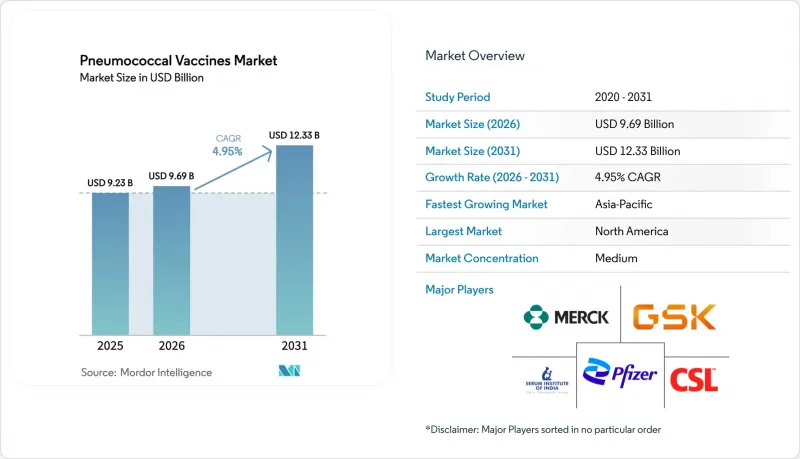
This report is Segmented by Vaccine Type (Pneumococcal Conjugate Vaccine (PCV) and Pneumococcal Polysaccharide Vaccine (PPV)), Product Type (Prevnar 13, Synflorix, and More), Distribution Channel (Government Authorities, Private & Retail Pharmacies, and More), Age Group (Adults, Geriatric, and More) and Geography (North America, and More). The Market and Forecasts are Provided in Terms of Value (USD).
Global Pneumococcal Vaccines Market Trends and Insights
Increased GAVI-Funded Uptake in LICs After USD 2.75/Dose Tender Price
GAVI's 2024 renewal of its Advance Market Commitment fixed pneumococcal conjugate vaccine procurement at USD 2.75 per dose, sustaining routine immunization in 57 low-income countries and injecting predictable volume that lifts the forecast CAGR by 1.2 percentage points. WHO prequalification of SK bioscience's GBP301 in 2024 diversified supply and mitigated single-source risk. Long-run impact depends on governments co-financing doses as GAVI's graduation schedules advance, a transition that could expose fragile health budgets to shortfalls. Manufacturers meanwhile pursue volume over margin, delaying ultra-valent launches in donor markets until new economics emerge.
Rising Prevalence of Pneumococcal Infections
CDC surveillance confirmed that invasive pneumococcal disease rates in U.S. adults 65+ remained above pre-pandemic baselines through 2024 despite PCV13 coverage, underscoring ongoing unmet need. Similar patterns persist in Asia-Pacific and Middle East & Africa where aging populations collide with historically low adult vaccination. The driver adds 0.8 percentage points to CAGR and is long term because building adult immunization infrastructure and reimbursement pathways is a slow, policy-heavy process. Emergent serotypes not covered by PCV13 further raise clinical urgency and validate higher-valent pipeline strategies.
High Manufacturing Cost of Conjugate Vaccines
Conjugation chemistry remains capital intensive, with 2024 U.S. estimates placing total capitalized development costs at USD 886.8 million per vaccine, shaving 0.7 percentage points off CAGR. Scale economies help incumbents, yet donor markets demand sub-USD 3 pricing, capping margins and slowing diffusion of higher valencies. Disruptive platforms like cell-free synthesis have potential but will not be validated at scale before 2028.
Other drivers and restraints analyzed in the detailed report include:
- Launch of Higher-Valent PCVs (PCV15/20/21)
- Pipeline of Ultra-Valent PCVs (>= 30-Valent) Accelerating Due-Diligence Deals
- Serotype-Replacement Diminishing Long-Term Efficacy
For complete list of drivers and restraints, kindly check the Table Of Contents.
Segment Analysis
Pneumococcal conjugate vaccines held 77.56% of pneumococcal vaccines market share in 2025, a position supported by T-cell-dependent immunity that sustains herd protection in infants. Their 8.25% CAGR through 2031 reflects strong adoption in both pediatric and newly eligible adult cohorts. Pneumococcal polysaccharide vaccines trail because they lack memory response and face utility erosion as conjugate alternatives gain adult indications, particularly after ACIP's 2024 recommendation favoring PCV20 or PCV15 before PPSV23. Emerging-market payers still deploy polysaccharides to contain budgets, but WHO prequalification trends and cost-reducing tech may ultimately accelerate their displacement.
Conjugate production costs remain higher, yet payers in high-income markets accept premium prices knowing that reduced boosters offset long-run expenses. GAVI programs exclusively source conjugates for infants, while many middle-income countries use polysaccharides for seniors only, creating a dual-track procurement landscape. New platforms like Vaxcyte's cell-free synthesis could cut cost curves and entrench conjugate leadership by widening the price-efficacy gap.
Prevnar 13 accounted for 47.53% of pneumococcal vaccines market size in 2025, but Prevnar 20 is expanding at a 15.85% CAGR on the strength of its seven extra serotypes and rapid approvals in Japan and China. Merck's Capvaxive (PCV21) entered the adult segment in 2024 and positions itself as a direct competitor with eight unique serotypes. Lower-valent Synflorix holds on in GAVI markets because of price advantages, yet efficacy-conscious middle-income buyers are gradually trading up.
Domestic Chinese producers such as Walvax and Beijing Minhai provide cost-competitive options, but their lower valency constrains penetration in urban private segments. The imminent arrival of VAX-31 could upend the hierarchy; if approved, its 31 valencies would reset the competitive baseline and hasten obsolescence of existing products in premium markets.
Complete Report Scope:
- By Vaccine Type
- Pneumococcal Conjugate Vaccine (PCV)
- Pneumococcal Polysaccharide Vaccine (PPV)
- By Product Type
- Prevnar 13
- Prevnar 20
- Synflorix
- Pneumovax 23
- Other PCVs
- By Distribution Channel
- Government Authorities
- GAVI/Multilateral & NGO Procurement
- Private & Retail Pharmacies
- Hospital-based Vaccine Clinics
- By Age Group
- Pediatric (<5 years)
- Adults (19-64 years)
- Geriatric (>65 years)
- By Geography
- North America
- United States
- Canada
- Mexico
- Europe
- Germany
- United Kingdom
- France
- Italy
- Spain
- Rest of Europe
- Asia-Pacific
- China
- Japan
- India
- South Korea
- Australia
- Rest of Asia-Pacific
- Middle East and Africa
- GCC
- South Africa
- Rest of Middle East and Africa
- South America
- Brazil
- Argentina
- Rest of South America
- North America
Geography Analysis
North America contributed 38.53% of 2025 revenue, propelled by Medicare's 2024 elimination of cost-sharing for adult vaccines and rapid inclusion of PCV20 and PCV21 on formularies at USD 200-plus reimbursement levels. Canada and Mexico maintain high pediatric coverage, yet adult penetration lags. The Inflation Reduction Act will pressure prices from 2026, narrowing margins but likely expanding volume as co-pays fall.
Asia-Pacific is forecast to log a 6.21% CAGR through 2031, benefiting from multi-national approvals, domestic production, and tariff-free fill-finish operations. China and Japan now offer Prevnar 20, challenging domestic 13-valent competitors. India's Serum Institute and South Korea's SK bioscience supply GAVI at sub-USD 3 pricing, while private segments in Indonesia and Vietnam are beginning to pay premiums for higher valency. ASEAN regulatory harmonization could streamline clearances but remains uneven.
Europe sustains demand through centralized tenders that secure volume discounts; Germany, the United Kingdom, France, Italy, and Spain together represent the bulk of regional consumption. EMA's 2024 acceptance of AI-generated serotype models may shorten timelines for ultra-valent approvals. Middle East & Africa and South America rely on donor or government tenders; cold-chain gaps and fiscal volatility limit uptake of premium products, yet localization projects like South Africa's Biovac are slowly improving resilience.
- Affinivax Inc.
- Aspen Pharmacare Holdings Ltd.
- Beijing Minhai Biotechnology Co., Ltd.
- Bharat Biotech International Ltd.
- Biological E. Limited
- GlaxoSmithKline
- Inventprise LLC
- KM Biologics Co., Ltd.
- Merck
- Panacea Biotec Ltd.
- Pfizer
- Sanofi
- Serum Institute of India
- SK bioscience Co., Ltd.
- Vaxcyte Inc.
- Walvax Biotechnology Co., Ltd.
- Zhejiang Pukang Biotechnology Co., Ltd.
Additional Benefits:
- The market estimate (ME) sheet in Excel format
- 3 months of analyst support
TABLE OF CONTENTS
1 Introduction
- 1.1 Study Assumptions & Market Definition
- 1.2 Scope of the Study
2 Research Methodology
3 Executive Summary
4 Market Landscape
- 4.1 Market Overview
- 4.2 Market Drivers
- 4.2.1 Increased GAVI-funded uptake in LICs after USD 2/dose tender price
- 4.2.2 Rising prevalence of pneumococcal infections
- 4.2.3 Launch of higher-valent PCVs (PCV15/20/21)
- 4.2.4 Pipeline of ultra-valent PCVs (Greater than 30-valent) accelerating due-diligence deals
- 4.2.5 AI-enabled serotype surveillance speeding label expansions
- 4.2.6 Local fill-finish partnerships unlocking tariff-free entry in APAC
- 4.3 Market Restraints
- 4.3.1 High manufacturing cost of conjugate vaccines
- 4.3.2 Serotype-replacement diminishing long-term efficacy
- 4.3.3 IRA-linked U.S. price negotiations compressing adult-dose ASPs
- 4.3.4 Short-term cold-chain power outages tied to energy transition volatility
- 4.4 Supply-Chain Analysis
- 4.5 Regulatory Landscape
- 4.6 Technological Outlook
- 4.7 Porter's Five Forces
- 4.7.1 Threat of New Entrants
- 4.7.2 Bargaining Power of Suppliers
- 4.7.3 Bargaining Power of Buyers/Consumers
- 4.7.4 Threat of Substitutes
- 4.7.5 Intensity of Competitive Rivalry
5 Market Size & Growth Forecasts (Value, USD)
- 5.1 By Vaccine Type
- 5.1.1 Pneumococcal Conjugate Vaccine (PCV)
- 5.1.2 Pneumococcal Polysaccharide Vaccine (PPV)
- 5.2 By Product Type
- 5.2.1 Prevnar 13
- 5.2.2 Prevnar 20
- 5.2.3 Synflorix
- 5.2.4 Pneumovax 23
- 5.2.5 Other PCVs
- 5.3 By Distribution Channel
- 5.3.1 Government Authorities
- 5.3.2 GAVI/Multilateral & NGO Procurement
- 5.3.3 Private & Retail Pharmacies
- 5.3.4 Hospital-based Vaccine Clinics
- 5.4 By Age Group
- 5.4.1 Pediatric (<5 years)
- 5.4.2 Adults (19-64 years)
- 5.4.3 Geriatric (?65 years)
- 5.5 By Geography
- 5.5.1 North America
- 5.5.1.1 United States
- 5.5.1.2 Canada
- 5.5.1.3 Mexico
- 5.5.2 Europe
- 5.5.2.1 Germany
- 5.5.2.2 United Kingdom
- 5.5.2.3 France
- 5.5.2.4 Italy
- 5.5.2.5 Spain
- 5.5.2.6 Rest of Europe
- 5.5.3 Asia-Pacific
- 5.5.3.1 China
- 5.5.3.2 Japan
- 5.5.3.3 India
- 5.5.3.4 South Korea
- 5.5.3.5 Australia
- 5.5.3.6 Rest of Asia-Pacific
- 5.5.4 Middle East and Africa
- 5.5.4.1 GCC
- 5.5.4.2 South Africa
- 5.5.4.3 Rest of Middle East and Africa
- 5.5.5 South America
- 5.5.5.1 Brazil
- 5.5.5.2 Argentina
- 5.5.5.3 Rest of South America
- 5.5.1 North America
6 Competitive Landscape
- 6.1 Market Concentration
- 6.2 Market Share Analysis
- 6.3 Company Profiles (includes Global level Overview, Market level overview, Core Segments, Financials as available, Strategic Information, Market Rank/Share for key companies, Products & Services, and Recent Developments)
- 6.3.1 Affinivax Inc.
- 6.3.2 Aspen Pharmacare Holdings Ltd.
- 6.3.3 Beijing Minhai Biotechnology Co., Ltd.
- 6.3.4 Bharat Biotech International Ltd.
- 6.3.5 Biological E. Limited
- 6.3.6 GSK plc
- 6.3.7 Inventprise LLC
- 6.3.8 KM Biologics Co., Ltd.
- 6.3.9 Merck & Co., Inc.
- 6.3.10 Panacea Biotec Ltd.
- 6.3.11 Pfizer Inc.
- 6.3.12 Sanofi S.A.
- 6.3.13 Serum Institute of India Pvt. Ltd.
- 6.3.14 SK bioscience Co., Ltd.
- 6.3.15 Vaxcyte Inc.
- 6.3.16 Walvax Biotechnology Co., Ltd.
- 6.3.17 Zhejiang Pukang Biotechnology Co., Ltd.
7 Market Opportunities & Future Outlook
- 7.1 White-space & Unmet-need Assessment

