PUBLISHER: Mordor Intelligence | PRODUCT CODE: 2123623

PUBLISHER: Mordor Intelligence | PRODUCT CODE: 2123623
Cellulite Treatment - Market Share Analysis, Industry Trends & Statistics, Growth Forecasts (2026 - 2031)
According to Mordor Intelligence, the cellulite treatment market size is expected to grow from USD 2.56 billion in 2025 to USD 2.79 billion in 2026 and is forecast to reach USD 4.36 billion by 2031 at 9.30% CAGR over 2026-2031.
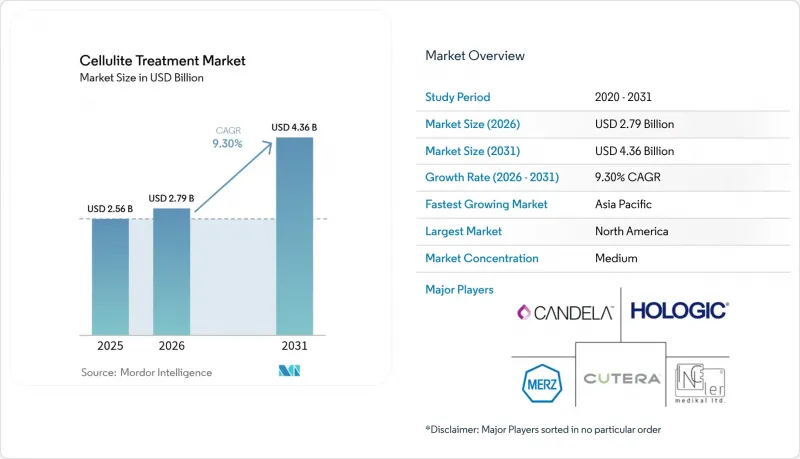
This report is Segmented by Procedure (Minimally Invasive, Non-Invasive, and Topical), Cellulite Type (Soft Cellulite, Hard Cellulite, and Edematous Cellulite), End User (Hospitals, Specialized Dermatology Clinics, and More), and Geography. The Market Sizes and Forecasts are Provided in Terms of Value (USD).
Global Cellulite Treatment Market Trends and Insights
Rising Global Obesity & Overweight Prevalence
Higher body mass index intensifies dermal-adipose interactions that create visible dimpling, cementing obesity as a prime catalyst for the cellulite treatment market. A peer-reviewed evaluation of aesthetic clinics found 78% of cellulite patients present with elevated BMI, correlating directly with severity grades. Excess adiposity disrupts lymphatic flow and thins collagen septae, prompting practitioners to layer radiofrequency, ultrasound and injectable collagenase in one plan. Because such multimodal strategies command higher price points, average treatment revenue is rising alongside case volumes. The trend is particularly enduring in the United States and Western Europe, where processed-food consumption and sedentary lifestyles remain entrenched, providing a sustained clinical pipeline for providers.
Growing Preference for Non-Invasive Aesthetic Procedures
Social media advocacy and mainstream acceptance of lunchtime procedures have tilted demand sharply toward non-surgical care. Industry association data show non-invasive body contouring reached USD 17 billion in 2024, with cellulite therapies at the forefront . Younger demographics display markedly lower risk tolerance, favoring energy-based platforms that let them resume work the same day. Technical refinements in radiofrequency and high-intensity focused ultrasound now close much of the efficacy gap that once separated surgery and surface treatments. Clinics report that roughly 85% of consultations revolve exclusively around non-invasive options, a fundamental redesign of provider service mix that continues to widen the cellulite treatment market.
Low Awareness in Emerging Markets
Despite better spending power, fewer than 15% of prospective APAC or Latin American patients can name a cellulite therapy beyond topical creams, contrasting with 67% brand recall in North America. Lack of professional training programs and limited regional workshops slow practitioner adoption, capping territory expansion for device vendors. The resulting demand gap undercuts global revenue potential for the cellulite treatment market until sustained education campaigns gain traction.
Other drivers and restraints analyzed in the detailed report include:
- Technological Advances in Energy-Based Devices
- Increasing Disposable Income & Aesthetic Consciousness
- AI-Driven Personalised Treatment Protocols
- High Procedure Cost & Limited Reimbursement
For complete list of drivers and restraints, kindly check the Table Of Contents.
Segment Analysis
Non-invasive platforms commanded 48.15% of 2025 revenue, a testament to consumer preference for low-downtime solutions. Radiofrequency leads within this bracket thanks to deeper heat penetration and intelligent temperature controls that minimize epidermal risk. High-intensity ultrasound is closing ground as real-time thermal imaging supports precise energy deposition. Together, these improvements keep the cellulite treatment market size for non-invasive solutions on an uptrend.
Minimally invasive options accelerate at a 10.05% CAGR to 2031, buoyed by FDA greenlights for Aveli and next-generation subcision tools that use micro-blade designs to sever fibrous septae with fewer passes . Injectable collagenase, spearheaded by QWO, inaugurates a drug-device hybrid niche, offering clinicians chemical lysis alongside mechanical release. As efficacy data pile up, clinics diversify procedure menus, reinforcing the modality convergence that now characterizes the cellulite treatment market.
Complete Report Scope:
- By Procedure
- Non-invasive
- Radiofrequency-based
- Laser-based
- Ultrasound-based
- Acoustic-wave
- Cryolipolysis
- Minimally Invasive
- Subcision
- Injectable collagenase
- Laser-assisted lipolysis
- Topical
- Retinol creams
- Caffeine creams
- Peptide-based formulations
- Non-invasive
- By Cellulite Type
- Soft Cellulite
- Hard Cellulite
- Edematous Cellulite
- By End User
- Hospitals
- Specialized Dermatology Clinics
- Medical Spas & Beauty Centers
- Others
- By Geography
- North America
- United States
- Canada
- Mexico
- Europe
- Germany
- United Kingdom
- France
- Italy
- Spain
- Rest of Europe
- Asia-Pacific
- China
- Japan
- India
- Australia
- South Korea
- Rest of Asia-Pacific
- Middle East & Africa
- GCC
- South Africa
- Rest of Middle East & Africa
- South America
- Brazil
- Argentina
- Rest of South America
- North America
Geography Analysis
North America retained 41.95% revenue leadership in 2025 thanks to affluent patient cohorts, broad device availability and a regulatorily transparent pathway for innovative platforms. The region added nearly 1,600 medical spas in 2023, increasing procedure access points. Corporate wellness stipends that reimburse aesthetic services extend demand beyond vanity-driven consumption, expanding the cellulite treatment market across diverse employee bases.
Europe follows as a technology-mature arena, anchored by Germany, France and the United Kingdom. The European Medicines Agency's stringent clinical-data requirements elevate capital hurdles, yet once cleared, devices benefit from physician confidence and sizeable private-pay markets. Multi-modality packages that marry cellulite therapy with skin-tightening and fat-reduction are commonplace, supporting cross-selling and deepening wallet share per patient. Intellectual property protections and robust clinical trial networks continue to draw U.S. and Asian manufacturers into European partnerships, enriching the cellulite treatment industry ecosystem.
Asia-Pacific posts the highest 11.02% CAGR to 2031, riding middle-class expansion and social media-fueled aesthetic awareness. China's tier-1 cities see double-digit annual growth in high-end cosmetic clinics, while India's metro hubs invest in AI-guided RF systems to attract medical tourists. South Korea remains an innovation bellwether, exporting patent-backed handpieces and licensed algorithms worldwide. Meanwhile, price-competitive packages bundled with vacation itineraries funnel international patients into Thai and Malaysian hospitals, broadening the cellulite treatment market size in the region.
- Hologic
- Candela Medical
- Cutera
- Merz Pharma
- Allergan Aesthetics (AbbVie)
- Sisram Medical
- Venus Concept Inc.
- BTL
- Endo International plc (Qwo)
- Lumenis
- Sciton
- Fotona d.o.o.
- Lutronic
- Zimmer Aesthetics
- Cynosure LLC
- Inceler Medikal Co. Ltd.
- Beijing Nubway S&T Co. Ltd.
- Cymedics
- BeautyBio Inc.
- Tanceuticals
- Solta Medical
Additional Benefits:
- The market estimate (ME) sheet in Excel format
- 3 months of analyst support
TABLE OF CONTENTS
1 Introduction
- 1.1 Study Assumptions & Market Definition
- 1.2 Scope of the Study
2 Research Methodology
3 Executive Summary
4 Market Landscape
- 4.1 Market Overview
- 4.2 Market Drivers
- 4.2.1 Rising Global Obesity & Overweight Prevalence
- 4.2.2 Growing Preference For Non-Invasive Aesthetic Procedures
- 4.2.3 Technological Advances In Energy-Based Devices
- 4.2.4 Increasing Disposable Income & Aesthetic Consciousness
- 4.2.5 Ai-Driven Personalised Treatment Protocols
- 4.2.6 Corporate Wellness Aesthetic Stipends
- 4.3 Market Restraints
- 4.3.1 Low Awareness In Emerging Markets
- 4.3.2 High Procedure Cost & Limited Reimbursement
- 4.3.3 Regulatory Tightening On Device Safety
- 4.3.4 Counterfeit Home-Use Device Proliferation
- 4.4 Value / Supply-Chain Analysis
- 4.5 Regulatory Landscape
- 4.6 Technological Outlook
- 4.7 Porter's Five Forces Analysis
- 4.7.1 Threat of New Entrants
- 4.7.2 Bargaining Power of Buyers
- 4.7.3 Bargaining Power of Suppliers
- 4.7.4 Threat of Substitutes
- 4.7.5 Intensity of Competitive Rivalry
5 Market Size & Growth Forecasts
- 5.1 By Procedure
- 5.1.1 Non-invasive
- 5.1.1.1 Radiofrequency-based
- 5.1.1.2 Laser-based
- 5.1.1.3 Ultrasound-based
- 5.1.1.4 Acoustic-wave
- 5.1.1.5 Cryolipolysis
- 5.1.2 Minimally Invasive
- 5.1.2.1 Subcision
- 5.1.2.2 Injectable collagenase
- 5.1.2.3 Laser-assisted lipolysis
- 5.1.3 Topical
- 5.1.3.1 Retinol creams
- 5.1.3.2 Caffeine creams
- 5.1.3.3 Peptide-based formulations
- 5.1.1 Non-invasive
- 5.2 By Cellulite Type
- 5.2.1 Soft Cellulite
- 5.2.2 Hard Cellulite
- 5.2.3 Edematous Cellulite
- 5.3 By End User
- 5.3.1 Hospitals
- 5.3.2 Specialized Dermatology Clinics
- 5.3.3 Medical Spas & Beauty Centers
- 5.3.4 Others
- 5.4 By Geography
- 5.4.1 North America
- 5.4.1.1 United States
- 5.4.1.2 Canada
- 5.4.1.3 Mexico
- 5.4.2 Europe
- 5.4.2.1 Germany
- 5.4.2.2 United Kingdom
- 5.4.2.3 France
- 5.4.2.4 Italy
- 5.4.2.5 Spain
- 5.4.2.6 Rest of Europe
- 5.4.3 Asia-Pacific
- 5.4.3.1 China
- 5.4.3.2 Japan
- 5.4.3.3 India
- 5.4.3.4 Australia
- 5.4.3.5 South Korea
- 5.4.3.6 Rest of Asia-Pacific
- 5.4.4 Middle East & Africa
- 5.4.4.1 GCC
- 5.4.4.2 South Africa
- 5.4.4.3 Rest of Middle East & Africa
- 5.4.5 South America
- 5.4.5.1 Brazil
- 5.4.5.2 Argentina
- 5.4.5.3 Rest of South America
- 5.4.1 North America
6 Competitive Landscape
- 6.1 Market Concentration
- 6.2 Market Share Analysis
- 6.3 Company Profiles (includes Global level Overview, Market level overview, Core Segments, Financials as available, Strategic Information, Market Rank/Share for key companies, Products & Services, and Recent Developments)
- 6.3.1 Hologic Inc.
- 6.3.2 Candela Corporation
- 6.3.3 Cutera Inc.
- 6.3.4 Merz Pharma GmbH & Co KGaA
- 6.3.5 Allergan Aesthetics (AbbVie)
- 6.3.6 Sisram Medical (Alma Lasers)
- 6.3.7 Venus Concept Inc.
- 6.3.8 BTL Aesthetics
- 6.3.9 Endo International plc (Qwo)
- 6.3.10 Lumenis Ltd.
- 6.3.11 Sciton Inc.
- 6.3.12 Fotona d.o.o.
- 6.3.13 Lutronic Corporation
- 6.3.14 Zimmer Aesthetics
- 6.3.15 Cynosure LLC
- 6.3.16 Inceler Medikal Co. Ltd.
- 6.3.17 Beijing Nubway S&T Co. Ltd.
- 6.3.18 cymedics GmbH & Co KG
- 6.3.19 BeautyBio Inc.
- 6.3.20 Tanceuticals LLC
- 6.3.21 Solta Medical
7 Market Opportunities & Future Outlook
- 7.1 White-space & Unmet-need Assessment

