PUBLISHER: Mordor Intelligence | PRODUCT CODE: 2123653

PUBLISHER: Mordor Intelligence | PRODUCT CODE: 2123653
Bowel Management Systems - Market Share Analysis, Industry Trends & Statistics, Growth Forecasts (2026 - 2031)
According to Mordor Intelligence, the bowel management systems market size is expected to grow from USD 2.57 billion in 2025 to USD 2.68 billion in 2026 and is forecast to reach USD 3.31 billion by 2031 at 4.29% CAGR over 2026-2031.
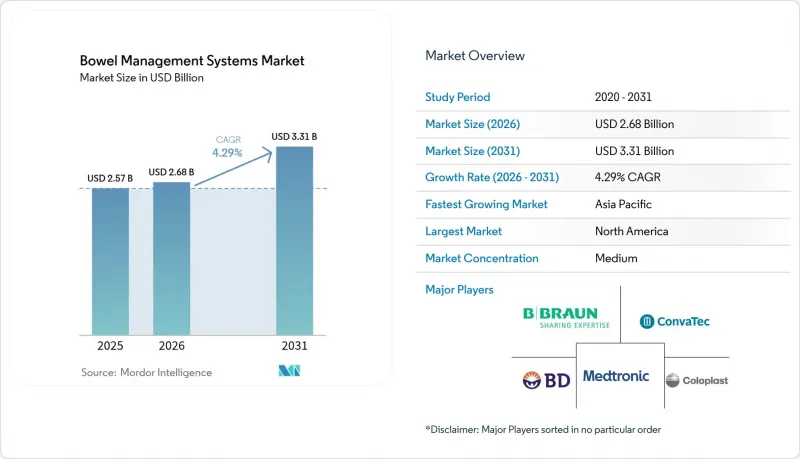
This report is Segmented by Product (Ostomy Bags [Colostomy Bags, and More], Transanal Irrigation Systems, Nerve Modulation Devices, and More), Patient Type (Pediatric, Adult, Geriatric), End User (Hospitals, Ambulatory Surgery Centers, Home Care Settings, and Skilled Nursing Facilities), and Geography (North America, Europe, and More). The Market Forecasts are Provided in Terms of Value (USD).
Global Bowel Management Systems Market Trends and Insights
High Incidence of Inflammatory Bowel Disease
Inflammatory bowel disease affects 3.1 million U.S. adults, while incidence climbs in industrializing economies, sustaining demand for ostomy supplies. Earlier surgical intervention among biologic-therapy non-responders reduces the window from diagnosis to stoma creation, driving sales of high-output pouches with convex barriers that fit complex abdomens. Device makers respond with deeper filters that tame odor during active flares, an attribute valued by younger Crohn's patients returning to school or work. Clinicians increasingly pair temporary ileostomies with restorative proctocolectomy, ensuring continued ostomy-bag replacement cycles. These patterns keep the bowel management systems market on a stable volume trajectory even if biologics delay some surgeries.
Rapidly Growing Geriatric Population
Adults aged 65 and over will reach 1.5 billion by 2050, with fecal-incontinence prevalence at 14.1% among community dwellers and up to 70% in nursing homes. Aging magnifies pelvic-floor weakness, polypharmacy, and neurogenic bowel, expanding the candidate base for disposable pouches and neuromodulation implants. Japan's long-term-care insurance now reimburses electronic irrigation and sacral nerve evaluation, signaling payer willingness to fund high-ticket devices that keep seniors at home. Chinese provinces include ostomy supplies on essential-drug lists, and Germany finances tibial nerve stimulation, boosting therapy penetration. Suppliers are redesigning closure clips, finger tabs, and color coding to suit arthritic hands and low vision, further embedding geriatric loyalty in the bowel management systems market.
Patient Preference for Conservative/Non-Invasive Care
A 2024 survey showed 68% of fecal-incontinence patients favor diet or physiotherapy over stoma formation, delaying conversion to pouch use. Cultural stigma around visible appliances amplifies hesitation in Asia, Latin America, and the Middle East. Tibial nerve stimulation offers a lower-invasiveness bridge, yet 30-40% of sessions fail to deliver durable control, leaving patients oscillating between suboptimal symptom relief and reluctance to pursue permanent diversion. Injectable bulking agents and magnetic sphincters also absorb candidates who might otherwise adopt ostomy systems. This conservatism tempers early-stage demand in the bowel management systems market.
Other drivers and restraints analyzed in the detailed report include:
- Reimbursement Expansion in High-Income Markets
- Smart-Sensor Ostomy Pouches Enable Remote Monitoring
- Post-Operative Infections & Device-Recall Headwinds
For complete list of drivers and restraints, kindly check the Table Of Contents.
Segment Analysis
Nerve-modulation devices logged the highest 6.25% CAGR between 2026 and 2031, benefiting from policy coverage and miniaturized leads that simplify implantation. Ostomy bags, though still 48.54% of the bowel management systems market size in 2025, are ceding share as colorectal surgeons adopt sphincter-sparing protocols. Within pouches, colostomy variants dominate due to left-sided resections, but ileostomy lines grow faster on rising IBD surgeries. Transanal irrigation systems, especially programmable electronic types, gain reimbursement in Germany and the U.K., offering an alternative for sigmoid stomas. Anal implants and magnetic sphincters open a small but high-margin niche after the FDA's humanitarian approval of Implantica's device in 2024. Accessory demand scales with pouch rotation; hydrocolloid rings designed for seven-day wear sell briskly to athletes who value discretion.
Suppliers hedge by bundling barriers, vent filters, and deodorizer sachets with baseplates, raising average selling price per patient episode. Recyclable pouch films bolster EU tenders, and electronic pumps with warmed saline broaden adhesion for chronic-constipation management.
Complete Report Scope:
- By Product
- Ostomy Bags
- Colostomy Bags
- Ileostomy Bags
- Urostomy Bags
- Transanal Irrigation Systems
- Manual Pump-based Irrigation
- Electronic Smart Irrigation
- Nerve Modulation Devices
- Sacral Nerve Stimulation Systems
- Tibial Nerve Stimulation Systems
- Anal Implants & Artificial Sphincters
- Hydraulic Artificial Sphincters
- Magnetic Sphincters
- Skin Barriers & Accessories
- Skin Barrier Sheets & Rings
- Deodorizing Filters & Pouch Accessories
- Ostomy Bags
- By Patient Type
- Pediatric (<18 yrs)
- Adult (18-64 yrs)
- Geriatric (65+ yrs)
- By End User
- Hospitals
- Ambulatory Surgery Centers
- Home Care Settings
- Skilled Nursing Facilities
- By Geography
- North America
- United States
- Canada
- Mexico
- Europe
- Germany
- United Kingdom
- France
- Italy
- Spain
- Rest of Europe
- Asia-Pacific
- China
- India
- Japan
- Australia
- South Korea
- Rest of Asia-Pacific
- Middle East and Africa
- GCC
- South Africa
- Rest of Middle East and Africa
- South America
- Brazil
- Argentina
- Rest of South America
- North America
Geography Analysis
North America accounted for 38.23% of bowel management systems market size in 2025 thanks to Medicare coverage for sacral nerve stimulation and a dense network of certified wound-ostomy-continence nurses. The 2024 National Coverage Determination removed prior-authorization lag, adding roughly 120,000 fecal-incontinence beneficiaries per year. Eleven Health's Bluetooth pouch system is live at 15 integrated delivery networks earning USD 50-65 monthly remote-monitoring fees. Canada broadened essential-benefit lists in Ontario and British Columbia, trimming patient copay. Mexico's growth sits mostly in private clinics treating medical tourists, with government hospitals buying basic two-piece systems.
Asia-Pacific posts the fastest 6.62% CAGR, propelled by China's 297 million seniors and India's Ayushman Bharat package that now funds ostomy bags and irrigation. Shanghai and Guangdong pilot reimbursement for tibial nerve stimulation, while Japan's long-term-care insurance subsidizes electronic irrigation. Australia's Pharmaceutical Benefits Scheme added sacral nerve stimulation in 2024, reimbursing the AUD 25,000 implant. South Korea pilots bundled colorectal episodes including a year of pouch supply, signaling payer migration to value contracting across the region.
Europe's bowel management systems market grows modestly amid MDR recertification bottlenecks that forced 30% of accessory SKUs off shelves in 2024. Germany's statutory insurance covers tibial nerve stimulation, adding 80,000 eligible patients. NHS England bundled ostomy products into colorectal surgery tariffs, steering purchasing toward higher-quality convex barriers that curb readmissions. France and Italy test circular-economy pouch take-back modeled on Coloplast's Dutch program. The Middle East and Africa stay nascent, with GCC private hospitals importing premium systems for expatriates, while South Africa's public sector buys volume packs of two-piece bags. In South America, Brazil's private insurers fund neuromodulation, but public shortages persist, keeping penetration low outside affluent metros.
- Abena A/S
- Axonics Inc.
- B. Braun
- Beckton Dickinson
- Boston Scientific
- Cardinal Health
- Coloplast
- Consure Medical
- ConvaTec Group plc
- Cook MyoSite
- Hollister
- Implantica AG
- Laborie Medical Technologies
- Medtronic
- Qufora A/S
- Salts Healthcare
- Solventum Corporation
- Wellspect Healthcare
Additional Benefits:
- The market estimate (ME) sheet in Excel format
- 3 months of analyst support
TABLE OF CONTENTS
1 Introduction
- 1.1 Study Assumptions & Market Definition
- 1.2 Scope of the Study
2 Research Methodology
3 Executive Summary
4 Market Landscape
- 4.1 Market Overview
- 4.2 Market Drivers
- 4.2.1 High incidence of inflammatory bowel disease (IBD)
- 4.2.2 Rapidly growing geriatric (65+) population
- 4.2.3 Reimbursement expansion in high-income markets
- 4.2.4 Smart-sensor ostomy pouches enable remote monitoring
- 4.2.5 ESG-driven shift to recyclable, bio-based single-use materials
- 4.3 Market Restraints
- 4.3.1 Patient preference for conservative/non-invasive care
- 4.3.2 Post-operative infections & device-recall headwinds
- 4.3.3 High upfront cost of sacral-nerve stimulation implants
- 4.3.4 Regulatory scrutiny on single-use plastic waste
- 4.4 Supply-Chain Analysis
- 4.5 Regulatory Landscape
- 4.6 Technological Outlook
- 4.7 Porter's Five Forces
- 4.7.1 Threat of New Entrants
- 4.7.2 Bargaining Power of Buyers
- 4.7.3 Bargaining Power of Suppliers
- 4.7.4 Threat of Substitutes
- 4.7.5 Competitive Rivalry
5 Market Size & Growth Forecasts (Value, USD)
- 5.1 By Product
- 5.1.1 Ostomy Bags
- 5.1.1.1 Colostomy Bags
- 5.1.1.2 Ileostomy Bags
- 5.1.1.3 Urostomy Bags
- 5.1.2 Transanal Irrigation Systems
- 5.1.2.1 Manual Pump-based Irrigation
- 5.1.2.2 Electronic Smart Irrigation
- 5.1.3 Nerve Modulation Devices
- 5.1.3.1 Sacral Nerve Stimulation Systems
- 5.1.3.2 Tibial Nerve Stimulation Systems
- 5.1.4 Anal Implants & Artificial Sphincters
- 5.1.4.1 Hydraulic Artificial Sphincters
- 5.1.4.2 Magnetic Sphincters
- 5.1.5 Skin Barriers & Accessories
- 5.1.5.1 Skin Barrier Sheets & Rings
- 5.1.5.2 Deodorizing Filters & Pouch Accessories
- 5.1.1 Ostomy Bags
- 5.2 By Patient Type
- 5.2.1 Pediatric (<18 yrs)
- 5.2.2 Adult (18-64 yrs)
- 5.2.3 Geriatric (65+ yrs)
- 5.3 By End User
- 5.3.1 Hospitals
- 5.3.2 Ambulatory Surgery Centers
- 5.3.3 Home Care Settings
- 5.3.4 Skilled Nursing Facilities
- 5.4 By Geography
- 5.4.1 North America
- 5.4.1.1 United States
- 5.4.1.2 Canada
- 5.4.1.3 Mexico
- 5.4.2 Europe
- 5.4.2.1 Germany
- 5.4.2.2 United Kingdom
- 5.4.2.3 France
- 5.4.2.4 Italy
- 5.4.2.5 Spain
- 5.4.2.6 Rest of Europe
- 5.4.3 Asia-Pacific
- 5.4.3.1 China
- 5.4.3.2 India
- 5.4.3.3 Japan
- 5.4.3.4 Australia
- 5.4.3.5 South Korea
- 5.4.3.6 Rest of Asia-Pacific
- 5.4.4 Middle East and Africa
- 5.4.4.1 GCC
- 5.4.4.2 South Africa
- 5.4.4.3 Rest of Middle East and Africa
- 5.4.5 South America
- 5.4.5.1 Brazil
- 5.4.5.2 Argentina
- 5.4.5.3 Rest of South America
- 5.4.1 North America
6 Competitive Landscape
- 6.1 Market Concentration
- 6.2 Market Share Analysis
- 6.3 Company Profiles (includes Global level Overview, Market level overview, Core Segments, Financials as available, Strategic Information, Market Rank/Share for key companies, Products & Services, and Recent Developments)
- 6.3.1 Abena A/S
- 6.3.2 Axonics Inc.
- 6.3.3 B. Braun Melsungen AG
- 6.3.4 Becton Dickinson & Company
- 6.3.5 Boston Scientific Corp.
- 6.3.6 Cardinal Health Inc.
- 6.3.7 Coloplast A/S
- 6.3.8 Consure Medical
- 6.3.9 ConvaTec Group plc
- 6.3.10 Cook MyoSite
- 6.3.11 Hollister Incorporated
- 6.3.12 Implantica AG
- 6.3.13 Laborie Medical Technologies
- 6.3.14 Medtronic plc
- 6.3.15 Qufora A/S
- 6.3.16 Salts Healthcare Ltd
- 6.3.17 Solventum Corporation
- 6.3.18 Wellspect Healthcare
7 Market Opportunities & Future Outlook
- 7.1 White-space & Unmet-Need Assessment

