PUBLISHER: Mordor Intelligence | PRODUCT CODE: 2123668

PUBLISHER: Mordor Intelligence | PRODUCT CODE: 2123668
US HVAC Services - Market Share Analysis, Industry Trends & Statistics, Growth Forecasts (2026 - 2031)
According to Mordor Intelligence, the US HVAC services market size was valued at USD 17.93 billion in 2025 and is estimated to grow from USD 18.98 billion in 2026 to reach USD 25.35 billion by 2031, at a CAGR of 5.90% during the forecast period (2026-2031).
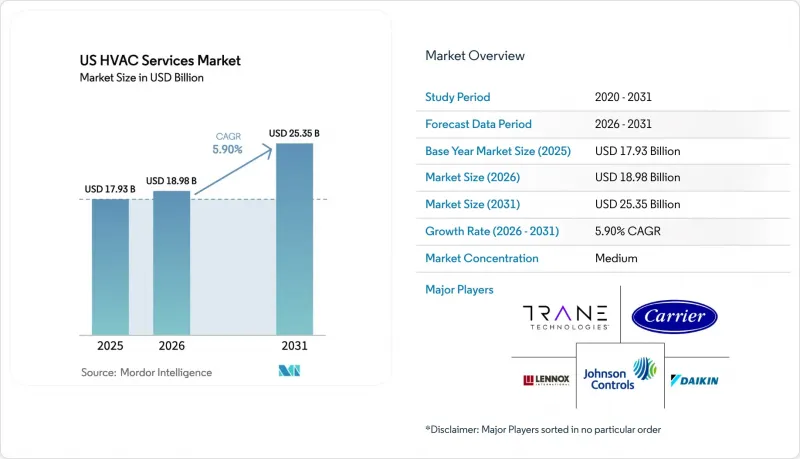
This report is Segmented by Implementation Type (New Construction, and Retrofit Buildings), Service Type (Installation and Replacement, Maintenance and Repair, and More), System Type (Heating, Cooling, Ventilation and IAQ, and More), End User (Residential, Commercial, Industrial), Application Vertical (Data Centers, Healthcare, and More), and Geography. Market Forecasts are Provided in Terms of Value (USD).
US HVAC Services Market Trends and Insights
Aging Building Stock in OECD Markets Requiring Upgrades
The median commercial building in the United States was 44 years old in 2025, and many structures erected before 1980 still rely on single-stage rooftop units that lack variable-speed drives, economizers, or modern controls. Energy use by those legacy units runs 30%-40% above code-minimum systems, which pressures landlords in cities with disclosure mandates to commit capital to HVAC retrofits. Institutional investors now price carbon intensity into property valuations, so ESG compliance is another trigger. The Infrastructure Investment and Jobs Act allocated USD 3.5 billion for public-sector upgrades that often serve as templates for private owners. Retrofit urgency is highest in the Northeast and Midwest where heating loads dominate, though Sun Belt buildings also pursue upgrades to manage peak cooling demand.
Mandatory Refrigerant Phase-Downs Driving Retrofit Demand
The American Innovation and Manufacturing Act targets an 85% cut in hydrofluorocarbon production by 2036, propelling the transition from R-410A toward lower-GWP A2L blends such as R-32 and R-454B. Because A2L refrigerants require sensors, ventilation, and spark-safe components, most existing equipment cannot simply be recharged, so owners face a retrofit or replacement decision well ahead of normal life cycles. ASHRAE Standard 15 drives up installation cost by USD 2,000-USD 5,000 for detection gear. California and several Northeastern states front-loaded compliance deadlines to 2028, compressing project schedules and crowding service pipelines.
Skilled-Labor Shortages and Escalating Wage Bills
HVAC employment is projected to add 23,000 roles from 2024-2034, but attrition will create 35,000 openings annually, leaving a sizable gap. Median hourly wages climbed to USD 28.50 in 2025, while A2L-certified master technicians topped USD 40. Labor now exceeds 55% of total project cost, up from 48% in 2020. Apprenticeships expand, yet four-year training requirements delay relief. Contractors deploy augmented-reality guidance and remote diagnostics to boost productivity, but wage inflation still squeezes margins, especially for smaller firms.
Other drivers and restraints analyzed in the detailed report include:
- Expansion of Hyperscale Data-Center Build-Outs
- HVAC-as-a-Service Contracts Unlocking Annuity Revenues
- Volatile HVAC Component Supply and Material Inflation
For complete list of drivers and restraints, kindly check the Table Of Contents.
Segment Analysis
Retrofit buildings contributed 58.49% of 2025 revenue and are forecast to rise at 6.23% through 2031, reinforcing their role as the growth engine of the US HVAC services market. The US HVAC services market size for retrofit projects is expanding as owners race to replace R-410A systems ahead of the EPA phase-down calendar, creating a retrofit wave that overlaps with normal end-of-life milestones. ESG mandates tie asset values to operational carbon, so capital partners increasingly insist on variable-speed compressors and smart controls that lower kWh per square foot. Prefabricated modular kits, craned into place in a single day, slash disruption and let contractors deliver more jobs per crew per month.
New construction trails at a 5.40% CAGR yet still benefits from stronger design-build coordination. Developers in growth metros specify heat-recovery VRF systems that improve tenant comfort and differentiate Class A properties. Federal funding for public buildings steers toward retrofits, but ground-up healthcare and industrial facilities keep new-build pipelines active in Sun Belt states.
Maintenance and repair retained the largest share at 46.15% in 2025, yet the highest momentum sits with energy-efficiency and retrofit services, advancing 7.03%. The US HVAC services market size for optimization projects benefits from utility rebates that buy down payback to three years or less. Controls upgrades climb 6.50% as buildings migrate from stand-alone thermostats to IP-connected platforms. Installation services face commoditization in residential split-system changeouts, motivating contractors to pivot toward bundled commercial scopes that fold in commissioning and multi-year service.
Consulting and other advisory work accelerates as owners seek third-party audits before allocating capital. Energy-savings performance contracts, now endorsed for federal facilities, enable providers to front the cost and recover investments from verified kWh reductions, reshaping revenue recognition.
Complete Report Scope:
- By Implementation Type
- New Construction
- Retrofit Buildings
- By Service Type
- Installation and Replacement Services
- Maintenance and Repair Services
- Energy-Efficiency and Retrofit Services
- HVAC Controls Upgrade and Integration
- Consulting and Other Services
- By System Type
- Heating Services
- Cooling Services
- Ventilation and IAQ Services
- Integrated Building-Management Services
- By End User
- Residential
- Commercial
- Industrial
- By Application
- Data Centers
- Healthcare Facilities
- Educational Institutions
- Hospitality and Leisure
- Retail Spaces
- Government and Public Buildings
- Other Applications
- By Geography
- North America
- United States
- Canada
- Mexico
- South America
- Brazil
- Argentina
- Mexico
- Rest of South America
- Europe
- United Kingdom
- Germany
- France
- Benelux
- Rest of Europe
- Asia Pacific
- China
- India
- Japan
- Rest of Asia Pacific
- Middle East and Africa
- Middle East
- United Arab Emirates
- Saudi Arabia
- Rest of Middle East
- Africa
- South Africa
- Rest of Africa
- Middle East
- North America
List of Companies Covered in this Report:
- Johnson Controls International PLC
- Carrier Global Corporation
- Daikin Industries Ltd.
- Trane Technologies plc
- Lennox International Inc.
- Honeywell International Inc.
- Siemens AG
- LG Electronics Inc.
- Electrolux AB
- Robert Bosch GmbH
- Fujitsu General Ltd.
- Nortek Global HVAC
- Mitsubishi Electric Corporation
- Rheem Manufacturing Company
- Danfoss A/S
- GREE Electric Appliances Inc.
- Midea Group Co. Ltd.
- Johnson Service Group plc
- Comfort Systems USA, Inc.
- EMCOR Group Inc.
Additional Benefits:
- The market estimate (ME) sheet in Excel format
- 3 months of analyst support
TABLE OF CONTENTS
1 INTRODUCTION
- 1.1 Study Assumptions and Market Definition
- 1.2 Scope of the Study
2 RESEARCH METHODOLOGY
3 EXECUTIVE SUMMARY
4 MARKET LANDSCAPE
- 4.1 Market Overview
- 4.2 Market Drivers
- 4.2.1 Aging Building Stock in OECD Markets Requiring Upgrades
- 4.2.2 Mandatory Refrigerant Phase-Downs Driving Retrofit Demand
- 4.2.3 Expansion of Hyperscale Data-Center Build-Outs
- 4.2.4 HVAC-as-a-Service Contracts Unlocking Annuity Revenues
- 4.2.5 Prefabricated Modular Retrofit Solutions Accelerating Project Timelines
- 4.2.6 Utility-Backed Predictive-Maintenance Subscriptions Boosting Service Revenues
- 4.3 Market Restraints
- 4.3.1 Skilled-Labor Shortages and Escalating Wage Bills
- 4.3.2 Volatile HVAC Component Supply and Material Inflation
- 4.3.3 Cyber-Security Risks in Connected Building Systems
- 4.3.4 Rising Urban Permitting Barriers for A2L Refrigerant Storage
- 4.4 Industry Value-Chain Analysis
- 4.5 Regulatory Landscape
- 4.6 Technological Outlook
- 4.7 Impact of Macroeconomic Factors on the Market
- 4.8 Porter's Five Forces Analysis
- 4.8.1 Bargaining Power of Suppliers
- 4.8.2 Bargaining Power of Buyers
- 4.8.3 Threat of New Entrants
- 4.8.4 Threat of Substitutes
- 4.8.5 Intensity of Competitive Rivalry
- 4.9 Investment and M&A Landscape
5 MARKET SIZE AND GROWTH FORECASTS (VALUE)
- 5.1 By Implementation Type
- 5.1.1 New Construction
- 5.1.2 Retrofit Buildings
- 5.2 By Service Type
- 5.2.1 Installation and Replacement Services
- 5.2.2 Maintenance and Repair Services
- 5.2.3 Energy-Efficiency and Retrofit Services
- 5.2.4 HVAC Controls Upgrade and Integration
- 5.2.5 Consulting and Other Services
- 5.3 By System Type
- 5.3.1 Heating Services
- 5.3.2 Cooling Services
- 5.3.3 Ventilation and IAQ Services
- 5.3.4 Integrated Building-Management Services
- 5.4 By End User
- 5.4.1 Residential
- 5.4.2 Commercial
- 5.4.3 Industrial
- 5.5 By Application
- 5.5.1 Data Centers
- 5.5.2 Healthcare Facilities
- 5.5.3 Educational Institutions
- 5.5.4 Hospitality and Leisure
- 5.5.5 Retail Spaces
- 5.5.6 Government and Public Buildings
- 5.5.7 Other Applications
- 5.6 By Geography
- 5.6.1 North America
- 5.6.1.1 United States
- 5.6.1.2 Canada
- 5.6.1.3 Mexico
- 5.6.2 South America
- 5.6.2.1 Brazil
- 5.6.2.2 Argentina
- 5.6.2.3 Mexico
- 5.6.2.4 Rest of South America
- 5.6.3 Europe
- 5.6.3.1 United Kingdom
- 5.6.3.2 Germany
- 5.6.3.3 France
- 5.6.3.4 Benelux
- 5.6.3.5 Rest of Europe
- 5.6.4 Asia Pacific
- 5.6.4.1 China
- 5.6.4.2 India
- 5.6.4.3 Japan
- 5.6.4.4 Rest of Asia Pacific
- 5.6.5 Middle East and Africa
- 5.6.5.1 Middle East
- 5.6.5.1.1 United Arab Emirates
- 5.6.5.1.2 Saudi Arabia
- 5.6.5.1.3 Rest of Middle East
- 5.6.5.2 Africa
- 5.6.5.2.1 South Africa
- 5.6.5.2.2 Rest of Africa
- 5.6.5.1 Middle East
- 5.6.1 North America
6 COMPETITIVE LANDSCAPE
- 6.1 Market Concentration
- 6.2 Strategic Moves
- 6.3 Market Share Analysis
- 6.4 Company Profiles (includes Global level Overview, Market level overview, Core Segments, Financials as available, Strategic Information, Market Rank/Share for key companies, Products & Services, and Recent Developments)
- 6.4.1 Johnson Controls International PLC
- 6.4.2 Carrier Global Corporation
- 6.4.3 Daikin Industries Ltd.
- 6.4.4 Trane Technologies plc
- 6.4.5 Lennox International Inc.
- 6.4.6 Honeywell International Inc.
- 6.4.7 Siemens AG
- 6.4.8 LG Electronics Inc.
- 6.4.9 Electrolux AB
- 6.4.10 Robert Bosch GmbH
- 6.4.11 Fujitsu General Ltd.
- 6.4.12 Nortek Global HVAC
- 6.4.13 Mitsubishi Electric Corporation
- 6.4.14 Rheem Manufacturing Company
- 6.4.15 Danfoss A/S
- 6.4.16 GREE Electric Appliances Inc.
- 6.4.17 Midea Group Co. Ltd.
- 6.4.18 Johnson Service Group plc
- 6.4.19 Comfort Systems USA, Inc.
- 6.4.20 EMCOR Group Inc.
7 MARKET OPPORTUNITIES AND FUTURE OUTLOOK
- 7.1 White-Space and Unmet-Need Assessment

