PUBLISHER: Mordor Intelligence | PRODUCT CODE: 2123672

PUBLISHER: Mordor Intelligence | PRODUCT CODE: 2123672
Homeopathy Product - Market Share Analysis, Industry Trends & Statistics, Growth Forecasts (2026 - 2031)
According to Mordor Intelligence, the homeopathy product market size was valued at USD 12.45 billion in 2025 and is estimated to grow from USD 13.02 billion in 2026 to reach USD 16.65 billion by 2031, at a CAGR of 5.04% during the forecast period (2026-2031).
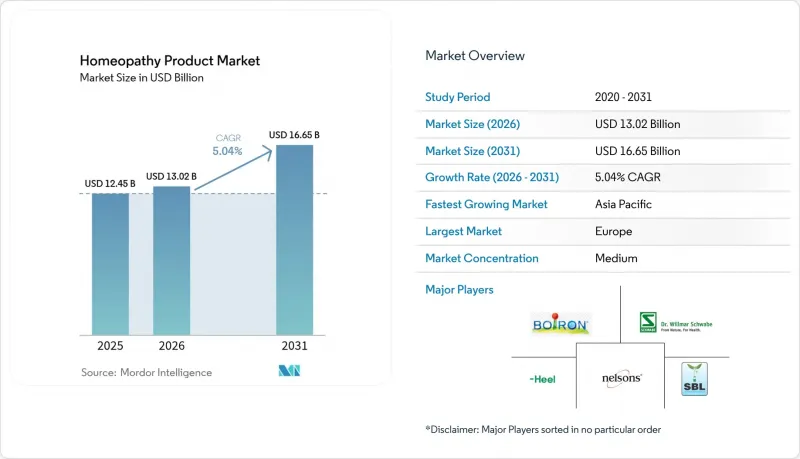
This report is Segmented by Product Type (Tinctures, Dilutions, Tablets, Ointments & Creams, Others), Application (Analgesic & Antipyretic, Respiratory, and More), Source (Plant-Based, Animal-Based, Mineral-Based), Distribution Channel (Retail Pharmacies & Drugstores, Homeopathic Clinics, and More), and Geography (North America, Europe, and More). The Market Forecasts are Provided in Terms of Value (USD).
Global Homeopathy Product Market Trends and Insights
Consumer Shift Toward Natural and Holistic Medicine
Escalating preference for plant-based and mineral-derived remedies is reshaping portfolios as 80% of surveyed consumers express interest in natural health products, yet familiarity with homeopathy lingers at 60%. Boots' June 2025 release of 300 wellness SKUs, including homeopathic lines, signals mainstream confidence in category growth. Millennials and Gen Z emphasize transparency and sustainability, prompting brands to spotlight botanical sourcing. Retail shelf gains coexist with knowledge gaps around potentization, inviting scrutiny over efficacy claims. Firms investing in omnichannel education capture outsized share as they translate curiosity into repeat purchase.
Self-Care and Preventive Health Adoption
Combination OTC remedies, expanding at a 6.85% CAGR, illustrate consumer demand for simplified multi-symptom control. Boiron's Oscillococcinum and Hyland's Cold'n Cough target flu-like syndromes without consultation, a habit reinforced by pandemic-era telehealth autonomy. Classical practitioners caution that a one-size-fits-all approach dilutes an individualized philosophy. Manufacturers straddle this divide through tiered portfolios that place single remedies in clinic channels and blends in mass retail.
Limited Clinical Evidence and Scientific Skepticism
The absence of large-scale placebo-controlled trials limits hospital and insurer adoption. FDA's 2022 risk-based guidance sidelines efficacy considerations, focusing on safety while maintaining a watchlist. Canada's 2025 disclaimer mandate codifies doubt on retail shelves, and advocacy groups challenge the policy in court. Heel undertakes the rare rigorous program yet faces methodology critiques. Without compelling data, many brands stay confined to OTC aisles and practitioner scripts.
Other drivers and restraints analyzed in the detailed report include:
- Aging Population and Chronic Disease Prevalence
- Regulatory Recognition and Healthcare Integration
- Regulatory Fragmentation and Reimbursement Rollbacks
For complete list of drivers and restraints, kindly check the Table Of Contents.
Segment Analysis
Over-the-counter medicines accounted for 67.02% of the homeopathic product market share in 2025. The segment thrives on mass distribution through Walgreens, Walmart and Boots, reinforced by Hyland's 2025 rollout into 7,400 new U.S. outlets. OTC expansion aligns with digital education campaigns that deepen shopper confidence and raise basket sizes.
Self-care combination remedies underpin forecast acceleration, advancing at 6.85% CAGR as time-pressed consumers embrace multi-symptom relief. Boiron devoted USD 6.6 million to pediatric cold-and-flu advertising, lifting U.S. channel sales 11.4% year on year. Prescription lines persist in Germany and India where practitioner ecosystems remain influential, but their contribution to the homeopathy product market size shrinks as reimbursement wanes.
Plant-based inputs accounted for 60.34% of the value in 2025, thanks to familiarity with Arnica, Belladonna, and Chamomilla. Sustainability narratives and clean-label cues reinforce share across Europe and North America. Mineral remedies maintain a stable demand through practitioner prescriptions.
Animal-based nosodes and sarcodes, though a minority today, are projected to grow at a 9.33% CAGR. Brands like Dr. Reckeweg educate clinicians on chronic-disease protocols, widening acceptance. Ethical sourcing and EU traceability rules introduce cost and reputational hurdles that could moderate growth but have not yet derailed momentum.
Complete Report Scope:
- By Product Type
- OTC Homeopathic Medicines
- Prescription Homeopathic Medicines
- Self-care Combination Remedies
- By Source
- Plant-based
- Mineral-based
- Animal-based
- Biochemic
- By Form
- Liquid Dilutions
- Tablets & Pellets
- Drops & Tinctures
- Ointments & Creams
- Powders
- By Distribution Channel
- Retail Pharmacies
- Homeopathic Clinics
- Other Distribution Channels
- By Geography
- North America
- United States
- Canada
- Mexico
- Europe
- Germany
- United Kingdom
- France
- Italy
- Spain
- Rest of Europe
- Asia-Pacific
- China
- Japan
- India
- Australia
- South Korea
- Rest of Asia-Pacific
- Middle East & Africa
- GCC
- South Africa
- Rest of Middle East & Africa
- South America
- Brazil
- Argentina
- Rest of South America
- North America
Geography Analysis
North America led 2025 revenue at 37.78%, anchored by mature OTC channels and digital subscriptions. United States retailers stock broad assortments, while Canada balances opportunity with a 2025 disclaimer that could mute growth. Mexico remains nascent but benefits from rising wellness spend.
Europe shows mixed prospects. Germany's population familiarity of 95.1% sustains baseline demand despite the coverage debate, and France's reimbursement cut forces a retail pivot for Boiron. Spain, Italy, and Eastern Europe offer mid-single-digit growth under lighter regulation. Weleda's Cell Longevity debut in prestige boutiques illustrates premium repositioning.
Asia-Pacific is set to climb at 7.03% CAGR, the highest regional rate. India dominates with 300,000 practitioners and INR 3,050 crore federal backing. China sees cautious interest beyond TCM, while Australia's strict TGA oversight supports premium pricing. Southeast Asian markets open white-space through smartphone-driven telehealth adoption.
- A. Nelson & Co. Ltd
- Adonis Laboratories Pvt. Ltd
- Ainsworths Ltd
- Allen Homeopathy
- Archibel SA (RadarOpus)
- Bhandari Homoeopathic Laboratories
- Biologische Heilmittel Heel
- Boericke & Tafel
- Boiron
- Dr. Willmar Schwabe GmbH
- Hahnemann Laboratories Inc.
- Homeocan Inc.
- Hyland's (Standard Homeopathic)
- Mediral International
- Pekana Naturheilmittel
- Sanat Products Ltd.
- SBL World Pharmaceuticals
- Similia Research Laboratories
- Weleda
Additional Benefits:
- The market estimate (ME) sheet in Excel format
- 3 months of analyst support
TABLE OF CONTENTS
1 Introduction
- 1.1 Study Assumptions & Market Definition
- 1.2 Scope of the Study
2 Research Methodology
3 Executive Summary
4 Market Landscape
- 4.1 Market Overview
- 4.2 Market Drivers
- 4.2.1 Increasing Prevalence of Chronic Diseases & Dissatisfaction with Allopathy
- 4.2.2 Growing Adoption of Integrative Healthcare Models
- 4.2.3 Regulatory Recognition in Emerging Markets
- 4.2.4 Expansion of E-Commerce & Tele-Consult Platforms
- 4.2.5 Evidence-Based Nano-Dilution Analytics
- 4.2.6 Venture Funding in Personalised Micro-Dose Remedies
- 4.3 Market Restraints
- 4.3.1 Scientific Scepticism & Limited RCT Evidence
- 4.3.2 Reimbursement Cuts / Regulatory Bans in Key Nations
- 4.3.3 Organic Raw-Material Supply Bottlenecks
- 4.3.4 Adulteration & Cross-Contamination Recall Risk
- 4.4 Regulatory Landscape
- 4.5 Technological Outlook
- 4.6 Porter's Five Forces Analysis
- 4.6.1 Threat of New Entrants
- 4.6.2 Bargaining Power of Buyers
- 4.6.3 Bargaining Power of Suppliers
- 4.6.4 Threat of Substitute Products
- 4.6.5 Intensity of Competitive Rivalry
5 Market Size & Growth Forecasts
- 5.1 By Product Type
- 5.1.1 OTC Homeopathic Medicines
- 5.1.2 Prescription Homeopathic Medicines
- 5.1.3 Self-care Combination Remedies
- 5.2 By Source
- 5.2.1 Plant-based
- 5.2.2 Mineral-based
- 5.2.3 Animal-based
- 5.2.4 Biochemic
- 5.3 By Form
- 5.3.1 Liquid Dilutions
- 5.3.2 Tablets & Pellets
- 5.3.3 Drops & Tinctures
- 5.3.4 Ointments & Creams
- 5.3.5 Powders
- 5.4 By Distribution Channel
- 5.4.1 Retail Pharmacies
- 5.4.2 Homeopathic Clinics
- 5.4.3 Other Distribution Channels
- 5.5 By Geography
- 5.5.1 North America
- 5.5.1.1 United States
- 5.5.1.2 Canada
- 5.5.1.3 Mexico
- 5.5.2 Europe
- 5.5.2.1 Germany
- 5.5.2.2 United Kingdom
- 5.5.2.3 France
- 5.5.2.4 Italy
- 5.5.2.5 Spain
- 5.5.2.6 Rest of Europe
- 5.5.3 Asia-Pacific
- 5.5.3.1 China
- 5.5.3.2 Japan
- 5.5.3.3 India
- 5.5.3.4 Australia
- 5.5.3.5 South Korea
- 5.5.3.6 Rest of Asia-Pacific
- 5.5.4 Middle East & Africa
- 5.5.4.1 GCC
- 5.5.4.2 South Africa
- 5.5.4.3 Rest of Middle East & Africa
- 5.5.5 South America
- 5.5.5.1 Brazil
- 5.5.5.2 Argentina
- 5.5.5.3 Rest of South America
- 5.5.1 North America
6 Competitive Landscape
- 6.1 Market Concentration
- 6.2 Market Share Analysis
- 6.3 Company Profiles (includes Global Level Overview, Market Level Overview, Core Segments, Financials as Available, Strategic Information, Market Rank/Share for Key Companies, Products & Services, and Recent Developments)
- 6.3.1 A. Nelson & Co. Ltd
- 6.3.2 Adonis Laboratories Pvt. Ltd
- 6.3.3 Ainsworths Ltd
- 6.3.4 Allen Homeopathy
- 6.3.5 Archibel SA (RadarOpus)
- 6.3.6 Bhandari Homoeopathic Laboratories
- 6.3.7 Biologische Heilmittel Heel GmbH
- 6.3.8 Boericke & Tafel
- 6.3.9 Boiron
- 6.3.10 Dr. Willmar Schwabe GmbH
- 6.3.11 Hahnemann Laboratories Inc.
- 6.3.12 Homeocan Inc.
- 6.3.13 Hyland's (Standard Homeopathic)
- 6.3.14 Mediral International
- 6.3.15 Pekana Naturheilmittel
- 6.3.16 Sanat Products Ltd.
- 6.3.17 SBL World Pharmaceuticals
- 6.3.18 Similia Research Laboratories
- 6.3.19 Weleda AG
7 Market Opportunities & Future Outlook
- 7.1 White-space & Unmet-Need Assessment

