PUBLISHER: Mordor Intelligence | PRODUCT CODE: 2123687

PUBLISHER: Mordor Intelligence | PRODUCT CODE: 2123687
Moist Wound Dressings - Market Share Analysis, Industry Trends & Statistics, Growth Forecasts (2026 - 2031)
According to Mordor Intelligence, moist wound dressings market size in 2026 is estimated at USD 5.31 billion, growing from 2025 value of USD 5.05 billion with 2031 projections showing USD 6.86 billion, growing at 5.24% CAGR over 2026-2031.
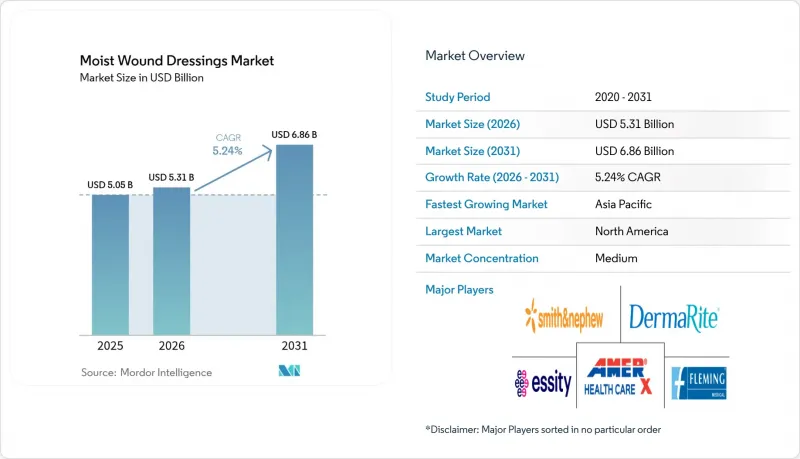
This report is Segmented by Product (Foam, Alginate, Hydrocolloid, Hydrogel, and Others), Application (Burn Wounds, Pressure Ulcers, Diabetic Ulcers, Surgical Wounds, and Others), End Use (Hospitals, Homecare, and Others), and Geography (North America, Europe, Asia-Pacific, The Middle East and Africa, and South America). The Report Provides the Value (USD) for all the Above-Mentioned Segments.
Global Moist Wound Dressings Market Trends and Insights
Increasing Incidence of Chronic & Acute Wounds
Roughly 6.7 million Americans live with a chronic wound, a population expected to climb as peripheral arterial disease, obesity, and diabetes intersect with older age. The American Heart Association noted in 2024 that diabetic foot ulcer patients face a >25% lifetime risk and a 70% five-year post-amputation mortality rate . Such statistics are steering providers toward early use of advanced moist dressings that shorten healing cycles and curb readmissions. Hospital cost modeling in the European Union shows diabetic foot ulcer admissions averaging EUR 4,888 (USD 5,308) per patient, with 88% of costs tied to prolonged stays. Payers therefore view moisture-retentive protocols not as optional extras but as cost-avoidance tools.
Growing Geriatric Population & Diabetes Prevalence
Asia-Pacific adds more than 45 million individuals aged >=65 each year, and many also live with diabetes, peripheral neuropathy, or vascular insufficiency. Scientific Reports found that 44.4% of diabetes patients developed neuropathy, 21.7% underwent amputations, and 96.9% reported poor quality of life . Hyperglycemia triggers oxidative stress and macrophage imbalance, slowing natural closure phases. Advanced moist dressings address such biological hurdles by preserving endogenous growth factors and optimizing exudate management, making them first-line therapy in many specialty clinics.
High Product & Procedure Cost
In Spain, chronic wound care consumed EUR 34,991,854 (USD 38,057,000) in primary care over three years, with materials alone costing EUR 8,455,787 (USD 9,203,000) and clinician time making up the remainder. Multiple dressing changes per week compound expenses for payers and patients. Similar patterns appear in India, where diabetic foot ulcer treatment is often paid out of pocket, shrinking access to advanced dressings. Tiered product ranges and smaller pack sizes aim to bridge price gaps but risk commoditizing innovations.
Other drivers and restraints analyzed in the detailed report include:
- Favorable Reimbursement Reforms in OECD Outpatient Settings
- Rise of Smart-Sensor Dressings Enabling Tele-Monitoring
- Limited Reimbursement in Emerging Economies
For complete list of drivers and restraints, kindly check the Table Of Contents.
Segment Analysis
Foam dressings accounted for 23.54% of moist wound dressings market share in 2025, reflecting their broad applicability across postoperative, pressure, and trauma wounds. Their polyurethane matrix balances high absorption with thermal insulation, reducing dressing changes and protecting peri-wound skin. Technological upgrades, such as Smith+Nephew's ALLEVYN Ag+ SURGICAL, which combines silver ions with a flexible trilaminate, strengthen clinical appeal. Hydrocolloid formats, although smaller in today's revenue terms, display the fastest 5.93% CAGR. High gel-forming capacity and seven-day wear time make hydrocolloids an increasingly preferred preventive measure for pressure injury in immobile patients, particularly in homecare. The FDA's streamlined 510(k) exemption for hydrocolloid formulations lowers entry barriers and sparks niche players to innovate on odor control, transparency, and biodegradability.
Over 2026-2031, alginate and hydrogel categories are expected to carve distinct roles rather than challenge foam outright. Alginate's calcium-sodium ion exchange underpins hemostatic performance in profusely exuding wounds, ensuring it remains indispensable in emergency departments. Hydrogel sheets, prized for cooling analgesic effects, dominate oncology-related radiation burns and necrotic tissue debridement. Film, contact-layer, and composite dressings retain niche status but gain renewed attention as sensor backings for smart platforms. Together these dynamics reinforce a multi-product portfolio imperative for firms seeking durable positions in the moist wound dressings market.
Complete Report Scope:
- By Product
- Foam Dressings
- Alginate Dressings
- Hydrocolloid Dressings
- Hydrogel Dressings
- Film Dressings
- Collagen Dressings
- Antimicrobial/Silver Dressings
- Contact-Layer Dressings
- Others
- By Application
- Burn Wounds
- Pressure Ulcers
- Diabetic Foot Ulcers
- Surgical / Traumatic Wounds
- Venous Leg Ulcers
- Other Applications
- By End User
- Hospitals
- Homecare Settings
- Others
- By Geography
- North America
- United States
- Canada
- Mexico
- Europe
- Germany
- United Kingdom
- France
- Italy
- Spain
- Rest of Europe
- Asia-Pacific
- China
- Japan
- India
- Australia
- South Korea
- Rest of Asia-Pacific
- Middle East & Africa
- GCC
- South Africa
- Rest of Middle East & Africa
- South America
- Brazil
- Argentina
- Rest of South America
- North America
Geography Analysis
North America remains the epicenter of technological and reimbursement evolution. The region's payer mix, Medicare, commercial insurers, and the Veterans Health Administration, collectively drives rapid diffusion of clinically proven products. Providers increasingly deploy remote monitoring kits that bundle foam dressings with smartphone-linked pH sensors, enabling same-day intervention when inflammation spikes. Cross-border supply chains are resilient due to the United States-Mexico-Canada Agreement, though manufacturers are localizing production to mitigate tariff and freight volatility.
Asia-Pacific's trajectory reflects a convergence of epidemiology and policy. China's Healthy China 2030 plan earmarks funds for chronic disease prevention, channeling investment into diabetic foot clinics where hydrofiber dressings cut debridement frequency. In India, state-level health insurance schemes reimburse advanced dressings for low-income patients undergoing limb-salvage surgery, stimulating public-sector tenders. Japanese and South Korean markets focus on pressure-injury prevention in super-aged populations, fostering adoption of silicone-foam prophylactics designed to remain intact during MRI scans.
Europe exhibits nuanced growth. Northern European health systems emphasize home-based care, prompting high uptake of antimicrobial foams with twelve-day wear protocols that minimize nurse visits. Southern Europe's constrained public budgets favor cost-effectiveness studies; recent NHS England real-world data showed a 19% reduction in weekly dressing changes when switching from plain gauze to hydrocolloid, saving USD 1.7 million annually. East European accession to common procurement procedures brings price harmonization but also intensifies competition from Asia-Pacific suppliers, pressuring local incumbents to differentiate through sustainability certifications and recyclable packaging.
- Smiths Group
- Molnlycke Health Care
- 3M (Health Care)
- Convatec
- Coloplast
- Essity AB (BSN medical)
- Cardinal Health
- B. Braun
- Medtronic plc (Acelity/KCI)
- Johnson & Johnson
- Lohmann & Rauscher GmbH
- Hartmann Group
- Urgo Medical
- Hollister
- Integra LifeSciences
- DermaRite Industries
- AMERX Health Care Corp.
- Fleming Medical Ltd.
- Derma Sciences (Nipro)
- Milliken Healthcare
Additional Benefits:
- The market estimate (ME) sheet in Excel format
- 3 months of analyst support
TABLE OF CONTENTS
1 Introduction
- 1.1 Study Assumptions & Market Definition
- 1.2 Scope of the Study
2 Research Methodology
3 Executive Summary
4 Market Landscape
- 4.1 Market Overview
- 4.2 Market Drivers
- 4.2.1 Increasing incidence of chronic & acute wounds
- 4.2.2 Growing geriatric population & diabetes prevalence
- 4.2.3 Accelerating adoption of home-based chronic-wound management
- 4.2.4 Favorable reimbursement reforms in OECD outpatient settings
- 4.2.5 Rise of smart-sensor dressings enabling tele-monitoring
- 4.2.6 Climate-linked uptick in burn & trauma cases
- 4.3 Market Restraints
- 4.3.1 High product & procedure cost
- 4.3.2 Limited reimbursement in emerging economies
- 4.3.3 Infection risk from improper moist-dressing usage
- 4.3.4 Stricter eco-toxicity rules on silver dressings
- 4.4 Value / Supply-Chain Analysis
- 4.5 Technological Outlook
- 4.6 Regulatory Landscape
- 4.7 Porter's Five Forces Analysis
- 4.7.1 Bargaining Power of Buyers/Consumers
- 4.7.2 Bargaining Power of Suppliers
- 4.7.3 Threat of New Entrants
- 4.7.4 Threat of Substitute Products
- 4.7.5 Intensity of Competitive Rivalry
5 Market Size & Growth Forecasts
- 5.1 By Product
- 5.1.1 Foam Dressings
- 5.1.2 Alginate Dressings
- 5.1.3 Hydrocolloid Dressings
- 5.1.4 Hydrogel Dressings
- 5.1.5 Film Dressings
- 5.1.6 Collagen Dressings
- 5.1.7 Antimicrobial/Silver Dressings
- 5.1.8 Contact-Layer Dressings
- 5.1.9 Others
- 5.2 By Application
- 5.2.1 Burn Wounds
- 5.2.2 Pressure Ulcers
- 5.2.3 Diabetic Foot Ulcers
- 5.2.4 Surgical / Traumatic Wounds
- 5.2.5 Venous Leg Ulcers
- 5.2.6 Other Applications
- 5.3 By End User
- 5.3.1 Hospitals
- 5.3.2 Homecare Settings
- 5.3.3 Others
- 5.4 By Geography
- 5.4.1 North America
- 5.4.1.1 United States
- 5.4.1.2 Canada
- 5.4.1.3 Mexico
- 5.4.2 Europe
- 5.4.2.1 Germany
- 5.4.2.2 United Kingdom
- 5.4.2.3 France
- 5.4.2.4 Italy
- 5.4.2.5 Spain
- 5.4.2.6 Rest of Europe
- 5.4.3 Asia-Pacific
- 5.4.3.1 China
- 5.4.3.2 Japan
- 5.4.3.3 India
- 5.4.3.4 Australia
- 5.4.3.5 South Korea
- 5.4.3.6 Rest of Asia-Pacific
- 5.4.4 Middle East & Africa
- 5.4.4.1 GCC
- 5.4.4.2 South Africa
- 5.4.4.3 Rest of Middle East & Africa
- 5.4.5 South America
- 5.4.5.1 Brazil
- 5.4.5.2 Argentina
- 5.4.5.3 Rest of South America
- 5.4.1 North America
6 Competitive Landscape
- 6.1 Market Concentration
- 6.2 Market Share Analysis
- 6.3 Company Profiles (includes Global level Overview, Market level overview, Core Segments, Financials as available, Strategic Information, Market Rank/Share for key companies, Products & Services, and Recent Developments)
- 6.3.1 Smith & Nephew plc
- 6.3.2 Molnlycke Health Care AB
- 6.3.3 3M (Health Care)
- 6.3.4 ConvaTec Group PLC
- 6.3.5 Coloplast A/S
- 6.3.6 Essity AB (BSN medical)
- 6.3.7 Cardinal Health Inc.
- 6.3.8 B. Braun Melsungen AG
- 6.3.9 Medtronic plc (Acelity/KCI)
- 6.3.10 Johnson & Johnson (Ethicon)
- 6.3.11 Lohmann & Rauscher GmbH
- 6.3.12 Hartmann Group
- 6.3.13 Urgo Medical
- 6.3.14 Hollister Incorporated
- 6.3.15 Integra LifeSciences
- 6.3.16 DermaRite Industries LLC
- 6.3.17 AMERX Health Care Corp.
- 6.3.18 Fleming Medical Ltd.
- 6.3.19 Derma Sciences (Nipro)
- 6.3.20 Milliken Healthcare
7 Market Opportunities & Future Outlook
- 7.1 White-Space & Unmet Need Assessment

