PUBLISHER: Mordor Intelligence | PRODUCT CODE: 2123712

PUBLISHER: Mordor Intelligence | PRODUCT CODE: 2123712
Medical Electronics - Market Share Analysis, Industry Trends & Statistics, Growth Forecasts (2026 - 2031)
According to Mordor Intelligence, the medical electronics market size is projected to be USD 11.31 billion in 2025, USD 11.92 billion in 2026, and reach USD 16.44 billion by 2031, growing at a CAGR of 6.65% from 2026 to 2031.
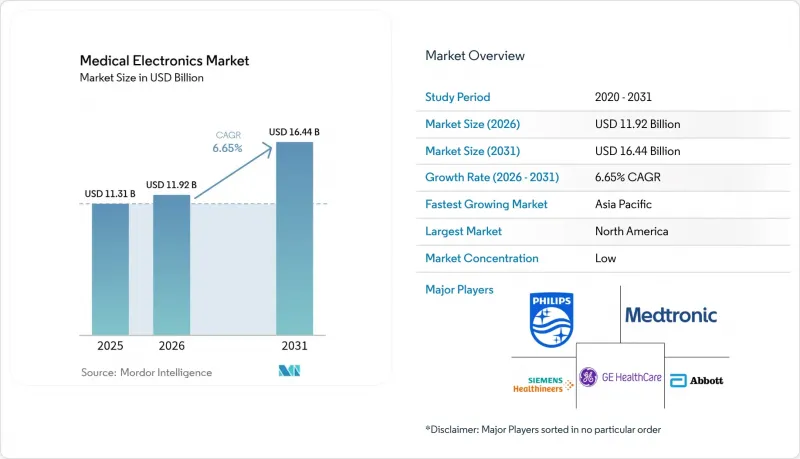
This report is Segmented by Product Type (Diagnostic Imaging, Monitoring, Therapeutic, Wearables), Component (Sensors, Power ICs, Mcus, Displays), End-User (Hospitals, Home-Healthcare, Ascs, Imaging Centers), Clinical Application (Cardiology, Neurology, Oncology, Orthopedics), Connectivity (Wired, Bluetooth, Wi-Fi, Hybrid), and Geography (North America, and More). Market Forecasts are in Value (USD).
Global Medical Electronics Market Trends and Insights
Rapid Adoption of AI-Enabled Imaging Modalities
More than 600 AI-enabled devices cleared by the FDA by mid-2024 have turned image-analysis tasks into near-real-time workflows, trimming MRI scan times by up to 50% and cutting interpretation backlogs. Providers recoup investments swiftly because Medicare Advantage and several European payers reimburse AI-assisted reads at premium rates, enhancing ROI while creating defensible upgrade cycles.
Shift Toward Home-Based and Wearable Diagnostics
Expanded U.S. remote patient-monitoring codes that came into force in 2026 pay physicians for reviewing patient-generated data, turning connected wearables into reimbursable assets. Continuous glucose monitors and cuff-less blood-pressure devices are embedding multi-parameter sensing and mobile links, allowing clinicians to titrate therapies without office visits.
Silicon Supply-Chain Volatility Post-2025
Lead-times for power semiconductors peaked at 52 weeks in 2024, forcing many device OEMs into expensive redesigns or spot-market buys that eroded margins. New fabs funded by the CHIPS Acts will not ease constraints until after 2027.
Other drivers and restraints analyzed in the detailed report include:
- Regulatory Push for IEC 60601-1 4th Edition Compliance
- Emergence of Printable & Flexible Bioelectronics
- Stringent Post-Market Surveillance Under EU MDR
For complete list of drivers and restraints, kindly check the Table Of Contents.
Segment Analysis
Diagnostic imaging platforms generated 39.68% of 2025 revenue, underpinning the medical electronics market through multiyear service contracts and upgrade bundles. Imaging OEMs now embed on-device AI to automate reconstruction and annotate scans, recapturing value that once flowed to stand-alone software vendors.
Wearables and implantables, while smaller in absolute revenue, are forecast to expand at a 10.73% CAGR through 2031. Reimbursement for continuous glucose and blood-pressure monitoring plus smartphone tethering is lifting average selling prices. This double-digit trajectory will steadily lift the medical electronics market as capital-light home devices supplement hospital imaging budgets.
Sensors and MEMS accounted for 32.33% of 2025 sales and will rise at 9.43% per year, a pace that outstrips every other chip class. Miniaturized inertial and biochemical sensors allow single-use adhesive patches that stream multi-vital data over Bluetooth or Wi-Fi. Power-management ICs lag on growth yet remain essential for battery-operated form factors. Early adoption of solid-state batteries in cochlear and cardiac implants promises longer replacement cycles, reinforcing aftermarket parts revenue in the medical electronics market.
Complete Report Scope:
- By Product Type
- Diagnostic Imaging Systems
- Patient Monitoring Devices
- Therapeutic & Surgical Devices
- Wearables & Implantables
- By Component
- Sensors & MEMS
- Power Management ICs & Batteries
- MCUs/MPUs & DSPs
- Displays & Optoelectronics
- By End-user
- Hospitals & Clinics
- Home-Healthcare Settings
- Ambulatory Surgical Centers
- Diagnostic Imaging Centers
- By Clinical Application
- Cardiology
- Neurology
- Oncology
- Orthopedics
- Others
- By Connectivity
- Wired (LAN/Field-bus)
- Wireless-Bluetooth/BLE
- Wireless-Wi-Fi/Cellular
- Hybrid (Wired + Wireless)
- By Geography
- North America
- United States
- Canada
- Mexico
- Europe
- Germany
- France
- United Kingdom
- Italy
- Spain
- Rest of Europe
- Asia-Pacific
- China
- Japan
- India
- South Korea
- Australia
- Rest of Asia-Pacific
- Middle East & Africa
- GCC
- South Africa
- Rest of Middle East & Africa
- South America
- Brazil
- Argentina
- Rest of South America
- North America
Geography Analysis
North America generated 33.46% of 2025 revenue, buoyed by CMS reimbursement expansion and the FDA's fast-track pathways for AI-based devices. Robust venture funding channels accelerate commercialization, sealing the region's leadership in both imaging and wearable pipelines.
Europe trails in share but boasts harmonized market access under EU MDR, simplifying multi-country launches once conformity is achieved. Germany's Digital Healthcare Act offers structured coding for digital therapeutics, turning the bloc into a proving ground for outcome-based payment models.
Asia-Pacific is the fastest-growing region at 8.02% CAGR. China's localization push for high-end ultrasound and MRI components and India's Production-Linked Incentive scheme draw OEM assembly and R&D footprints into the region, lifting the medical electronics market across APAC.
- Abbott Laboratories
- Analog Devices
- Boston Scientific
- Canon
- Dexcom
- FUJIFILM
- GE Healthcare
- Koninklijke Philips
- Masimo
- Medtronic
- NXP Semiconductors
- OMRON
- Renesas Electronics
- Samsung Group
- Shimadzu
- Siemens Healthineers
- STMicroelectronics
- TDK Corporation
- TE Connectivity
- Texas Instruments
Additional Benefits:
- The market estimate (ME) sheet in Excel format
- 3 months of analyst support
TABLE OF CONTENTS
1 Introduction
- 1.1 Study Assumptions & Market Definition
- 1.2 Scope of the Study
2 Research Methodology
3 Executive Summary
4 Market Landscape
- 4.1 Market Overview
- 4.2 Market Drivers
- 4.2.1 Rapid Adoption of AI-Enabled Imaging Modalities
- 4.2.2 Shift Toward Home-Based and Wearable Diagnostics
- 4.2.3 Regulatory Push for IEC 60601-1 4th Edition Compliance
- 4.2.4 Emergence of Printable & Flexible Bioelectronics
- 4.2.5 Growing Demand for Radiation-Hard Semiconductors in Proton-Therapy Systems
- 4.2.6 Expansion of Telehealth Reimbursement Accelerating Remote Patient-Monitoring Electronics
- 4.3 Market Restraints
- 4.3.1 Silicon Supply-Chain Volatility Post-2025
- 4.3.2 Stringent Post-Market Surveillance Under EU MDR
- 4.3.3 Cybersecurity Certification Bottlenecks for Connected Implants
- 4.3.4 Helium Shortage Increasing MRI Magnet Lead-Times and Costs
- 4.4 Value / Supply-Chain Analysis
- 4.5 Regulatory Landscape
- 4.6 Technological Outlook
- 4.7 Porter's Five Forces Analysis
- 4.7.1 Threat of New Entrants
- 4.7.2 Bargaining Power of Suppliers
- 4.7.3 Bargaining Power of Buyers
- 4.7.4 Threat of Substitutes
- 4.7.5 Intensity of Competitive Rivalry
5 Market Size & Growth Forecasts (Value in USD)
- 5.1 By Product Type
- 5.1.1 Diagnostic Imaging Systems
- 5.1.2 Patient Monitoring Devices
- 5.1.3 Therapeutic & Surgical Devices
- 5.1.4 Wearables & Implantables
- 5.2 By Component
- 5.2.1 Sensors & MEMS
- 5.2.2 Power Management ICs & Batteries
- 5.2.3 MCUs/MPUs & DSPs
- 5.2.4 Displays & Optoelectronics
- 5.3 By End-user
- 5.3.1 Hospitals & Clinics
- 5.3.2 Home-Healthcare Settings
- 5.3.3 Ambulatory Surgical Centers
- 5.3.4 Diagnostic Imaging Centers
- 5.4 By Clinical Application
- 5.4.1 Cardiology
- 5.4.2 Neurology
- 5.4.3 Oncology
- 5.4.4 Orthopedics
- 5.4.5 Others
- 5.5 By Connectivity
- 5.5.1 Wired (LAN/Field-bus)
- 5.5.2 Wireless-Bluetooth/BLE
- 5.5.3 Wireless-Wi-Fi/Cellular
- 5.5.4 Hybrid (Wired + Wireless)
- 5.6 By Geography
- 5.6.1 North America
- 5.6.1.1 United States
- 5.6.1.2 Canada
- 5.6.1.3 Mexico
- 5.6.2 Europe
- 5.6.2.1 Germany
- 5.6.2.2 France
- 5.6.2.3 United Kingdom
- 5.6.2.4 Italy
- 5.6.2.5 Spain
- 5.6.2.6 Rest of Europe
- 5.6.3 Asia-Pacific
- 5.6.3.1 China
- 5.6.3.2 Japan
- 5.6.3.3 India
- 5.6.3.4 South Korea
- 5.6.3.5 Australia
- 5.6.3.6 Rest of Asia-Pacific
- 5.6.4 Middle East & Africa
- 5.6.4.1 GCC
- 5.6.4.2 South Africa
- 5.6.4.3 Rest of Middle East & Africa
- 5.6.5 South America
- 5.6.5.1 Brazil
- 5.6.5.2 Argentina
- 5.6.5.3 Rest of South America
- 5.6.1 North America
6 Competitive Landscape
- 6.1 Market Concentration
- 6.2 Market Share Analysis
- 6.3 Company Profiles (includes Global level Overview, Market level overview, Core Segments, Financials as available, Strategic Information, Market Rank/Share for key companies, Products and Services, and Recent Developments)
- 6.3.1 Abbott Laboratories
- 6.3.2 Analog Devices
- 6.3.3 Boston Scientific
- 6.3.4 Canon Medical Systems
- 6.3.5 Dexcom, Inc.
- 6.3.6 Fujifilm Holdings
- 6.3.7 GE Healthcare
- 6.3.8 Koninklijke Philips N.V.
- 6.3.9 Masimo Corporation
- 6.3.10 Medtronic
- 6.3.11 NXP Semiconductors
- 6.3.12 Omron Healthcare
- 6.3.13 Renesas Electronics
- 6.3.14 Samsung Medison
- 6.3.15 Shimadzu Corporation
- 6.3.16 Siemens Healthineers
- 6.3.17 STMicroelectronics
- 6.3.18 TDK Corporation
- 6.3.19 TE Connectivity
- 6.3.20 Texas Instruments
7 Market Opportunities & Future Outlook
- 7.1 White-space & Unmet-need Assessment

