PUBLISHER: Mordor Intelligence | PRODUCT CODE: 2123744

PUBLISHER: Mordor Intelligence | PRODUCT CODE: 2123744
Stick Packaging - Market Share Analysis, Industry Trends & Statistics, Growth Forecasts (2026 - 2031)
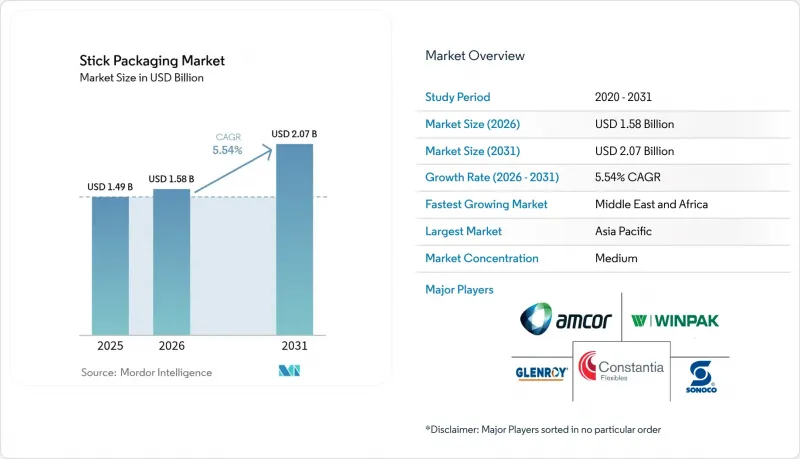
According to Mordor Intelligence, the stick packaging market size is projected to expand from USD 1.49 billion in 2025 and USD 1.58 billion in 2026 to USD 2.07 billion by 2031, registering a CAGR of 5.54% between 2026 to 2031.
This report is Segmented by Material (Plastics, Paper, Metal Foils, and Bioplastics), Product Form (Powders, Granules, Liquids, and Semi-Solids), End-User Industry (Food and Beverages, Pharmaceuticals, Cosmetics and Personal Care, and Industrial and Household), Packaging-Machinery Lane Count (1-3 Lanes, 4-10 Lanes, 11-20 Lanes, and More), and Geography. The Market Forecasts are Provided in Terms of Value (USD).
Global Stick Packaging Market Trends and Insights
Convenience and On-The-Go Consumption Boom
Millennial and Gen Z shoppers favor single-serve formats that slip into backpacks, gym bags, and hospitality trays, so instant coffee, electrolyte mixes, and probiotic powders now appear in subscription bundles that create predictable annuity volumes for co-packers. The empty rate of more than 95% minimizes product waste, an attribute valued in emerging economies where disposable incomes rise faster than recycling infrastructure. Vending operators and office caterers buy 250- to 1,000-count cases to reduce restocking labor, while endurance-sports brands release customizable electrolyte sticks that replace heavy ready-to-drink bottles.
Demand For Material and Weight Reduction
Slim sticks use 10-40% less film than pillow pouches, lowering carbon per shipped unit and unlocking freight savings that compound across high-volume beverage powders. Converters stretch mono-polyethylene films and deploy ultra-thin foils that still keep moisture-vapor transmission below 0.5 g/m2-day, and new fiber-based structures like FunctionalBarrier Paper Ultimate achieve grease and moisture resistance without plastic coatings. Pharmaceutical cold-chain shippers report that lighter pack weight improves box payload efficiency and trims dry-ice use in temperature-controlled lanes.
Single-Use Plastic Regulation Tightening
Jurisdictions impose bans, taxes, or reporting duties on disposable plastic packs, penalizing multi-layer laminates that cannot pass material-recovery facility sortation. California's fee differential can reach 50% between recyclable and non-recyclable formats, and Canada's nationwide plastics registry requires annual tonnage reports, adding an administrative layer that discourages complex films . As a result, converters accelerate R&D spending on paper and bio-PE sticks, lengthening qualification cycles and increasing capital outlays.
Other drivers and restraints analyzed in the detailed report include:
- Sustainability Mandates For Flexible Packs
- Pharma Micro-Dosing And Pediatric Formats
- Volatile Nitrosamine Contamination Risk Limits Stick Sachet Use In Pharma
For complete list of drivers and restraints, kindly check the Table Of Contents.
Segment Analysis
Plastics accounted for 56.74% of the stick packaging market revenue in 2025 because polyethylene balances cost, seal strength, and moisture protection. The stick packaging market size for plastics remains significant, yet bioplastics are forecast to post a 6.34% CAGR as brand owners seek industrial-composting claims. Polylactic acid and polyhydroxyalkanoate films enable organic waste bin disposal in Western Europe, but their 5 g/m2-day moisture-vapor transmission rate throttles the use of low-water-activity powders. Cellulose-based compostable sachets now enter condiment and cosmetic sample niches, while aluminum foil stays indispensable where oxygen transmission below 0.01 cm3/m2-day is mandatory.
Paper sticks gain share in sugar and sweetener applications thanks to uncoated kraft that can be dropped directly into existing paper recycling streams. Yet converters must run at higher sealing temperatures to overcome paper porosity, thereby increasing energy use. The paper stick packaging market share is likely to rise only if heat-seal lacquers with lower glass transition temperatures launch at scale. Metal foils will persist for tropical pharmaceutical logistics, where 80% humidity accelerates vitamin oxidation.
Powders retained 42.34% of 2025 revenue, but liquids are on pace for a 6.29% CAGR, as aseptic multi-lane fillers now handle suspensions up to 5,000 cP without drip or voids. Contract manufacturers operate 20-lane lines that turn out 1,600 packed units per minute, making the stick packaging market for liquids the fastest-growing among product forms. Hot-fill acidic beverages tolerate 85 °C lethality, while probiotics need ISO Class 7 cold-fill rooms.
Granules sit between powders and tablets, offering flow advantages for high-speed dosing of oral rehydration salts, and semi-solid gels exploit sticks' hygienic single-use promise in topical ointments and eye creams. Servo-driven augers and weight-check feedback loops cut fill variance below +-1%, essential for pediatric dosing accuracy. Continuous improvement in neck-proof seals reduces leak complaints that once occurred with liquid adoption.
Complete Report Scope:
- By Material
- Plastics
- Paper
- Metal Foils
- Bioplastics
- By Product Form
- Powders
- Granules
- Liquids
- Semi-Solids
- By End-User Industry
- Food and Beverages
- Instant Beverages
- Nutraceutical Powders
- Sugar and Sweeteners
- Pharmaceuticals
- OTC
- Rx
- Cosmetics and Personal Care
- Industrial and Household
- Food and Beverages
- By Packaging-Machinery Lane Count
- 1-3 Lanes
- 4-10 Lanes
- 11-20 Lanes
- Greater Than 20 Lanes
- By Geography
- North America
- United States
- Canada
- Mexico
- Europe
- United Kingdom
- Germany
- France
- Italy
- Rest of Europe
- Asia-Pacific
- China
- Japan
- India
- South Korea
- Rest of Asia-Pacific
- Middle East
- Israel
- Saudi Arabia
- United Arab Emirates
- Turkey
- Rest of Middle East
- Africa
- South Africa
- Egypt
- Rest of Africa
- South America
- Brazil
- Argentina
- Rest of South America
- North America
Geography Analysis
Asia-Pacific accounted for 32.76% of 2025 revenue, driven by China's film extrusion base and India's antibiotic sachet exports. Local converters imported USD 203.2 million of filling machinery in 2024, up 32.8% year-over-year, showing that the stick packaging market there is scaling modern automation. India uses unit-dose antibiotics for rural clinics lacking refrigeration, and Japanese servo-driven equipment finds buyers in North America because of micron-accurate fill weight.
The Middle East is projected to log a 6.52% CAGR to 2031, spurred by Saudi Vision 2030 mandates for local drug manufacturing and the UAE's pharmaceutical free zones. Regional imports of packaging machinery hit EUR 1.3 billion (USD 1.46 billion) in 2024, a 25.4% annual jump. Cleanroom-grade stick lines equipped with Arabic human-machine interfaces allow exporters to serve hot-climate markets without a cold chain.
North America and Europe display mature adoption but funnel capex toward mono-material film extrusion to satisfy recycling rules. Germany shipped EUR 362.6 million (USD 407 million) of machinery abroad in 2024, with a notable share headed to Asian co-packers. South America gains momentum in Brazil and Argentina, though currency swings complicate the payback of imported equipment. Africa's volumes remain modest outside South Africa and Egypt, but donor-funded malaria and ORS programs could seed long-term demand.
- Amcor plc
- Constantia Flexibles Group GmbH
- Glenroy, Inc.
- Aranow Packaging Machinery S.L.
- Fres-Co System USA, Inc.
- Catalent, Inc.
- Winpak Ltd.
- Sonoco Products Company
- ePac Holdings, LLC
- GFR Pharma Ltd.
- Sonic Packaging Industries, Inc.
- Viking Masek Global Packaging Technologies s.r.o.
- Nichrome India Ltd.
- Unither Pharmaceuticals SAS
- Marchesini Group S.p.A.
- Huhtamaki Oyj
- ProAmpac LLC
- Rengo Co., Ltd.
- Stick Pack Company Inc.
Additional Benefits:
- The market estimate (ME) sheet in Excel format
- 3 months of analyst support
TABLE OF CONTENTS
1 INTRODUCTION
- 1.1 Study Assumptions and Market Definition
- 1.2 Scope of the Study
2 RESEARCH METHODOLOGY
3 EXECUTIVE SUMMARY
4 MARKET LANDSCAPE
- 4.1 Market Overview
- 4.2 Market Drivers
- 4.2.1 Convenience and On-the-Go Consumption Boom
- 4.2.2 Demand for Material and Weight Reduction
- 4.2.3 Sustainability Mandates for Flexible Packs
- 4.2.4 Pharma Micro-Dosing and Pediatric Formats
- 4.2.5 Smart Moisture-Activated Barrier Coatings Enabling Desiccant-Free Sachets
- 4.2.6 Rise of Functional Beverage Stick Packs in Micro-Fulfilment Dark Stores
- 4.3 Market Restraints
- 4.3.1 Single-Use-Plastic Regulation Tightening
- 4.3.2 Limited Recyclability of Multi-Layer Films
- 4.3.3 Barrier-Grade Mono-Material Film Shortage
- 4.3.4 Volatile Nitrosamine Contamination Risk Limits Stick Sachet Use in Pharma
- 4.4 Industry Value / Supply-Chain Analysis
- 4.5 Regulatory Landscape
- 4.6 Technological Outlook
- 4.7 Porter's Five Forces Analysis
- 4.7.1 Bargaining Power of Suppliers
- 4.7.2 Bargaining Power of Consumers
- 4.7.3 Threat of New Entrants
- 4.7.4 Threat of Substitutes
- 4.7.5 Intensity of Rivalry
- 4.8 Impact of Macroeconomic Factors on the Market
- 4.9 Key Performance Indicators (KPIs)
5 MARKET SIZE AND GROWTH FORECASTS (VALUE)
- 5.1 By Material
- 5.1.1 Plastics
- 5.1.2 Paper
- 5.1.3 Metal Foils
- 5.1.4 Bioplastics
- 5.2 By Product Form
- 5.2.1 Powders
- 5.2.2 Granules
- 5.2.3 Liquids
- 5.2.4 Semi-Solids
- 5.3 By End-User Industry
- 5.3.1 Food and Beverages
- 5.3.1.1 Instant Beverages
- 5.3.1.2 Nutraceutical Powders
- 5.3.1.3 Sugar and Sweeteners
- 5.3.2 Pharmaceuticals
- 5.3.2.1 OTC
- 5.3.2.2 Rx
- 5.3.3 Cosmetics and Personal Care
- 5.3.4 Industrial and Household
- 5.3.1 Food and Beverages
- 5.4 By Packaging-Machinery Lane Count
- 5.4.1 1-3 Lanes
- 5.4.2 4-10 Lanes
- 5.4.3 11-20 Lanes
- 5.4.4 Greater Than 20 Lanes
- 5.5 By Geography
- 5.5.1 North America
- 5.5.1.1 United States
- 5.5.1.2 Canada
- 5.5.1.3 Mexico
- 5.5.2 Europe
- 5.5.2.1 United Kingdom
- 5.5.2.2 Germany
- 5.5.2.3 France
- 5.5.2.4 Italy
- 5.5.2.5 Rest of Europe
- 5.5.3 Asia-Pacific
- 5.5.3.1 China
- 5.5.3.2 Japan
- 5.5.3.3 India
- 5.5.3.4 South Korea
- 5.5.3.5 Rest of Asia-Pacific
- 5.5.4 Middle East
- 5.5.4.1 Israel
- 5.5.4.2 Saudi Arabia
- 5.5.4.3 United Arab Emirates
- 5.5.4.4 Turkey
- 5.5.4.5 Rest of Middle East
- 5.5.5 Africa
- 5.5.5.1 South Africa
- 5.5.5.2 Egypt
- 5.5.5.3 Rest of Africa
- 5.5.6 South America
- 5.5.6.1 Brazil
- 5.5.6.2 Argentina
- 5.5.6.3 Rest of South America
- 5.5.1 North America
6 COMPETITIVE LANDSCAPE
- 6.1 Market Concentration
- 6.2 Strategic Moves
- 6.3 Market Share Analysis
- 6.4 Company Profiles (includes Global Level Overview, Market Level Overview, Core Segments, Financials As Available, Strategic Information, Market Rank/Share, Products And Services, Recent Developments)
- 6.4.1 Amcor plc
- 6.4.2 Constantia Flexibles Group GmbH
- 6.4.3 Glenroy, Inc.
- 6.4.4 Aranow Packaging Machinery S.L.
- 6.4.5 Fres-Co System USA, Inc.
- 6.4.6 Catalent, Inc.
- 6.4.7 Winpak Ltd.
- 6.4.8 Sonoco Products Company
- 6.4.9 ePac Holdings, LLC
- 6.4.10 GFR Pharma Ltd.
- 6.4.11 Sonic Packaging Industries, Inc.
- 6.4.12 Viking Masek Global Packaging Technologies s.r.o.
- 6.4.13 Nichrome India Ltd.
- 6.4.14 Unither Pharmaceuticals SAS
- 6.4.15 Marchesini Group S.p.A.
- 6.4.16 Huhtamaki Oyj
- 6.4.17 ProAmpac LLC
- 6.4.18 Rengo Co., Ltd.
- 6.4.19 Stick Pack Company Inc.
7 MARKET OPPORTUNITIES AND FUTURE OUTLOOK
- 7.1 White-Space and Unmet-Need Assessment

