PUBLISHER: Mordor Intelligence | PRODUCT CODE: 2123747

PUBLISHER: Mordor Intelligence | PRODUCT CODE: 2123747
Vinyl Ester - Market Share Analysis, Industry Trends & Statistics, Growth Forecasts (2026 - 2031)
According to Mordor Intelligence, vinyl ester market size in 2026 is estimated at USD 1.22 billion, growing from 2025 value of USD 1.17 billion with 2031 projections showing USD 1.54 billion, growing at 4.66% CAGR over 2026-2031.
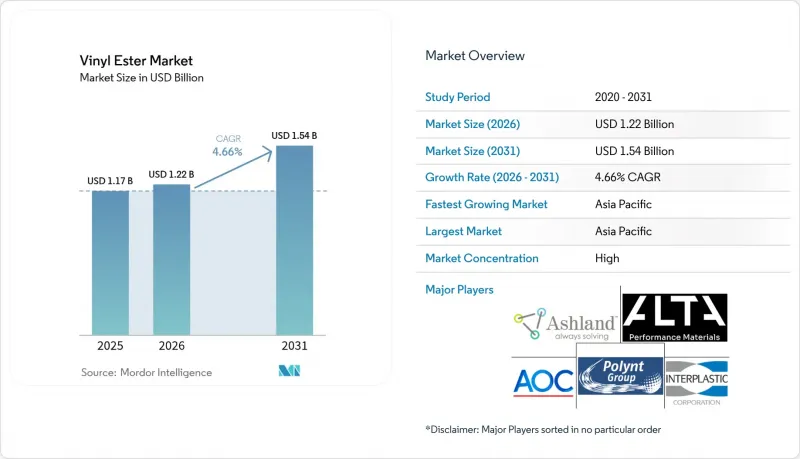
This report Segments the Industry by Type (Bisphenol A Diglycidyl Ether (DGEBA), Epoxy Phenol Novolac (EPN), and Other Types), Application (Pipes and Tanks, Paints and Coatings, Transportation, and Other Applications), and Geography (Asia-Pacific, North America, Europe, South America, and Middle East and Africa). The Market Forecasts are Provided in Terms of Value (USD).
Global Vinyl Ester Market Trends and Insights
Superior Chemical and Corrosion Resistance
Vinyl ester resins resist acids, alkalis, and solvents better than steel, concrete, or polyester composites, enabling longer service life for chemical processing gear, wastewater assets, and marine platforms. Fewer ester linkages limit hydrolysis, cutting material failures, and shutdown costs. New grades containing silicon-carbide particles boost abrasion resistance for agitators and pump housings. End users increasingly weigh full lifecycle economics, favoring vinyl ester when downtime penalties exceed initial outlay.
Expansion of Renewable Energy Sector
Wind-turbine blades rely on vinyl ester composites for superior fatigue resistance and moisture tolerance. Capacity additions in onshore and offshore parks drive multi-year pull-through for spar caps and nacelle covers. Hydrogen-storage vessel builders use high-modulus vinyl ester wraps on Type 3 cylinders to meet burst-strength codes. Tin-treated glass/vinyl-ester reflectors achieving 95% solar reflectivity unlock scope in concentrated-solar plants.
Styrene/Epoxy Feedstock Price Volatility Pressuring Margins
Styrene and epoxide monomers faced sharp price spikes in 2024, prompting resin makers to raise list prices for vinyl-ester formulations. Margin protection now hinges on long-term supply deals, hedging, and formula-based pass-through clauses. Research into lower-styrene or styrene-free blends is also accelerating.
Other drivers and restraints analyzed in the detailed report include:
- Growing Demand in Infrastructure and Industrial Applications
- Advancements in Composite Manufacturing
- Availability of Substitutes
For complete list of drivers and restraints, kindly check the Table Of Contents.
Segment Analysis
DGEBA resins accounted for 53.45% vinyl ester market share in 2025, underpinned by a cost-to-performance balance suited to marine, chemical, and infrastructure laminates. The segment records a 4.74% CAGR, supported by the ongoing development of low-styrene mixes that ease workplace emission caps. Manufacturers are also pursuing styrene-free DGEBA variants to gain acceptance in tight-ventilation production halls.
Epoxy-phenol-novolac (EPN) resins, though smaller, secure orders for high-temperature scrubbers and acid plants. Brominated grades address flame-spread codes in rail interiors, while elastomer-modified resins supply hull sections needing impact damping. Recent UL 94 V0-compliant compounds maintain tensile strength above 80 MPa, reflecting formulation progress without halogen overuse.
Complete Report Scope:
- By Type
- Bisphenol A Diglycidyl Ether (DGEBA)
- Epoxy Phenol Novolac (EPN)
- Other Types
- By Application
- Pipes and Tanks
- Paints and Coatings
- Transportation
- Other Applications
- By Geography
- Asia-Pacific
- China
- India
- Japan
- South Korea
- Rest of Asia-Pacific
- North America
- United States
- Canada
- Mexico
- Europe
- Germany
- United Kingdom
- France
- Italy
- Rest of Europe
- South America
- Brazil
- Argentina
- Rest of South America
- Middle East and Africa
- Saudi Arabia
- South Africa
- Rest of Middle East and Africa
- Asia-Pacific
Geography Analysis
Asia-Pacific retained a 55.60% revenue share in 2025 and grows fastest at 4.85% through 2031. State-backed rail corridors, desalination projects, and onshore wind farms in China and India underpin the resin offtake. Regional producers benefit from localized supply chains that sidestep transocean freight risks.
North America is buoyed by refinery overhauls along the Gulf Coast and government incentives for offshore wind arrays. The vinyl ester market size in the United States is also lifted by bridge-deck replacement programs that specify corrosion-resistant composites to extend asset life beyond 75 years.
Europe emphasizes recycling and low-styrene emissions, prompting the adoption of next-generation formulations. Grants for hydrogen-demo hubs in Germany and the Netherlands accelerate demand for Type 3 vessels with vinyl-ester liners.
South America sees strong orders in Brazil's water-treatment build-outs and petrochemical capacity additions, while the Middle East applies vinyl-ester composites in desalination piping and chemical handling at new refining complexes. Africa's mining sector is trialing vinyl-ester lined leach tanks to improve acid resistance in copper extraction circuits.
- AOC
- Allnex GmbH
- ALTA Performance Materials
- Ashland Inc.
- Changzhou Tianma Group
- DIC Corporation
- Hexion Inc.
- Huntsman Corporation
- Interplastic Corporation
- Nan Ya Plastics
- Poliya Composite Resins
- Polynt-Reichhold Group
- Reichhold LLC2
- Resoltech
- Resonac Holdings Corporation
- Royal DSM
- Scott Bader Co. Ltd
- Sino Polymer Co. Ltd
- Sir Industriale
- Swancor Holding
Additional Benefits:
- The market estimate (ME) sheet in Excel format
- 3 months of analyst support
TABLE OF CONTENTS
1 Introduction
- 1.1 Study Assumptions and Market Definition
- 1.2 Scope of the Study
2 Research Methodology
3 Executive Summary
4 Market Landscape
- 4.1 Market Overview
- 4.2 Market Drivers
- 4.2.1 Superior Chemical and Corrosion Resistance
- 4.2.2 Growing Application in the Manufacture of Fiber Reinforced Plastic Tanks and Vessels
- 4.2.3 Expansion of Renewable Energy Sector
- 4.2.4 Growing Demand in Infrastructure and Industrial Applications
- 4.2.5 Advancements in Composite Manufacturing
- 4.3 Market Restraints
- 4.3.1 Styrene/Epoxy Feedstock Price Volatility Pressuring Margins
- 4.3.2 Availability of Substitutes
- 4.3.3 Limited Shelf Life
- 4.4 Value Chain Analysis
- 4.5 Porter's Five Forces
- 4.5.1 Threat of New Entrants
- 4.5.2 Bargaining Power of Buyers
- 4.5.3 Bargaining Power of Suppliers
- 4.5.4 Threat of Substitute Products
- 4.5.5 Degree of Competition
- 4.6 Import-Export Trends
- 4.7 Feedstock Analysis
- 4.8 Technological Snapshot
- 4.9 Price Analysis
5 Market Size and Growth Forecasts (Value)
- 5.1 By Type
- 5.1.1 Bisphenol A Diglycidyl Ether (DGEBA)
- 5.1.2 Epoxy Phenol Novolac (EPN)
- 5.1.3 Other Types
- 5.2 By Application
- 5.2.1 Pipes and Tanks
- 5.2.2 Paints and Coatings
- 5.2.3 Transportation
- 5.2.4 Other Applications
- 5.3 By Geography
- 5.3.1 Asia-Pacific
- 5.3.1.1 China
- 5.3.1.2 India
- 5.3.1.3 Japan
- 5.3.1.4 South Korea
- 5.3.1.5 Rest of Asia-Pacific
- 5.3.2 North America
- 5.3.2.1 United States
- 5.3.2.2 Canada
- 5.3.2.3 Mexico
- 5.3.3 Europe
- 5.3.3.1 Germany
- 5.3.3.2 United Kingdom
- 5.3.3.3 France
- 5.3.3.4 Italy
- 5.3.3.5 Rest of Europe
- 5.3.4 South America
- 5.3.4.1 Brazil
- 5.3.4.2 Argentina
- 5.3.4.3 Rest of South America
- 5.3.5 Middle East and Africa
- 5.3.5.1 Saudi Arabia
- 5.3.5.2 South Africa
- 5.3.5.3 Rest of Middle East and Africa
- 5.3.1 Asia-Pacific
6 Competitive Landscape
- 6.1 Market Concentration
- 6.2 Strategic Moves
- 6.3 Market Share Analysis
- 6.4 Company Profiles (includes Global level Overview, Market level overview, Core Segments, Financials as available, Strategic Information, Market Rank/Share for key companies, Products and Services, and Recent Developments)
- 6.4.1 AOC
- 6.4.2 Allnex GmbH
- 6.4.3 ALTA Performance Materials
- 6.4.4 Ashland Inc.
- 6.4.5 Changzhou Tianma Group
- 6.4.6 DIC Corporation
- 6.4.7 Hexion Inc.
- 6.4.8 Huntsman Corporation
- 6.4.9 Interplastic Corporation
- 6.4.10 Nan Ya Plastics
- 6.4.11 Poliya Composite Resins
- 6.4.12 Polynt-Reichhold Group
- 6.4.13 Reichhold LLC2
- 6.4.14 Resoltech
- 6.4.15 Resonac Holdings Corporation
- 6.4.16 Royal DSM
- 6.4.17 Scott Bader Co. Ltd
- 6.4.18 Sino Polymer Co. Ltd
- 6.4.19 Sir Industriale
- 6.4.20 Swancor Holding
7 Market Opportunities and Future Outlook
- 7.1 White-Space and Unmet-Need Assessment
- 7.2 Growing Application in Flue Gas Desulphurization

