PUBLISHER: Mordor Intelligence | PRODUCT CODE: 2123753

PUBLISHER: Mordor Intelligence | PRODUCT CODE: 2123753
Quantum Cryptography - Market Share Analysis, Industry Trends & Statistics, Growth Forecasts (2026 - 2031)
According to Mordor Intelligence, the quantum cryptography market size is projected to expand from USD 0.70 billion in 2025 and USD 0.94 billion in 2026 to USD 2.98 billion by 2031, registering a CAGR of 25.96% between 2026 to 2031.
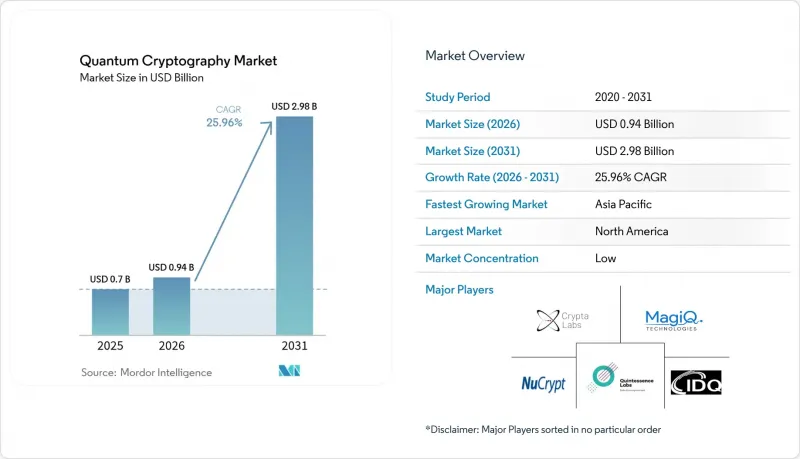
This report is Segmented by Component (Hardware, Software, and Services), Technology (Quantum Key Distribution, Post-Quantum Cryptography, Quantum Random Number Generation, and More), Deployment Mode (On-Premises, and More), Application (Network Security, and More), End-User (IT and Telecommunications, and More), and Geography. The Market Forecasts are Provided in Terms of Value (USD).
Global Quantum Cryptography Market Trends and Insights
Rising Number of Quantum-Enabled Cyber-Attacks
Incidents in which adversaries captured encrypted traffic for future decryption rose sharply during 2025, moving the discussion from theoretical to operational risk. Financial institutions, defense primes, and cloud providers reacted by accelerating roadmaps for both QKD and post-quantum cryptography. Boards are now briefed quarterly on "harvest-now-decrypt-later" exposures, pushing budgets for quantum-safe upgrades ahead of broader IT refresh cycles. Insurance carriers excluding quantum-related breaches from new cyber policies are amplifying the urgency. As a result, the quantum cryptography market is transitioning from proof-of-concept trials to enterprise-wide rollouts.
Government Funding for Quantum Communication Infrastructure
Public-sector capital reached USD 4.2 billion in 2025, underwriting nationwide backbones that de-risk private adoption. China's 10 000-kilometer fiber network, the EU's flagship cross-border links, U.S. defense satellite projects, and Japan's metro deployments all created anchor tenants for domestic vendors. These early networks validated performance over long haul and urban metro distances, demonstrating commercial service-level agreements. Subsidies also accelerated standards work because agencies demanded interoperable gear, indirectly lowering vendor lock-in fears for enterprises evaluating multi-supplier strategies.
High Deployment and Maintenance Costs of QKD Hardware
Per-node spending frequently exceeds USD 500 000 because single-photon detectors, precision lasers, and synchronization electronics remain niche components with limited manufacturing scale. Maintenance contracts add material operational expenditure because uptime requires tight environmental control. Currency volatility further inflates import prices in emerging markets, widening the affordability gap. Vendors are responding with compact 19-inch rack units that consume under 100 watts, but cost curves still trail conventional networking equipment by an order of magnitude, slowing the quantum cryptography market adoption in price-sensitive regions.
Other drivers and restraints analyzed in the detailed report include:
- Need for Quantum-Safe Security in 5G and IoT Ecosystems
- Standardization Progress at ETSI and ITU Enabling Interoperable QKD
- Shortage of Skilled Quantum-Security Professionals
For complete list of drivers and restraints, kindly check the Table Of Contents.
Segment Analysis
The quantum cryptography market size for components shows hardware leading with 46.19% of 2025 revenue, reflecting early network buildouts that required dedicated transmitters, receivers, and photonic switches. A growing share of enterprises, however, prefer opex-based engagements that bundle equipment, integration, and 24/7 monitoring. Services consequently are projected to grow at 26.67% through 2031, the fastest among components, supported by subscription models that mirror broader IT outsourcing trends.
Momentum toward services is also propelled by a lack of internal quantum talent and by regulators urging third-party audits of key management operations. Compact rackmount QKD nodes consuming under 100 watts simplify colocation, yet day-to-day tuning of single-photon detectors remains specialized. Software continues to mature as vendors expose APIs that link QKD sources to classical public-key-infrastructure platforms, but without managed orchestration, many enterprises still struggle to operationalize policies. As field experience accumulates, service catalogues now include quantum-risk assessments, automated key-lifecycle management, and compliance reporting, rounding out the quantum cryptography market offering.
Quantum key distribution commanded 54.16% of 2025 technology spend because it remains the only field-proven method for information-theoretic key exchange. Yet integrated quantum secure communications platforms should post the highest growth, 26.91% CAGR to 2031, as customers demand unified dashboards that merge QKD channels, post-quantum cryptography, and quantum random number generators. This platform approach reduces operational silos and matches how security teams already manage firewalls and VPN concentrators.
The quantum cryptography market share for post-quantum cryptography software is expanding following NIST algorithm standardization, especially where fiber distance or budget constraints preclude QKD. QRNG silicon is now embedded inside hardware security modules, closing entropy gaps exploited via side-channels. Finally, satellite QKD has moved from demonstrations to limited commercial pilots, offering global coverage for regions lacking fiber backbones. Together, these modalities reposition quantum security as an integrated feature rather than an exotic bolt-on.
Complete Report Scope:
- By Component
- Hardware
- Software
- Services
- By Technology
- Quantum Key Distribution (QKD)
- Post-Quantum Cryptography (PQC)
- Quantum Random Number Generation (QRNG)
- Quantum Secure Communications Platforms
- By Deployment Mode
- On-Premises
- Cloud
- Hybrid
- By Application
- Network Security
- Application Security
- Database/Storage Security
- Secure Cloud Access
- Other Applications
- By End-User
- IT and Telecommunications
- BFSI
- Government and Defense
- Healthcare and Life Sciences
- Energy and Utilities
- Other End-Users
- By Geography
- North America
- United States
- Canada
- Mexico
- South America
- Brazil
- Argentina
- Rest of South America
- Europe
- United Kingdom
- Germany
- France
- Italy
- Russia
- Rest of Europe
- Asia-Pacific
- China
- Japan
- South Korea
- India
- Rest of Asia-Pacific
- Middle East
- GCC
- Turkey
- Rest of Middle East
- Africa
- South Africa
- Rest of Africa
- North America
Geography Analysis
North America led the quantum cryptography market with 36.67% of 2025 revenue owing to early financial-services and defense rollouts. Activity spans both metropolitan fiber corridors and experimental satellite links, anchored by federal funding and strong venture ecosystems. Europe follows closely, leveraging the EU Quantum Flagship to harmonize cross-border certification and subsidize regional vendor clusters. Performance benchmarks from Paris-Berlin-Vienna links have already fed back into procurement standards across the bloc.
Asia-Pacific is the fastest-growing region, projected at 27.01% CAGR, propelled by China's national backbone, Japan's Tokyo-Osaka metro buildouts, and South Korea's QRNG-enabled 5G base-station networks. These projects create domestic supply chains, lowering component costs and accelerating local standardization bodies' influence.
Middle East and Africa markets are nascent but strategically important as Gulf smart-city initiatives allocate sovereign wealth to secure financial hubs and critical infrastructure. Latin America is progressing unevenly; Brazil's pilot government network has slipped schedules because of photonic-detector shortages, illustrating how supply-chain fragility still shapes regional rollouts.
- ID Quantique SA
- Toshiba Corporation
- QuantumCTek Co., Ltd.
- QuintessenceLabs Pty Ltd
- Huawei Technologies Co., Ltd.
- Crypta Labs Ltd.
- MagiQ Technologies, Inc.
- NuCrypt LLC
- PQ Solutions Ltd.
- ISARA Corporation
- Quantum Xchange Inc.
- QuNu Labs Pvt Ltd
- Qutools GmbH
- AUREA Technology
- Infineon Technologies AG
- KETS Quantum Security Ltd.
- IBM Corporation
- Qrypt Inc.
- BT Group plc
- SK Telecom Co., Ltd.
- NEC Corporation
- Verizon Communications Inc.
- ZTE Corporation
Additional Benefits:
- The market estimate (ME) sheet in Excel format
- 3 months of analyst support
TABLE OF CONTENTS
1 INTRODUCTION
- 1.1 Study Assumptions and Market Definition
- 1.2 Scope of the Study
2 RESEARCH METHODOLOGY
3 EXECUTIVE SUMMARY
4 MARKET LANDSCAPE
- 4.1 Market Overview
- 4.2 Market Drivers
- 4.2.1 Rising Number of Quantum-Enabled Cyber-Attacks
- 4.2.2 Government Funding for Quantum Communication Infrastructure
- 4.2.3 Need for Quantum-Safe Security in 5G and IoT Ecosystems
- 4.2.4 Standardization Progress at ETSI and ITU Enabling Interoperable QKD
- 4.2.5 Emergence of Quantum Network Testbeds Accelerating Commercial Pilots
- 4.2.6 Convergence of QKD with Software-Defined Networking for Automated Key Orchestration
- 4.3 Market Restraints
- 4.3.1 High Deployment and Maintenance Costs of QKD Hardware
- 4.3.2 Shortage of Skilled Quantum-Security Professionals
- 4.3.3 Photonic Component Supply-Chain Bottlenecks
- 4.3.4 Inconsistent Quantum Channel Certification Frameworks Across Jurisdictions
- 4.4 Industry Value-Chain Analysis
- 4.5 Regulatory Landscape
- 4.6 Technological Outlook
- 4.7 Porter's Five Forces Analysis
- 4.7.1 Threat of New Entrants
- 4.7.2 Bargaining Power of Suppliers
- 4.7.3 Bargaining Power of Buyers
- 4.7.4 Threat of Substitutes
- 4.7.5 Degree of Competition
- 4.8 Impact of Macroeconomic Factors on the Market
5 MARKET SIZE AND GROWTH FORECASTS (VALUE)
- 5.1 By Component
- 5.1.1 Hardware
- 5.1.2 Software
- 5.1.3 Services
- 5.2 By Technology
- 5.2.1 Quantum Key Distribution (QKD)
- 5.2.2 Post-Quantum Cryptography (PQC)
- 5.2.3 Quantum Random Number Generation (QRNG)
- 5.2.4 Quantum Secure Communications Platforms
- 5.3 By Deployment Mode
- 5.3.1 On-Premises
- 5.3.2 Cloud
- 5.3.3 Hybrid
- 5.4 By Application
- 5.4.1 Network Security
- 5.4.2 Application Security
- 5.4.3 Database/Storage Security
- 5.4.4 Secure Cloud Access
- 5.4.5 Other Applications
- 5.5 By End-User
- 5.5.1 IT and Telecommunications
- 5.5.2 BFSI
- 5.5.3 Government and Defense
- 5.5.4 Healthcare and Life Sciences
- 5.5.5 Energy and Utilities
- 5.5.6 Other End-Users
- 5.6 By Geography
- 5.6.1 North America
- 5.6.1.1 United States
- 5.6.1.2 Canada
- 5.6.1.3 Mexico
- 5.6.2 South America
- 5.6.2.1 Brazil
- 5.6.2.2 Argentina
- 5.6.2.3 Rest of South America
- 5.6.3 Europe
- 5.6.3.1 United Kingdom
- 5.6.3.2 Germany
- 5.6.3.3 France
- 5.6.3.4 Italy
- 5.6.3.5 Russia
- 5.6.3.6 Rest of Europe
- 5.6.4 Asia-Pacific
- 5.6.4.1 China
- 5.6.4.2 Japan
- 5.6.4.3 South Korea
- 5.6.4.4 India
- 5.6.4.5 Rest of Asia-Pacific
- 5.6.5 Middle East
- 5.6.5.1 GCC
- 5.6.5.2 Turkey
- 5.6.5.3 Rest of Middle East
- 5.6.6 Africa
- 5.6.6.1 South Africa
- 5.6.6.2 Rest of Africa
- 5.6.1 North America
6 COMPETITIVE LANDSCAPE
- 6.1 Market Concentration
- 6.2 Strategic Moves
- 6.3 Market Share Analysis
- 6.4 Company Profiles (includes Global Level Overview, Market Level Overview, Core Segments, Financials as available, Strategic Information, Market Rank/Share, Products and Services, Recent Developments)
- 6.4.1 ID Quantique SA
- 6.4.2 Toshiba Corporation
- 6.4.3 QuantumCTek Co., Ltd.
- 6.4.4 QuintessenceLabs Pty Ltd
- 6.4.5 Huawei Technologies Co., Ltd.
- 6.4.6 Crypta Labs Ltd.
- 6.4.7 MagiQ Technologies, Inc.
- 6.4.8 NuCrypt LLC
- 6.4.9 PQ Solutions Ltd.
- 6.4.10 ISARA Corporation
- 6.4.11 Quantum Xchange Inc.
- 6.4.12 QuNu Labs Pvt Ltd
- 6.4.13 Qutools GmbH
- 6.4.14 AUREA Technology
- 6.4.15 Infineon Technologies AG
- 6.4.16 KETS Quantum Security Ltd.
- 6.4.17 IBM Corporation
- 6.4.18 Qrypt Inc.
- 6.4.19 BT Group plc
- 6.4.20 SK Telecom Co., Ltd.
- 6.4.21 NEC Corporation
- 6.4.22 Verizon Communications Inc.
- 6.4.23 ZTE Corporation
7 MARKET OPPORTUNITIES AND FUTURE OUTLOOK
- 7.1 White-Space and Unmet-Need Assessment

