PUBLISHER: Mordor Intelligence | PRODUCT CODE: 2123754

PUBLISHER: Mordor Intelligence | PRODUCT CODE: 2123754
Manufacturing Execution Systems - Market Share Analysis, Industry Trends & Statistics, Growth Forecasts (2026 - 2031)
According to Mordor Intelligence, the manufacturing execution systems market size is expected to grow from USD 17.27 billion in 2025 to USD 18.87 billion in 2026 and is forecast to reach USD 29.35 billion by 2031 at 9.23% CAGR over 2026-2031.
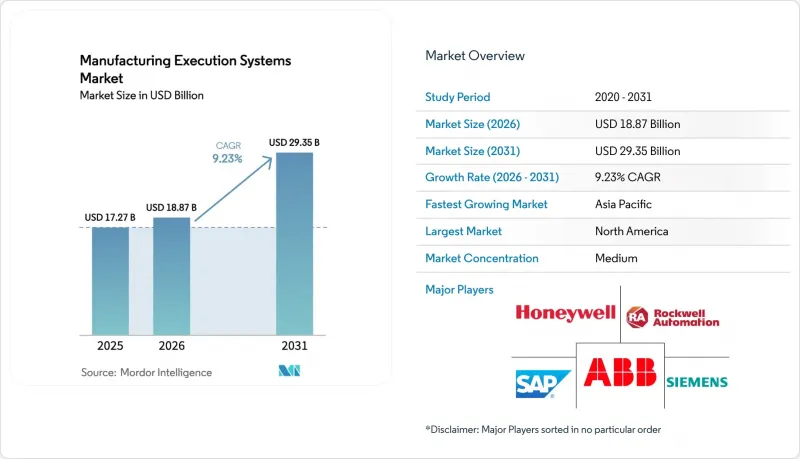
This report is Segmented by Offering (Software, and Service), Deployment (On-Premise, Cloud, and Edge-Based), End-User Industry (Food and Beverage, Oil and Gas, Automotive, and More), Enterprise Size (Large Enterprises, Small and Medium Enterprises (SMEs)), Process Type (Discrete Manufacturing, Process Manufacturing, and More), and Geography. The Market Forecasts are Provided in Terms of Value (USD).
Global Manufacturing Execution Systems Market Trends and Insights
Industry 4.0 And Smart-Factory Roll-outs
National manufacturing agendas continue to de-risk digital-twin investments. In the United States, the Department of Energy's Smart Manufacturing Innovation Institute funded live production trials in 2025 that cut energy intensity by double-digit percentages. Germany's Manufacturing-X framework requires interoperable asset-administration shells, ensuring that each connected machine can publish status without revealing proprietary know-how. Ireland earmarked grants for pharmaceutical clusters in Cork and Limerick, prompting contract manufacturers to swap spreadsheets for modular execution platforms. The United Kingdom tied innovation vouchers to verifiable scrap-rate reductions, prompting mid-tier suppliers to adopt platform-agnostic data models. Collectively, these initiatives convert abstract policy into direct demand for the manufacturing execution systems (MES) market.
Need For Real-Time Production Visibility
Supply-chain disruptions in 2024 exposed the cost of delayed shop-floor data. Automotive OEMs now require hourly electronic data interchange from tier-1 suppliers, an expectation that paper logs cannot meet. Semiconductor fabs deploy edge gateways that stream metrology readings to advanced process-control algorithms, shrinking excursion detection windows from hours to seconds. By 2025, sensor costs fell below USD 5 per node, enabling high-mix job shops to justify continuous monitoring. Energy-management layers now link machine utilization with time-of-use tariffs, carving 15%-20% off peak charges in regions with interval metering. As a result, live dashboards are becoming table stakes rather than differentiators in the manufacturing execution systems market.
Up-Front Integration Cost With Legacy OT And ERP
Brownfield facilities often rely on proprietary fieldbus networks such as Modbus or Profibus that predate modern APIs. Bridging these islands requires protocol gateways and custom scripts, inflating project budgets by 40%-60% according to a 2025 MESA survey. Pharmaceutical sites add validation overhead, where every change triggers installation, operational, and performance qualifications that consume months and hundreds of thousands of dollars. Such integration burdens can exhaust the first year of ROI models, delaying board approval for incremental modules and tempering growth in the manufacturing execution systems (MES) market.
Other drivers and restraints analyzed in the detailed report include:
- Compliance-Driven Digital Traceability
- SaaS Pricing Lowers CapEx Barriers
- Cyber-Security Risks In Cloud-Connected Plants
For complete list of drivers and restraints, kindly check the Table Of Contents.
Segment Analysis
Services revenue is set to outpace software through 2031 as manufacturers outsource integration, validation, and analytics. In 2025, software generated 58.64% of topline demand, yet the growing complexity of multi-plant roll-outs is unlocking double-digit expansion for managed services. Validation-as-a-service bundles shorten pharmaceutical qualification phases from nine months to twelve weeks, illustrating why professional support is eclipsing license fees in the manufacturing execution systems (MES) market size. Remote monitoring packages embedding predictive maintenance and changeover optimization are especially popular among automotive tiers that lack in-house data scientists.
Managed services also act as a talent bridge. Scarcity of ISA-95 architects and cloud-native DevOps engineers prompts factories to contract outcome-based agreements. Vendors assume responsibility for uptime, patching, and upgrades, effectively converting capital purchases into opex lines. This realignment aligns corporate cash-flow preferences with continuous improvement cycles, bolstering the manufacturing execution systems market.
On-premise systems held a 62.46% manufacturing execution systems market share in 2025 due to stringent pharma and semiconductor validation rules. Cloud platforms, however, are growing 10.12% annually as SMEs and contract manufacturers favor rapid configuration over server ownership. Edge-native hybrids satisfy latency and data-sovereignty concerns by performing time-critical loops locally while syncing aggregated metrics to cloud dashboards. The CHIPS and Science Act now ties funding to digital-twin yield dashboards accessible to distributed teams, catalyzing cloud adoption in new U.S. fabs.
Cybersecurity remains the chief hurdle. IEC 62443 certification for cloud services trails on-premise norms, and pharma CMOs negotiate data-residency clauses to lock server locations. Even so, Europe's Digital Product Passport and similar regulations require secure APIs that cloud infrastructure delivers more cost-effectively than on-premise portals. As regulatory glue hardens, the deployment mix within the manufacturing execution systems market is tilting toward hybrid-cloud.
Complete Report Scope:
- By Offering
- Software
- Services
- By Deployment Mode
- On-Premise
- Cloud
- Edge-Based
- By End-User Industry
- Food and Beverage
- Oil and Gas
- Pharmaceutical and Life Sciences
- Automotive
- Electronics and Semiconductor
- Chemicals
- Metals and Mining
- Pulp and Paper
- Aerospace and Defense
- Other End-User Industries
- By Enterprise Size
- Large Enterprises
- Small and Medium Enterprises
- By Process Type
- Discrete Manufacturing
- Process Manufacturing
- Hybrid
- By Geography
- North America
- United States
- Canada
- Mexico
- South America
- Brazil
- Argentina
- Rest of South America
- Europe
- Germany
- United Kingdom
- France
- Italy
- Spain
- Russia
- Rest of Europe
- Asia Pacific
- China
- Japan
- South Korea
- India
- Australia and New Zealand
- Rest of Asia Pacific
- Middle East
- Saudi Arabia
- United Arab Emirates
- Turkey
- Rest of Middle East
- Africa
- South Africa
- Nigeria
- Rest of Africa
- North America
Geography Analysis
North America's leadership stems from USD 52.7 billion in semiconductor incentives and a robust pharmaceutical base. Intel's Ohio and Arizona fabs and TSMC's Phoenix site embed digital-twin yield dashboards, anchoring execution budgets. Pharmaceutical hubs in New Jersey and Puerto Rico retrofit batch suites with continuous reactors to satisfy FDA serialization and process-verification rules. Canada's Ontario auto corridor now integrates battery-pack traceability as EV volumes scale, while Mexico's Bajio SMEs deploy cloud suites to meet IATF 16949 audits rapidly.
Asia Pacific's 11.94% forecast CAGR reflects policy and supply-chain shifts. China's Ministry of Industry and Information Technology backs industrial-internet pilots that graduate into full-scale deployments. India's subsidies hinge on proof of digitization, driving adoption among electronics and pharma SMEs. Southeast Asia absorbs electronics and automotive lines relocating from single-source geographies, and each OEM mandates execution-system compliance as supplier entry criteria. Japan focuses on predictive maintenance to counteract labor shortages, while Australia and New Zealand embed traceability to protect food-export brands.
Europe advances under the weight of regulation. Germany retrofits battery-cell lines to meet digital passport rules. United Kingdom pharma centers fund continuous-manufacturing pilots to offset Brexit-related cost pressures. France's defense plants favor on-premise, air-gapped deployments for ITAR compliance. Italy's PDO food processors use execution layers to authenticate provenance, and Spain's tier-1 automotive suppliers adopt cloud platforms to synchronize cross-border plants. Russia's refinery optimizations rely on historian integrations, even as sanctions curb Western licenses.
- Siemens AG
- Rockwell Automation Inc.
- SAP SE
- ABB Ltd.
- Honeywell International Inc.
- Dassault Systemes SE
- Schneider Electric SE
- Applied Materials Inc.
- Oracle Corporation
- GE Vernova
- Emerson Electric Co.
- Epicor Software Corp.
- Yokogawa Electric Corp.
- AVEVA Group plc
- Korber AG (Werum)
- MPDV Mikrolab GmbH
- Plex Systems
- iBASEt
- Parsec Automation Corp.
- Critical Manufacturing SA
- Aegis Software
- Aspen Technology Inc.
- Mitsubishi Electric Corp.
- Infor Inc.
- Tata Consultancy Services
- LandT Technology Services
Additional Benefits:
- The market estimate (ME) sheet in Excel format
- 3 months of analyst support
TABLE OF CONTENTS
1 INTRODUCTION
- 1.1 Study Assumptions and Market Definition
- 1.2 Scope of the Study
2 RESEARCH METHODOLOGY
3 EXECUTIVE SUMMARY
4 MARKET LANDSCAPE
- 4.1 Market Overview
- 4.2 Market Drivers
- 4.2.1 Industry 4.0 and Smart-Factory Roll-outs
- 4.2.2 Need for Real-Time Production Visibility
- 4.2.3 Compliance-Driven Digital Traceability
- 4.2.4 SaaS Pricing Lowers CapEx Barriers for Tier-2 Suppliers
- 4.2.5 Rise of Low-Code Composable MES Among SMEs
- 4.2.6 OEE-as-a-Service Linked to IIoT Edge Analytics
- 4.3 Market Restraints
- 4.3.1 Up-Front Integration Cost with Legacy OT and ERP
- 4.3.2 Cyber-Security Risks in Cloud-Connected Plants
- 4.3.3 OT and IT Skill-Gap Stalling Advanced MES Roll-outs
- 4.3.4 IP-Exposure Fears Among Contract Manufacturers
- 4.4 Industry Value / Supply-Chain Analysis
- 4.5 Regulatory Landscape
- 4.6 Technological Outlook
- 4.7 Impact of Macroeconomic Factors on the Market
- 4.8 Porter's Five Forces Analysis
- 4.8.1 Bargaining Power of Suppliers
- 4.8.2 Bargaining Power of Buyers
- 4.8.3 Threat of New Entrants
- 4.8.4 Threat of Substitute Products
- 4.8.5 Degree of Competition
5 MARKET SIZE AND GROWTH FORECASTS (VALUE)
- 5.1 By Offering
- 5.1.1 Software
- 5.1.2 Services
- 5.2 By Deployment Mode
- 5.2.1 On-Premise
- 5.2.2 Cloud
- 5.2.3 Edge-Based
- 5.3 By End-User Industry
- 5.3.1 Food and Beverage
- 5.3.2 Oil and Gas
- 5.3.3 Pharmaceutical and Life Sciences
- 5.3.4 Automotive
- 5.3.5 Electronics and Semiconductor
- 5.3.6 Chemicals
- 5.3.7 Metals and Mining
- 5.3.8 Pulp and Paper
- 5.3.9 Aerospace and Defense
- 5.3.10 Other End-User Industries
- 5.4 By Enterprise Size
- 5.4.1 Large Enterprises
- 5.4.2 Small and Medium Enterprises
- 5.5 By Process Type
- 5.5.1 Discrete Manufacturing
- 5.5.2 Process Manufacturing
- 5.5.3 Hybrid
- 5.6 By Geography
- 5.6.1 North America
- 5.6.1.1 United States
- 5.6.1.2 Canada
- 5.6.1.3 Mexico
- 5.6.2 South America
- 5.6.2.1 Brazil
- 5.6.2.2 Argentina
- 5.6.2.3 Rest of South America
- 5.6.3 Europe
- 5.6.3.1 Germany
- 5.6.3.2 United Kingdom
- 5.6.3.3 France
- 5.6.3.4 Italy
- 5.6.3.5 Spain
- 5.6.3.6 Russia
- 5.6.3.7 Rest of Europe
- 5.6.4 Asia Pacific
- 5.6.4.1 China
- 5.6.4.2 Japan
- 5.6.4.3 South Korea
- 5.6.4.4 India
- 5.6.4.5 Australia and New Zealand
- 5.6.4.6 Rest of Asia Pacific
- 5.6.5 Middle East
- 5.6.5.1 Saudi Arabia
- 5.6.5.2 United Arab Emirates
- 5.6.5.3 Turkey
- 5.6.5.4 Rest of Middle East
- 5.6.6 Africa
- 5.6.6.1 South Africa
- 5.6.6.2 Nigeria
- 5.6.6.3 Rest of Africa
- 5.6.1 North America
6 COMPETITIVE LANDSCAPE
- 6.1 Market Concentration
- 6.2 Strategic Moves
- 6.3 Market Share Analysis
- 6.4 Company Profiles (includes Global Level Overview, Market Level Overview, Core Segments, Financials as Available, Strategic Information, Market Rank/Share for Key Companies, Products and Services, and Recent Developments)
- 6.4.1 Siemens AG
- 6.4.2 Rockwell Automation Inc.
- 6.4.3 SAP SE
- 6.4.4 ABB Ltd.
- 6.4.5 Honeywell International Inc.
- 6.4.6 Dassault Systemes SE
- 6.4.7 Schneider Electric SE
- 6.4.8 Applied Materials Inc.
- 6.4.9 Oracle Corporation
- 6.4.10 GE Vernova
- 6.4.11 Emerson Electric Co.
- 6.4.12 Epicor Software Corp.
- 6.4.13 Yokogawa Electric Corp.
- 6.4.14 AVEVA Group plc
- 6.4.15 Korber AG (Werum)
- 6.4.16 MPDV Mikrolab GmbH
- 6.4.17 Plex Systems
- 6.4.18 iBASEt
- 6.4.19 Parsec Automation Corp.
- 6.4.20 Critical Manufacturing SA
- 6.4.21 Aegis Software
- 6.4.22 Aspen Technology Inc.
- 6.4.23 Mitsubishi Electric Corp.
- 6.4.24 Infor Inc.
- 6.4.25 Tata Consultancy Services
- 6.4.26 LandT Technology Services
7 MARKET OPPORTUNITIES AND FUTURE OUTLOOK
- 7.1 White-Space and Unmet-Need Assessment

