PUBLISHER: Mordor Intelligence | PRODUCT CODE: 2123762

PUBLISHER: Mordor Intelligence | PRODUCT CODE: 2123762
Urology Laser - Market Share Analysis, Industry Trends & Statistics, Growth Forecasts (2026 - 2031)
According to Mordor Intelligence, the urology laser market size is expected to grow from USD 1.41 billion in 2025 to USD 1.49 billion in 2026 and is forecast to reach USD 1.93 billion by 2031 at 5.34% CAGR over 2026-2031.
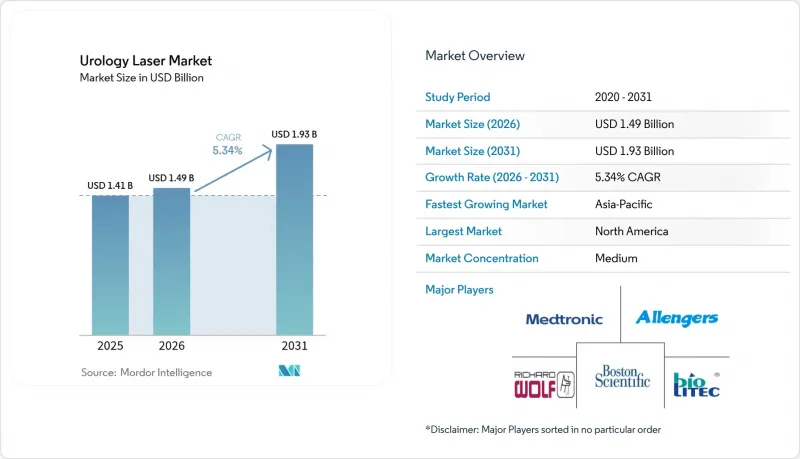
This report is Segmented by Laser Type (Holmium:YAG Laser, Thulium Fiber Laser, Greenlight (KTP/LBO) Laser, Diode Laser, Others), Application (Lithotripsy, BPH, Ureteroscopy, Bladder Tumor Resection, Others), End User (Hospitals, Ascs, Specialty Clinics, Others), and Geography (North America, Europe, Asia-Pacific, South America, and More). The Market Forecasts are Provided in Terms of Value (USD).
Global Urology Laser Market Trends and Insights
Growing Adoption of Minimally Invasive BPH Surgery
Laser enucleation has replaced transurethral resection as the favored BPH therapy because it yields durable symptom relief, minimal bleeding, and reoperation rates below 1% at 10-year follow-up. MOSES pulse modulation further boosts efficiency, allowing over 90% of treated men to leave on the same day, which trims inpatient costs and frees operating room capacity. Favorable Medicare fee-schedule updates reinforce economic viability and accelerate equipment purchase cycles. Updated American Urological Association guidelines now list holmium laser enucleation as a first-line option for glands of any size, strengthening referral volumes to centers with advanced platforms. Collectively, these clinical and policy tailwinds elevate procedure counts and stimulate recurring fiber sales, underpinning the urology laser market.
Technological Advancements in Pulse-Modulated Ho:YAG Systems
MOSES technology shapes a vapor bubble at the fiber tip, enhancing energy transfer and lowering stone retropulsion. Clinical trials document treatment-time reductions near 40% and demonstrably better hemostasis during prostate enucleation compared with standard holmium pulses. Shorter case times lift surgeon throughput, translating into higher revenue per laser console. Multi-application capability-moving seamlessly from lithotripsy to soft-tissue ablation-improves return on capital investment, prompting hospitals to consolidate disparate devices into a single high-power workstation. Early adopters report standardized outcomes across varied tissue densities and anatomy, dampening the learning curve for complex cases and catalyzing broader uptake. Leading vendors are layering AI algorithms on pulse-modulated systems to auto-adjust parameters based on tissue feedback, pointing to the next wave of performance gains.
High Capital and Maintenance Costs
Advanced laser workstations can list above USD 300,000 and require precision fibers, annual service contracts, and periodic software upgrades that raise ownership costs by another 15-20% per year. Smaller community hospitals and clinics often lack the case volume to amortize such investments, delaying replacement cycles and inhibiting penetration-especially in emerging economies where import tariffs and currency swings inflate prices further. Vendors have responded with pay-per-use and revenue-share arrangements, but senior finance teams still weigh lasers against competing capital needs such as imaging or robotic systems. Until pricing falls or reimbursement rises in budget-sensitive regions, fiscal barriers will temper the otherwise robust growth of the urology laser market.
Other drivers and restraints analyzed in the detailed report include:
- Rising Prevalence of Urolithiasis
- Hospital CAPEX and Reimbursement Tailwinds
- Steep HoLEP Learning Curve
For complete list of drivers and restraints, kindly check the Table Of Contents.
Segment Analysis
Holmium:YAG systems retained a 71.62% slice of the urology laser systems market share in 2025, reflecting long-standing clinical proof and surgeon comfort. Yet thulium fiber units are projected to log a 5.55% CAGR and capture incremental revenue as centers seek lower retropulsion and finer dusting for complex calculi. The urology laser systems market size for thulium solutions is forecast to widen particularly in Asia-Pacific where replacement cycles coincide with green-field hospital builds that favor the newest technology.
GreenLight potassium-titanyl-phosphate lasers remain the preferred choice for photoselective vaporization in anticoagulated patients, preserving a focused niche. Diode lasers provide economical entry points for smaller clinics, though their lower power limits procedural breadth. Blue-light systems under investigation show promise for preserving sexual function after BPH surgery, hinting at future niche expansion. Holmium's versatility in both high-power prostate work and lithotripsy, however, secures its leadership in the urology laser systems market, even as fiber lasers nibble share in select indications.
Complete Report Scope:
- By Laser Type
- Holmium:YAG Laser
- Thulium Fiber Laser
- GreenLight (KTP/LBO) Laser
- Diode Laser
- Others (Er:YAG, CO2, etc.)
- By Application
- Lithotripsy
- Benign Prostatic Hyperplasia (BPH)
- Ureteroscopy
- Bladder Tumor Resection
- Others (Stricture, Caruncle, Soft-tissue)
- By End User
- Hospitals
- Ambulatory Surgical Centers
- Specialty Clinics
- Others (Academic/Research Labs)
- By Geography
- North America
- United States
- Canada
- Mexico
- Europe
- Germany
- United Kingdom
- France
- Italy
- Spain
- Rest of Europe
- Asia-Pacific
- China
- India
- Japan
- South Korea
- Australia
- Rest of Asia-Pacific
- South America
- Brazil
- Argentina
- Rest of South America
- Middle East and Africa
- GCC
- South Africa
- Rest of Middle East and Africa
- North America
Geography Analysis
North America captured 37.05% of urology laser systems market revenue in 2025, underpinned by consistent Medicare and private-payer reimbursement, robust surgeon training pipelines, and FDA regulation that balances safety with timely clearances. Academic flagships in the United States set procedural standards that ripple across community hospitals, accelerating diffusion of innovations such as MOSES pulse modulation and AI-guided parameter selection. Consolidated group purchasing further supports large-scale console rollouts that lock in vendor partnerships and boost fiber pull-through.
Asia-Pacific is projected to advance at a 6.01% CAGR through 2031, the fastest regional clip in the urology laser systems market. China's hospital-modernization push and India's expanding insurance penetration are swelling procedure volumes, while manufacturers add regional assembly lines that temper import costs. Surgeons in Japan and South Korea-already adept with high-tech devices-are early adopters of thulium fiber and AI-enhanced consoles. Favorable government investments in medical tourism hubs, notably in Thailand and Singapore, foster demand for cutting-edge laser suites, further expanding the geographic footprint of the urology laser systems market.
Europe maintains steady mid-single-digit growth powered by universal coverage schemes that emphasize evidence-based care. Germany and the United Kingdom spearhead adoption of en-bloc bladder tumor resection, while the Nordic countries pilot AI-driven lasers within robotic programs. Harmonized CE requirements simplify vendor launches across the bloc, though budget austerity in Southern Europe slightly tempers capital spending. In emerging regions of South America and the Middle East & Africa, urology laser systems market penetration remains low but rising, led by private-sector centers catering to expatriate and affluent local populations.
- Boston Scientific
- Olympus
- Dornier MedTech
- Richard Wolf
- Karl Storz
- El.En.
- Lumenis
- Allengers Medical Systems Ltd.
- Jena GmbH
- OmniGuide Holdings
- Convergent Laser Technologies Inc.
- GIGAALASER (Shenzhen Gigaa Optronics)
- Cook Group
- Boston Medical Devices Inc.
- IPG Photonics
- Beckton Dickinson
- Coherent Corp.
Additional Benefits:
- The market estimate (ME) sheet in Excel format
- 3 months of analyst support
TABLE OF CONTENTS
1 Introduction
- 1.1 Study Assumptions & Market Definition
- 1.2 Scope of the Study
2 Research Methodology
3 Executive Summary
4 Market Landscape
- 4.1 Market Overview
- 4.2 Market Drivers
- 4.2.1 Rising prevalence of urolithiasis
- 4.2.2 Growing adoption of minimally invasive BPH surgery
- 4.2.3 Technological advancements (e.g., pulse-modulated Ho:YAG)
- 4.2.4 Hospital CAPEX & reimbursement tailwinds
- 4.2.5 ASC day-case surge for laser procedures
- 4.2.6 AI-driven laser parameter optimisation
- 4.3 Market Restraints
- 4.3.1 High capital & maintenance costs
- 4.3.2 Steep HoLEP learning curve
- 4.3.3 Intra-renal thermal-injury concerns
- 4.3.4 Rare-earth crystal supply-chain risk
- 4.4 Value / Supply-Chain Analysis
- 4.5 Regulatory Landscape
- 4.6 Technological Outlook
- 4.7 Porter's Five Forces
- 4.7.1 Bargaining Power of Buyers
- 4.7.2 Bargaining Power of Suppliers
- 4.7.3 Threat of New Entrants
- 4.7.4 Threat of Substitutes
- 4.7.5 Competitive Rivalry
5 Market Size & Growth Forecasts (Value, USD)
- 5.1 By Laser Type
- 5.1.1 Holmium:YAG Laser
- 5.1.2 Thulium Fiber Laser
- 5.1.3 GreenLight (KTP/LBO) Laser
- 5.1.4 Diode Laser
- 5.1.5 Others (Er:YAG, CO2, etc.)
- 5.2 By Application
- 5.2.1 Lithotripsy
- 5.2.2 Benign Prostatic Hyperplasia (BPH)
- 5.2.3 Ureteroscopy
- 5.2.4 Bladder Tumor Resection
- 5.2.5 Others (Stricture, Caruncle, Soft-tissue)
- 5.3 By End User
- 5.3.1 Hospitals
- 5.3.2 Ambulatory Surgical Centers
- 5.3.3 Specialty Clinics
- 5.3.4 Others (Academic/Research Labs)
- 5.4 By Geography
- 5.4.1 North America
- 5.4.1.1 United States
- 5.4.1.2 Canada
- 5.4.1.3 Mexico
- 5.4.2 Europe
- 5.4.2.1 Germany
- 5.4.2.2 United Kingdom
- 5.4.2.3 France
- 5.4.2.4 Italy
- 5.4.2.5 Spain
- 5.4.2.6 Rest of Europe
- 5.4.3 Asia-Pacific
- 5.4.3.1 China
- 5.4.3.2 India
- 5.4.3.3 Japan
- 5.4.3.4 South Korea
- 5.4.3.5 Australia
- 5.4.3.6 Rest of Asia-Pacific
- 5.4.4 South America
- 5.4.4.1 Brazil
- 5.4.4.2 Argentina
- 5.4.4.3 Rest of South America
- 5.4.5 Middle East and Africa
- 5.4.5.1 GCC
- 5.4.5.2 South Africa
- 5.4.5.3 Rest of Middle East and Africa
- 5.4.1 North America
6 Competitive Landscape
- 6.1 Market Concentration
- 6.2 Market Share Analysis
- 6.3 Company Profiles (includes Global overview, Market overview, Core Segments, Financials, Strategic Info, Market Rank/Share, Products & Recent Developments)
- 6.3.1 Boston Scientific Corporation
- 6.3.2 Olympus Corporation
- 6.3.3 Dornier MedTech GmbH
- 6.3.4 Richard Wolf GmbH
- 6.3.5 KARL STORZ SE & Co. KG
- 6.3.6 El.En. S.p.A.
- 6.3.7 Lumenis Be Ltd.
- 6.3.8 Allengers Medical Systems Ltd.
- 6.3.9 Jena GmbH
- 6.3.10 OmniGuide Holdings Inc.
- 6.3.11 Convergent Laser Technologies Inc.
- 6.3.12 GIGAALASER (Shenzhen Gigaa Optronics)
- 6.3.13 Cook Medical LLC
- 6.3.14 Boston Medical Devices Inc.
- 6.3.15 IPG Photonics Corporation
- 6.3.16 Becton Dickinson and Company
- 6.3.17 Coherent Corp.
7 Market Opportunities & Future Outlook
- 7.1 White-space & Unmet-need Assessment

