PUBLISHER: Mordor Intelligence | PRODUCT CODE: 2123781

PUBLISHER: Mordor Intelligence | PRODUCT CODE: 2123781
Neurofeedback Systems - Market Share Analysis, Industry Trends & Statistics, Growth Forecasts (2026 - 2031)
According to Mordor Intelligence, neurofeedback systems market size in 2026 is estimated at USD 1.5 billion, growing from 2025 value of USD 1.40 billion with 2031 projections showing USD 2.14 billion, growing at 7.33% CAGR over 2026-2031.
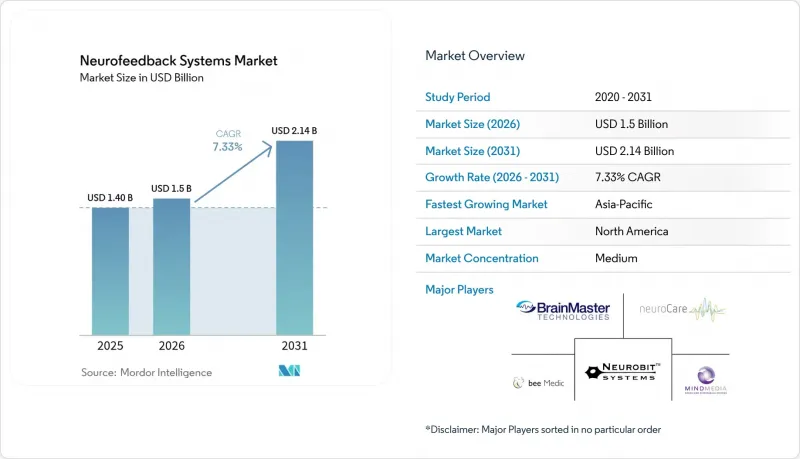
This report is Segmented by Product Type (Devices [EEG-Based, FNIRS-Based, and More], Software & Services), Application (ADHD, Anxiety & Depression, and More), Modality (In-Clinic Fixed, Portable/Wearable, Tele-Neurofeedback), End User (Hospitals & Specialty Clinics, Mental Health Centers, and More), and Geography (North America, Europe, and More). Market Forecasts are Provided in Terms of Value (USD).
Global Neurofeedback Systems Market Trends and Insights
Surge in ADHD diagnoses driving clinical adoption
Global ADHD prevalence climbed sharply post-pandemic, pressing caregivers to seek effective non-drug therapies. Randomized controlled trials show that mobile neurofeedback delivers significant gains in attention and response inhibition among children aged 8-15, with benefits sustained three months post-training. The FDA reclassification of digital ADHD therapy devices into Class II during September 2024 established special controls and simplified the 510(k) pathway. Clinics subsequently integrated neurofeedback into first-line behavioral programs, which lifted utilization rates across theneurofeedback systems market. Commercial payers have responded by running limited reimbursement pilots, creating a virtuous cycle that accelerates equipment demand. Collectively, these factors add measurable growth momentum through 2028.
Integration with wearables for at-home mental-wellness programs
Consumer EEG modules embedded in earbuds and headbands now stream brain-state data to smartphone apps, enabling continuous stress management and mindfulness coaching. Meta-analyses confirm that combining consumer-grade neurofeedback with guided meditation reduces psychological distress, albeit with small effect sizes, but on an unparalleled scale. Corporate wellness programs have begun subsidizing these devices, expanding the neurofeedback systems market beyond clinical settings. Device makers leverage cloud analytics to refine algorithms automatically, improving usability over time. Because wearables bypass clinic visits, they are well-suited for longitudinal mental-wellness initiatives, ensuring long-term demand.
Limited long-term clinical evidence for certain indications
While short-term trials show efficacy in PTSD, chronic pain, and insomnia, meta-analyses caution that long-term durability of benefit remains under-documented. Major insurers therefore classify most neurofeedback procedures as investigational outside a narrow ADHD definition. Academic groups initiated multi-year studies to close this gap, yet results will not influence coverage decisions until after 2027. This evidence deficit slows uptake in indications where reimbursement is essential, tempering growth in the neurofeedback systems market.
Other drivers and restraints analyzed in the detailed report include:
- Increasing insurance coverage pilots for neurofeedback therapy
- Rise of elite-sports demand for cognitive performance training
- High device costs and capital-budget constraints in clinics
For complete list of drivers and restraints, kindly check the Table Of Contents.
Segment Analysis
Devices dominated revenue with a 70.62% share in 2025, underscoring the hardware-centric entry point of the neurofeedback systems market. EEG-based systems remain the workhorse for clinical ADHD and epilepsy protocols, while premium fMRI and fNIRS rigs cater to research centers focusing on emotion regulation and depression. Software and services, although smaller, are on track for a 7.68% CAGR through 2031, driven by demand for AI-driven analytics that fine-tune thresholds in real-time. Subscription dashboards create ongoing revenue streams that cushion suppliers from equipment replacement cycles.
The fNIRS subsegment is gaining visibility as recent ventrolateral prefrontal cortex training studies report marked reductions in negative affect among high-efficiency learners. Concurrently, fMRI-guided feedback shows clinically meaningful modulation of depression-related neural networks. Legacy platforms such as HEG and SCP/LENS occupy niche therapeutic corridors, especially within concussion management, adding specialized breadth to the neurofeedback systems market.
Complete Report Scope:
- By Application
- Attention Deficit Hyperactivity Disorder (ADHD)
- Pain Management
- Insomnia
- Anxiety Disorder
- Other Applications
- Geography
- North America
- United States
- Canada
- Mexico
- Europe
- Germany
- United Kingdom
- France
- Italy
- Spain
- Rest of Europe
- Asia-Pacific
- China
- Japan
- India
- Australia
- South Korea
- Rest of Asia-Pacific
- Middle East and Africa
- GCC
- South Africa
- Rest of Middle East and Africa
- South America
- Brazil
- Argentina
- Rest of South America
- North America
Geography Analysis
North America generated 39.10% of 2025 revenue, reflecting early FDA approvals, strong venture funding, and pilot reimbursement programs that span ADHD and stroke rehabilitation. Academic-industry collaborations drive technology refinement, evidenced by the BEAM(TM) platform developed with more than USD 40 million in federal research grants. Nevertheless, broad payer coverage remains limited, compelling clinics to blend cash payments with emerging insurance pilots.
Europe holds a solid second position, aided by the European Union's joint health-technology assessment regulation that streamlines device evaluation across member states. National digital-health agencies in Germany, France, and Belgium expedite market access once clinical benefit is proven, and local payers have begun conditionally reimbursing digital neurofeedback for ADHD. Research institutes across the continent are exploring fNIRS and fMRI feedback for mood disorders, adding scientific gravitas to the regional neurofeedback systems market.
Asia-Pacific registers the fastest growth with an 8.07% CAGR projected through 2031. Governments in Japan and South Korea fund AI-enabled medical devices, accelerating regulatory approvals that favor domestic suppliers. China and India, with vast patient pools and growing telehealth ecosystems, are piloting low-cost portable EEG kits to bridge mental-health care gaps. The combination of policy support, technology manufacturing capability, and rising public health awareness propels Asia-Pacific to the forefront of neurofeedback systems market expansion.
- Brainmaster Technologies
- BEE Medic
- Neurobit Systems
- NeuroCare Group
- Thought Technology
- Mind Media
- Wearable Sensing
- Mitsar
- Myndlift
Additional Benefits:
- The market estimate (ME) sheet in Excel format
- 3 months of analyst support
TABLE OF CONTENTS
1 INTRODUCTION
- 1.1 Study Assumptions and Market Definition
- 1.2 Scope of the Study
2 RESEARCH METHODOLOGY
3 EXECUTIVE SUMMARY
4 MARKET DYNAMICS
- 4.1 Market Overview
- 4.2 Market Drivers
- 4.2.1 Increasing Burden of Brain Disorders
- 4.2.2 Increasing Technological Advancements Towards Brain Monitoring
- 4.3 Market Restraints
- 4.3.1 High-Cost and Time-Consuming Neurofeedback Sessions
- 4.4 Porter's Five Forces Analysis
- 4.4.1 Bargaining Power of Suppliers
- 4.4.2 Bargaining Power of Buyers/Consumers
- 4.4.3 Threat of New Entrants
- 4.4.4 Threat of Substitute Products
- 4.4.5 Intensity of Competitive Rivalry
5 MARKET SEGMENTATION
- 5.1 By Application
- 5.1.1 Attention Deficit Hyperactivity Disorder (ADHD)
- 5.1.2 Pain Management
- 5.1.3 Insomnia
- 5.1.4 Anxiety Disorder
- 5.1.5 Other Applications
- 5.2 Geography
- 5.2.1 North America
- 5.2.1.1 United States
- 5.2.1.2 Canada
- 5.2.1.3 Mexico
- 5.2.2 Europe
- 5.2.2.1 Germany
- 5.2.2.2 United Kingdom
- 5.2.2.3 France
- 5.2.2.4 Italy
- 5.2.2.5 Spain
- 5.2.2.6 Rest of Europe
- 5.2.3 Asia-Pacific
- 5.2.3.1 China
- 5.2.3.2 Japan
- 5.2.3.3 India
- 5.2.3.4 Australia
- 5.2.3.5 South Korea
- 5.2.3.6 Rest of Asia-Pacific
- 5.2.4 Middle East and Africa
- 5.2.4.1 GCC
- 5.2.4.2 South Africa
- 5.2.4.3 Rest of Middle East and Africa
- 5.2.5 South America
- 5.2.5.1 Brazil
- 5.2.5.2 Argentina
- 5.2.5.3 Rest of South America
- 5.2.1 North America
6 COMPETITIVE LANDSCAPE
- 6.1 Company Profiles
- 6.1.1 Brainmaster Technologies Inc.
- 6.1.2 BEE Medic
- 6.1.3 Neurobit Systems
- 6.1.4 NeuroCare Group GmbH
- 6.1.5 Thought Technology Ltd
- 6.1.6 Mind Media BV
- 6.1.7 Wearable Sensing
- 6.1.8 Mitsar Co. Ltd
- 6.1.9 Myndlift
7 MARKET OPPORTUNITIES AND FUTURE TRENDS

