PUBLISHER: Mordor Intelligence | PRODUCT CODE: 2123782

PUBLISHER: Mordor Intelligence | PRODUCT CODE: 2123782
Fungal Keratitis Treatment - Market Share Analysis, Industry Trends & Statistics, Growth Forecasts (2026 - 2031)
According to Mordor Intelligence, the fungal keratitis treatment market size is expected to grow from USD 920 million in 2025 to USD 961.86 million in 2026 and is forecast to reach USD 1.2 billion by 2031 at 4.55% CAGR over 2026-2031.
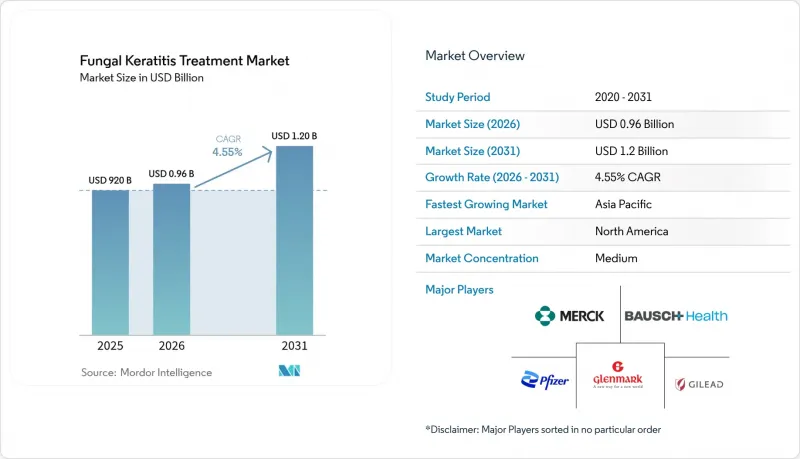
This report is Segmented by Drug Class (Polyenes, Azoles, and More), Route of Administration (Topical, Oral, and Intra-Ocular / Intrastromal Injection), Formulation Type (Solution, Suspension, and More), Distribution Channel (Hospital Pharmacies, and More), and Geography (North America, Europe, Asia-Pacific, and More). The Market Forecasts are Provided in Terms of Value (USD).
Global Fungal Keratitis Treatment Market Trends and Insights
Growing Burden of Fungal Keratitis in Tropical & Subtropical Regions
Tropical and subtropical zones report a rising incidence as urban heat islands, higher humidity, and ongoing agricultural activity expose residents to spore-laden debris. Trauma accounts for up to 60% of rural cases, yet access to protective eyewear remains inconsistent. Hospital records across Myanmar, Ghana, and northeast Brazil confirm diagnostic delays of 5-7 days; early intervention within 48 hours notably reduces perforation risk. Expansion into temperate belts now challenges health systems in southern Europe and parts of the United States as climate change raises fungal thermotolerance.
Increasing R&D Investment in Broad-Spectrum & Targeted Antifungals
Capital is migrating toward novel mechanisms such as dihydroorotate dehydrogenase inhibition; olorofim shows potency against azole-resistant Aspergillus isolates. Partnerships between academia and industry accelerate translational timelines: a University of Oklahoma team has isolated persephacin, a plant-derived compound with broad-spectrum activity and reduced toxicity. Venture funds favor combination regimens that cap resistance while controlling dosing frequency through nanocarriers or ocular inserts.
Patent Expiries & Generic Erosion of Key Azoles
Fluconazole's patent loss and an average USD 14.38 generic price in the United States intensify price compression. Voriconazole, posaconazole, and other second-generation compounds face similar trajectories, pushing innovators to justify premiums via novel carriers or fixed-dose combinations. Market entrants from India and China expand ophthalmic generic capacity, deepening competition and accelerating downward price pressure in Europe and North America.
Other drivers and restraints analyzed in the detailed report include:
- Rising Contact-Lens Use & Trauma-Related Ocular Infections
- Surge in LASIK & Corneal Transplant Procedures Elevating Post-Op Risk
- Escalating Antifungal Resistance in Candida auris & Fusarium
For complete list of drivers and restraints, kindly check the Table Of Contents.
Segment Analysis
Echinocandins post the strongest outlook at an 8.06% CAGR, even as polyenes retained 35.02% of the fungal keratitis treatment market share in 2025. FDA clearance of rezafungin for systemic candidiasis validates this class despite the absence of ocular-specific labeling. Polyene demand remains anchored by liposomal amphotericin B, which reduces nephrotoxicity and plays a central role in refractory keratitis protocols.
Pipeline activity aligns with resistance realities. Combination regimens linking echinocandins to azoles or allylamines aim to offset single-agent failure rates. The fungal keratitis treatment market size for echinocandins is reflecting their growing adoption for recalcitrant cases. Polyene innovation now focuses on better ocular retention gels to maintain high corneal concentrations without systemic exposure.
Topical drops accounted for 60.65% of the fungal keratitis treatment market size in 2025, driven by clinician familiarity and patient convenience. Intrastromal injection, however, is gaining traction and it is expected to grow with 9.54% between 2026 and 2031 because it delivers drug directly into the corneal stroma, bypassing epithelial barriers. Clinical studies show faster microbiological clearance when intrastromal voriconazole is used alongside lamellar keratoplasty.
Oral therapy remains a fallback for deep or systemic involvement, yet systemic toxicity curtails widespread use. Sustained-release implants, including micro-reservoir devices, are under investigation to extend dosing intervals to several weeks. Adoption hinges on surgical skill availability and reimbursement models that valorize procedure-based care.
Complete Report Scope:
- By Drug Class
- Polyenes
- Azoles
- Echinocandins
- Allylamines
- Novel & Combination Therapies
- By Route of Administration
- Topical
- Oral
- Intra-ocular / Intrastromal Injection
- By Formulation Type
- Solution
- Suspension
- Ointment / Gel
- Tablet / Capsule
- By Distribution Channel
- Hospital Pharmacies
- Retail Pharmacies & Drug Stores
- Online Pharmacies
- By Geography
- North America
- United States
- Canada
- Mexico
- Europe
- Germany
- United Kingdom
- France
- Italy
- Spain
- Rest of Europe
- Asia-Pacific
- China
- Japan
- India
- Australia
- South Korea
- Rest of Asia-Pacific
- Middle East & Africa
- GCC
- South Africa
- Rest of Middle East & Africa
- South America
- Brazil
- Argentina
- Rest of South America
- North America
Geography Analysis
North America contributed 36.02% of 2025 revenue, supported by higher treatment costs, insurance coverage for emerging modalities, and a well-established diagnostics infrastructure. Deep-learning algorithms have been commercialized and embedded in major academic eye centers, slashing time-to-therapy. The region also hosts most late-stage clinical trials, expediting local access to pipeline assets. Temperature anomalies along the U.S. Gulf Coast are already linked to rising Fusarium prevalence, increasing caseloads in states such as Texas and Louisiana.
Asia-Pacific is the fastest growing segment at 5.42% CAGR. Contact-lens adoption is accelerating across China, India, and South Korea, while agricultural exposure remains widespread in rural belts. Studies from northern Thailand found diverse Fusarium strains distinct from Western isolates, underscoring regional pathogen heterogeneity. Government insurance expansions in India and Indonesia now reimburse topical natamycin, widening formal treatment uptake. Public-private diagnostic partnerships seek to strengthen microscopy and culture capacity in district hospitals, which currently lack the ability to speciate pathogens.
Europe shows modest growth amid cost containment pressures. National health services favor generics where possible, trimming revenue per prescription. Yet the region maintains a leadership role in orphan designations and compassionate-use pathways, highlighted by SIFI's polihexanide ODD in 2024 that promises ten-year market exclusivity upon approval. Southern Europe faces increased fungal keratitis incidence as heatwaves become more frequent, nudging budgets toward prophylactic education and early intervention schemes. Middle East & Africa and South America remain underpenetrated due to limited cold-chain capacity and uneven specialist density, although rising urban incomes are beginning to stimulate demand for premium formulations.
- Bausch Health
- Pfizer
- Merck
- Gilead Sciences
- Glenmark Pharmaceuticals
- Alvogen
- Leadiant Biosciences
- Aurolab
- Eyevance Pharmaceuticals
- Xellia Pharmaceuticals
- Santen Pharmaceutical Co.
- CorneaGen
- Aerie Pharmaceutical
- Basilea Pharmaceutica
- SCYNEXIS
- Matinas BioPharma
- EyePoint Pharmaceuticals
- Natrapharm Inc.
- Cipla
- Sun Pharma (Polaris)
Additional Benefits:
- The market estimate (ME) sheet in Excel format
- 3 months of analyst support
TABLE OF CONTENTS
1 Introduction
- 1.1 Study Assumptions & Market Definition
- 1.2 Scope of the Study
2 Research Methodology
3 Executive Summary
4 Market Landscape
- 4.1 Market Overview
- 4.2 Market Drivers
- 4.2.1 Growing Burden of Fungal Keratitis in Tropical & Subtropical Regions
- 4.2.2 Increasing R&D Investment in Broad-Spectrum & Targeted Antifungals
- 4.2.3 Rising Contact-Lens Use & Trauma-Related Ocular Infections
- 4.2.4 Surge In Lasik & Corneal Transplant Procedures Elevating Post-Op Risk
- 4.2.5 Climate-Change-Driven Expansion of Fusarium & Aspergillus Habitat
- 4.2.6 AI-Enabled Early-Diagnosis Tools Accelerating Treatment Rates
- 4.3 Market Restraints
- 4.3.1 Patent Expiries & Generic Erosion of Key Azoles
- 4.3.2 Dose-Limiting Ocular Toxicity & Systemic Side-Effects
- 4.3.3 Escalating Antifungal Resistance in Candida Auris & Fusarium
- 4.3.4 Limited Cold-Chain & Diagnostics in Low-Income Regions
- 4.4 Regulatory Landscape
- 4.5 Porter's Five Forces Analysis
- 4.5.1 Threat of New Entrants
- 4.5.2 Bargaining Power of Buyers
- 4.5.3 Bargaining Power of Suppliers
- 4.5.4 Threat of Substitutes
- 4.5.5 Intensity of Competitive Rivalry
5 Market Size & Growth Forecasts (Value in USD)
- 5.1 By Drug Class
- 5.1.1 Polyenes
- 5.1.2 Azoles
- 5.1.3 Echinocandins
- 5.1.4 Allylamines
- 5.1.5 Novel & Combination Therapies
- 5.2 By Route of Administration
- 5.2.1 Topical
- 5.2.2 Oral
- 5.2.3 Intra-ocular / Intrastromal Injection
- 5.3 By Formulation Type
- 5.3.1 Solution
- 5.3.2 Suspension
- 5.3.3 Ointment / Gel
- 5.3.4 Tablet / Capsule
- 5.4 By Distribution Channel
- 5.4.1 Hospital Pharmacies
- 5.4.2 Retail Pharmacies & Drug Stores
- 5.4.3 Online Pharmacies
- 5.5 By Geography
- 5.5.1 North America
- 5.5.1.1 United States
- 5.5.1.2 Canada
- 5.5.1.3 Mexico
- 5.5.2 Europe
- 5.5.2.1 Germany
- 5.5.2.2 United Kingdom
- 5.5.2.3 France
- 5.5.2.4 Italy
- 5.5.2.5 Spain
- 5.5.2.6 Rest of Europe
- 5.5.3 Asia-Pacific
- 5.5.3.1 China
- 5.5.3.2 Japan
- 5.5.3.3 India
- 5.5.3.4 Australia
- 5.5.3.5 South Korea
- 5.5.3.6 Rest of Asia-Pacific
- 5.5.4 Middle East & Africa
- 5.5.4.1 GCC
- 5.5.4.2 South Africa
- 5.5.4.3 Rest of Middle East & Africa
- 5.5.5 South America
- 5.5.5.1 Brazil
- 5.5.5.2 Argentina
- 5.5.5.3 Rest of South America
- 5.5.1 North America
6 Competitive Landscape
- 6.1 Market Concentration
- 6.2 Market Share Analysis
- 6.3 Company Profiles (includes Global level Overview, Market level overview, Core Segments, Financials as available, Strategic Information, Market Rank/Share for key companies, Products & Services, and Recent Developments)
- 6.3.1 Bausch Health
- 6.3.2 Pfizer Inc.
- 6.3.3 Merck & Co. Inc.
- 6.3.4 Gilead Sciences Inc.
- 6.3.5 Glenmark Pharmaceuticals
- 6.3.6 Alvogen
- 6.3.7 Leadiant Biosciences
- 6.3.8 Aurolab
- 6.3.9 Eyevance Pharmaceuticals
- 6.3.10 Xellia Pharmaceuticals
- 6.3.11 Santen Pharmaceutical Co.
- 6.3.12 CorneaGen
- 6.3.13 Aerie Pharmaceuticals
- 6.3.14 Basilea Pharmaceutica
- 6.3.15 Scynexis Inc.
- 6.3.16 Matinas BioPharma
- 6.3.17 EyePoint Pharmaceuticals
- 6.3.18 Natrapharm Inc.
- 6.3.19 Cipla Ltd.
- 6.3.20 Sun Pharma (Polaris)
7 Market Opportunities & Future Outlook
- 7.1 White-space & Unmet-need Assessment

