PUBLISHER: Mordor Intelligence | PRODUCT CODE: 2123787

PUBLISHER: Mordor Intelligence | PRODUCT CODE: 2123787
Organic Pigments - Market Share Analysis, Industry Trends & Statistics, Growth Forecasts (2026 - 2031)
According to Mordor Intelligence, the organic pigments market size is estimated at 757.84 kilotons in 2026, and is expected to reach 889.69 kilotons by 2031, at a CAGR of 3.26% during the forecast period (2026-2031).
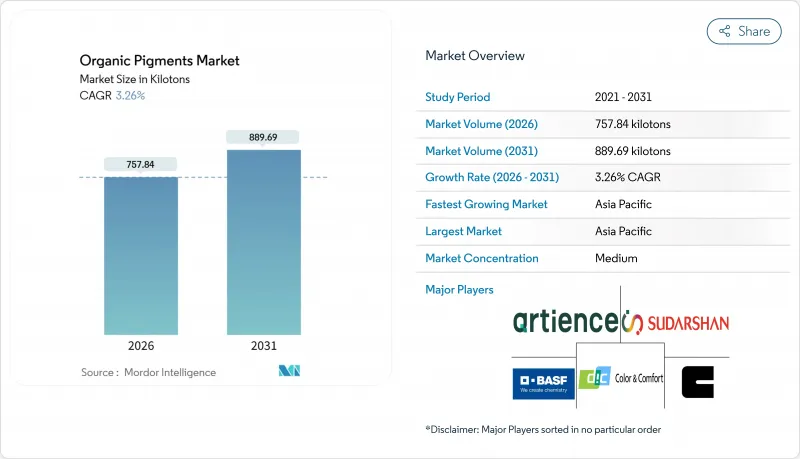
This report is Segmented by Pigment Type (Azo, Phthalocyanine, Quinacridone, Anthraquinone, and More), Source (Synthetic and Natural/Bio-based), End-User Industry (Paints and Coatings, Plastics and Polymer, Printing Inks, Textile, and More), and Geography (Asia-Pacific, North America, Europe, South America, and Middle-East and Africa). The Market Forecasts are Provided in Terms of Volume (tons).
Global Organic Pigments Market Trends and Insights
Growing Demand From Paints And Coatings Industry
Architectural and industrial coatings absorbed 39% of China's 251,000-tonne pigment output in 2024, reflecting rapid urban renewal and infrastructure upgrades. Water-based acrylic emulsions replacing solvent-borne alkyds require pigments that disperse without coupling agents, favoring quinacridone magenta and phthalocyanine blue that resist flocculation in high-pH latex paints. Automotive refinish shops specify effect grades combining quinacridone with aluminum flakes to ensure radar-friendly finishes on electric vehicles, pushing approved pigment lists toward sub-100-nanometer products. Continuous-flow reactors help producers meet this granularity while holding batch-to-batch ΔE within +-2, preserving brand color integrity. These technical prerequisites sustain premium pricing even when feedstock costs swing.
Shift Toward Eco-Friendly High-Performance Pigments
The European Union's microplastics restriction, active since October 2023, prohibits intentional particle release under 5 millimeters, propelling formulators to experiment with bio-based quinacridone precursors synthesized from lignin. California's Safer Consumer Products program lists several azo grades, obligating alternatives analysis for shipments above 1 tonne annually. Natural extractions from turmeric and spirulina win share in food-contact packaging but lack light-fastness beyond Blue Wool 4, limiting outdoor use. As regulations tighten, the organic pigments market rewards suppliers that can balance biodegradability with performance, spurring a bifurcation between commodity producers and specialty players offering certified low-migration grades.
Higher Production Costs From Stringent Environmental Regulations
The EU's 2024 Classification, Labelling and Packaging update requires fresh toxicology dossiers costing EUR 50,000-150,000 per pigment. China's 2024 Water-Pollution Law capped COD discharges at 50 mg/L, prompting CNY 20-50 million (USD 2.8-7 million) wastewater-treatment retrofits. India's real-time effluent monitoring adds 12%-18% to operating costs for mid-tier producers. These investments burden firms that lack scale to amortize compliance, tempering growth in the organic pigments market.
Other drivers and restraints analyzed in the detailed report include:
- Surging Flexible-Packaging And Digital-Printing Ink Demand
- Expanding Textile Production In Emerging Economies
- Performance/Cost Advantages Of Inorganic Pigments
For complete list of drivers and restraints, kindly check the Table Of Contents.
Segment Analysis
Azo grades secured 45.36% of the organic pigments market share in 2025, a position supported by low-complexity diazo-coupling synthesis that yields vivid yellows and reds at scale. Their ready dispersibility enables water-based flexographic inks to cut milling energy by 20% compared with quinacridone options. Disazo oranges deliver opacity in polypropylene masterbatch at 0.5% loading, doubling output rates on extruders that throttle back torque. Quinacridone pigments, though smaller in tonnage, expand at a 4.43% CAGR as OEMs demand polymorphs retaining hue after 2,000 hours of xenon-arc exposure, critical for 10-year vehicle warranties.
In the forecast horizon, the organic pigments market expects quinacridone's heat stability above 200°C to unlock new battery-cover and composite-body uses, yet cost sensitivity in flexible packaging keeps azo grades entrenched. Phthalocyanine blues and greens remain workhorses in architectural coatings, trading under USD 8/kg for alpha-crystal copper phthalocyanine. Niche anthraquinone and perylene reds fetch prices beyond USD 50/kg, where Blue Wool 7 light-fastness is non-negotiable. Digital color-matching systems may substitute costly pigments with optimized blends, pressuring specialty grades to prove lifetime value in the organic pigments market.
Complete Report Scope:
- By Pigment Type
- Azo
- Phthalocyanine
- Quinacridone
- Anthraquinone
- Other Pigment Types
- By Source
- Synthetic
- Natural / Bio-based
- By End-User Industry
- Paints and Coatings
- Plastics and Polymer
- Printing Inks
- Textile
- Other End-user Industries
- By Geography
- Asia-Pacific
- China
- India
- Japan
- South Korea
- Southeast Asia
- Rest of Asia-Pacific
- North America
- United States
- Canada
- Mexico
- Europe
- Germany
- United Kingdom
- Italy
- France
- Russia
- Rest of Europe
- South America
- Brazil
- Argentina
- Rest of South America
- Middle-East and Africa
- Saudi Arabia
- South Africa
- Rest of Middle-East and Africa
- Asia-Pacific
Geography Analysis
Asia-Pacific commanded 49.63% of 2025 volume and will expand at a 4.92% CAGR to 2031 as China's 251,000-tonne output and India's fast-growing textile and coatings sectors lift regional offtake. Chinese producers such as Baihehua and Qicai Chemical employ continuous-flow reactors that achieve color-strength tolerances within +-2 ΔE, qualifying for automotive approvals CPCIF.CN. India's organic pigments market registered 11% growth in FY 2024-25 on the back of USD 44.4 billion in textile exports and infrastructure-driven paint consumption.
North America and Europe jointly represent roughly 30% of global volume. The EU's microplastics restriction and REACH updates steer formulators toward low-migration and biodegradable grades, letting specialty suppliers capture margin. In the United States, California's regulatory stance accelerates the substitution of flagged azo pigments with quinacridone and phthalocyanine alternatives, pressuring commodity incumbents to upgrade toxicology data. Digital color-matching tools see early adoption across automotive refinish chains, enhancing service differentiation.
South America and the Middle East-Africa cover the remaining share. Brazil's construction rebound supports local pigment demand, whereas Saudi Arabia's downstream diversification under Vision 2030 seeds coatings capacity tied to petrochemical clusters. These regions import high-performance grades yet source commodity azo pigments from Asia, underscoring Asia-Pacific's role as the supply backbone of the organic pigments market.
- BASF
- artience Co., Ltd.
- Changzhou Longyu Pigment Chemical CO.,LTD.
- Clariant
- DIC CORPORATION (Sun Chemical)
- Ferro Corporation
- Hangzhou Han-Color Chemical CO. LTD
- Heubach GmbH
- Indian Chemical Industries
- Koel Colours Pvt Ltd
- LANXESS AG
- Meghmani Organics Ltd.
- Origo Chemical
- Pidilite Industries Ltd
- Sudarshan Chemical Industries Limited
- Trust Chem Co. Ltd
- VIBFAST PIGMENTS PVT LTD
- Vipul Organics Ltd
Additional Benefits:
- The market estimate (ME) sheet in Excel format
- 3 months of analyst support
TABLE OF CONTENTS
1 Introduction
- 1.1 Study Assumptions & Market Definition
- 1.2 Scope of the Study
2 Research Methodology
3 Executive Summary
4 Market Landscape
- 4.1 Market Overview
- 4.2 Market Drivers
- 4.2.1 Growing demand from paints and coatings industry
- 4.2.2 Shift toward eco-friendly high-performance pigments
- 4.2.3 Surging flexible-packaging and digital-printing ink demand
- 4.2.4 Expanding textile production in emerging economies
- 4.2.5 AI-enabled digital color-matching boosting high-consistency dispersions
- 4.3 Market Restraints
- 4.3.1 Higher production costs from stringent environmental regulations
- 4.3.2 Performance/cost advantages of inorganic pigments in specific uses
- 4.3.3 Volatility of petrochemical-based feedstock prices
- 4.4 Value Chain Analysis
- 4.5 Porter's Five Forces
- 4.5.1 Bargaining Power of Suppliers
- 4.5.2 Bargaining Power of Buyers
- 4.5.3 Threat of New Entrants
- 4.5.4 Threat of Substitute Products and Services
- 4.5.5 Degree of Competition
5 Market Size & Growth Forecasts (Volume)
- 5.1 By Pigment Type
- 5.1.1 Azo
- 5.1.2 Phthalocyanine
- 5.1.3 Quinacridone
- 5.1.4 Anthraquinone
- 5.1.5 Other Pigment Types
- 5.2 By Source
- 5.2.1 Synthetic
- 5.2.2 Natural / Bio-based
- 5.3 By End-User Industry
- 5.3.1 Paints and Coatings
- 5.3.2 Plastics and Polymer
- 5.3.3 Printing Inks
- 5.3.4 Textile
- 5.3.5 Other End-user Industries
- 5.4 By Geography
- 5.4.1 Asia-Pacific
- 5.4.1.1 China
- 5.4.1.2 India
- 5.4.1.3 Japan
- 5.4.1.4 South Korea
- 5.4.1.5 Southeast Asia
- 5.4.1.6 Rest of Asia-Pacific
- 5.4.2 North America
- 5.4.2.1 United States
- 5.4.2.2 Canada
- 5.4.2.3 Mexico
- 5.4.3 Europe
- 5.4.3.1 Germany
- 5.4.3.2 United Kingdom
- 5.4.3.3 Italy
- 5.4.3.4 France
- 5.4.3.5 Russia
- 5.4.3.6 Rest of Europe
- 5.4.4 South America
- 5.4.4.1 Brazil
- 5.4.4.2 Argentina
- 5.4.4.3 Rest of South America
- 5.4.5 Middle-East and Africa
- 5.4.5.1 Saudi Arabia
- 5.4.5.2 South Africa
- 5.4.5.3 Rest of Middle-East and Africa
- 5.4.1 Asia-Pacific
6 Competitive Landscape
- 6.1 Market Concentration
- 6.2 Strategic Moves
- 6.3 Market Share/Ranking Analysis
- 6.4 Company Profiles {(includes Global level Overview, Market level overview, Core Segments, Financials as available, Strategic Information, Market Rank/Share, Products & Services, and Recent Developments)}
- 6.4.1 BASF
- 6.4.2 artience Co., Ltd.
- 6.4.3 Changzhou Longyu Pigment Chemical CO.,LTD.
- 6.4.4 Clariant
- 6.4.5 DIC CORPORATION (Sun Chemical)
- 6.4.6 Ferro Corporation
- 6.4.7 Hangzhou Han-Color Chemical CO. LTD
- 6.4.8 Heubach GmbH
- 6.4.9 Indian Chemical Industries
- 6.4.10 Koel Colours Pvt Ltd
- 6.4.11 LANXESS AG
- 6.4.12 Meghmani Organics Ltd.
- 6.4.13 Origo Chemical
- 6.4.14 Pidilite Industries Ltd
- 6.4.15 Sudarshan Chemical Industries Limited
- 6.4.16 Trust Chem Co. Ltd
- 6.4.17 VIBFAST PIGMENTS PVT LTD
- 6.4.18 Vipul Organics Ltd
7 Market Opportunities and Future Outlook
- 7.1 White-space and Unmet-Need Assessment

