PUBLISHER: Mordor Intelligence | PRODUCT CODE: 2123788

PUBLISHER: Mordor Intelligence | PRODUCT CODE: 2123788
Epoxy Curing Agent - Market Share Analysis, Industry Trends & Statistics, Growth Forecasts (2026 - 2031)
According to Mordor Intelligence, the epoxy curing agent market size is expected to increase from USD 4.5 billion in 2025 to USD 4.70 billion in 2026 and reach USD 5.97 billion by 2031, growing at a CAGR of 4.87% over 2026-2031.
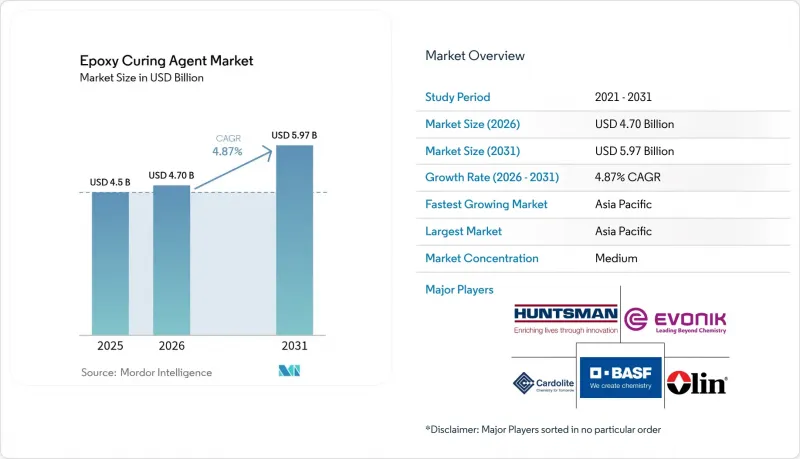
This report is Segmented by Type (Amines, Polyamides, Anhydrides, and Other Types (Phenalkamines, Amidoamines, and More)), Application (Paints and Coatings, Adhesives and Sealants, Composites, Electrical and Electronics, and Others), and Geography (Asia-Pacific, North America, Europe, South America, and the Middle East and Africa). The Market Forecasts are Provided in Terms of Value (USD).
Global Epoxy Curing Agent Market Trends and Insights
Infrastructure Boom Driving Demand for High-Performance Floor Coatings
Rising logistics, pharmaceutical, and data-center construction across China, India, and Gulf Cooperation Council countries is lifting solvent-free and high-solids epoxy flooring volumes. Authorities in China have set volatile organic compound (VOC) limits below 80 g/L, prompting formulators to adopt waterborne polyamide adducts despite humidity-sensitivity trade-offs. India's cleanroom standards cap VOC emissions at 50 g/L, accelerating solvent-free epoxy mortars. GCC mega-projects specify cycloaliphatic amine systems that cure at ambient temperatures above 40°C, ensuring rapid turnaround and chemical resistance.
Wind-Turbine Blade Production Surge in APAC & Europe
Installed wind capacity rose to 241.7 GW in the European Union during 2024, while blade manufacture is concentrating in China and India, where resin and labor costs are lower. Medium-reactivity amines offering 80-120 minute pot life dominate vacuum infusion of 80 m-plus blades. End-of-life waste, forecast at 350,000 t by 2030 in the EU, is accelerating the adoption of cleavable hardeners such as Swancor's EzCiclo that allow solvolysis recovery of carbon fiber.
Stricter VOC Caps on Solvent-Borne Amine Systems
Volatile organic compound regulations are compressing margins for solvent-borne polyamide and amine hardeners, forcing reformulation toward waterborne and high-solids alternatives that often sacrifice pot life or film build. EU Directive 2004/42/EC limits VOCs to 40 g/L in one-pack and 65 g/L in multi-pack coatings, rendering legacy polyamide hardeners obsolete. Similar caps are pending in North America and China, steering demand toward waterborne polyamide adducts and polyaspartic hybrids despite higher raw-material costs.
Other drivers and restraints analyzed in the detailed report include:
- Miniaturization of Electronics Requiring Ultra-Low-Void Encapsulants
- Lightweight CFRP Adoption in Automotive & Aerospace
- Volatile Epichlorohydrin & Benzyl-Amine Feedstock Prices
For complete list of drivers and restraints, kindly check the Table Of Contents.
Segment Analysis
Amines captured 41.91% revenue in 2025, and their share of the epoxy curing agents market is projected to expand at a 5.21% CAGR to 2031. Cycloaliphatic amines command 30-50% price premiums because they deliver ultraviolet stability and low viscosity essential for thick-section composites. Polyamides remain preferred for contaminated surfaces, but cannot match the two-hour overcoat readiness offered by polyaspartic hybrids. Anhydrides dominate electrical laminates thanks to glass-transition temperatures above 200°C, though their 150°C cure requirement limits field application. Phenalkamines, derived from cashew nutshell liquid, are winning niche marine and offshore jobs due to superior salt-fog performance and flexibility, while amidoamines offer a low-temperature cure for winter pipeline projects.
The epoxy curing agents market share of "Other Types" is set to climb as customers accept 20-40% upcharges for lifecycle cost savings. Adoption hinges on local availability because import lead times of eight weeks and tariffs of 7.5-10% erode project schedules. Patent activity in encapsulated imidazoles signals impending latent amine introductions that promise a six-month shelf life without refrigeration, a game-changer for additive manufacturing and field repair kits.
Complete Report Scope:
- By Type
- Amines
- Polyamides
- Anhydrides
- Other Types (Phenalkamines, Amidoamines, etc.)
- By Application
- Paints and Coatings
- Adhesives and Sealants
- Composites
- Electrical and Electronics
- Others (Industrial Flooring and Repairs, etc.)
- By Geography
- Asia-Pacific
- China
- India
- Japan
- South Korea
- ASEAN
- Rest of Asia-Pacific
- North America
- United States
- Canada
- Mexico
- Europe
- Germany
- United Kingdom
- France
- Italy
- Rest of Europe
- South America
- Brazil
- Argentina
- Rest of South America
- Middle East and Africa
- Saudi Arabia
- South Africa
- Rest of Middle East and Africa
- Asia-Pacific
Geography Analysis
Asia-Pacific held 35.51% of the epoxy curing agents market in 2025 and is set to post a 5.77% CAGR through 2031. China continues to dominate floor coatings for logistics hubs and data centers, despite property-sector headwinds, while the Ministry of Ecology and Environment rules cap VOCs, boosting waterborne demand. India's semiconductor expansion, Tata's 300 mm fab, and Micron's USD 2.75 billion assembly plant, will require domestic low-void encapsulants to avoid 10% tariffs and 60-day imports. Japan and South Korea retain technology leadership in sealing materials, but localization efforts in China and India are narrowing the gap.
North America benefits from aerospace composites and infrastructure upgrades funded by the Infrastructure Investment and Jobs Act. Aerospace OEMs increasingly specify vacuum-bag-only prepregs cured at 120°C, favoring modified aromatic amines. Offshore wind projects along the Atlantic demand cleavable hardeners to enable blade recycling mandates. Mexico's vehicle output pushes adhesive volumes higher, yet reliance on imported curing agents adds USD 0.15 kg freight cost.
Europe shows steady demand from offshore wind and automotive lightweighting, but stricter VOC caps erode margins for solvent-borne hardeners. Wind-blade manufacturing is migrating toward Asia, leaving European suppliers focused on recyclable epoxy matrices to meet the Union's 350,000 t end-of-life blade waste challenge. South America is led by Brazil's protective-coating needs, while Gulf Cooperation Council construction, valued at USD 4.3 trillion over the next decade, requires amines that can cure in 40°C ambient conditions.
- Aditya Birla Group
- Air Products Inc.
- Atul Ltd.
- BASF
- Cardolite Corporation
- DIC Corporation
- Evonik Industries AG
- Huntsman International LLC
- KUKDO CHEMICAL CO., LTD.
- Kumho P&B Chemicals Inc.
- Mitsubishi Chemical Group Corporation
- Olin Corporation
- Shandong Deyuan Epoxy Resin Co. Ltd
- Toray Industries Inc.
- Westlake Corporation
Additional Benefits:
- The market estimate (ME) sheet in Excel format
- 3 months of analyst support
TABLE OF CONTENTS
1 Introduction
- 1.1 Study Assumptions & Market Definition
- 1.2 Scope of the Study
2 Research Methodology
3 Executive Summary
4 Market Landscape
- 4.1 Market Overview
- 4.2 Market Drivers
- 4.2.1 Infrastructure boom driving demand for high-performance floor coatings
- 4.2.2 Wind-turbine blade production surge in APAC & Europe
- 4.2.3 Miniaturisation of electronics requiring ultra-low-void encapsulants
- 4.2.4 Light-weight CFRP adoption in automotive & aerospace
- 4.2.5 Emergence of ultra-fast latent systems enabling 3-D printing of thermosets
- 4.3 Market Restraints
- 4.3.1 Stricter VOC caps on solvent-borne amine systems
- 4.3.2 Volatile epichlorohydrin & benzyl-amine feedstock prices
- 4.3.3 Supply crunch in cashew-derived phenalkamine feedstock
- 4.4 Value Chain Analysis
- 4.5 Porter's Five Forces
- 4.5.1 Bargaining Power of Suppliers
- 4.5.2 Bargaining Power of Buyers
- 4.5.3 Threat of New Entrants
- 4.5.4 Threat of Substitutes
- 4.5.5 Competitive Rivalry
5 Market Size & Growth Forecasts (Value)
- 5.1 By Type
- 5.1.1 Amines
- 5.1.2 Polyamides
- 5.1.3 Anhydrides
- 5.1.4 Other Types (Phenalkamines, Amidoamines, etc.)
- 5.2 By Application
- 5.2.1 Paints and Coatings
- 5.2.2 Adhesives and Sealants
- 5.2.3 Composites
- 5.2.4 Electrical and Electronics
- 5.2.5 Others (Industrial Flooring and Repairs, etc.)
- 5.3 By Geography
- 5.3.1 Asia-Pacific
- 5.3.1.1 China
- 5.3.1.2 India
- 5.3.1.3 Japan
- 5.3.1.4 South Korea
- 5.3.1.5 ASEAN
- 5.3.1.6 Rest of Asia-Pacific
- 5.3.2 North America
- 5.3.2.1 United States
- 5.3.2.2 Canada
- 5.3.2.3 Mexico
- 5.3.3 Europe
- 5.3.3.1 Germany
- 5.3.3.2 United Kingdom
- 5.3.3.3 France
- 5.3.3.4 Italy
- 5.3.3.5 Rest of Europe
- 5.3.4 South America
- 5.3.4.1 Brazil
- 5.3.4.2 Argentina
- 5.3.4.3 Rest of South America
- 5.3.5 Middle East and Africa
- 5.3.5.1 Saudi Arabia
- 5.3.5.2 South Africa
- 5.3.5.3 Rest of Middle East and Africa
- 5.3.1 Asia-Pacific
6 Competitive Landscape
- 6.1 Market Concentration
- 6.2 Strategic Moves
- 6.3 Market Share (%)/Ranking Analysis
- 6.4 Company Profiles (includes Global level Overview, Market level overview, Core Segments, Financials as available, Strategic Information, Products & Services, and Recent Developments)
- 6.4.1 Aditya Birla Group
- 6.4.2 Air Products Inc.
- 6.4.3 Atul Ltd.
- 6.4.4 BASF
- 6.4.5 Cardolite Corporation
- 6.4.6 DIC Corporation
- 6.4.7 Evonik Industries AG
- 6.4.8 Huntsman International LLC
- 6.4.9 KUKDO CHEMICAL CO., LTD.
- 6.4.10 Kumho P&B Chemicals Inc.
- 6.4.11 Mitsubishi Chemical Group Corporation
- 6.4.12 Olin Corporation
- 6.4.13 Shandong Deyuan Epoxy Resin Co. Ltd
- 6.4.14 Toray Industries Inc.
- 6.4.15 Westlake Corporation
7 Market Opportunities & Future Outlook
- 7.1 White-Space & Unmet-Need Assessment
- 7.2 Bio-Based Epoxy Curing Agents

