PUBLISHER: Mordor Intelligence | PRODUCT CODE: 2123792

PUBLISHER: Mordor Intelligence | PRODUCT CODE: 2123792
Patient-centric Health Care App - Market Share Analysis, Industry Trends & Statistics, Growth Forecasts (2026 - 2031)
According to Mordor Intelligence, the patient centric healthcare app market size was valued at USD 26.13 billion in 2025 and estimated to grow from USD 36.28 billion in 2026 to reach USD 187.34 billion by 2031, at a CAGR of 38.85% during the forecast period (2026-2031).
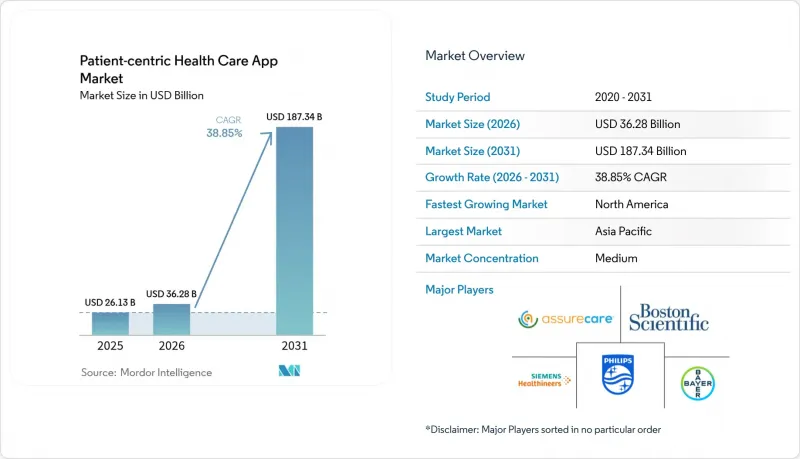
This report is Segmented by Mode of Operation (Phone-Based, Web-Based, and Hybrid Apps), Application (Wellness Management, and More), End User (Patients Self-Use, and More), Delivery Platform (iOS, Android, Cross-Platform/Progressive Web Apps), and Geography (North America, Europe, Asia-Pacific, Middle East & Africa, South America). The Market Forecasts are Provided in Terms of Value (USD).
Global Patient-centric Health Care App Market Trends and Insights
Rising Burden of Chronic Diseases and Aging Population
Non-communicable illnesses now account for 74% of worldwide deaths, prompting public-health authorities to push continuous monitoring outside clinical walls. Data from a 2,883-person trial in China showed that an app-enabled diabetes program lowered fasting glucose by 1.68 mmol/L and HbA1c by 0.45 percentage points, with stronger outcomes among high-adherence users. Novo Nordisk has built commercial alliances around connected-pen technology that transmits dose data directly to coaching apps, aligning pharmaceutical revenue with measurable adherence. Teladoc Health reports that 58% of participants in its diabetes program reach remission-level A1c after one year, while 88% of hypertension users improve or maintain blood pressure, validating digital pathways as complements to pharmacotherapy. As life expectancy lengthens, these results underscore why payers are tilting budgets toward proactive digital engagement.
Technological Advancements in Mobile and Cloud Connectivity
Asia-Pacific added USD 880 billion in mobile-economy value in 2023, buoyed by 5G roll-outs and edge-compute pilots that stream clinical-grade signals in real time. The U.S. Food and Drug Administration cleared OMRON's connected blood-pressure monitor featuring atrial-fibrillation algorithms that achieved 95% sensitivity and 98% specificity in validation studies. Epic Systems pledged to plug 280 million patient records into the government-backed TEFCA network by 2025, opening a national spine for low-latency data exchange. Smartphone-camera application FibriCheck passed FDA review with 98.3% sensitivity for atrial-fibrillation detection, proving that consumer devices can meet Class II medical-device thresholds. Collectively, these milestones reinforce the technology stack that underpins the patient centric healthcare app market.
Lack of Interoperability and Data Standardization
Only six certified IT vendors had committed to extended USCDI+ Cancer data elements by late 2024, underscoring the slow march toward uniform data semantics. The Sequoia Project's roadmap schedules QHIN-to-QHIN FHIR pilots for 2025, meaning that true plug-and-play exchange will remain partial for several budget cycles. Patients still juggle download portals, login credentials, and PDF discharge summaries, complicating the longitudinal views that engagement apps depend on. Until governance bodies enforce common identifiers and version control, fragmentation will temper growth in the patient centric healthcare app market.
Other drivers and restraints analyzed in the detailed report include:
- Growing Acceptance of Digital Health Post-Pandemic
- Transition Toward Value-Based Care and Outcome-Linked Reimbursements
- Clinician Resistance Due to Workflow Integration Challenges
For complete list of drivers and restraints, kindly check the Table Of Contents.
Segment Analysis
Phone-Based programs controlled 45.12% of patient centric healthcare app market share in 2025, benefiting from the global reach of iOS and Android storefronts. Hybrid Apps are on track for a 41.02% CAGR to 2031 as healthcare systems seek code-once-deploy-anywhere economics that sidestep device-fragmentation costs. Cross-compatibility also simplifies privacy updates and security patching, critical in regulated environments. Epic's approach-native mobile front ends that draw decision logic from cloud micro-services-illustrates how hybrid stacks absorb emerging AI modules without rewriting user interfaces. Consequently, developers aligned to hybrid toolchains are positioned to expand faster than single-platform peers inside the patient centric healthcare app market.
The pivot is equally fueled by payer requirements. Health plans increasingly demand multi-channel outreach-short message service, app push, and email-so that members can select their preferred modality. Hybrid frameworks reuse business logic across those messaging pipes, cutting upgrade time. As provider organizations chase value-based bonuses tied to engagement, demand for lower-cost cross-platform builds will support sustained double-digit revenue expansion.
Wellness Management commanded 38.02% of patient centric healthcare app market size in 2025, propelled by weight-loss coaching, sleep tracking, and preventive-care reminders. Regulatory momentum, however, is shifting attention to evidence-based Mental Health & Mindfulness, forecast to surge at 42.11% CAGR through 2031. The FDA cleared Rejoyn for depression and SleepioRx for chronic insomnia, formalizing software-as-therapy pathways. CMS billing codes for digital cognitive-behavioral programs further legitimize reimbursement, encouraging employers to include subscription apps in health benefits packages. Consumer willingness to pay out-of-pocket also expands the total addressable base, especially among Gen Z users for whom asynchronous chat and meditation sessions are comfort zones. These factors combine to keep mental-health use-cases at the vanguard of innovation within the patient centric healthcare app market.
Complete Report Scope:
- By Mode Of Operation
- Phone-Based
- Web-Based
- Hybrid Apps
- By Application
- Wellness Management
- Disease & Treatment Management
- Mental Health & Mindfulness
- Medication Adherence
- Other Applications
- By End User
- Patients (Self-Use)
- Providers / Clinics
- Payers
- Pharma & Med-Tech Sponsors
- By Delivery Platform
- IOS
- Android
- Cross-Platform / Progressive Web Apps
- Geography
- North America
- United States
- Canada
- Mexico
- Europe
- Germany
- United Kingdom
- France
- Italy
- Spain
- Rest of Europe
- Asia-Pacific
- China
- Japan
- India
- Australia
- South Korea
- Rest of Asia-Pacific
- Middle East & Africa
- GCC
- South Africa
- Rest of Middle East & Africa
- South America
- Brazil
- Argentina
- Rest of South America
- North America
Geography Analysis
North America retained 41.78% share in 2025, anchored by TEFCA-driven interoperability rules and the FDA's mature digital-therapeutic frameworks. CMS added Advanced Primary Care Management codes (GPCM1-3) to its 2025 fee schedule, ensuring that remote coaching and biometric monitoring can bill under risk-stratified capitations. Epic's pledge to onboard its customer base to TEFCA by 2025 will extend high-fidelity data feeds to 280 million individual records, making the region a test bed for outcome-based contracts. Nonetheless, clinician resistance in smaller practices and persistent rural broadband gaps temper the region's growth ceiling.
Asia-Pacific is the fastest-growing cluster at a 39.95% CAGR, propelled by mobile-first health-system builds and government mandates that fold digital services into universal-coverage agendas. India's health-tech economy is on track to hit USD 25 billion in 2025, with telemedicine leading transaction counts and AI-driven radiology reads improving throughput at district hospitals. China's inclusion in the WHO-backed Global Initiative on Digital Health accelerates standardization, while operators explore private 5G for hospital campuses to cut latency in remote-surgery pilots. Southeast Asian deal-flow-Halodoc's USD 100 million Series E and Doctor Anywhere's USD 40.8 million raise-signals continued venture appetite, underscoring why multinationals are localizing interfaces into Bahasa and Thai.
Europe registers steady mid-teens expansion under the European Health Data Space program, with Germany leading Class II digital-therapeutic clearances and the United Kingdom embedding AI algorithms in National Health Service triage lines. Harmonized privacy rules expedite cross-border roll-outs, yet adoption remains uneven due to localized reimbursement rules. The Middle East & Africa and South America offer long-run upside as smartphone penetration climbs, but infrastructure and digital-literacy constraints delay revenue realization, positioning them as secondary waves for the patient centric healthcare app market.
- Apple Inc. (CareKit)
- Google LLC (Fit/Health Connect)
- Koninklijke Philips
- Teladoc Health
- Epic Systems Corp. (MyChart)
- Merck
- Pfizer
- Novartis
- Bayer
- Oracle Health (Cerner)
- Athenahealth
- AssureCare LLC (IPatientCare)
- MobileSmith Health
- Mfine
- MyFitnessPal Inc.
- Omada Health
- Babylon Holdings Ltd.
Additional Benefits:
- The market estimate (ME) sheet in Excel format
- 3 months of analyst support
TABLE OF CONTENTS
1 Introduction
- 1.1 Study Assumptions & Market Definition
- 1.2 Scope Of The Study
2 Research Methodology
3 Executive Summary
4 Market Landscape
- 4.1 Market Overview
- 4.2 Market Drivers
- 4.2.1 Rising Burden of Chronic Diseases and Aging Population
- 4.2.2 Technological Advancements in Mobile and Cloud Connectivity
- 4.2.3 Growing Acceptance of Digital Health Post-Pandemic
- 4.2.4 Transition Toward Value-Based Care and Outcome-Linked Reimbursements
- 4.2.5 Increasing Focus on Patient Engagement and Adherence Solutions
- 4.2.6 Strategic Collaborations Between Pharmaceutical and Health-Tech Companies
- 4.3 Market Restraints
- 4.3.1 Lack Of Interoperability and Data Standardization
- 4.3.2 Clinician Resistance Due to Workflow Integration Challenges
- 4.3.3 Evolving Regulatory Framework for Artificial Intelligence and Digital Health
- 4.3.4 Persistent Digital Divide And Limited Access in Low-Resource Settings
- 4.4 Regulatory Landscape
- 4.5 Technological Outlook
- 4.6 Porter's Five Forces Analysis
- 4.6.1 Threat Of New Entrants
- 4.6.2 Bargaining Power Of Buyers
- 4.6.3 Bargaining Power Of Suppliers
- 4.6.4 Threat Of Substitutes
- 4.6.5 Intensity Of Competitive Rivalry
5 Market Size & Growth Forecasts (Value, USD)
- 5.1 By Mode Of Operation
- 5.1.1 Phone-Based
- 5.1.2 Web-Based
- 5.1.3 Hybrid Apps
- 5.2 By Application
- 5.2.1 Wellness Management
- 5.2.2 Disease & Treatment Management
- 5.2.3 Mental Health & Mindfulness
- 5.2.4 Medication Adherence
- 5.2.5 Other Applications
- 5.3 By End User
- 5.3.1 Patients (Self-Use)
- 5.3.2 Providers / Clinics
- 5.3.3 Payers
- 5.3.4 Pharma & Med-Tech Sponsors
- 5.4 By Delivery Platform
- 5.4.1 IOS
- 5.4.2 Android
- 5.4.3 Cross-Platform / Progressive Web Apps
- 5.5 Geography
- 5.5.1 North America
- 5.5.1.1 United States
- 5.5.1.2 Canada
- 5.5.1.3 Mexico
- 5.5.2 Europe
- 5.5.2.1 Germany
- 5.5.2.2 United Kingdom
- 5.5.2.3 France
- 5.5.2.4 Italy
- 5.5.2.5 Spain
- 5.5.2.6 Rest of Europe
- 5.5.3 Asia-Pacific
- 5.5.3.1 China
- 5.5.3.2 Japan
- 5.5.3.3 India
- 5.5.3.4 Australia
- 5.5.3.5 South Korea
- 5.5.3.6 Rest of Asia-Pacific
- 5.5.4 Middle East & Africa
- 5.5.4.1 GCC
- 5.5.4.2 South Africa
- 5.5.4.3 Rest of Middle East & Africa
- 5.5.5 South America
- 5.5.5.1 Brazil
- 5.5.5.2 Argentina
- 5.5.5.3 Rest of South America
- 5.5.1 North America
6 Competitive Landscape
- 6.1 Market Concentration
- 6.2 Market Share Analysis
- 6.3 Company Profiles (Includes Global Level Overview, Market Level Overview, Core Segments, Financials As Available, Strategic Information, Market Rank/Share, Products & Services, Recent Developments)
- 6.3.1 Apple Inc. (CareKit)
- 6.3.2 Google LLC (Fit/Health Connect)
- 6.3.3 Koninklijke Philips N.V.
- 6.3.4 Teladoc Health Inc.
- 6.3.5 Epic Systems Corp. (MyChart)
- 6.3.6 Merck & Co. Inc.
- 6.3.7 Pfizer Inc.
- 6.3.8 Novartis AG
- 6.3.9 Bayer AG
- 6.3.10 Oracle Health (Cerner)
- 6.3.11 Athenahealth Inc.
- 6.3.12 AssureCare LLC (IPatientCare)
- 6.3.13 MobileSmith Health
- 6.3.14 Mfine Pvt. Ltd
- 6.3.15 MyFitnessPal Inc.
- 6.3.16 Omada Health Inc.
- 6.3.17 Babylon Holdings Ltd.
7 Market Opportunities & Future Outlook
- 7.1 White-Space & Unmet-Need Assessment

