PUBLISHER: Mordor Intelligence | PRODUCT CODE: 2123795

PUBLISHER: Mordor Intelligence | PRODUCT CODE: 2123795
Compound Management - Market Share Analysis, Industry Trends & Statistics, Growth Forecasts (2026 - 2031)
According to Mordor Intelligence, the compound management market size is projected to be USD 0.47 billion in 2025, USD 0.54 billion in 2026, and reach USD 1.08 billion by 2031, growing at a CAGR of 14.87% from 2026 to 2031.
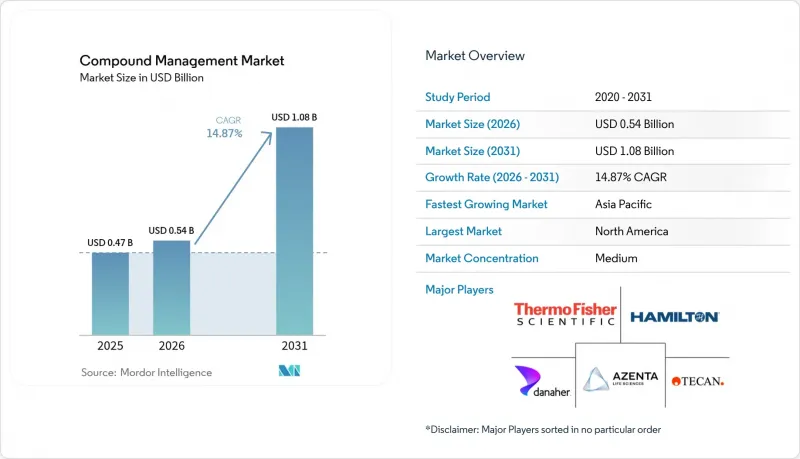
This report is Segmented by Type (Products [Automated Compound/Sample Storage Systems, and More], Services), Sample Type (Chemical Compounds, Biosamples), Application (Drug Discovery, Gene Synthesis, and More), End User (Pharmaceutical Companies, and More), and Geography (North America, Europe, Asia Pacific, Middle East & Africa, South America). The Market Forecasts are Provided in Terms of Value (USD).
Global Compound Management Market Trends and Insights
Expanding AI-Enabled High-Content Screening Platforms
Advanced imaging systems that embed machine-learning models now cut hit-to-lead timelines by up to 40%, fueling demand for robotic freezers that can deliver 384-well plates within minutes. Molecular Devices' ImageXpress HCS.ai, introduced in 2024, enabled an oncology screen of 1.2 million compounds in six weeks. ZEISS followed with the arivis Cloud in 2025, linking 3-D analytics to compound databases via RESTful APIs for real-time structure-activity insights. Open-source pipelines such as PhenoProfiler validate AI triage by predicting bioactivity with 82% accuracy, halving reagent consumption. Start-ups like Automata integrate schedulers that reduce manual transfers by 70%. Together these advances redirect spending from static storage toward integrated discovery suites.
Surging Biologics & Cell-/Gene-Therapy Pipelines
The American Society of Gene and Cell Therapy counted 4,418 active programs in Q1 2025, up 12% year on year. Cryogenic precision is critical: WuXi Biologics added three automated vial-thaw suites in 2024 to curb contamination during master-cell-bank expansion. Evotec's EUR 15 million partnership with Halozyme targets high-concentration biologics that demand inert storage conditions. Novartis collaborates with Isomorphic Labs to rapidly archive thousands of AI-designed antibody sequences. Rising construct volumes therefore elevate the need for scalable, barcode-driven compound management market solutions.
High CapEx for -80°C & LN2 Automated Stores
Fully robotic cryogenic systems cost USD 1.5-3 million each, a hurdle for CROs with revenue below USD 50 million. Azenta's BioStore III lists near USD 2.5 million before validation, while Brooks' legacy SampleStore demands clean-room retrofits adding 30-40% to project totals. Six-tank LN2 arrays can push redundancy budgets beyond USD 2 million. Lease-to-own models from Heraeus offer relief yet struggle for uptake because sponsors want ownership over IP-sensitive libraries. Capital intensity therefore concentrates demand among cash-rich enterprises.
Other drivers and restraints analyzed in the detailed report include:
- Outsourcing of Sample Libraries to Specialized Biorepositories
- Cold-Chain Automation Mandates in Regulated Markets
- Data-Integrity & Cybersecurity Exposure of Cloud LIMS
For complete list of drivers and restraints, kindly check the Table Of Contents.
Segment Analysis
Products delivered 58.55% of 2025 revenue, anchored by robotic freezers, liquid handlers, and inventory scanners. However, services will outpace hardware with a 16.25% CAGR through 2031 as CROs absorb stewardship duties that once resided in-house. Automated storage systems-typified by Tecan's Fluent and Hamilton's Microlab STAR-reduce manual errors 95%, sustaining demand even while commoditization narrows margins. Sponsors refocus capital on AI analytics, letting external biorepositories finance cold-chain infrastructure.
Sample-archiving contracts convert fixed depreciation into variable fees and guarantee four-hour fulfillment. BioAscent's Edinburgh upgrade added 12 million vial slots, while Syngene's Bangalore facility undercuts U.S. pricing by 40%. Such models expand the compound management market size for services even as hardware sales plateau.
Chemical compounds held 52.53% in 2025, yet biosamples will climb at 17.75% CAGR as cell and gene therapies proliferate. Each investigational product spawns thousands of cryovials that must remain at -80°C or in LN2 with chain-of-custody metadata. WuXi Biologics added automated vial-thaw suites that cut contamination in master-cell banks. Enzymatic gene-synthesis start-ups also swell demand for plasmid storage.
Virtual catalogs such as Enamine's REAL reduce physical small-molecule footprints, slowing chemical growth. Conversely, population cohorts and rare-disease registries extend biosample retention horizons to 50 years, elevating freezer capacity planning across the compound management industry.
Complete Report Scope:
- By Type
- Products
- Automated Compound/Sample Storage Systems
- Automated Liquid-Handling Systems
- Other Storage/Handling Systems
- Services
- Products
- By Sample Type
- Chemical Compounds
- Biosamples
- By Application
- Drug Discovery
- Gene Synthesis
- Biobanking
- Other Applications
- By End User
- Pharmaceutical Companies
- Biopharmaceutical Companies
- Contract Research Organisations
- Academic & Government Institutes
- By Geography
- North America
- United States
- Canada
- Mexico
- Europe
- Germany
- United Kingdom
- France
- Italy
- Spain
- Rest of Europe
- Asia-Pacific
- China
- India
- Japan
- Australia
- South Korea
- Rest of Asia-Pacific
- Middle East and Africa
- GCC
- South Africa
- Rest of Middle East and Africa
- South America
- Brazil
- Argentina
- Rest of South America
- North America
Geography Analysis
North America led with 38.23% of 2025 revenue, propelled by FDA guidance that mandates real-time temperature alerts and by deep venture funding for lab-automation start-ups such as Automata. Large players like Thermo Fisher, which bought Olink for USD 3.1 billion in 2024, integrate spatial-biology assays with storage workflows, reinforcing the region's dominance. Canada and Mexico grow as satellite CRO hubs; BioAscent plans a 5 million-vial Toronto site by 2027.
Europe benefits from a unified Annex 11 framework effective June 2025, spurring multi-country biorepository networks. Evotec and Lonza illustrate regional momentum, the latter posting a 12% emission reduction after freezer upgrades. Germany, the UK, and France remain flagship markets, while Switzerland and the Nordics specialize in gene synthesis and precision biobanking.
Asia-Pacific will record the fastest 16.42% CAGR through 2031. Chinese CDMOs like WuXi AppTec reported USD 3.89 billion revenue in 2024 and are deploying automated vial-thaw suites to serve global sponsors. India's Syngene offers FDA-compliant storage at 40% lower cost, attracting multinational trials. Yokogawa's RAPID-Lab system aligns with Japan's legacy ERP frameworks, easing adoption. Emerging clusters in Singapore and Taiwan court investment with modular automation and favorable regulation.
The Middle East, Africa, and South America together represent a smaller but rising share. Brazil's National Cancer Institute modernized its biobank in 2024, and South Africa's CSIR opened a gene-synthesis unit in 2025. Supply-chain fragility and skills shortages limit near-term growth yet create long-run catch-up potential.
- Abcam Compound Libraries
- AXXAM S.p.A.
- Azenta
- Beckman Coulter Life Sciences
- BioAscent
- Biosero
- Brooks Automation (SampleStore)
- Evotec
- FluidX (Azenta)
- Hamilton Company
- Heraeus CryoPac
- HighRes Biosolutions
- Inheco GmbH
- LiCONiC
- NEXUS Cryogenic Solutions
- SPT Labtech
- Tecan Group
- Thermo Fisher Scientific
- Titian Software
- WuXi App Tec
- Yokogawa RAPID-Lab
- Ziath
Additional Benefits:
- The market estimate (ME) sheet in Excel format
- 3 months of analyst support
TABLE OF CONTENTS
1 Introduction
- 1.1 Study Assumptions & Market Definition
- 1.2 Scope of the Study
2 Research Methodology
3 Executive Summary
4 Market Landscape
- 4.1 Market Overview
- 4.2 Market Drivers
- 4.2.1 Expanding AI-enabled high-content screening platforms
- 4.2.2 Surging biologics & cell-/gene-therapy pipelines
- 4.2.3 Outsourcing of sample libraries to specialised biorepositories
- 4.2.4 Cold-chain automation mandates in regulated markets
- 4.2.5 Venture-capital inflows into robotic life-science infrastructure
- 4.2.6 ESG-driven de-carbonised laboratory operations
- 4.3 Market Restraints
- 4.3.1 High CapEx for -80 °C & LN2 automated stores
- 4.3.2 Data-integrity & cyber-security exposure of cloud LIMS
- 4.3.3 Shortage of compound-management skillsets in emerging hubs
- 4.3.4 Volatile supply of lab-grade CO2/N2 for cryostorage
- 4.4 Regulatory Landscape
- 4.5 Technological Outlook
- 4.6 Porter's Five Forces
- 4.6.1 Threat of New Entrants
- 4.6.2 Bargaining Power of Buyers
- 4.6.3 Bargaining Power of Suppliers
- 4.6.4 Threat of Substitutes
- 4.6.5 Intensity of Competitive Rivalry
5 Market Size & Growth Forecasts (Value, USD)
- 5.1 By Type
- 5.1.1 Products
- 5.1.1.1 Automated Compound/Sample Storage Systems
- 5.1.1.2 Automated Liquid-Handling Systems
- 5.1.1.3 Other Storage/Handling Systems
- 5.1.2 Services
- 5.1.1 Products
- 5.2 By Sample Type
- 5.2.1 Chemical Compounds
- 5.2.2 Biosamples
- 5.3 By Application
- 5.3.1 Drug Discovery
- 5.3.2 Gene Synthesis
- 5.3.3 Biobanking
- 5.3.4 Other Applications
- 5.4 By End User
- 5.4.1 Pharmaceutical Companies
- 5.4.2 Biopharmaceutical Companies
- 5.4.3 Contract Research Organisations
- 5.4.4 Academic & Government Institutes
- 5.5 By Geography
- 5.5.1 North America
- 5.5.1.1 United States
- 5.5.1.2 Canada
- 5.5.1.3 Mexico
- 5.5.2 Europe
- 5.5.2.1 Germany
- 5.5.2.2 United Kingdom
- 5.5.2.3 France
- 5.5.2.4 Italy
- 5.5.2.5 Spain
- 5.5.2.6 Rest of Europe
- 5.5.3 Asia-Pacific
- 5.5.3.1 China
- 5.5.3.2 India
- 5.5.3.3 Japan
- 5.5.3.4 Australia
- 5.5.3.5 South Korea
- 5.5.3.6 Rest of Asia-Pacific
- 5.5.4 Middle East and Africa
- 5.5.4.1 GCC
- 5.5.4.2 South Africa
- 5.5.4.3 Rest of Middle East and Africa
- 5.5.5 South America
- 5.5.5.1 Brazil
- 5.5.5.2 Argentina
- 5.5.5.3 Rest of South America
- 5.5.1 North America
6 Competitive Landscape
- 6.1 Market Concentration
- 6.2 Market Share Analysis
- 6.3 Company Profiles (includes Global-level Overview, Market-level Overview, Core Segments, Financials as available, Strategic Information, Market Rank/Share for key companies, Products & Services, and Recent Developments)
- 6.3.1 Abcam Compound Libraries
- 6.3.2 AXXAM S.p.A.
- 6.3.3 Azenta Life Sciences
- 6.3.4 Beckman Coulter Life Sciences
- 6.3.5 BioAscent
- 6.3.6 Biosero
- 6.3.7 Brooks Automation (SampleStore)
- 6.3.8 Evotec SE
- 6.3.9 FluidX (Azenta)
- 6.3.10 Hamilton Company
- 6.3.11 Heraeus CryoPac
- 6.3.12 HighRes Biosolutions
- 6.3.13 Inheco GmbH
- 6.3.14 LiCONiC AG
- 6.3.15 NEXUS Cryogenic Solutions
- 6.3.16 SPT Labtech
- 6.3.17 Tecan Trading AG
- 6.3.18 Thermo Fisher Scientific
- 6.3.19 Titian Software
- 6.3.20 WuXi AppTec
- 6.3.21 Yokogawa RAPID-Lab
- 6.3.22 Ziath
7 Market Opportunities & Future Outlook
- 7.1 White-space & Unmet-need Assessment

