PUBLISHER: Mordor Intelligence | PRODUCT CODE: 2123985

PUBLISHER: Mordor Intelligence | PRODUCT CODE: 2123985
Bio-based Polypropylene - Market Share Analysis, Industry Trends & Statistics, Growth Forecasts (2026 - 2031)
According to Mordor Intelligence, the bio-based polypropylene market size was valued at 34.84 kilotons in 2025 and is estimated to grow from 42.21 kilotons in 2026 to reach 110.21 kilotons by 2031, at a CAGR of 21.16% during the forecast period (2026-2031).
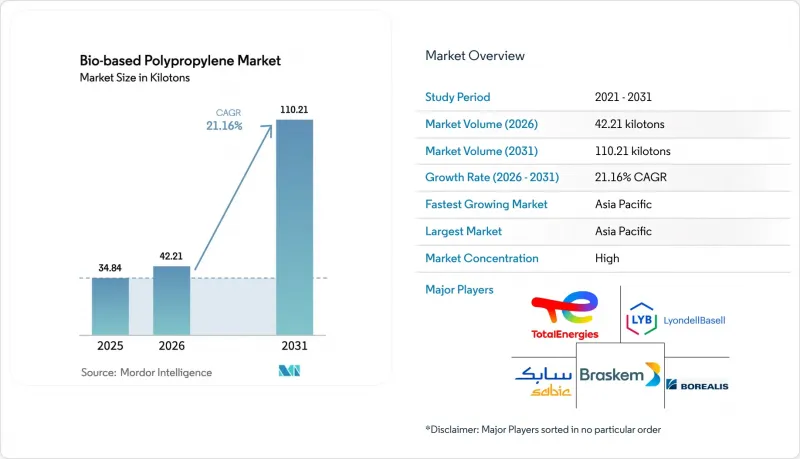
This report is Segmented by Feedstock (Sugarcane, Corn, Cellulosic Biomass, and More), Product Type (Homopolymer, and More), Application (Injection Molding, Films, and More), End-User Industry (Packaging, Automotive, Consumer Goods, and More), and Geography (Asia-Pacific, North America, Europe, South America, and Middle-East and Africa). The Market Forecasts are Provided in Terms of Volume (tons).
Global Bio-based Polypropylene Market Trends and Insights
European Union Strict Packaging Recycled-Content Mandates Spur Rigid Bio-PP Demand
The Packaging and Packaging Waste Regulation that came into force in February 2025 obligates all plastic packaging sold in the bloc to achieve 30% recycled content by 2030 and 50%-65% by 2040. A carve-out enables bio-based feedstock to count toward these thresholds until viable food-grade recycling technology is commercialized, a clause that the Commission will review by February 2028. Rigid polypropylene tubs, caps, and crates, therefore, gain a regulatory "insurance policy," prompting retailers to line up mass-balance-certified supply ahead of enforcement. The Regulation simultaneously bans PFAS in food-contact formats, nudging grease-resistant use-cases formerly dominated by fluorinated coatings toward bio-attributed polypropylene grades. Multinationals are thus front-loading procurement contracts to hedge against compliance risk.
Automotive OEM Lightweighting and Net-Zero Commitments
BMW targets 40% recycled content in thermoplastics by 2030 and is piloting bio-based polypropylene door panels and instrument clusters that slot into extant molds without requalification. Volvo plans 30% recycled plastics across its fleet by 2030, assigning renewable polypropylene to interior trim parts to preserve crash-worthiness. Ford received a USD 2.5 million US DOE grant to advance CO2-to-polyol chemistry that could dovetail with bio-attributed propylene derivatives. Borealis counters with Bornewables compounds that deliver up to 100% renewable content via ISCC Plus allocation, while Lignin Industries' Renol nucleating agent trims part weight by 10% and cycle time by 30% in injection-molded copolymers.
Production Cost Premium vs. Fossil PP
Bio-based polypropylene trades at a 20%-50% premium because feedstock logistics, hydro-processing, and small-scale dehydration units add fixed costs that legacy naphtha crackers amortized decades ago. Neste's Singapore complex produces 1.3 million t/y renewable hydrocarbons from waste cooking oil, yet collection and pre-treatment inflate delivered cost relative to fossil naphtha. LyondellBasell passes these differentials through its Circulen Plus line, limiting penetration to customers who can book carbon savings against corporate targets. Cellulosic pathways require enzymatic hydrolysis and multi-step catalysis, pushing capex 40% above first-generation sugarcane ethanol. Consequently, bio-attributed grades concentrate in high-value applications where sustainability differentiation outweighs margin erosion.
Other drivers and restraints analyzed in the detailed report include:
- Global FMCG Shift to Mono-PP Flexible Films
- Rapid Growth of 3-D Printing in Medical Prototyping (Bio-PP Filaments)
- Lower Heat-Deflection Temperature Limits Under-Hood Use
For complete list of drivers and restraints, kindly check the Table Of Contents.
Segment Analysis
Sugarcane accounted for 61.17% of the bio-based polypropylene market in 2025, owing to Brazil's mature ethanol chain, but cellulosic inputs are forecast to register a 25.21% CAGR as enzyme economics improve. Sugarcane mills supply monohydrate ethanol that is dehydrated to ethylene and oligomerized to propylene in Europe under ISCC Plus allocation. The bio-based polypropylene market size derived from sugarcane is therefore expected to rise steadily, yet its overall proportional share will erode as agricultural residues scale.
Cellulosic residues such as corn stover, wheat straw, and bagasse lower indirect land-use change risk and qualify for additional sustainability credits, positioning them to capture incremental volume in North America and China. LanzaTech blends gas-fermentation ethanol with catalytic upgrading, while Neste processes waste oils and fats that bypass fermentation altogether. Feedstock diversification de-risks supply shocks and stabilizes the bio-based polypropylene market, yet long-haul transport of low-density residues still taxes delivered cost outside integrated agro-industrial hubs.
Homopolymers held a 57.89% share of the bio-based polypropylene market size in 2025, favored for rigid containers and closures requiring stiffness and clarity. Impact copolymers are expected to grow at a 23.78% CAGR through 2031 because automotive door panels, glove boxes, and side-claddings demand high toughness at sub-zero temperatures. The bio-based polypropylene market share attributed to impact copolymers will thus widen as OEMs integrate Scope 3 metrics in design briefs.
Random copolymers trail owing to head-to-head competition with polyethylene in films, yet FMCG brand owners are shifting confectionery wrappers to mono-polypropylene structures, which could resurrect demand. Borealis, SABIC, and LyondellBasell have launched random-copolymer grades with tailored seal-initiation temperatures that align with high-speed horizontal form-fill-seal equipment. Medical-device housings now specify random-copolymer bio-based polypropylene to pair clarity with autoclave resistance, a niche that commands price premiums sufficient to absorb feedstock surcharges.
Complete Report Scope:
- By Feedstock
- Sugarcane
- Corn
- Cellulosic Biomass
- Waste Cooking Oil and Used Oils
- Others (Algae, Lignin, etc.)
- By Product Type
- Homopolymer
- Random Copolymer
- Impact Copolymer
- By Application
- Injection Molding
- Films
- Textiles
- Other Applications (Foams, Blow Molding, Extrusion Coating)
- By End-user Industry
- Packaging
- Automotive
- Consumer Goods
- Textile
- Medical and Healthcare
- Other End-user Industries (Electronics, Building and Construction, Agriculture)
- By Geography
- Asia-Pacific
- China
- India
- Japan
- South Korea
- ASEAN Countries
- Rest of Asia-Pacific
- North America
- United States
- Canada
- Mexico
- Europe
- Germany
- United Kingdom
- France
- Italy
- Rest of Europe
- South America
- Brazil
- Argentina
- Rest of South America
- Middle-East and Africa
- Saudi Arabia
- South Africa
- Rest of Middle-East and Africa
- Asia-Pacific
Geography Analysis
Asia-Pacific contributed 41.28% of the global bio-based polypropylene market volume in 2025 and is forecast to climb at a 24.71% CAGR to 2031. China's 14th Five-Year Plan earmarks bio-based materials as a strategic pillar, while India's single-use plastic ban seeds domestic demand for renewable polymers. Japan's Green Innovation Fund and South Korea's K-Circular Economy Plan inject grant capital across pilot plants, expanding regional feedstock diversity.
Europe remains the compliance bellwether. The Packaging and Packaging Waste Regulation codifies 30% recycled content by 2030 but explicitly allows bio-based substitution, ensuring continued import demand for ISCC-Plus grades. North America benefits from the Inflation Reduction Act and Clean Fuel Regulations, underwriting automotive trials and cradle-to-gate carbon tracking. South America leverages Brazil's sugarcane-ethanol backbone yet lacks the demand breadth seen in Asia. The Middle East and Africa add incremental supply but confront certification barriers that impede entry into premium import markets.
- Avient Corporation
- Borealis GmbH
- Braskem
- Danimer Scientific
- FKuR
- Global Bioenergies
- Impact Recycling
- LanzaTech
- LyondellBasell Industries Holdings B.V.
- Mitsui Chemicals, Inc.
- Neste
- Reliance Industries Limited
- SABIC
- Solvay
- TotalEnergies
- Toyota Tsusho Corporation
- Trifilon AB
Additional Benefits:
- The market estimate (ME) sheet in Excel format
- 3 months of analyst support
TABLE OF CONTENTS
1 Introduction
- 1.1 Study Assumptions and Market Definition
- 1.2 Scope of the Study
2 Research Methodology
3 Executive Summary
4 Market Landscape
- 4.1 Market Overview
- 4.2 Market Drivers
- 4.2.1 European Union strict packaging recycled-content mandates spur rigid bio-PP demand
- 4.2.2 Automotive OEM lightweighting and net-zero commitments
- 4.2.3 Global FMCG shift to mono-PP flexible films
- 4.2.4 Rapid growth of 3-D printing in medical prototyping (bio-PP filaments)
- 4.2.5 Shipping-industry move toward ISCC-Plus mass-balance pallets
- 4.3 Market Restraints
- 4.3.1 Production cost premium vs. fossil PP
- 4.3.2 Lower heat-deflection temperature limits under-hood use
- 4.3.3 Lack of unified biomass-balance certification in Middle-East and North Africa
- 4.4 Value Chain Analysis
- 4.5 Regulatory Outlook
- 4.6 Porter's Five Forces
- 4.6.1 Bargaining Power of Suppliers
- 4.6.2 Bargaining Power of Buyers
- 4.6.3 Threat of New Entrants
- 4.6.4 Threat of Substitutes
- 4.6.5 Degree of Competition
5 Market Size and Growth Forecasts (Volume)
- 5.1 By Feedstock
- 5.1.1 Sugarcane
- 5.1.2 Corn
- 5.1.3 Cellulosic Biomass
- 5.1.4 Waste Cooking Oil and Used Oils
- 5.1.5 Others (Algae, Lignin, etc.)
- 5.2 By Product Type
- 5.2.1 Homopolymer
- 5.2.2 Random Copolymer
- 5.2.3 Impact Copolymer
- 5.3 By Application
- 5.3.1 Injection Molding
- 5.3.2 Films
- 5.3.3 Textiles
- 5.3.4 Other Applications (Foams, Blow Molding, Extrusion Coating)
- 5.4 By End-user Industry
- 5.4.1 Packaging
- 5.4.2 Automotive
- 5.4.3 Consumer Goods
- 5.4.4 Textile
- 5.4.5 Medical and Healthcare
- 5.4.6 Other End-user Industries (Electronics, Building and Construction, Agriculture)
- 5.5 By Geography
- 5.5.1 Asia-Pacific
- 5.5.1.1 China
- 5.5.1.2 India
- 5.5.1.3 Japan
- 5.5.1.4 South Korea
- 5.5.1.5 ASEAN Countries
- 5.5.1.6 Rest of Asia-Pacific
- 5.5.2 North America
- 5.5.2.1 United States
- 5.5.2.2 Canada
- 5.5.2.3 Mexico
- 5.5.3 Europe
- 5.5.3.1 Germany
- 5.5.3.2 United Kingdom
- 5.5.3.3 France
- 5.5.3.4 Italy
- 5.5.3.5 Rest of Europe
- 5.5.4 South America
- 5.5.4.1 Brazil
- 5.5.4.2 Argentina
- 5.5.4.3 Rest of South America
- 5.5.5 Middle-East and Africa
- 5.5.5.1 Saudi Arabia
- 5.5.5.2 South Africa
- 5.5.5.3 Rest of Middle-East and Africa
- 5.5.1 Asia-Pacific
6 Competitive Landscape
- 6.1 Market Concentration
- 6.2 Strategic Moves
- 6.3 Market Share (%)/Ranking Analysis
- 6.4 Company Profiles (includes Global-level Overview, Market-level Overview, Core Segments, Financials as available, Strategic Information, Products and Services, and Recent Developments)
- 6.4.1 Avient Corporation
- 6.4.2 Borealis GmbH
- 6.4.3 Braskem
- 6.4.4 Danimer Scientific
- 6.4.5 FKuR
- 6.4.6 Global Bioenergies
- 6.4.7 Impact Recycling
- 6.4.8 LanzaTech
- 6.4.9 LyondellBasell Industries Holdings B.V.
- 6.4.10 Mitsui Chemicals, Inc.
- 6.4.11 Neste
- 6.4.12 Reliance Industries Limited
- 6.4.13 SABIC
- 6.4.14 Solvay
- 6.4.15 TotalEnergies
- 6.4.16 Toyota Tsusho Corporation
- 6.4.17 Trifilon AB
7 Market Opportunities and Future Outlook
- 7.1 White-space and Unmet-Need Assessment
- 7.2 Increasing Demand for Sustainable Agricultural Practices

