PUBLISHER: Mordor Intelligence | PRODUCT CODE: 2123986

PUBLISHER: Mordor Intelligence | PRODUCT CODE: 2123986
Urinalysis - Market Share Analysis, Industry Trends & Statistics, Growth Forecasts (2026 - 2031)
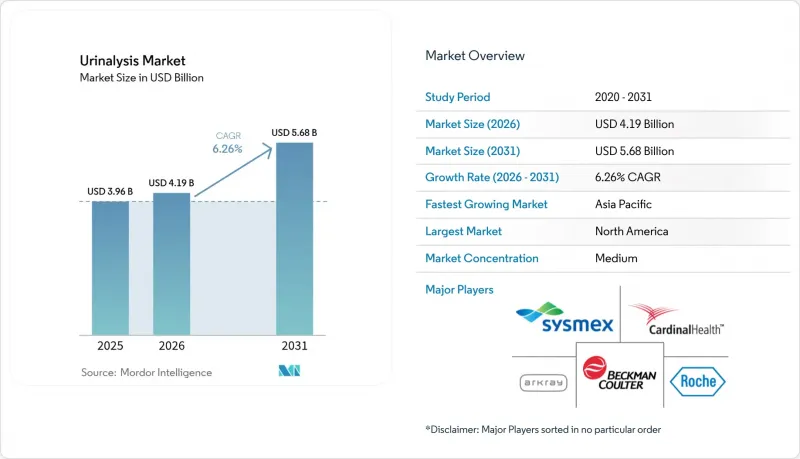
According to Mordor Intelligence, the urinalysis market size was valued at USD 3.96 billion in 2025 and is estimated to grow from USD 4.19 billion in 2026 to reach USD 5.68 billion by 2031, at a CAGR of 6.26% during the forecast period (2026-2031).
This report is Segmented by Product (Consumables, Instruments [Automated Analyzers, Semi-Automated Analyzers], Point-Of-Care Devices), Test Type (Biochemical Urinalysis, Sediment Analysis, Pregnancy & Fertility Testing, and More), End User (Hospitals, and More), and Geography (North America, Europe, Asia-Pacific, Middle East & Africa, South America). The Market Forecasts are Provided in Terms of Value (USD).
Global Urinalysis Market Trends and Insights
Rising Prevalence of Chronic Kidney Diseases
Worldwide, an estimated 788 million people live with CKD, and 14% of U.S. adults carried a diagnosis in 2024. Quarterly or semi-annual urine screening for proteinuria and hematuria has therefore become standard for diabetics and hypertensives. Hospitals and diagnostic chains rely on analyzers that process 240-480 samples per hour, reducing labor costs and enabling same-day clinical intervention. Rapid hub-and-spoke expansion in India's tier-2 and tier-3 cities channels additional volumes to centralized labs. Recurring reagent revenue rises with every mandated follow-up but faces reimbursement caps when public insurers fix per-test fees.
Growing Diabetic Population Necessitating Routine Urine Testing
The International Diabetes Federation counted 537 million adults with diabetes in 2024 and expects the figure to top 640 million by 2030. Urinalysis detects microalbuminuria early in diabetic nephropathy and monitors glycosuria in uncontrolled patients. Public insurers favor preventive testing to avoid late-stage complications, yet India's Ayushman Bharat program under-reimburses private hospitals, prompting a shift toward lower-cost pharmacy and home testing. Vendors pairing glucose and albumin strips with Bluetooth readers have secured contracts in community health centers across South Asia and the Middle East.
Reimbursement Gaps Across Emerging Markets
Public insurance programs often reimburse below the cost of reagents, discouraging private investment. Only 13% of private hospitals in a 2025 Maharashtra survey accepted Ayushman Bharat rates, pushing patients toward public facilities or cash payments. WHO noted that low- and middle-income countries spend less than 5% of their health budgets on diagnostics. Suppliers pivot to low-cost strips, but margins remain tight and distribution fragmented.
Other drivers and restraints analyzed in the detailed report include:
- Shift Toward Automated, High-Throughput Platforms
- Integration of AI-Powered Image Analysis for Sediment Examination
- Shortage of Skilled Laboratory Technicians
For complete list of drivers and restraints, kindly check the Table Of Contents.
Segment Analysis
Consumables generated 49.82% of urinalysis market revenue in 2025, underscoring the lock-in created by proprietary reagent strips calibrated for specific analyzers. Automated analyzers split into fully automatic workcells serving core laboratories and semi-automatic benchtop units addressing 60-240 daily tests. The urinalysis market for consumables is projected to grow steadily, even as pricing pressure from centralized procurement compresses per-test margins. Hospitals in China paid an average of RMB 53,300 (USD 7,400) for fully automatic analyzers during 2024 tenders, favoring domestic brands that bundled reagents and service contracts.
Point-of-care devices grow at a 7.06% CAGR through 2031 as pharmacies and home-health programs adopt smartphone-linked readers and microfluidic cartridges. Instruments segment revenue benefits from capital purchases of CLINITEK Novus and DxU Iris platforms, which integrate strip analysis with digital microscopy and AI particle recognition. Semi-automated analyzers remain relevant in tier-2 hospitals across India and Latin America, where budgets are tight. Veterinary clinics and companion-animal hospitals are a niche but expanding outlet, adding incremental demand for consumables as pet ownership rises.
Complete Report Scope:
- By Product
- Consumables (Reagents & Strips)
- Instruments
- Automated Analyzers
- Semi-Automated Analyzers
- Point-of-Care Devices
- By Test Type
- Biochemical Urinalysis
- Sediment Analysis
- Pregnancy & Fertility Testing
- Drug-of-Abuse Testing
- Infectious Disease Detection
- By End User
- Hospitals
- Diagnostic Laboratories
- Home-Care Settings
- Academic & Research Institutes
- Veterinary Clinics
- By Geography
- North America
- United States
- Canada
- Mexico
- Europe
- Germany
- United Kingdom
- France
- Italy
- Spain
- Rest of Europe
- Asia-Pacific
- China
- Japan
- India
- Australia
- South Korea
- Rest of Asia-Pacific
- Middle East & Africa
- GCC
- South Africa
- Rest of Middle East & Africa
- South America
- Brazil
- Argentina
- Rest of South America
- North America
Geography Analysis
North America accounted for 36.78% of the urinalysis market share in 2025, owing to established reimbursement pathways and early uptake of AI sediment platforms. The FDA's 2024 cybersecurity guidance clarified 510(k) routes, speeding commercial launches. Workforce shortages drive hospitals to automate, aligning with capital spend on high-throughput analyzers. Canada invests through provincial screening initiatives, whereas Mexico increases private-sector laboratory chains focused on diabetes monitoring. Reimbursement cuts temper revenue, but rising preventive-health volumes partly offset price erosion.
Asia-Pacific is the fastest-growing region, with a 9.28% CAGR projected for 2026-2031. China's centralized tenders shifted volumes toward domestically produced analyzers from Youlite, Dirui, and Mindray, whose integrated reagent offers secured 73.61% of 2024 contract value. Japan maintains a mature market with 11% of Eiken Chemical's 2023 revenue from urinalysis strips, and the 2024 MoH guidebook supports software-as-a-medical-device reimbursement. Australia and South Korea are quickly adopting connected home devices due to their robust telemedicine infrastructure.
Europe holds a significant stake thanks to universal coverage and the enforcement of ISO 15189. Germany and the United Kingdom lead automated-analyzer uptake, while GDPR raises compliance hurdles for cloud-connected devices. Eastern European hospitals modernize under EU health-fund grants, yet constrained budgets limit premium analyzer penetration. Latin America and the Middle East & Africa contribute smaller portions but register steady growth as private hospitals expand diagnostics capacity, although currency volatility and fragmented reimbursement pose ongoing risks.
- Abbott Laboratories
- Acon Laboratories
- Arkray
- Bio-Rad Laboratories
- Beckton Dickinson
- Cardinal Health
- Danaher
- DIRUI Industrial Co., Ltd.
- EKF Diagnostics Holdings plc
- Roche
- HORIBA
- IDEXX
- Medica Corporation
- Mindray Bio-Medical Electronics Co., Ltd.
- QuidelOrtho
- Shenzhen Mindel Medical Co., Ltd.
- Siemens Healthineers
- Sysmex
- Thermo Fisher Scientific
- Trinity Biotech plc
Additional Benefits:
- The market estimate (ME) sheet in Excel format
- 3 months of analyst support
TABLE OF CONTENTS
1 Introduction
- 1.1 Study Assumptions & Market Definition
- 1.2 Scope of the Study
2 Research Methodology
3 Executive Summary
4 Market Landscape
- 4.1 Market Overview
- 4.2 Market Drivers
- 4.2.1 Rising Prevalence of Chronic Kidney Diseases
- 4.2.2 Growing Diabetic Population Necessitating Routine Urine Testing
- 4.2.3 Shift Toward Automated, High-Throughput Urinalysis Platforms
- 4.2.4 Integration of AI-Powered Image Analysis for Sediment Examination
- 4.2.5 Expansion of Self-Testing & Tele-Urinalysis Kits
- 4.2.6 Increasing Adoption of Urinary Biomarkers for Oncology Screening
- 4.3 Market Restraints
- 4.3.1 Reimbursement Gaps Across Emerging Markets
- 4.3.2 Shortage of Skilled Laboratory Technicians
- 4.3.3 Data-Privacy Concerns in At-Home Connected Devices
- 4.3.4 Supply-Chain Vulnerability in Reagent-Grade Chemicals
- 4.4 Regulatory Landscape
- 4.5 Technological Outlook
- 4.6 Porter's Five Forces Analysis
- 4.6.1 Threat of New Entrants
- 4.6.2 Bargaining Power of Buyers
- 4.6.3 Bargaining Power of Suppliers
- 4.6.4 Threat of Substitute Products
- 4.6.5 Intensity of Competitive Rivalry
5 Market Size & Growth Forecasts
- 5.1 By Product
- 5.1.1 Consumables (Reagents & Strips)
- 5.1.2 Instruments
- 5.1.2.1 Automated Analyzers
- 5.1.2.2 Semi-Automated Analyzers
- 5.1.3 Point-of-Care Devices
- 5.2 By Test Type
- 5.2.1 Biochemical Urinalysis
- 5.2.2 Sediment Analysis
- 5.2.3 Pregnancy & Fertility Testing
- 5.2.4 Drug-of-Abuse Testing
- 5.2.5 Infectious Disease Detection
- 5.3 By End User
- 5.3.1 Hospitals
- 5.3.2 Diagnostic Laboratories
- 5.3.3 Home-Care Settings
- 5.3.4 Academic & Research Institutes
- 5.3.5 Veterinary Clinics
- 5.4 By Geography
- 5.4.1 North America
- 5.4.1.1 United States
- 5.4.1.2 Canada
- 5.4.1.3 Mexico
- 5.4.2 Europe
- 5.4.2.1 Germany
- 5.4.2.2 United Kingdom
- 5.4.2.3 France
- 5.4.2.4 Italy
- 5.4.2.5 Spain
- 5.4.2.6 Rest of Europe
- 5.4.3 Asia-Pacific
- 5.4.3.1 China
- 5.4.3.2 Japan
- 5.4.3.3 India
- 5.4.3.4 Australia
- 5.4.3.5 South Korea
- 5.4.3.6 Rest of Asia-Pacific
- 5.4.4 Middle East & Africa
- 5.4.4.1 GCC
- 5.4.4.2 South Africa
- 5.4.4.3 Rest of Middle East & Africa
- 5.4.5 South America
- 5.4.5.1 Brazil
- 5.4.5.2 Argentina
- 5.4.5.3 Rest of South America
- 5.4.1 North America
6 Competitive Landscape
- 6.1 Market Concentration
- 6.2 Market Share Analysis
- 6.3 Company Profiles (includes Global Level Overview, Market Level Overview, Core Segments, Financials as Available, Strategic Information, Market Rank/Share for Key Companies, Products & Services, and Recent Developments)
- 6.3.1 Abbott Laboratories
- 6.3.2 ACON Laboratories, Inc.
- 6.3.3 ARKRAY Inc.
- 6.3.4 Bio-Rad Laboratories Inc.
- 6.3.5 Beckman Coulter Inc.
- 6.3.6 Cardinal Health, Inc.
- 6.3.7 Danaher Corporation
- 6.3.8 DIRUI Industrial Co., Ltd.
- 6.3.9 EKF Diagnostics Holdings plc
- 6.3.10 F. Hoffmann-La Roche Ltd
- 6.3.11 HORIBA, Ltd.
- 6.3.12 Idexx Laboratories, Inc.
- 6.3.13 Medica Corporation
- 6.3.14 Mindray Bio-Medical Electronics Co., Ltd.
- 6.3.15 QuidelOrtho Corporation
- 6.3.16 Shenzhen Mindel Medical Co., Ltd.
- 6.3.17 Siemens Healthineers AG
- 6.3.18 Sysmex Corporation
- 6.3.19 Thermo Fisher Scientific Inc.
- 6.3.20 Trinity Biotech plc
7 Market Opportunities & Future Outlook
- 7.1 White-space & Unmet-Need Assessment

