PUBLISHER: Mordor Intelligence | PRODUCT CODE: 2123989

PUBLISHER: Mordor Intelligence | PRODUCT CODE: 2123989
Veterinary CRO - Market Share Analysis, Industry Trends & Statistics, Growth Forecasts (2026 - 2031)
According to Mordor Intelligence, the veterinary CRO market size is projected to be USD 1.18 billion in 2025, USD 1.27 billion in 2026, and reach USD 1.85 billion by 2031, growing at a CAGR of 7.78% from 2026 to 2031.
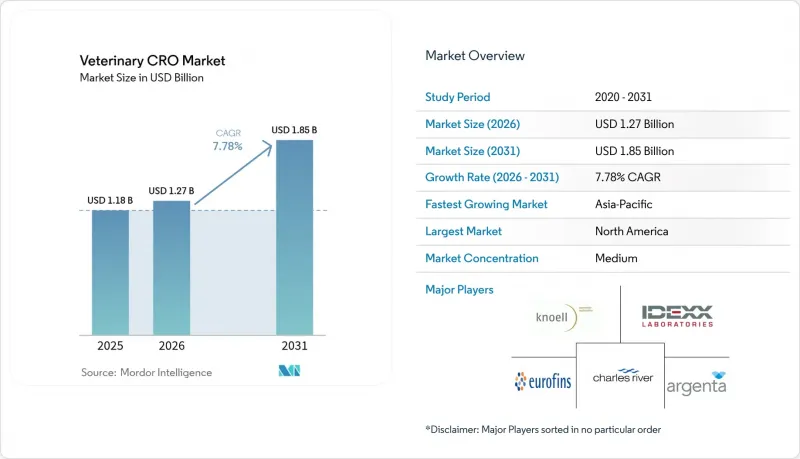
This report is Segmented by Service Type (Clinical Trials, and More), Animal Type (Companion Animals [Dogs, Cats, and Other Companion Species], and Livestock [Cattle, Swine, Poultry, and Other Livestocks]), End User (Animal-Health Pharma & Biotech Companies, and More), Indication (Oncology, and More), and Geography (North America, Europe, and More). The Market Forecasts are Provided in Terms of Value (USD).
Global Veterinary CRO Market Trends and Insights
Growth in Global Animal Health Expenditure
Global veterinary pharmaceutical sales, including over-the-counter products and diagnostics, exceeded USD 50 billion in 2025, up sharply from pre-pandemic levels. U.S. households now spend an average of USD 1,500 per pet each year, a 22% jump since 2020, which sustains demand for advanced trials in oncology, cardiology, and neurology. Livestock producers have likewise raised biosecurity budgets, allocating up to 12% of farm operating costs to veterinary services and vaccines. As spending expands on both the companion and production sides, the veterinary CRO market attracts projects that amortize fixed infrastructure across species. Heightened willingness to pay for specialty therapies underscores a durable revenue base for providers capable of serving multi-species portfolios.
Favorable Regulatory Pathways for Veterinary Pharmaceuticals
The U.S. Animal Drug User Fee Act V provides USD 35 million a year to expedite reviews and broaden conditional approvals for products targeting serious conditions. In Europe, the Platform Technology Master File enables a single dossier to support multiple vaccine candidates, reducing redundant studies by nearly 20%. VICH guideline GL52 now harmonizes pharmacokinetic protocols across key markets, eliminating region-specific bridging trials that once extended timelines. Although these tailwinds shorten time-to-market, they also elevate documentation standards, prompting sponsors to enlist CROs with proven regulatory track records. Post-approval efficacy commitments linked to conditional pathways further extend CRO engagement across the product life cycle.
High Development Costs and Lengthy Approval Timelines
Bringing a novel veterinary biologic to market can cost up to USD 150 million and take 7-9 years, versus 5-6 years a decade ago. Field trials for livestock vaccines may involve 10-15 commercial farms, with each site adding USD 200,000-400,000 to budgets. Companion-animal oncology studies are similarly expensive, sometimes exceeding USD 5 million for 100 dogs enrolled across specialty centers. The EMA's five-year post-approval monitoring rule for food-animal products adds another USD 2-4 million to lifecycle costs. Escalating capital requirements deter smaller innovators and concentrate projects among well-funded sponsors, which could slow the overall expansion pace of the veterinary CRO market.
Other drivers and restraints analyzed in the detailed report include:
- Increasing Outsourcing of R&D Activities by Animal-Health Companies
- Intensifying Focus on One Health and Zoonotic-Disease Preparedness
- Limited Availability of Specialized Animal Research Infrastructure
For complete list of drivers and restraints, kindly check the Table Of Contents.
Segment Analysis
Clinical trials accounted for the largest share of 2025 revenue, yet the segment's 7.2% growth lags the 9.43% CAGR projected for regulatory and consulting work as harmonized VICH guidelines streamline dossier strategies across regions. Toxicology and safety studies held nearly 28% share, buoyed by stringent residue-depletion rules for food-animal therapies. Integrated providers that pair GLP toxicology with real-time bioanalytical support are steadily increasing their market share in the veterinary CRO market.
Over the forecast horizon, the regulatory-consulting niche is poised to expand its contribution to the veterinary CRO market, as sponsors prize rapid, audit-ready submissions. ISO 13485 certification has emerged as a key differentiator, with compliant firms able to command double-digit price premiums. Service bundling increasingly places dossier preparation, study monitoring, and pharmacovigilance under single-provider contracts, simplifying oversight for resource-constrained sponsors.
Companion species accounted for 57.45% of 2025 revenue, led by canine and feline projects that mimic human medicine protocols. Oncology and dermatology remain the highest-value indications, often supported by owner-paid expenses that offset trial costs. Even so, accelerating vaccine development for African swine fever and avian influenza positions livestock programs to capture a larger share of the veterinary CRO market.
Livestock trials are forecast to post a 9.66% CAGR as governments inject funding to safeguard food security. Swine studies, propelled by new ASF vaccine candidates, are the fastest riser. Cattle respiratory-disease projects and poultry biosecurity mandates also add volume. The shift diversifies revenue streams away from consumer discretionary spending toward publicly financed disease-control budgets.
Complete Report Scope:
- By Service Type
- Clinical Trials
- Toxicology & Safety Studies
- Regulatory & Consulting Services
- Other Specialized Services
- By Animal Type
- Companion Animals
- Dogs
- Cats
- Other Companion Species
- Livestock
- Cattle
- Swine
- Poultry
- Other Livestocks
- Companion Animals
- By End User
- Animal-Health Pharma & Biotech Companies
- Academic & Research Institutes
- Government & Non-Profit Sponsors
- Other End Users
- By Indication
- Oncology
- Infectious Diseases
- Dermatology
- Gastrointestinal Disorders
- Neurology
- Other Indications
- Geography
- North America
- United States
- Canada
- Mexico
- Europe
- Germany
- United Kingdom
- France
- Italy
- Spain
- Rest of Europe
- Asia-Pacific
- China
- Japan
- India
- Australia
- South Korea
- Rest of Asia-Pacific
- Middle East & Africa
- GCC
- South Africa
- Rest of Middle East & Africa
- South America
- Brazil
- Argentina
- Rest of South America
- North America
Geography Analysis
North America contributed 41.75% of 2025 revenue on the strength of its dense GLP infrastructure, 67 million pet-owning households, and the FDA's conditional-approval pathway that rewards early data packages. Canada adds volume via harmonized reviews, while Mexico offers cost-effective sites for poultry and swine vaccine work. Although regional CAGR moderates to 6.5% through 2031, North America will remain the largest component of the veterinary CRO market thanks to entrenched capacity and owner willingness to fund premium therapies.
Europe accounted for roughly 32% of global revenue, supported by EMA pharmacovigilance mandates that generate recurring service streams. Germany's large swine population, the UK's fast-track antimicrobial process, and France's expansive companion-animal base concentrate trial activity in Western Europe. Regional growth is projected at 7.0%, aided by the EU Animal Health Law's surveillance requirements, which sustain demand for epidemiology and diagnostics validation services.
Asia-Pacific is set to outpace all regions with an 8.65% CAGR, led by China's USD 8 billion domestic veterinary-drug market and India's vast cattle population. Expanded AAALAC accreditation, local approval of monoclonal antibodies, and government vaccination programs drive trial volume. Australia and Japan add high-compliance capacity, though longer regulatory timelines temper immediate revenue gains. Middle East & Africa and South America jointly deliver 8% of 2025 sales, yet infrastructure gaps and fragmented rules keep their share below 10% through 2031.
- Altasciences Company, Inc.
- Argenta Limited
- Charles River
- Clinvet International (Pty) Ltd
- East Tennessee Clinical Research, Inc.
- Envigo RMS Holding Corp. (Inotiv)
- Eurofins
- IDEXX
- KLIFOVET GmbH
- knoell Germany GmbH
- LabCorp
- Mispro Biotech Services Corp.
- Oncovet Clinical Research
- Triveritas (knoell Animal Health Ltd)
- TriviumVet
- Veeda Clinical Research Ltd.
- Vetworks BV
- Wageningen Bioveterinary Research
Additional Benefits:
- The market estimate (ME) sheet in Excel format
- 3 months of analyst support
TABLE OF CONTENTS
1 Introduction
- 1.1 Study Assumptions & Market Definition
- 1.2 Scope of the Study
2 Research Methodology
3 Executive Summary
4 Market Landscape
- 4.1 Market Overview
- 4.2 Market Drivers
- 4.2.1 Growth in Global Animal Health Expenditure
- 4.2.2 Favorable Regulatory Pathways for Veterinary Pharmaceuticals
- 4.2.3 Increasing Outsourcing of R&D Activities by Animal-Health Companies
- 4.2.4 Intensifying Focus on One-Health And Zoonotic Disease Preparedness
- 4.2.5 Expansion of Companion-Animal Biologics and Specialty Therapies
- 4.2.6 Digitalization and Data-Driven Approaches in Veterinary Research
- 4.3 Market Restraints
- 4.3.1 High Development Costs and Lengthy Approval Timelines
- 4.3.2 Limited Availability of Specialized Animal Research Infrastructure
- 4.3.3 Shortage of Skilled Veterinary Research Professionals
- 4.3.4 Ethical Concerns and Regulatory Scrutiny Over Animal Testing
- 4.4 Value / Supply-Chain Analysis
- 4.5 Regulatory Landscape
- 4.6 Technological Outlook
- 4.7 Porter's Five Forces
- 4.7.1 Threat Of New Entrants
- 4.7.2 Bargaining Power Of Suppliers
- 4.7.3 Bargaining Power Of Buyers
- 4.7.4 Threat Of Substitutes
- 4.7.5 Competitive Rivalry
5 Market Size & Growth Forecasts (Value, USD)
- 5.1 By Service Type
- 5.1.1 Clinical Trials
- 5.1.2 Toxicology & Safety Studies
- 5.1.3 Regulatory & Consulting Services
- 5.1.4 Other Specialized Services
- 5.2 By Animal Type
- 5.2.1 Companion Animals
- 5.2.1.1 Dogs
- 5.2.1.2 Cats
- 5.2.1.3 Other Companion Species
- 5.2.2 Livestock
- 5.2.2.1 Cattle
- 5.2.2.2 Swine
- 5.2.2.3 Poultry
- 5.2.2.4 Other Livestocks
- 5.2.1 Companion Animals
- 5.3 By End User
- 5.3.1 Animal-Health Pharma & Biotech Companies
- 5.3.2 Academic & Research Institutes
- 5.3.3 Government & Non-Profit Sponsors
- 5.3.4 Other End Users
- 5.4 By Indication
- 5.4.1 Oncology
- 5.4.2 Infectious Diseases
- 5.4.3 Dermatology
- 5.4.4 Gastrointestinal Disorders
- 5.4.5 Neurology
- 5.4.6 Other Indications
- 5.5 Geography
- 5.5.1 North America
- 5.5.1.1 United States
- 5.5.1.2 Canada
- 5.5.1.3 Mexico
- 5.5.2 Europe
- 5.5.2.1 Germany
- 5.5.2.2 United Kingdom
- 5.5.2.3 France
- 5.5.2.4 Italy
- 5.5.2.5 Spain
- 5.5.2.6 Rest of Europe
- 5.5.3 Asia-Pacific
- 5.5.3.1 China
- 5.5.3.2 Japan
- 5.5.3.3 India
- 5.5.3.4 Australia
- 5.5.3.5 South Korea
- 5.5.3.6 Rest of Asia-Pacific
- 5.5.4 Middle East & Africa
- 5.5.4.1 GCC
- 5.5.4.2 South Africa
- 5.5.4.3 Rest of Middle East & Africa
- 5.5.5 South America
- 5.5.5.1 Brazil
- 5.5.5.2 Argentina
- 5.5.5.3 Rest of South America
- 5.5.1 North America
6 Competitive Landscape
- 6.1 Market Concentration
- 6.2 Market Share Analysis
- 6.3 Company Profiles (Includes Global-Level Overview, Market-Level Overview, Core Segments, Financials As Available, Strategic Information, Market Rank/Share For Key Companies, Products & Services, And Recent Developments)
- 6.3.1 Altasciences Company, Inc.
- 6.3.2 Argenta Limited
- 6.3.3 Charles River Laboratories, Inc.
- 6.3.4 Clinvet International (Pty) Ltd
- 6.3.5 East Tennessee Clinical Research, Inc.
- 6.3.6 Envigo RMS Holding Corp. (Inotiv)
- 6.3.7 Eurofins Scientific SE
- 6.3.8 IDEXX Laboratories, Inc.
- 6.3.9 KLIFOVET GmbH
- 6.3.10 knoell Germany GmbH
- 6.3.11 Labcorp Drug Development
- 6.3.12 Mispro Biotech Services Corp.
- 6.3.13 Oncovet Clinical Research
- 6.3.14 Triveritas (knoell Animal Health Ltd)
- 6.3.15 TriviumVet
- 6.3.16 Veeda Clinical Research Ltd.
- 6.3.17 Vetworks BV
- 6.3.18 Wageningen Bioveterinary Research
7 Market Opportunities & Future Outlook
- 7.1 White-Space & Unmet-Need Assessment

