PUBLISHER: Mordor Intelligence | PRODUCT CODE: 2123993

PUBLISHER: Mordor Intelligence | PRODUCT CODE: 2123993
Cheese - Market Share Analysis, Industry Trends & Statistics, Growth Forecasts (2026 - 2031)
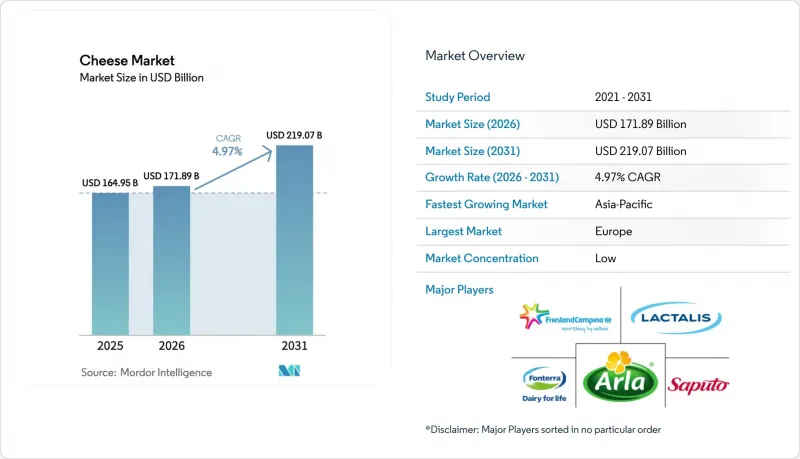
According to Mordor Intelligence, the cheese market size is projected to expand from USD 164.95 billion in 2025 and USD 171.89 billion in 2026 to USD 219.07 billion by 2031, registering a compound annual growth rate (CAGR) of 4.97% between 2026 to 2031.
This report is Segmented Into Product Type (Natural Cheese and Processed Cheese), Milk Source (Cow, Goat, Buffalo, and Others), Format (Blocks/Wheels, Slices, Shredded and Grated, Spreads, and More), Distribution Channels (Foodservice (HoReCa), and Retail), and Geography (North America, Europe, Asia-Pacific, and More). The Market Forecasts are Provided in Terms of Value (USD) and Volume (Tons).
Global Cheese Market Trends and Insights
Growth in cheese varieties and specialty types
The growing demand for specialty cheese varieties is transforming value pools as consumers increasingly opt for options like feta, halloumi, and aged Gouda instead of standard choices such as mozzarella and cheddar. This shift is particularly evident in North America, where specialty cheese sales recorded year-over-year growth in 2025, outpacing the overall category growth by a factor of three. Retailers are expanding shelf space for curated cheese assortments, often positioning them alongside charcuterie and crackers to encourage complementary purchases. In Europe, a similar trend is observed, with protected designation of origin cheeses such as Parmigiano-Reggiano and Roquefort using their authenticity to command price premiums of 40 percent to 60 percent over generic hard and blue cheeses. Smaller producers are leveraging direct-to-consumer channels to bypass traditional distribution markups, allowing them to retain margins that would otherwise go to wholesalers. In response, larger companies are acquiring artisanal brands or launching premium sub-brands to protect their market share in the fastest-growing premium price segments.
Sustainability concerns influencing demand for eco-friendly cheese products
Environmental considerations are significantly shaping sourcing and packaging strategies, with dairy cooperatives increasingly adopting regenerative agriculture practices to reduce methane emissions from cattle. In 2025, Fonterra announced its plan to transition 30% of its New Zealand supplier base to low-emission feed additives by 2028, with the goal of achieving a 15% reduction in Scope 3 emissions. Furthermore, the European Union LIFE (L'Instrument Financier pour l'Environnement) program allocated EUR 45 million (USD 48 million) in grants in 2024 to support pilot projects for carbon-neutral cheese production facilities in France and the Netherlands, reflecting strong regulatory backing for decarbonization efforts . On the packaging front, innovation remains critical as single-use plastics face bans in several jurisdictions. In 2025, Arla Foods introduced a fiber-based wrapper for sliced cheese, which reduced plastic content by 60% while maintaining the 90-day shelf life required for export markets. However, these sustainability initiatives come with substantial upfront capital costs, posing challenges for smaller producers. This financial strain may lead to increased industry consolidation, as achieving compliance with sustainability standards increasingly demands economies of scale.
Regulatory challenges in food safety, adulteration, and labeling
Divergent regulatory frameworks across jurisdictions increase compliance costs, disproportionately affecting exporters and smaller producers. In 2024, the U.S. Food and Drug Administration issued updated guidance requiring country-of-origin labeling for all imported cheeses, adding an estimated USD 0.15 per kilogram in labeling and documentation costs . Similarly, the European Food Safety Authority tightened limits on Listeria monocytogenes in soft cheeses in 2025, necessitating more frequent testing and compelling several French producers to upgrade aging facilities with improved sanitation systems. Adulteration remains a significant concern in price-sensitive markets; for instance, India's Food Safety and Standards Authority found palm oil substitution in 18% of processed cheese samples tested during a 2024 inspection, leading to recalls and diminishing consumer trust . Labeling disputes also remain contentious, particularly regarding terms like "natural" and "artisanal," which lack standardized definitions and often result in accusations of greenwashing.
Other drivers and restraints analyzed in the detailed report include:
- Popularity of ready-to-eat and convenience foods
- Advancements in cheese ripening and flavor enhancement technology
- Health concerns related to high fat and calorie content
For complete list of drivers and restraints, kindly check the Table Of Contents.
Segment Analysis
In 2025, natural cheese accounted for 73.03% of the market share, underscoring a strong consumer preference for dairy products that undergo minimal processing. This preference highlights the growing demand for products perceived as more natural and wholesome. On the other hand, processed cheese is anticipated to grow at a Compound Annual Growth Rate (CAGR) of 5.24% through 2031. This growth is primarily driven by clean-label reformulations, which appeal to health-conscious consumers by offering transparency in ingredients while maintaining the convenience features that are crucial for adoption in the foodservice industry. Mozzarella continues to dominate as the largest sub-segment within natural cheese, supported by the increasing consumption of pizza in Asia-Pacific markets. This trend is further bolstered by the expansion of quick-service restaurant chains in the region.
Parmesan and other hard cheeses are experiencing significant benefits from premiumization trends, with aged variants commanding retail prices that are approximately 50% higher than those of commodity mozzarella. Feta and other brined cheeses are becoming increasingly popular in Mediterranean and Middle Eastern cuisines, reflecting a shift in consumer preferences toward diverse and authentic flavors. Meanwhile, ricotta and cottage cheese are gaining traction among fitness-focused consumers who prioritize high-protein, low-fat options in their diets. Cream cheese, while showing stagnant growth in mature markets, is witnessing rapid expansion in Asia due to the growing popularity of Western-style breakfasts in the region.
Cow milk accounted for 53.01% of the cheese market in 2025, primarily due to its cost efficiency and the presence of well-established supply chains. This dominance underscores the widespread availability and affordability of cow milk, making it the preferred choice for large-scale cheese production. In contrast, goat milk cheese is experiencing a compound annual growth rate (CAGR) of 6.34%. This growth is attributed to increasing consumer demand for its digestibility benefits and its positioning as a premium product. Goat cheese typically commands retail prices 30% to 50% higher than cow milk cheese, a premium linked to its perceived superior nutritional value and the artisanal methods used in its production.
Buffalo milk cheese, primarily represented by mozzarella di bufala, occupies a niche yet profitable segment within the cheese market. Italian exports of buffalo milk cheese to the Asia-Pacific region increased by 19% year-over-year in 2025. This growth is supported by the rising preference among affluent consumers in countries such as China and Japan for authentic Mediterranean products. Meanwhile, sheep milk cheese production remains concentrated in Southern Europe and the Middle East, where traditional varieties such as Pecorino Romano and feta are protected by geographic indications. These geographic protections play a crucial role in preserving the authenticity of these cheeses but also limit the potential for significant expansion in supply.
Complete Report Scope:
- By Type
- Natural Cheese
- Mozzarella
- Feta
- Ricotta
- Cottage
- Cream
- Parmesan
- Others
- Processed Cheese
- Natural Cheese
- By Milk Source
- Cow
- Goat
- Buffalo
- Others
- By Format
- Blocks/Wheels
- Slices
- Shredded and Grated
- Spreads
- Cubes and Sticks
- Others
- By Distribution Channel
- Foodservice (HoReCa)
- Retail
- Supermarkets and Hypermarkets
- Convenience Stores
- Specialist Retailers
- Online Retail
- Others
- By Geography
- North America
- United States
- Canada
- Mexico
- Rest of North America
- Europe
- Germany
- United Kingdom
- Italy
- France
- Spain
- Netherlands
- Poland
- Belgium
- Sweden
- Rest of Europe
- Asia-Pacific
- China
- India
- Japan
- Australia
- Indonesia
- South Korea
- Thailand
- Singapore
- Rest of Asia-Pacific
- South America
- Brazil
- Argentina
- Colombia
- Chile
- Peru
- Rest of South America
- Middle East and Africa
- South Africa
- Saudi Arabia
- United Arab Emirates
- Nigeria
- Egypt
- Morocco
- Turkey
- Rest of Middle East and Africa
- North America
Geography Analysis
In 2025, Europe led the global cheese market, accounting for 27.32% of the total share. This dominance is rooted in its long-standing consumption traditions and the Protected Designation of Origin (PDO) frameworks, which provide regional producers with pricing advantages. Germany, France, Italy, and the Netherlands collectively contributed over 60% of European production, each specializing in unique cheese varieties that reflect local terroir and production methods. However, growth in the region is slowing as per-capita consumption approaches saturation and health concerns over saturated fats influence dietary preferences. Regulatory oversight remains significant, with the European Food Safety Authority (EFSA) enforcing strict microbial limits and the European Union's Farm to Fork strategy targeting a 20% reduction in food waste by 2030. Producers are responding by investing in shelf-life extension technologies, while sustainability-focused innovations, such as carbon-neutral production and biodegradable packaging, are gaining traction. Post-Brexit trade disruptions in the United Kingdom have increased supply chain costs, while Eastern European countries like Poland are expanding production capacity to meet both domestic and export demand.
The Asia-Pacific region is the fastest-growing cheese market, with a compound annual growth rate (CAGR) of 6.89% projected through 2031. This growth is driven by urbanization, rising disposable incomes, and the adoption of Western dietary habits. China is the standout market, with per-capita cheese consumption tripling between 2020 and 2025 due to the proliferation of pizza and burger chains and the expansion of modern retail. In India, traditional paneer consumption remains robust, while Western-style cheese adoption is concentrated in urban areas and among younger consumers. Japan and South Korea are mature markets, where demand is shifting toward premium imported varieties and fusion products that combine cheese with traditional ingredients. Improvements in cold-chain infrastructure across Southeast Asia are unlocking demand, although price sensitivity remains a challenge in lower-income markets such as Indonesia and the Philippines. Australia and New Zealand are net exporters, leveraging pasture-based production systems that command sustainability premiums in Asian export markets.
Other regions are also contributing to the global cheese market's growth. North America held a significant share in 2025, with the United States as the largest contributor, where per-capita cheese consumption exceeded 17 kilograms annually. The region is characterized by high foodservice penetration, with quick-service restaurants accounting for nearly 40% of cheese volume. Mexico is experiencing rapid growth, driven by traditional queso fresco consumption and increasing urban adoption of processed cheese. In Canada, bilingual labeling requirements and provincial trade barriers fragment distribution, raising costs for national brands. Additionally, updated guidance from the U.S. Food and Drug Administration (FDA) on country-of-origin labeling has increased compliance costs for importers, while tariff uncertainties complicate long-term sourcing strategies for multinational producers. South America is steadily expanding, with Brazil and Argentina as key markets. Brazil's cheese consumption is rising as middle-class growth drives demand for both traditional requeijao and imported European varieties. Argentina benefits from a strong dairy farming base and exports significant volumes of hard cheeses to neighboring countries and Europe, although economic instability and currency fluctuations pose challenges. In the Middle East and Africa, the market is fragmented. Gulf Cooperation Council (GCC) countries rely heavily on imports, with demand driven by expatriate populations and tourism. Meanwhile, North African markets such as Egypt and Morocco have established local production but face challenges in maintaining quality consistency.
- Groupe Lactalis SA
- FrieslandCampina NV
- Arla Foods amba
- Fonterra Co-operative Group Ltd
- Saputo Inc.
- The Kraft Heinz Company
- Savencia Fromage & Dairy
- Dairy Farmers of America Inc.
- Land O'Lakes Inc.
- Gujarat Co-operative Milk Marketing Federation
- Almarai Company
- Hochland SE
- DMK Group
- Sargento Foods Inc.
- Associated Milk Producers Inc.
- Ornua Co-operative Ltd
- Emmi AG
- Leprino Foods Company
- Unibel SA
- Hilmar Cheese Company
Additional Benefits:
- The market estimate (ME) sheet in Excel format
- 3 months of analyst support
TABLE OF CONTENTS
1 INTRODUCTION
- 1.1 Study Assumptions and Market Definition
- 1.2 Scope of the Study
2 RESEARCH METHODOLOGY
3 EXECUTIVE SUMMARY
4 MARKET LANDSCAPE
- 4.1 Market Overview
- 4.2 Market Drivers
- 4.2.1 Growth in cheese varieties and specialty types
- 4.2.2 Sustainability concerns influencing demand for eco-friendly cheese products
- 4.2.3 Popularity of ready-to-eat and convenience foods
- 4.2.4 Advancements in cheese ripening and flavor enhancement technology
- 4.2.5 Premiumization trend boosting demand for aged and artisanal cheeses
- 4.2.6 Increasing product visibility through new formats
- 4.3 Market Restraints
- 4.3.1 Regulatory challenges in food safety, adulteration, and labeling
- 4.3.2 Health concerns related to high fat and calorie content
- 4.3.3 Lack of standardization in regional cheese quality and type definitions
- 4.3.4 Hygiene and traceability issues in farm-to-table supply chains
- 4.4 Value Chain Analysis
- 4.5 Regulatory Outlook
- 4.6 Porter's Five Forces
- 4.6.1 Threat of New Entrants
- 4.6.2 Bargaining Power of Buyers
- 4.6.3 Bargaining Power of Suppliers
- 4.6.4 Threat of Substitute Products
- 4.6.5 Intensity of Competitive Rivalry
5 MARKET SIZE AND GROWTH FORECASTS (VALUE AND VOLUME)
- 5.1 By Type
- 5.1.1 Natural Cheese
- 5.1.1.1 Mozzarella
- 5.1.1.2 Feta
- 5.1.1.3 Ricotta
- 5.1.1.4 Cottage
- 5.1.1.5 Cream
- 5.1.1.6 Parmesan
- 5.1.1.7 Others
- 5.1.2 Processed Cheese
- 5.1.1 Natural Cheese
- 5.2 By Milk Source
- 5.2.1 Cow
- 5.2.2 Goat
- 5.2.3 Buffalo
- 5.2.4 Others
- 5.3 By Format
- 5.3.1 Blocks/Wheels
- 5.3.2 Slices
- 5.3.3 Shredded and Grated
- 5.3.4 Spreads
- 5.3.5 Cubes and Sticks
- 5.3.6 Others
- 5.4 By Distribution Channel
- 5.4.1 Foodservice (HoReCa)
- 5.4.2 Retail
- 5.4.2.1 Supermarkets and Hypermarkets
- 5.4.2.2 Convenience Stores
- 5.4.2.3 Specialist Retailers
- 5.4.2.4 Online Retail
- 5.4.2.5 Others
- 5.5 By Geography
- 5.5.1 North America
- 5.5.1.1 United States
- 5.5.1.2 Canada
- 5.5.1.3 Mexico
- 5.5.1.4 Rest of North America
- 5.5.2 Europe
- 5.5.2.1 Germany
- 5.5.2.2 United Kingdom
- 5.5.2.3 Italy
- 5.5.2.4 France
- 5.5.2.5 Spain
- 5.5.2.6 Netherlands
- 5.5.2.7 Poland
- 5.5.2.8 Belgium
- 5.5.2.9 Sweden
- 5.5.2.10 Rest of Europe
- 5.5.3 Asia-Pacific
- 5.5.3.1 China
- 5.5.3.2 India
- 5.5.3.3 Japan
- 5.5.3.4 Australia
- 5.5.3.5 Indonesia
- 5.5.3.6 South Korea
- 5.5.3.7 Thailand
- 5.5.3.8 Singapore
- 5.5.3.9 Rest of Asia-Pacific
- 5.5.4 South America
- 5.5.4.1 Brazil
- 5.5.4.2 Argentina
- 5.5.4.3 Colombia
- 5.5.4.4 Chile
- 5.5.4.5 Peru
- 5.5.4.6 Rest of South America
- 5.5.5 Middle East and Africa
- 5.5.5.1 South Africa
- 5.5.5.2 Saudi Arabia
- 5.5.5.3 United Arab Emirates
- 5.5.5.4 Nigeria
- 5.5.5.5 Egypt
- 5.5.5.6 Morocco
- 5.5.5.7 Turkey
- 5.5.5.8 Rest of Middle East and Africa
- 5.5.1 North America
6 COMPETITIVE LANDSCAPE
- 6.1 Market Concentration
- 6.2 Strategic Moves
- 6.3 Market Ranking Analysis
- 6.4 Company Profiles (includes Global-level Overview, Market-level Overview, Core Segments, Financials (if available), Strategic Information, Market Rank/Share, Products and Services, Recent Developments)
- 6.4.1 Groupe Lactalis SA
- 6.4.2 FrieslandCampina NV
- 6.4.3 Arla Foods amba
- 6.4.4 Fonterra Co-operative Group Ltd
- 6.4.5 Saputo Inc.
- 6.4.6 The Kraft Heinz Company
- 6.4.7 Savencia Fromage & Dairy
- 6.4.8 Dairy Farmers of America Inc.
- 6.4.9 Land O'Lakes Inc.
- 6.4.10 Gujarat Co-operative Milk Marketing Federation
- 6.4.11 Almarai Company
- 6.4.12 Hochland SE
- 6.4.13 DMK Group
- 6.4.14 Sargento Foods Inc.
- 6.4.15 Associated Milk Producers Inc.
- 6.4.16 Ornua Co-operative Ltd
- 6.4.17 Emmi AG
- 6.4.18 Leprino Foods Company
- 6.4.19 Unibel SA
- 6.4.20 Hilmar Cheese Company
7 MARKET OPPORTUNITIES AND FUTURE OUTLOOK

