PUBLISHER: Mordor Intelligence | PRODUCT CODE: 2123994

PUBLISHER: Mordor Intelligence | PRODUCT CODE: 2123994
Canned Fruits - Market Share Analysis, Industry Trends & Statistics, Growth Forecasts (2026 - 2031)
According to Mordor Intelligence, the canned fruits market size was valued at USD 13.82 billion in 2025, reached USD 14.51 billion in 2026, and is projected to grow to USD 18.48 billion by 2031, registering a compound annual growth rate (CAGR) of 4.95% during 2026-2031.
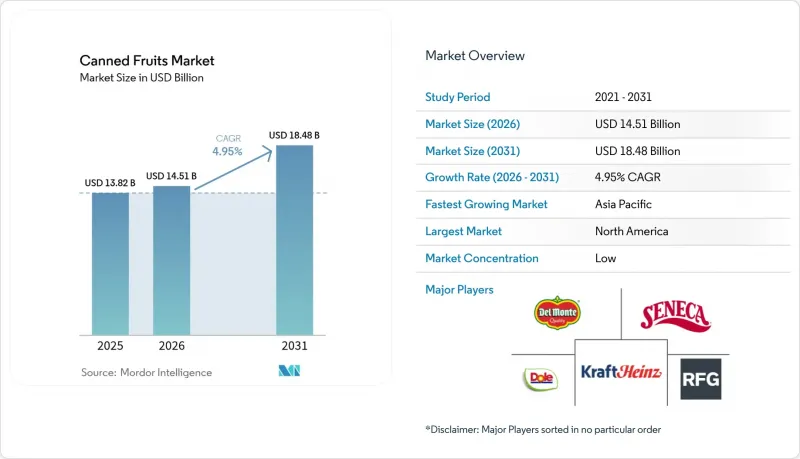
This report is Segmented by Product Type (Peaches, Pineapple, Mandarin Oranges, Mixed Fruits, Pears, and Other Fruit Types), Form (Whole Fruits and Cut Fruits), Distribution Channel (Supermarkets/Hypermarkets, Convenience Stores, and More), and Geography (North America, Europe, Asia-Pacific, South America, Middle East and Africa). The Market Forecasts are Provided in Terms of Value (USD).
Global Canned Fruits Market Trends and Insights
Rising focus on fruit-based diets for nutrition drives consumption
The increasing global focus on fruit-based diets as part of balanced and preventive nutrition is driving the growth of the canned fruits market. Rising awareness of the health benefits of fruits, including their natural fiber, antioxidants, vitamins, and hydration properties, has encouraged consumers to incorporate fruits more regularly into their daily diets. As dietary guidelines and wellness trends advocate for higher fruit consumption to support digestive health, immunity, and overall well-being, canned fruits offer a convenient, year-round alternative to fresh produce. Their extended shelf life, ready-to-eat format, and availability in juice or no-added-sugar options make them a practical choice for consumers aiming to meet recommended fruit intake levels. Additionally, the growing popularity of plant-forward diets and clean-label preferences continues to drive demand for shelf-stable fruit products.
Busy urban lifestyles boost the need for ready-to-eat fruit
Rapid urbanization and increasingly busy lifestyles are driving the demand for convenient, ready-to-eat fruit options. As working professionals, dual-income households, and students face tighter schedules, the need for time-saving food solutions has grown. Canned fruits address this demand by eliminating the need for washing, peeling, and cutting, while also reducing spoilage concerns. They offer the convenience of immediate consumption without compromising nutritional value. This trend is particularly prominent in highly urbanized regions. For example, the United Nations Economic and Social Commission for Asia and the Pacific reports that the Asia-Pacific region is home to over 2.2 billion urban residents, making it the most populous urban area globally. Furthermore, the region's urban population is projected to grow by 50% by 2050 . This rapid urbanization is influencing food consumption patterns, increasing the preference for shelf-stable, easy-to-store, and ready-to-eat products.
High sugar and syrup-related health concerns
Health concerns related to high sugar intake are a significant restraint on the global canned fruits market, particularly for products packed in heavy or light syrup. Many traditional canned fruit products include added sugars to enhance flavor and preservation, which conflicts with the growing consumer preference for low-sugar and clean-label foods. Rising awareness of obesity, diabetes, and metabolic health risks has led consumers to be more cautious about products high in free sugars. For example, the World Health Organization recommends limiting free sugar consumption to less than 10% of total daily energy intake, supporting global public health efforts to reduce sugar consumption. Consequently, consumers are increasingly opting for fruit packed in natural juice, no-added-sugar formulations, or fresh alternatives. This focus on sugar content pressures manufacturers to reformulate products and may limit the growth potential of traditional syrup-based canned fruits, thereby restraining overall market growth.
Other drivers and restraints analyzed in the detailed report include:
- Growing preference for organic and preservative-free options
- Growing fitness culture among younger demographics
- Growing preference for minimally processed foods
For complete list of drivers and restraints, kindly check the Table Of Contents.
Segment Analysis
Peaches, accounting for 31.54% of the Global Canned Fruits Market revenue in 2025, play a significant role in driving market growth due to their strong cross-channel demand, versatile applications, and broad consumer acceptance across age groups. Canned peaches provide an optimal balance of sweetness, texture retention after thermal processing, and visual appeal, making them one of the most commercially viable fruits for canning compared to softer or highly seasonal alternatives. Additionally, peaches align well with product innovation trends such as no-added-sugar formulations, juice-packed variants, diced and sliced convenience formats, and portion-controlled cups. These innovations enable manufacturers to cater to health-conscious consumers without compromising on taste. The fruit's compatibility with premium positioning, including organic offerings and clean-label packaging, further supports value growth within this segment.
Mandarin oranges, projected to grow at a CAGR of 6.21% through 2031, are emerging as one of the fastest-growing segments within the Global Canned Fruits Market, contributing significantly to incremental revenue growth and category diversification. Their naturally sweet flavor, bright color, seedless convenience, and easy-to-separate segments make them highly appealing across children, family, and institutional consumption segments. Mandarin oranges maintain strong structural integrity and visual appeal after canning, making them ideal for applications such as fruit salads, dessert cups, yogurt toppings, bakery products, and ready-to-eat snack packs. Additionally, mandarins are widely cultivated and well-suited for large-scale processing, supporting export-oriented production hubs and private-label expansion.
Complete Report Scope:
- By Product Type
- Peaches
- Pineapple
- Mandarin Oranges
- Mixed Fruits
- Pears
- Other Fruit Types
- By Form
- Whole Fruits
- Cut Fruits
- By Distribution Channel
- Supermarkets/Hypermarkets
- Convenience Stores
- Online Retail Stores
- Other Distribution Channels
- By Geography
- North America
- United States
- Canada
- Mexico
- Rest of North America
- Europe
- Germany
- United Kingdom
- Italy
- France
- Spain
- Netherlands
- Poland
- Belgium
- Sweden
- Rest of Europe
- Asia-Pacific
- China
- India
- Japan
- Australia
- Indonesia
- South Korea
- Thailand
- Singapore
- Rest of Asia-Pacific
- South America
- Brazil
- Argentina
- Colombia
- Chile
- Peru
- Rest of South America
- Middle East and Africa
- South Africa
- Saudi Arabia
- United Arab Emirates
- Nigeria
- Egypt
- Morocco
- Turkey
- Rest of Middle East and Africa
- North America
Geography Analysis
North America accounted for 32.43% of the canned fruits market revenue in 2025, supported by the United States' highly developed and mature retail infrastructure, strong private-label penetration, and established household consumption patterns. The region benefits from robust domestic fruit production and processing capabilities, particularly in peaches and pears. For instance, according to the United States Department of Agriculture, total peach production in the United States reached 709,200 tons in 2024, representing a 20% increase compared to the previous year, ensuring stable raw material availability for canning operations . The presence of advanced food processing technologies, strong distribution networks, and high consumer familiarity with shelf-stable fruit products further anchors the region's dominance.
The Middle East and Africa are forecast to grow at a CAGR of 5.56% through 2031, driven by expanding urban retail infrastructure, rising adoption of packaged and shelf-stable food products, and increasing product availability through import channels. Growing awareness of food safety, longer shelf life, and year-round fruit access is gradually enhancing market penetration across metropolitan areas in this region. Europe represents another major regional contributor, supported by established fruit-processing traditions and structured retail networks across Germany, the United Kingdom, Italy, France, and Spain. The region's demand is reinforced by a strong preference for clean-label, organic, and reduced-sugar canned fruit variants, alongside steady consumption in household and retail channels.
Asia-Pacific is projected to record steady growth, supported by rising urbanization, modernization of grocery retail, and evolving dietary patterns. Key markets such as China, India, Japan, and Australia are driving demand due to increasing consumption of bakery products, dairy desserts, and ready-to-eat meal components that incorporate canned fruits. Improvements in domestic fruit processing capacity, combined with strong export potential from regional production hubs, are expected to further accelerate growth. As modern retail penetration expands and consumers seek convenient, long-lasting fruit options, Asia-Pacific remains a significant contributor to incremental global revenue growth in the canned fruits market.
- Dole PLC
- The Kraft Heinz Company
- Del Monte Foods Inc.
- Rhodes Food Group
- Seneca Foods Corporation
- Roland Foods LLC
- Xiamen Gulong Group Co., Ltd.
- Kangfa Foods Co., Ltd.
- CHB Group
- Delicia Foods India Pvt. Ltd.
- Bonduelle S.A.
- La Doria S.p.A.
- Princes Group
- Conagra Brands, Inc.
- General Mills, Inc.
- Kronos S.A.
- Shandong Wanlilai Foodstuff Co., Ltd.
- SunOpta Inc.
- Goya Foods, Inc.
- Tropical Food Manufacturing (Thailand) Co., Ltd.
Additional Benefits:
- The market estimate (ME) sheet in Excel format
- 3 months of analyst support
TABLE OF CONTENTS
1 INTRODUCTION
- 1.1 Study Assumptions and Market Definition
- 1.2 Scope of the Study
2 RESEARCH METHODOLOGY
3 EXECUTIVE SUMMARY
4 MARKET LANDSCAPE
- 4.1 Market Overview
- 4.2 Market Drivers
- 4.2.1 Rising focus on fruit-based diets for nutrition drives consumption
- 4.2.2 Busy urban lifestyles boost the need for ready-to-eat fruit
- 4.2.3 Growing preference for organic and preservative-free options
- 4.2.4 Growing fitness culture among younger demographics
- 4.2.5 Sustainability and waste-reduction positioning
- 4.2.6 Increasing adoption in breakfast formats
- 4.3 Market Restraints
- 4.3.1 High sugar and syrup-related health concerns
- 4.3.2 Growing preference for minimally processed foods
- 4.3.3 Competition from frozen and aseptic fruit formats
- 4.3.4 Logistics weight and space inefficiency
- 4.4 Consumer Behaviour Analysis
- 4.5 Regulatory Landscape
- 4.6 Technological Outlook
- 4.7 Porter's Five Forces Analysis
- 4.7.1 Threat of New Entrants
- 4.7.2 Bargaining Power of Buyers
- 4.7.3 Bargaining Power of Suppliers
- 4.7.4 Threat of Substitutes
- 4.7.5 Intensity of Competitive Rivalry
5 MARKET SIZE AND GROWTH FORECASTS (VALUE)
- 5.1 By Product Type
- 5.1.1 Peaches
- 5.1.2 Pineapple
- 5.1.3 Mandarin Oranges
- 5.1.4 Mixed Fruits
- 5.1.5 Pears
- 5.1.6 Other Fruit Types
- 5.2 By Form
- 5.2.1 Whole Fruits
- 5.2.2 Cut Fruits
- 5.3 By Distribution Channel
- 5.3.1 Supermarkets/Hypermarkets
- 5.3.2 Convenience Stores
- 5.3.3 Online Retail Stores
- 5.3.4 Other Distribution Channels
- 5.4 By Geography
- 5.4.1 North America
- 5.4.1.1 United States
- 5.4.1.2 Canada
- 5.4.1.3 Mexico
- 5.4.1.4 Rest of North America
- 5.4.2 Europe
- 5.4.2.1 Germany
- 5.4.2.2 United Kingdom
- 5.4.2.3 Italy
- 5.4.2.4 France
- 5.4.2.5 Spain
- 5.4.2.6 Netherlands
- 5.4.2.7 Poland
- 5.4.2.8 Belgium
- 5.4.2.9 Sweden
- 5.4.2.10 Rest of Europe
- 5.4.3 Asia-Pacific
- 5.4.3.1 China
- 5.4.3.2 India
- 5.4.3.3 Japan
- 5.4.3.4 Australia
- 5.4.3.5 Indonesia
- 5.4.3.6 South Korea
- 5.4.3.7 Thailand
- 5.4.3.8 Singapore
- 5.4.3.9 Rest of Asia-Pacific
- 5.4.4 South America
- 5.4.4.1 Brazil
- 5.4.4.2 Argentina
- 5.4.4.3 Colombia
- 5.4.4.4 Chile
- 5.4.4.5 Peru
- 5.4.4.6 Rest of South America
- 5.4.5 Middle East and Africa
- 5.4.5.1 South Africa
- 5.4.5.2 Saudi Arabia
- 5.4.5.3 United Arab Emirates
- 5.4.5.4 Nigeria
- 5.4.5.5 Egypt
- 5.4.5.6 Morocco
- 5.4.5.7 Turkey
- 5.4.5.8 Rest of Middle East and Africa
- 5.4.1 North America
6 COMPETITIVE LANDSCAPE
- 6.1 Market Concentration
- 6.2 Strategic Moves
- 6.3 Market Share Analysis
- 6.4 Company Profiles (includes Global level Overview, Market level overview, Core Segments, Financials as available, Strategic Information, Market Rank/Share for key companies, Products and Services, and Recent Developments)
- 6.4.1 Dole PLC
- 6.4.2 The Kraft Heinz Company
- 6.4.3 Del Monte Foods Inc.
- 6.4.4 Rhodes Food Group
- 6.4.5 Seneca Foods Corporation
- 6.4.6 Roland Foods LLC
- 6.4.7 Xiamen Gulong Group Co., Ltd.
- 6.4.8 Kangfa Foods Co., Ltd.
- 6.4.9 CHB Group
- 6.4.10 Delicia Foods India Pvt. Ltd.
- 6.4.11 Bonduelle S.A.
- 6.4.12 La Doria S.p.A.
- 6.4.13 Princes Group
- 6.4.14 Conagra Brands, Inc.
- 6.4.15 General Mills, Inc.
- 6.4.16 Kronos S.A.
- 6.4.17 Shandong Wanlilai Foodstuff Co., Ltd.
- 6.4.18 SunOpta Inc.
- 6.4.19 Goya Foods, Inc.
- 6.4.20 Tropical Food Manufacturing (Thailand) Co., Ltd.
7 MARKET OPPORTUNITIES AND FUTURE OUTLOOK

