PUBLISHER: Mordor Intelligence | PRODUCT CODE: 2123997

PUBLISHER: Mordor Intelligence | PRODUCT CODE: 2123997
Craft Spirits - Market Share Analysis, Industry Trends & Statistics, Growth Forecasts (2026 - 2031)
According to Mordor Intelligence, the craft spirits market size is projected to expand from USD 21.20 billion in 2025 and USD 23.75 billion in 2026 to USD 41.87 billion by 2031, registering a CAGR of 12.01% between 2026 to 2031.
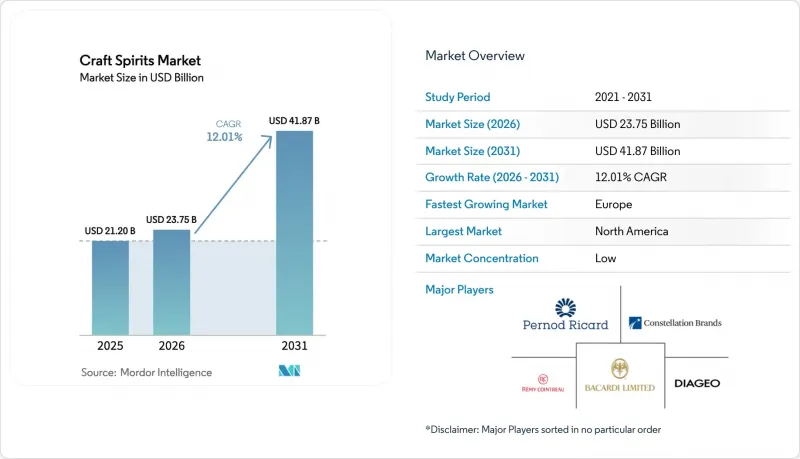
This report is Segmented by Product Type (Whiskey, Gin, Vodka, Brandy, and Other Types), by Ingredient (Grain-Based, Fruit-Based, Agave-Based, and Others), by Distribution Channel (On-Trade and Off-Trade), and by Geography (North America, Europe, Asia-Pacific, South America, and Middle East and Africa). The Market Forecasts are Provided in Terms of Value (USD).
Global Craft Spirits Market Trends and Insights
Rising Number of Microbreweries Propelling the Demand for Craft Spirits
The growth of microbreweries has established a strong foundation for craft spirits development, as many beer producers have expanded into distillation operations. According to the American Craft Spirits Association, the number of active craft distillers in the United States reached 3,069 by 2024, showing an 11.5% increase despite challenging market conditions. States such as California, New York, Pennsylvania, Texas, and Washington have emerged as major centers for craft production . Micro-distilleries are now using fruit fermentation to create unique vodka bases, combining skills from craft brewing and distilling. Improved production capabilities have enabled these producers to offer small-batch and limited-edition products, increasing consumer interest and expanding the market. This trend is expected to continue until 2031.
Product Diffrentiation in Terms of Ingredients And Alcohol Content
Craft distillers are using product differentiation as a key strategy by incorporating unique ingredients and offering varied alcohol content levels. This approach helps them create distinct market positions and attract specific consumer groups. The market is expanding its alcohol content options, as seen in April 2024 when Barrell Craft Spirits launched its first Full Proof Bourbon at 123 proof (61.5% ABV) to meet the demand for stronger flavor profiles. Additionally, the low and no-alcohol spirits segment is growing rapidly. Leading companies like Heineken are planning to achieve a 90% market share in zero-alcohol options by 2025. This strategy addresses the rising demand from health-conscious consumers and changing drinking habits. These trends highlight the industry's focus on meeting diverse consumer preferences.
Stringent Government Regulations
The craft spirits industry faces complex regulatory challenges that affect market entry and growth. In the U.S., the three-tier distribution system remains a major hurdle for small producers, though recent changes in regulations have created new opportunities. Despite 85% of craft spirits consumers wanting easier access, only nine states and D.C. currently allow direct-to-consumer (D2C) spirits shipping (Crafted ERP). Trade disputes add further complications, with the U.S. reintroducing steel and aluminum tariffs in Q1 2025, which may lead to a 50% EU tariff on American whiskey, impacting exports (The Whiskey Lab). Additionally, the Tobacco Tax and Trade Bureau (TTB) plans to introduce mandatory "Alcohol Facts" labels. While this will improve transparency for consumers, it will also increase compliance costs for craft producers.
Other drivers and restraints analyzed in the detailed report include:
- Surge in Demand for Premium Alcoholic Beverages
- Increasing Preference For Innovative Flavors
- Consumers Inclination Towards low/no Alcohol Spirits
For complete list of drivers and restraints, kindly check the Table Of Contents.
Segment Analysis
In 2025, whiskey commands a dominant 26.77% share of the craft spirits market, buoyed by a consumer shift towards premium offerings and a nod to traditional production methods. However, this category grapples with challenges stemming from oversupply, leading to pricing pressures and inventory management dilemmas. In May 2025, Radico made a strategic move, unveiling TRIKAL Indian Single Malt and Morpheus Super Premium Whisky, aiming squarely at the luxury and super-premium segments.
Gin is poised for the most significant growth, projected to achieve a CAGR of 12.25% from 2026 to 2031. This surge is largely attributed to innovative flavor developments and regional adaptations. Distillers in numerous countries are harnessing local botanicals, crafting unique products tailored for both domestic and global markets. Vodka remains a staple segment, with craft producers innovating through fruit fermentation to craft distinctive base spirits. While brandy holds a smaller slice of the market, it's witnessing a surge in popularity, especially in regions like South Korea, where there's a notable uptick in premium spirit imports.
Complete Report Scope:
- By Product Type
- Whiskey
- Gin
- Vodka
- Brandy
- Other Types
- By Ingredient
- Grain-based
- Fruit-based
- Agave-based
- Others
- By Distribution Channel
- On-Trade
- Off-Trade
- Specialty/Liquor Stores
- Other Off Trade Channels
- By Geography
- North America
- United States
- Canada
- Mexico
- Rest of North America
- Europe
- Germany
- United Kingdom
- Italy
- France
- Spain
- Netherlands
- Poland
- Belgium
- Sweden
- Rest of Europe
- Asia-Pacific
- China
- India
- Japan
- Australia
- Indonesia
- South Korea
- Thailand
- Singapore
- Rest of Asia-Pacific
- South America
- Brazil
- Argentina
- Colombia
- Chile
- Peru
- Rest of South America
- Middle East and Africa
- South Africa
- Saudi Arabia
- United Arab Emirates
- Nigeria
- Egypt
- Morocco
- Turkey
- Rest of Middle East and Africa
- North America
Geography Analysis
In 2025, North America held the largest market share at 38.75%. The United States has a strong craft distilling industry, with 3,069 active craft distillers, according to the American Craft Spirits Association. However, the sector faced its first decline in 2023, with a 3.6% drop in production volumes and a 1.1% decrease in value, based on the same source. Regulations are changing, with nine states and Washington, D.C., now allowing direct-to-consumer spirits shipping. Trade tensions remain a challenge, as the U.S. planned to introduce a 25% tariff on Canadian and Mexican imports in March 2025. This could lead to retaliatory actions and disrupt supply chains.
Europe is expected to grow the fastest, with a projected CAGR of 12.96% from 2026 to 2031. This growth is driven by strong craft traditions, a well-established cocktail culture, and rising demand for premium products. In Asia, the market is expanding, especially in South Korea, where whisky imports reached a record 30,586 tons in 2023, a 13.1% increase from the previous year, according to the Korea Customs Service.
South America and the Middle East and Africa are emerging markets. Brazil and the UAE are seeing higher consumption of premium spirits. Distillers in these regions are using local botanicals to create unique gin products for both domestic and international markets. These regions offer growth opportunities for craft spirits manufacturers who can adapt to local regulations and meet consumer preferences.
- Pernod Ricard SA
- Diageo PLC
- Bacardi Limited
- Constellation Brands Inc.
- Remy Cointreau SA
- Davide Campari-Milano NV
- William Grant & Sons Ltd
- Suntory Holdings Ltd
- Brown-Forman Corporation
- Heaven Hill Distilleries, Inc.
- Rogue Ales & Spirits
- Hotaling & Co.
- Kings County Distillery
- St. George Spirits Inc.
- Ian Macleod Distillers Ltd
- Copperworks Distilling Company
- Cotswolds Distillery Ltd
- Kweichow Moutai Co. Ltd.
- Allied Blenders And Distillers Limited (ABDL)
- Sazerac Company, Inc.
Additional Benefits:
- The market estimate (ME) sheet in Excel format
- 3 months of analyst support
TABLE OF CONTENTS
1 INTRODUCTION
- 1.1 Study Assumptions and Market Definition
- 1.2 Scope of the Study
2 RESEARCH METHODOLOGY
3 EXECUTIVE SUMMARY
4 MARKET LANDSCAPE
- 4.1 Market Overview
- 4.2 Market Drivers
- 4.2.1 Rising Number of Microbreweries Propelling the Demand for Craft Spirits
- 4.2.2 Tourism and Experiential Marketing
- 4.2.3 Product Diffrentiation in Terms of Ingredients And Alcohol Content
- 4.2.4 Surge in Demand for Premium Alcoholic Beverages
- 4.2.5 Increasing Preference For Innovative Flavors
- 4.2.6 Growth of Cocktail Culture and Mixology
- 4.3 Market Restraints
- 4.3.1 Stringent Government Regulations
- 4.3.2 Consumers Inclination Towards low/no Alcohol Spirits
- 4.3.3 Supply chain disruptions affecting equipment and packaging
- 4.3.4 Premium pricing of craft spirits faces resistance from price-sensitive consumers
- 4.4 Consumer Behaviour Analysis
- 4.5 Regulatory Outlook
- 4.6 Porter's Five Forces Analysis
- 4.6.1 Bargaining Power of Suppliers
- 4.6.2 Bargaining Power of Buyers
- 4.6.3 Threat of New Entrants
- 4.6.4 Threat of Substitutes
- 4.6.5 Degree of Competition
5 MARKET SIZE AND GROWTH FORECASTS (VALUE)
- 5.1 By Product Type
- 5.1.1 Whiskey
- 5.1.2 Gin
- 5.1.3 Vodka
- 5.1.4 Brandy
- 5.1.5 Other Types
- 5.2 By Ingredient
- 5.2.1 Grain-based
- 5.2.2 Fruit-based
- 5.2.3 Agave-based
- 5.2.4 Others
- 5.3 By Distribution Channel
- 5.3.1 On-Trade
- 5.3.2 Off-Trade
- 5.3.2.1 Specialty/Liquor Stores
- 5.3.2.2 Other Off Trade Channels
- 5.4 By Geography
- 5.4.1 North America
- 5.4.1.1 United States
- 5.4.1.2 Canada
- 5.4.1.3 Mexico
- 5.4.1.4 Rest of North America
- 5.4.2 Europe
- 5.4.2.1 Germany
- 5.4.2.2 United Kingdom
- 5.4.2.3 Italy
- 5.4.2.4 France
- 5.4.2.5 Spain
- 5.4.2.6 Netherlands
- 5.4.2.7 Poland
- 5.4.2.8 Belgium
- 5.4.2.9 Sweden
- 5.4.2.10 Rest of Europe
- 5.4.3 Asia-Pacific
- 5.4.3.1 China
- 5.4.3.2 India
- 5.4.3.3 Japan
- 5.4.3.4 Australia
- 5.4.3.5 Indonesia
- 5.4.3.6 South Korea
- 5.4.3.7 Thailand
- 5.4.3.8 Singapore
- 5.4.3.9 Rest of Asia-Pacific
- 5.4.4 South America
- 5.4.4.1 Brazil
- 5.4.4.2 Argentina
- 5.4.4.3 Colombia
- 5.4.4.4 Chile
- 5.4.4.5 Peru
- 5.4.4.6 Rest of South America
- 5.4.5 Middle East and Africa
- 5.4.5.1 South Africa
- 5.4.5.2 Saudi Arabia
- 5.4.5.3 United Arab Emirates
- 5.4.5.4 Nigeria
- 5.4.5.5 Egypt
- 5.4.5.6 Morocco
- 5.4.5.7 Turkey
- 5.4.5.8 Rest of Middle East and Africa
- 5.4.1 North America
6 COMPETITIVE LANDSCAPE
- 6.1 Market Concentration
- 6.2 Strategic Moves
- 6.3 Market Share Analysis
- 6.4 Company Profiles (Includes Global-level Overview, Market-level Overview, Core Segments, Financials, Strategic Info, Market Rank/Share, Products and Services, Recent Developments)
- 6.4.1 Pernod Ricard SA
- 6.4.2 Diageo PLC
- 6.4.3 Bacardi Limited
- 6.4.4 Constellation Brands Inc.
- 6.4.5 Remy Cointreau SA
- 6.4.6 Davide Campari-Milano NV
- 6.4.7 William Grant & Sons Ltd
- 6.4.8 Suntory Holdings Ltd
- 6.4.9 Brown-Forman Corporation
- 6.4.10 Heaven Hill Distilleries, Inc.
- 6.4.11 Rogue Ales & Spirits
- 6.4.12 Hotaling & Co.
- 6.4.13 Kings County Distillery
- 6.4.14 St. George Spirits Inc.
- 6.4.15 Ian Macleod Distillers Ltd
- 6.4.16 Copperworks Distilling Company
- 6.4.17 Cotswolds Distillery Ltd
- 6.4.18 Kweichow Moutai Co. Ltd.
- 6.4.19 Allied Blenders And Distillers Limited (ABDL)
- 6.4.20 Sazerac Company, Inc.
7 MARKET OPPORTUNITIES AND FUTURE OUTLOOK

