PUBLISHER: Mordor Intelligence | PRODUCT CODE: 2123999

PUBLISHER: Mordor Intelligence | PRODUCT CODE: 2123999
Plant Asset Management - Market Share Analysis, Industry Trends & Statistics, Growth Forecasts (2026 - 2031)
According to Mordor Intelligence, the plant asset management market size is expected to grow from USD 9.82 billion in 2025 to USD 11.01 billion in 2026 and is forecast to reach USD 19.51 billion by 2031 at 12.12% CAGR over 2026-2031.
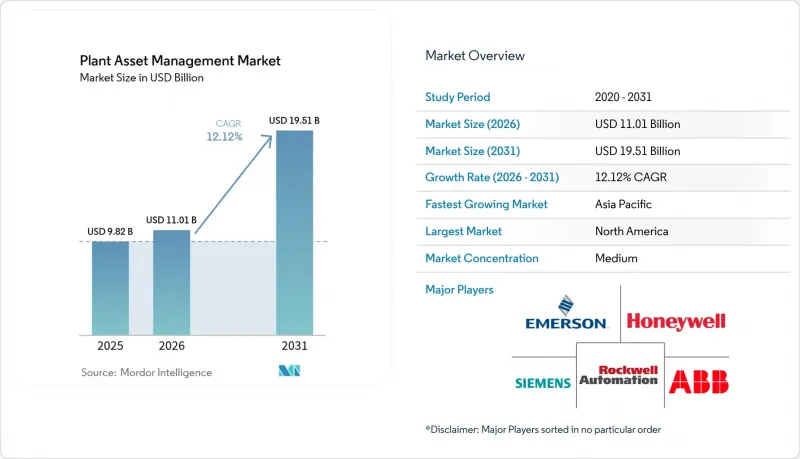
This report is Segmented by Offering (Software, Services, and More), Deployment (On-Premise, Cloud, and More), Asset Type (Rotating Equipment, Fixed Equipment, and More), End User (Energy and Power, Oil and Gas, and More), Organization Size (Large Enterprises and Small and Medium Enterprises (SMEs)), and Geography.
Global Plant Asset Management Market Trends and Insights
IIoT-enabled Real-time Analytics Adoption
Continuous sensor streams lift overall equipment effectiveness by 30% in plants that marry IIoT devices with edge computing, enabling millisecond-level anomaly detection and swift operator response. Large manufacturers record 15% cost savings by removing manual inspections and triggering predictive tasks automatically. Pairing AI with IIoT yields self-diagnosing assets that schedule repairs without human input, a pivotal shift for facilities facing an aging asset base. These benefits are tempered by data-interoperability gaps and fresh cybersecurity risks when operational networks connect to IT domains. Standardized protocols and zero-trust architectures are therefore gaining board-level attention to support wider IIoT rollout.
Growth in Predictive and Prescriptive Maintenance Programs
Early adopters tally 5:1 to 10:1 returns on predictive projects as unplanned downtime plummets and maintenance windows shrink. Transitioning from time-based to condition-based routines extends asset lifespans by up to 40% and cuts maintenance spend by 18-25%. Prescriptive analytics now takes the baton by suggesting optimal fixes and scheduling them for minimal disruption. Accuracy gains reduce false alarms that once eroded technician trust, while falling sensor prices and pay-per-use cloud models lower barriers for newcomers. Plants achieving holistic programs report 50% fewer breakdowns and double-digit gains in asset availability.
High Upfront CAPEX and ROI Uncertainty
Full-featured systems can surpass USD 1 million per site when sensors, gateways, licences, and training are bundled, a daunting outlay for many SMEs. Although documented ROI ranges from 5:1 to 10:1, payback can straddle several budget cycles, complicating approvals. Outcome-based services that shift expenditure to operating budgets are gaining traction, with vendors guaranteeing uptime or energy-savings thresholds. Phased pilot-to-scale strategies also soften risk, enabling proof points before enterprise rollouts. Growing availability of rental sensors and subscription analytics is therefore pivotal for widening participation in the plant asset management market.
Other drivers and restraints analyzed in the detailed report include:
- Digital-twin Integration Across Brownfield Plants
- Stringent Safety and Environmental Compliance Mandates
- Private 5G Networks for Ultra-low-latency Asset Data
- Edge-AI Sensors Driving Cost-effective Monitoring
- Shortage of Domain-skilled Reliability Engineers
- Cyber-security and Data-sovereignty Concerns
- Legacy OT Protocol Fragmentation Inflating Integration Cost
For complete list of drivers and restraints, kindly check the Table Of Contents.
Segment Analysis
Software commanded 50.70% of revenue in 2025 as enterprises anchored reliability programs around condition monitoring dashboards, asset performance management suites, and analytics engines. Implementation complexity and skill shortages are propelling services at 12.74% CAGR, the fastest growth in the plant asset management market. Consulting, integration, and training projects remain prime revenue streams because each brownfield site brings distinct control architectures that demand bespoke data pipelines. SME clients prefer outcome-based contracts that tie fees to uptime or energy-savings milestones, lowering risk and securing internal buy-in. Vendors increasingly package hardware, software, and advisory expertise to differentiate in crowded bids. AI-infused sensors that perform on-board analytics are nudging hardware revenues upward, yet the largest profit pools still derive from recurring software licences and long-term service agreements that cement customer stickiness.
Integrated solutions catalyse OEM strategies: Emerson noted 48% annual expansion in software and control solutions in FY 2024, lifting those lines to 30.5% of its total turnover. Such traction underscores the shift toward converged stacks that shave integration time and ease security assurance. As domain-specific AI models mature, software teams are embedding cause-analysis libraries that let technicians troubleshoot failures faster, reinforcing the software segment's primacy within the plant asset management market.
On-premise deployments retain 53.20% market share because many industrial clients insist on local governance for operational data and require deterministic response times unattainable over wide-area links. Yet cloud subscriptions are clocking 13.05% CAGR as policymakers clarify data-residency rules and hyperscalers roll out regional zones with industry-specific controls. Hybrid designs lead the plant asset management market size calculations for new projects; companies stream raw telemetry to edge nodes for instant processing, then batch insights to cloud repositories for fleet-level optimisation. This pattern pairs latency-critical control with elastic analytics that would otherwise overwhelm on-site infrastructure budgets.
Private 5G networks deepen the attraction of distributed architectures by connecting thousands of mobile or hard-to-reach assets without the interference and roaming issues that hobble Wi-Fi. Energy, oil, and gas players still lean toward air-gapped or DMZ-secured systems due to stringent safety audits, whereas discrete manufacturers gravitate to SaaS suites that minimise capex. Over the forecast horizon, multisite enterprises are expected to refactor legacy installs into cloud-connected nodes, unlocking benchmarking insights across geographies and boosting vendor opportunities for advanced analytics modules.
Complete Report Scope:
- By Offering
- Software
- Asset Performance Management (APM)
- Condition and Vibration Monitoring
- Predictive Analytics Platform
- Services
- Implementation and Integration
- Training and Support
- Hardware / Devices
- Software
- By Deployment
- On-Premise
- Cloud
- Hybrid / Edge
- By Asset Type
- Rotating Equipment
- Fixed Equipment
- Instrumentation and Control Devices
- Electrical Assets
- By End User
- Energy and Power
- Oil and Gas
- Chemicals and Petrochemicals
- Mining and Metals
- Aerospace and Defense
- Automotive and Transportation
- Food and Beverage
- Pharmaceuticals and Life Sciences
- Water and Wastewater
- Others
- By Organization Size
- Large Enterprises
- Small and Medium Enterprises (SMEs)
- By Geography
- North America
- United States
- Canada
- Mexico
- Europe
- Germany
- United Kingdom
- France
- Italy
- Spain
- Russia
- Rest of Europe
- Asia-Pacific
- China
- Japan
- South Korea
- India
- ASEAN
- Australia and New Zealand
- Rest of Asia-Pacific
- South America
- Brazil
- Argentina
- Rest of South America
- Middle East and Africa
- Middle East
- Saudi Arabia
- UAE
- Turkey
- Rest of Middle East
- Africa
- South Africa
- Nigeria
- Rest of Africa
- Middle East
- North America
Geography Analysis
North America owned 40.80% of 2025 revenue owing to legacy infrastructure, mature 5G rollouts, and strict environmental oversight that encourages real-time emissions tracking. Federal incentives for grid modernization and tax credits for energy-efficiency upgrades underpin high adoption across utilities and heavy manufacturing. Regional universities and OEMs collaborate on pilot labs that showcase AI-enabled maintenance, further anchoring leadership in the plant asset management market.
Asia-Pacific is accelerating at a 12.76% CAGR to 2031, propelled by China's expansive renewable installations and India's Production-Linked Incentive scheme that prioritises smart factories. Governments in Japan and South Korea sponsor 5G and robotics testbeds, reducing perceived risk for private firms. Low median asset ages combine with aggressive capacity expansion, letting many plants leapfrog directly to predictive maintenance rather than incremental upgrades. Local vendors bundle affordable sensors with cloud back ends hosted in-region to satisfy data residency mandates, catalyzing uptake among SMEs.
Europe shows steady growth under the European Green Deal and Corporate Sustainability Reporting Directive, both of which necessitate granular asset-level data for energy and climate disclosures. Digital twin pilots in Germany's process industries streamline ESG reporting while trimming maintenance spend. Eastern Europe's emerging manufacturing hubs view asset analytics as a route to competitiveness against higher-wage Western peers. South America and the Middle East, and Africa remain smaller today but post solid mid-single-digit growth as mining, water, and energy diversification agendas unlock investments, especially where sovereign funds prioritise digital infrastructure.
- ABB
- Emerson Electric
- Honeywell International
- Siemens
- Rockwell Automation
- SKF
- Schneider Electric
- General Electric
- Endress+Hauser
- Yokogawa Electric
- AVEVA
- IBM
- AspenTech
- Bentley Systems
- Dassault Systemes
- Bosch Rexroth
- SAP
- Oracle
- Ramco Systems
Additional Benefits:
- The market estimate (ME) sheet in Excel format
- 3 months of analyst support
TABLE OF CONTENTS
1 INTRODUCTION
- 1.1 Study Assumptions and Market Definition
- 1.2 Scope of the Study
2 RESEARCH METHODOLOGY
3 EXECUTIVE SUMMARY
4 MARKET LANDSCAPE
- 4.1 Market Overview
- 4.2 Market Drivers
- 4.2.1 IIoT-enabled real-time analytics adoption
- 4.2.2 Growth in predictive and prescriptive maintenance programs
- 4.2.3 Digital-twin integration across brownfield plants
- 4.2.4 Stringent safety and environmental compliance mandates
- 4.2.5 Private 5G networks for ultra-low latency asset data
- 4.2.6 Edge-AI sensors driving cost-effective monitoring
- 4.3 Market Restraints
- 4.3.1 High upfront CAPEX and ROI uncertainty
- 4.3.2 Shortage of domain-skilled reliability engineers
- 4.3.3 Cyber-security and data-sovereignty concerns
- 4.3.4 Legacy OT protocol fragmentation inflating integration cost
- 4.4 Value Chain Analysis
- 4.5 Technological Outlook
- 4.6 Porter's Five Forces Analysis
- 4.6.1 Threat of New Entrants
- 4.6.2 Bargaining Power of Buyers
- 4.6.3 Bargaining Power of Suppliers
- 4.6.4 Threat of Substitutes
- 4.6.5 Intensity of Competitive Rivalry
- 4.7 Assessment of the Impact of Macroeconomic Trends on the Market
5 MARKET SIZE AND GROWTH FORECASTS (VALUE)
- 5.1 By Offering
- 5.1.1 Software
- 5.1.1.1 Asset Performance Management (APM)
- 5.1.1.2 Condition and Vibration Monitoring
- 5.1.1.3 Predictive Analytics Platform
- 5.1.2 Services
- 5.1.2.1 Implementation and Integration
- 5.1.2.2 Training and Support
- 5.1.3 Hardware / Devices
- 5.1.1 Software
- 5.2 By Deployment
- 5.2.1 On-Premise
- 5.2.2 Cloud
- 5.2.3 Hybrid / Edge
- 5.3 By Asset Type
- 5.3.1 Rotating Equipment
- 5.3.2 Fixed Equipment
- 5.3.3 Instrumentation and Control Devices
- 5.3.4 Electrical Assets
- 5.4 By End User
- 5.4.1 Energy and Power
- 5.4.2 Oil and Gas
- 5.4.3 Chemicals and Petrochemicals
- 5.4.4 Mining and Metals
- 5.4.5 Aerospace and Defense
- 5.4.6 Automotive and Transportation
- 5.4.7 Food and Beverage
- 5.4.8 Pharmaceuticals and Life Sciences
- 5.4.9 Water and Wastewater
- 5.4.10 Others
- 5.5 By Organization Size
- 5.5.1 Large Enterprises
- 5.5.2 Small and Medium Enterprises (SMEs)
- 5.6 By Geography
- 5.6.1 North America
- 5.6.1.1 United States
- 5.6.1.2 Canada
- 5.6.1.3 Mexico
- 5.6.2 Europe
- 5.6.2.1 Germany
- 5.6.2.2 United Kingdom
- 5.6.2.3 France
- 5.6.2.4 Italy
- 5.6.2.5 Spain
- 5.6.2.6 Russia
- 5.6.2.7 Rest of Europe
- 5.6.3 Asia-Pacific
- 5.6.3.1 China
- 5.6.3.2 Japan
- 5.6.3.3 South Korea
- 5.6.3.4 India
- 5.6.3.5 ASEAN
- 5.6.3.6 Australia and New Zealand
- 5.6.3.7 Rest of Asia-Pacific
- 5.6.4 South America
- 5.6.4.1 Brazil
- 5.6.4.2 Argentina
- 5.6.4.3 Rest of South America
- 5.6.5 Middle East and Africa
- 5.6.5.1 Middle East
- 5.6.5.1.1 Saudi Arabia
- 5.6.5.1.2 UAE
- 5.6.5.1.3 Turkey
- 5.6.5.1.4 Rest of Middle East
- 5.6.5.2 Africa
- 5.6.5.2.1 South Africa
- 5.6.5.2.2 Nigeria
- 5.6.5.2.3 Rest of Africa
- 5.6.5.1 Middle East
- 5.6.1 North America
6 COMPETITIVE LANDSCAPE
- 6.1 Market Concentration
- 6.2 Strategic Moves
- 6.3 Market Share Analysis
- 6.4 Company Profiles (includes Global level Overview, Market level overview, Core Segments, Financials as available, Strategic Information, Market Rank/Share for key companies, Products and Services, and Recent Developments)
- 6.4.1 ABB
- 6.4.2 Emerson Electric
- 6.4.3 Honeywell International
- 6.4.4 Siemens
- 6.4.5 Rockwell Automation
- 6.4.6 SKF
- 6.4.7 Schneider Electric
- 6.4.8 General Electric
- 6.4.9 Endress+Hauser
- 6.4.10 Yokogawa Electric
- 6.4.11 AVEVA
- 6.4.12 IBM
- 6.4.13 AspenTech
- 6.4.14 Bentley Systems
- 6.4.15 Dassault Systemes
- 6.4.16 Bosch Rexroth
- 6.4.17 SAP
- 6.4.18 Oracle
- 6.4.19 Ramco Systems
- 6.5 Investment Analysis
7 MARKET OPPORTUNITIES AND FUTURE OUTLOOK
- 7.1 White-space and Unmet-need Assessment

