PUBLISHER: Mordor Intelligence | PRODUCT CODE: 2124013

PUBLISHER: Mordor Intelligence | PRODUCT CODE: 2124013
Idiopathic Pulmonary Fibrosis - Market Share Analysis, Industry Trends & Statistics, Growth Forecasts (2026 - 2031)
According to Mordor Intelligence, the idiopathic pulmonary fibrosis market size is expected to grow from USD 4.39 billion in 2025 to USD 4.68 billion in 2026 and is forecast to reach USD 6.43 billion by 2031 at 6.55% CAGR over 2026-2031.
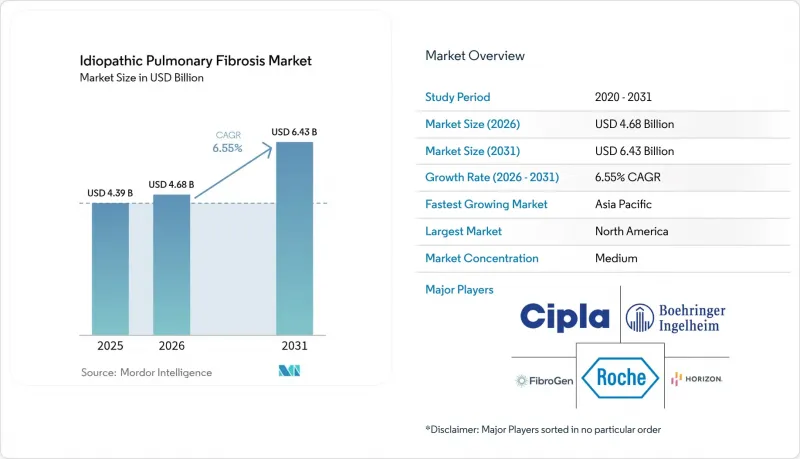
This report is Segmented by Drug Type (Nintedanib, Pirfenidone, Other Drug Types), Mode of Action (Antifibrotic Agents, Tyrosine Kinase Inhibitors, Other Modes of Action), Route of Administration (Oral, Parenteral, Inhalation), End User (Hospitals and Clinics, and More), and Geography (North America, Europe, Asia-Pacific, and More). The Market Forecasts are Provided in Terms of Value (USD).
Global Idiopathic Pulmonary Fibrosis Market Trends and Insights
Increasing Prevalence of IPF Coupled with Aging Demographics
Incidence continues to rise in tandem with global population aging, placing sustained pressure on healthcare systems and pushing demand for novel medicines. Europe diagnoses about 40,000 new cases annually, and prevalence in South Korea tops 4.5 per 10,000 persons, nearly double North American rates. Care costs run 2.5-to-3.5 times higher than for non-IPF patients, incentivizing pharmaceutical investment and stimulating development of geriatric-adapted formulations.
Expansion of Diagnostic Capabilities and Early Detection Programs
High-resolution computed tomography remains foundational, yet 2024 FDA clearance of an AI-enabled algorithm signaled a step-change in radiology workflows. Parallel progress in circulating and exhaled-breath biomarkers such as the PROLIFIC multi-analyte panel supports earlier confirmatory testing and stratifies patients more effectively for therapy selection. Earlier intervention strengthens treatment response durability, expanding the addressable idiopathic pulmonary fibrosis market.
High Cost and Limited Accessibility of Antifibrotic Drugs
Annual treatment bills consume a sizable share of respiratory-care budgets, constraining uptake in lower-income regions. With only 25% of eligible patients started on therapy, manufacturers are exploring value-based pricing and co-pay assistance programs. Generic pirfenidone, available since 2021, offers near-term relief but broad commercial impact hinges on further price erosion once additional patents lapse.
Other drivers and restraints analyzed in the detailed report include:
- Advancements in Antifibrotic Therapies and Robust Pipeline Momentum
- Strategic Collaborations & Investments in Fibrosis Research
- Adverse Side-Effect Profile Leading to Treatment Discontinuation
For complete list of drivers and restraints, kindly check the Table Of Contents.
Segment Analysis
Pirfenidone captured 43.35% idiopathic pulmonary fibrosis market share in 2025 through wider prescriber familiarity and earlier commercial rollout. Nintedanib's broader label covering progressive fibrosing interstitial lung diseases underpins its 7.52% CAGR forecast. Comparative cohort studies report similar survival benefit yet divergent AE profiles that directly shape physician choice. Next-wave candidates such as PDE4B and LPA1 modulators-could recalibrate share distribution by offering organ-specific targeting and lower discontinuation risk.
The introduction of deupirfenidone (LYT-100) lowered gastrointestinal events by 50% versus reference pirfenidone, signaling that reformulations can stretch product lifecycles and sustain pirfenidone's franchise. Combination regimens under investigation could embed pirfenidone or nintedanib as backbone therapy, anchoring their commercial relevance even as new agents arrive.
Antifibrotic agents controlled 82.05% of 2025 revenue, highlighting their foundational role in dampening extracellular-matrix deposition. Tyrosine kinase inhibitors contribute the sharpest growth trajectory at 9.12% CAGR, thanks to nintedanib's multi-receptor blockade. Dual-pathway drugs such as nerandomilast combine anti-inflammatory and antifibrotic effects, mirroring evolving scientific consensus that parallel pathway modulation affords superior lung-function preservation.
Early-stage programs are exploring senolytics, integrin blockers, and TGF-B signaling disruptors. Shanghai Ark Biopharmaceutical's AK3280 illustrated significant lung-function gains by modulating multiple fibrosis-linked pathways across 31 Chinese trial sites. Sophisticated biomarker panels guide endotype selection, supporting differentiated regulatory filings and payer negotiations.
Complete Report Scope:
- By Drug Type
- Nintedanib
- Pirfenidone
- Other Drug Types
- By Mode of Action
- Antifibrotic Agents
- Tyrosine Kinase Inhibitors
- Other Modes of Action
- By Route of Administration
- Oral
- Parenteral
- Inhalation
- By End User
- Hospitals & Clinics
- Specialty Clinics
- Home-Care Settings
- Other End Users
- By Geography
- North America
- United States
- Canada
- Mexico
- Europe
- Germany
- United Kingdom
- France
- Italy
- Spain
- Rest of Europe
- Asia-Pacific
- China
- Japan
- India
- Australia
- South Korea
- Rest of Asia-Pacific
- Middle East & Africa
- GCC
- South Africa
- Rest of Middle East & Africa
- South America
- Brazil
- Argentina
- Rest of South America
- North America
Geography Analysis
North America held 41.05% of 2025 revenue, supported by deep reimbursement coverage, a dense network of ILD centers, and rapid incorporation of AI diagnostics into radiology suites. Venture capital continues to sponsor late-stage programs, and adaptive trial designs pioneered in United States academic consortia are accelerating regulatory timetables. Precision-medicine approaches, bolstered by payer acceptance of biomarker testing, are widening specialist adoption and stabilizing patient retention on therapy.
Asia-Pacific is the fastest-expanding region, posting an 8.62% CAGR across 2026-2031. China and Japan dominate commercial potential owing to large diagnosed populations, while South Korea records the highest prevalence globally at 4.5 per 10,000 persons. The idiopathic pulmonary fibrosis market benefits from regional trial-site density 44% of current IPF studies are run in Asia-Pacific, strengthening early physician familiarity with investigational agents and shortening launch ramp-up times. Domestic innovators such as Shanghai Ark are further stimulating local competition.
Europe remains a pivotal market with strong regulatory incentives for rare-disease therapeutics. National reimbursement expansion exemplified by Belgium's 2024 update broadens antifibrotic accessibility, while pan-EU Horizon funding underwrites translational projects. Specialist ILD centers exhibit 91% antifibrotic access versus 60% in non-specialist facilities, underlining the benefits of concentrated expertise. Harmonized clinical-practice guidelines support consistent uptake across major economies, sustaining Europe's contribution to global revenue.
- Roche
- Boehringer Ingelheim
- Cipla
- Merck
- Bristol-Myers Squibb
- United Therapeutics Corp.
- FibroGen Inc.
- Horizon Therapeutics
- Avalyn Pharma Inc.
- MediciNova Inc.
- Gyre Therapeutics Inc.
- AstraZeneca
- Vicore Pharma
- Novartis
- Tvardi Therapeutics
- Pliant Therapeutics
- Galapagos NV
- Gyre Therapeutics
- AdAlta Ltd
Additional Benefits:
- The market estimate (ME) sheet in Excel format
- 3 months of analyst support
TABLE OF CONTENTS
1 Introduction
- 1.1 Study Assumptions & Market Definition
- 1.2 Scope of the Study
2 Research Methodology
3 Executive Summary
4 Market Landscape
- 4.1 Market Overview
- 4.2 Market Drivers
- 4.2.1 Increasing Prevalence of IPF Coupled with Aging Demographics
- 4.2.2 Expansion of Diagnostic Capabilities and Early Detection Programs
- 4.2.3 Advancements in Antifibrotic Therapies and Robust Pipeline Momentum
- 4.2.4 Strategic Collaborations & Investments in Fibrosis Research
- 4.2.5 Increased Use of Artificial Intelligence for Radiological Screening & Disease Progression Monitoring
- 4.2.6 Rising Patient Advocacy and Awareness Campaigns Worldwide
- 4.3 Market Restraints
- 4.3.1 High Cost and Limited Accessibility of Antifibrotic Drugs
- 4.3.2 Adverse Side-Effect Profile Leading to Treatment Discontinuation
- 4.3.3 Limited Therapeutic Options Beyond Antifibrotics
- 4.3.4 Low Diagnosis Rates in Primary Care Settings
- 4.4 Regulatory Landscape
- 4.5 Porter's Five Forces Analysis
- 4.5.1 Threat of New Entrants
- 4.5.2 Bargaining Power of Buyers/Consumers
- 4.5.3 Bargaining Power of Suppliers
- 4.5.4 Threat of Substitute Products
- 4.5.5 Intensity of Competitive Rivalry
5 Market Size & Growth Forecasts (Value in USD)
- 5.1 By Drug Type
- 5.1.1 Nintedanib
- 5.1.2 Pirfenidone
- 5.1.3 Other Drug Types
- 5.2 By Mode of Action
- 5.2.1 Antifibrotic Agents
- 5.2.2 Tyrosine Kinase Inhibitors
- 5.2.3 Other Modes of Action
- 5.3 By Route of Administration
- 5.3.1 Oral
- 5.3.2 Parenteral
- 5.3.3 Inhalation
- 5.4 By End User
- 5.4.1 Hospitals & Clinics
- 5.4.2 Specialty Clinics
- 5.4.3 Home-Care Settings
- 5.4.4 Other End Users
- 5.5 By Geography
- 5.5.1 North America
- 5.5.1.1 United States
- 5.5.1.2 Canada
- 5.5.1.3 Mexico
- 5.5.2 Europe
- 5.5.2.1 Germany
- 5.5.2.2 United Kingdom
- 5.5.2.3 France
- 5.5.2.4 Italy
- 5.5.2.5 Spain
- 5.5.2.6 Rest of Europe
- 5.5.3 Asia-Pacific
- 5.5.3.1 China
- 5.5.3.2 Japan
- 5.5.3.3 India
- 5.5.3.4 Australia
- 5.5.3.5 South Korea
- 5.5.3.6 Rest of Asia-Pacific
- 5.5.4 Middle East & Africa
- 5.5.4.1 GCC
- 5.5.4.2 South Africa
- 5.5.4.3 Rest of Middle East & Africa
- 5.5.5 South America
- 5.5.5.1 Brazil
- 5.5.5.2 Argentina
- 5.5.5.3 Rest of South America
- 5.5.1 North America
6 Competitive Landscape
- 6.1 Market Concentration
- 6.2 Market Share Analysis
- 6.3 Company Profiles (includes Global level Overview, Market level overview, Core Segments, Financials as available, Strategic Information, Market Rank/Share for key companies, Products & Services, and Recent Developments)
- 6.3.1 F. Hoffmann-La Roche Ltd (Genentech)
- 6.3.2 Boehringer Ingelheim International GmbH
- 6.3.3 Cipla Ltd
- 6.3.4 Merck & Co., Inc.
- 6.3.5 Bristol-Myers Squibb Company
- 6.3.6 United Therapeutics Corp.
- 6.3.7 FibroGen Inc.
- 6.3.8 Horizon Therapeutics plc
- 6.3.9 Avalyn Pharma Inc.
- 6.3.10 MediciNova Inc.
- 6.3.11 Gyre Therapeutics Inc.
- 6.3.12 AstraZeneca plc
- 6.3.13 Vicore Pharma
- 6.3.14 Novartis AG
- 6.3.15 Tvardi Therapeutics
- 6.3.16 Pliant Therapeutics
- 6.3.17 Galapagos NV
- 6.3.18 Gyre Therapeutics
- 6.3.19 AdAlta Ltd
7 Market Opportunities & Future Outlook
- 7.1 White-Space & Unmet-Need Assessment

